
Quick Take
- A housefly's muscles makes them nearly impossible to swat. See the muscle mechanics →
- When you swing a flyswatter, the fly isn’t simply reacting quickly. It's perceiving something you'd never expect. Explore the fly's perception →
- Houseflies have a hidden organ and without it they couldn't dodge anything. Discover the hidden organ →
- Young houseflies can remain airborne for surprisingly long periods, but their endurance declines rapidly with age. Check the flight endurance data →
Houseflies can avoid a flyswatter until the very last moment. You may never have considered the biomechanics of the common housefly when following one around the house and attempting to swat at it. However, these tiny flying insects are marvels of flight. They can beat their wings about 180 to 200 times per second using specialized asynchronous flight muscles, sometimes called “super muscles.” Even more fascinating, a housefly’s muscles don’t need a separate nerve signal for every wingbeat; instead, they respond to mechanical stretching. How does this tiny insect flap its wings so quickly, and how long can it keep going? Let’s find out.
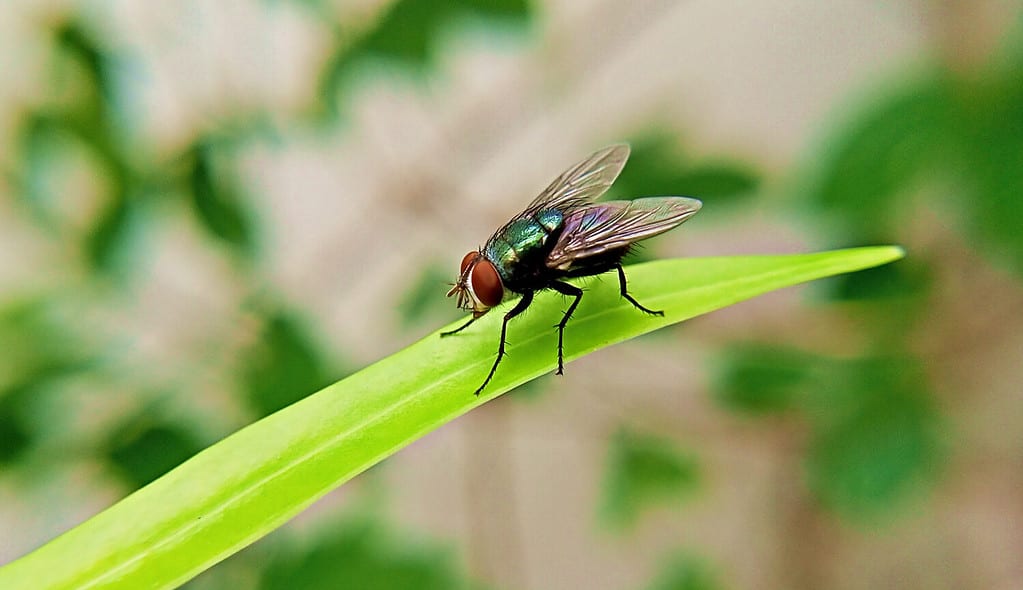
Houseflies beat their wings around 180 to 200 beats per second.
©AvishekS/Shutterstock.com
Why the Common Housefly Is More Than a Nuisance
The common housefly (Musca domestica) is a pest that can be found on every continent in the world except for Antarctica. There are many things to dislike about houseflies, such as their rapid reproduction rate and their ability to carry and spread potentially harmful bacteria. One scientific review from 2023 found that houseflies can harbor more than 200 pathogenic bacteria, including E. coli and Salmonella.
The Incredible Biology Behind the Buzz
And yet, there are things to admire about this bothersome but fascinating insect. Houseflies belong to the order Diptera. Like all true flies in the order, houseflies have a single pair of flight wings. Their hind wings have evolved into small, knob-like gyroscopic sensory organs called halteres.
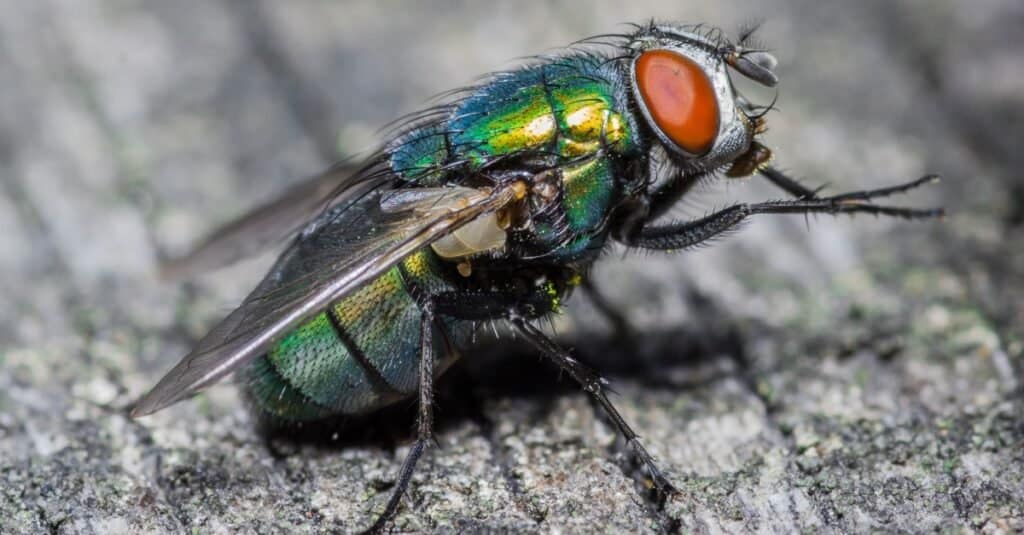
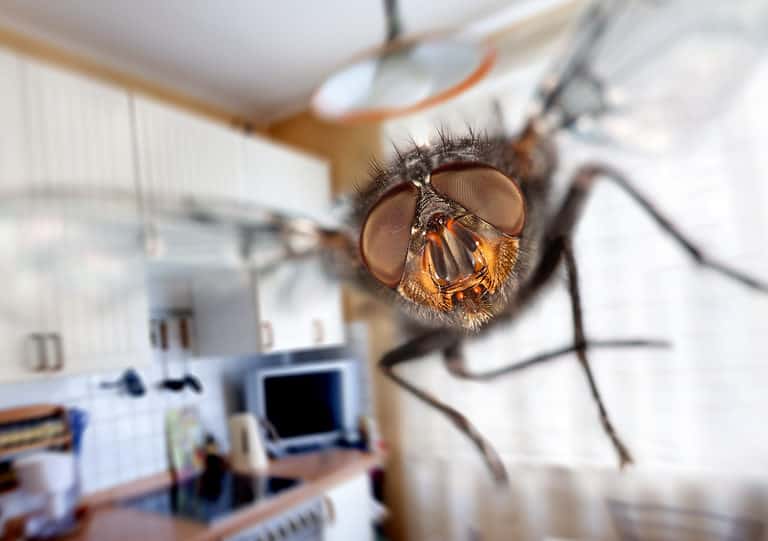
The housefly can make quick adjustments midflight and change course abruptly.
©Fotopstryk/Shutterstock.com
The halteres detect rotations of the fly’s body, providing rapid feedback that helps it stabilize and make quick adjustments in flight. This sensory feedback allows flies to turn, speed up, stop, roll, and rapidly change course while in flight, which is why it’s so hard to swat at them. Flies also have tiny steering muscles attached directly to the base of the wings, which help them change their angle or direction as they fly.
Inside the Energy Efficient Muscle Engine of the Fly
In addition to the stabilizing halteres, houseflies also have incredibly powerful flight muscles. They don’t move their wings up and down the way birds do. Instead, they use an indirect flight mechanism. Like many insects, houseflies use a two-stage process. Vertical muscles pull the roof of the thorax down, causing the wings to rise. Longitudinal muscles then compress the thorax, snapping the wings down. The advantage of this system is that it’s much more energy-efficient than direct wing movement.
Another factor that makes this two-stage process so efficient is the housefly’s asynchronous muscles. They don’t require a separate nerve impulse to control every beat of their wings. Instead, they respond to mechanical tension.
When a housefly’s flight muscles are stretched, they contract. As the vertical muscles pull down, the longitudinal muscles are stretched, causing them to snap back. In turn, the vertical muscles are stretched, continuing the cycle. This mechanical loop allows the fly to beat its wings up to 200 times per second without tiring.
How Long Can a House Fly Keep Its Wings Going?
We know how fast a housefly can flap its wings, but how long can it keep going? Research has shown it depends on the age of the fly. In the experiment, a one-day-old female could fly continuously for 500 minutes. But her endurance fell as she aged, dropping to 110 minutes at 22 days old. The male flies in the experiment lost their endurance even more quickly. One-day-old males could fly for 420 minutes. By the time they were nine days old, their endurance was down to 63 minutes.
How Fast Can a Housefly Fly?
Houseflies may have powerful flight muscles, but they aren’t the speediest fliers in the insect world. According to the Smithsonian, that would be sphinx moths, which can fly at speeds of 33 mph. In comparison, houseflies average around five miles per hour.
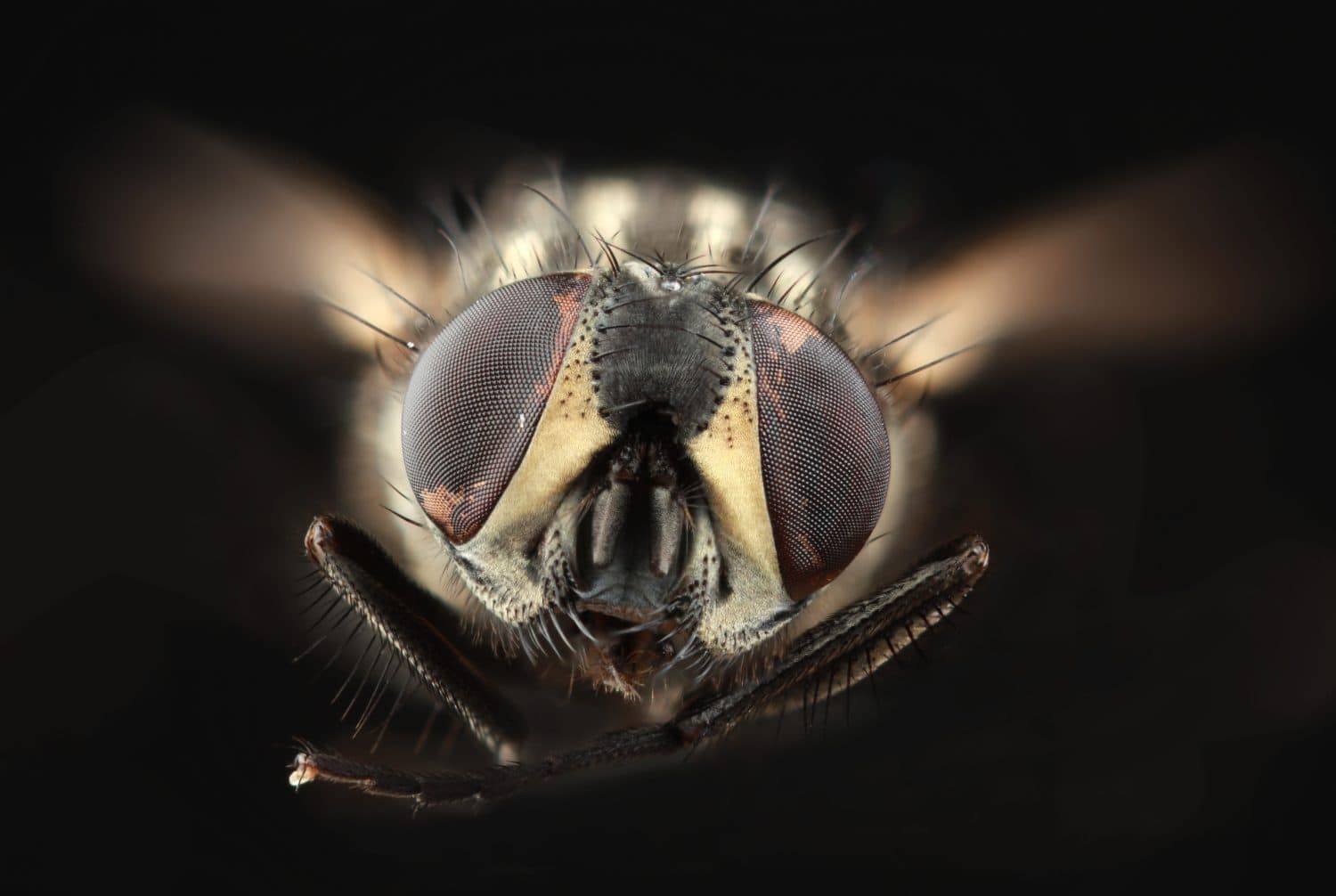
But what they lack in speed, they make up for in reaction time. Houseflies’ asynchronous flight muscles and halteres help them maneuver through the air. Their highly developed vision also allows them to process information nearly seven times faster than humans. When a human strikes at a fly with a swatter, the fly perceives the human’s hand as moving in slow motion.
More Than Just a Pest
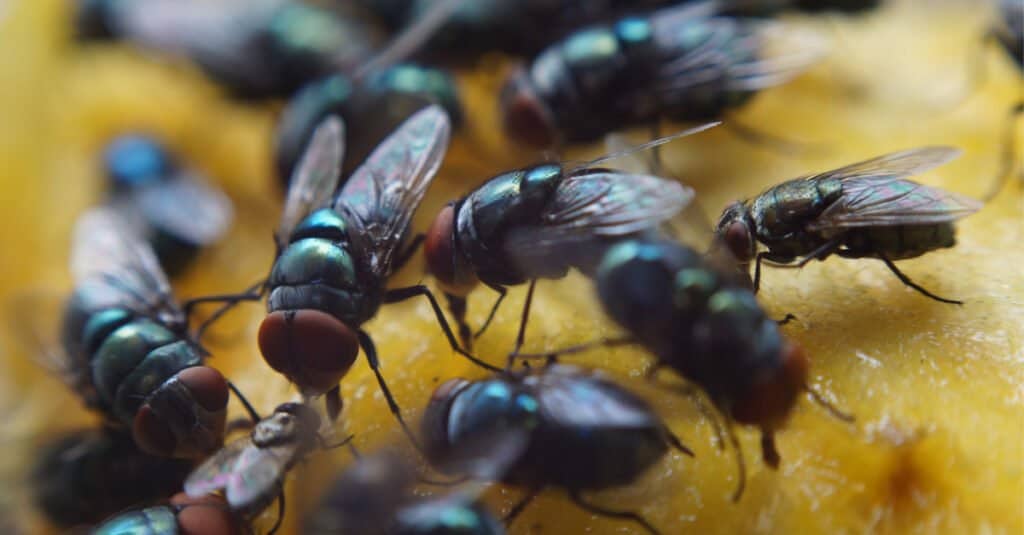
Houseflies have important ecological roles as food sources, natural recyclers, and accidental pollinators.
©iStock.com/reyborfrla
Houseflies are considered pests and are known to spread disease. But they do play an important role in the ecosystem. In their larval stage, they consume waste. As adults, they are prey for many insects and small animals. They are also accidental pollinators of flowers.
Houseflies, with their incredibly fast asynchronous muscles, tiny steering muscles, halteres, and superhuman vision, are much more than meets the eye. The next time you hear that annoying buzz around your ears, remember the humble housefly is actually in possession of an extraordinarily sophisticated biological flight system.