
Quick Take
- Your dog blinks differently depending on who's in the room, and the reason why reveals something unexpected about the bond you share. See how dogs blinked differently →
- Blinking may be a two-way signal between dogs and humans, though scientists found the communication only flows in one direction under specific conditions. Explore the one-way blink signal →
Have you ever looked at your dog and wondered what they were thinking? Some dogs are more expressive than others and stare at their owners lovingly, while others are harder to read. In an effort to decode some of a dog’s more subtle language, scientists at the University of Parma, Italy, decided to test out a theory. Their experiment focused on one involuntary action shared by all mammals with eyelids: blinking.
The study focused on dogs’ blinking in response to several factors, including strangers and their owners. The results left some mysteries but also revealed a surprising conclusion.
Continue reading
The Study Tested 38 Dogs With a Projector Screen
To ensure the hypothesis was well-tested, scientists assembled a group of 38 dogs. The dogs varied in breed, size, and age, ranging from 1 to 12 years old. About half of the dogs were spayed or neutered, and the genders were split almost evenly.
Of the dogs, 20 had female owners and 18 had male owners. While this detail may not seem significant at first, it became relevant in the experiment’s results. Before the dogs began the trial, they were also put through a simple test. Any dog that looked at a large projector screen for four seconds or more qualified for the test. Those that did not—including a Border Collie, a Labrador Retriever, and a German Shorthaired Pointer mix—did not pass the initial screening.

Dogs sometimes mirror actions with bonded owners, such as yawning.
©nurten erdal/Shutterstock.com
After these three dogs were excluded, the experiment continued with 35 dogs. Each was placed in a room large enough to accommodate the dog, its owner, and a large projector screen. On the screen, scientists projected images of the dog’s owner and unfamiliar human faces. The goal was to determine who—if anyone—affected the rate and duration of a dog’s blinking.
Owners Recorded Their Own Blinks For Playback
After each dog was familiar with the room and comfortable enough to focus on the screen ahead, the experiment began. The entire thing lasted only 12 minutes. During this time, owners were instructed to ignore their dogs and focus on the projected image.
| Experiment | What It Involved |
| Initial Habituation | Dogs were permitted to explore the room and get comfortable for five minutes. |
| First Video Session | Dogs observed a human on screen for 40 seconds, during which a BLINK or CONTROL projection was shown. |
| Brief Break | Dogs were given a 5-minute pause to reset and prevent fatigue and loss of interest. |
| Second Video Session | Dogs observed a human on screen for the final 40 seconds, during which a BLINK or CONTROL projection was shown. |
During BLINK videos, scientists digitally stitched together rhythmic sequences of blinks performed by an actor, resulting in one blink every three seconds. Each actor’s 12-second blinking sequence was then played back for each dog.
During CONTROL videos, actors were instructed to remain completely still. They wore neutral expressions and did not blink. Both types of videos, along with footage of the dogs’ owners, were compiled into two 40-second segments. Between the video segments, scientists inserted a beep sound that consistently captured each dog’s attention. All 35 dogs were shown similar videos, with the only difference being that each dog saw footage of its own owner.
Dogs React to Certain People With Visual Stimuli
Researchers analyzed changes in each dog’s responses to visual stimuli following the experiments. The first conclusion they reached was that dogs behaved differently when presented with different human subjects. During the BLINK portions of each video, the dogs reacted much more than during the CONTROL portions, where no blinking occurred.
Not surprisingly, dogs reacted more strongly to their owners than to the actors. When their owners appeared on screen, blink rates increased. Conversely, their blink rates decreased when shown the CONTROL segments featuring the actors. Researchers noted no significant changes when either male or female actors were shown on the projector. This indicates that dogs were equally unstimulated by both male and female actors, unlike when viewing their owners.
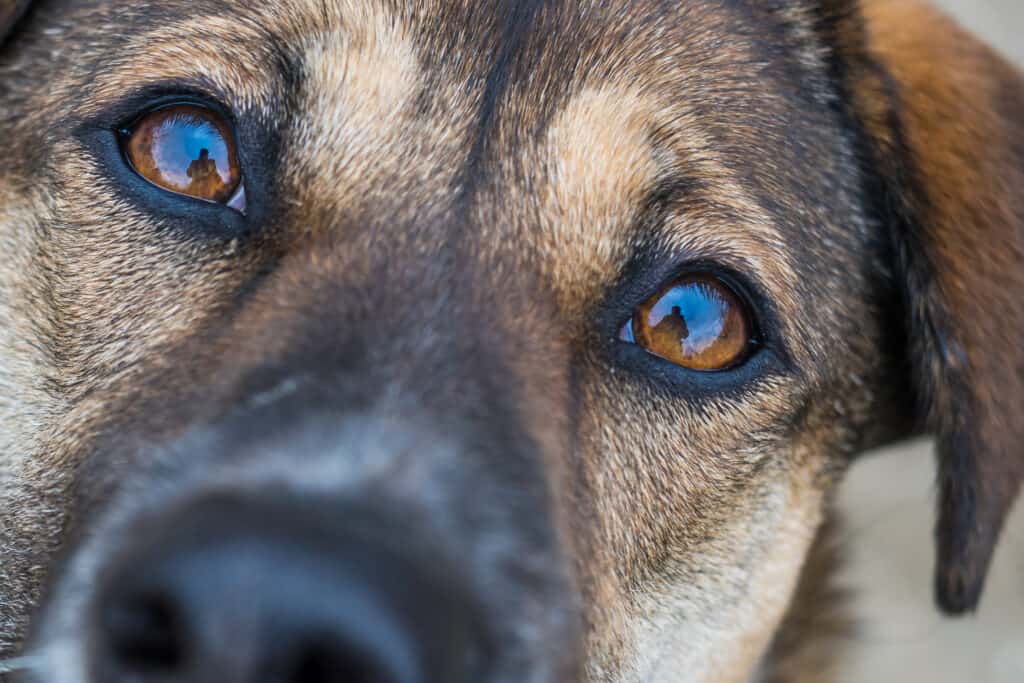
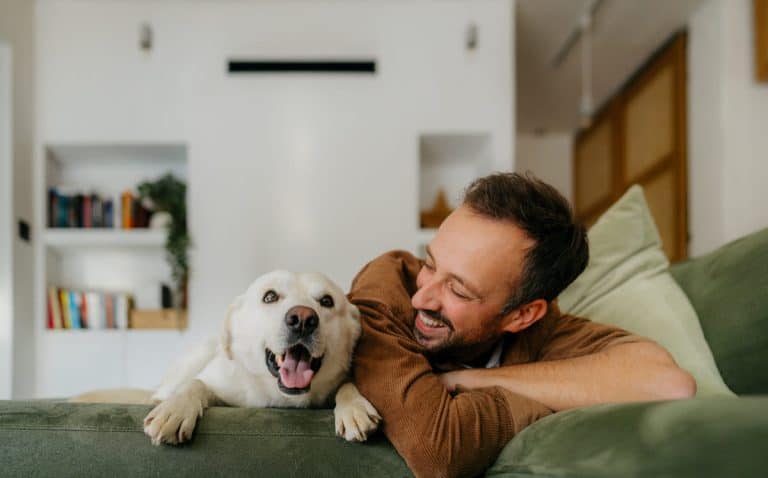
Blink tests revealed that dogs responded more to their female owners.
©iStock.com/Corey O'Hara
However, one surprising result popped up during the blink rate analysis. Scientists noted that dogs showed higher blink rates towards their female owners than towards unfamiliar humans during the BLINK parts of each video, but did not find a significant difference between female and male owners.
While this experiment alone is not enough to draw definitive conclusions about dogs and blinking communication, it is a start. Further research is necessary to understand why and how dogs might communicate through blink rates.