
Quick Take
- A toad that can't see and has no tongue is somehow one of the most precise hunters in the Amazon, and it relies on a bizarre sensory trick to pull it off. See how it hunts →
- Its fingers are built like no other amphibian's, a fact that scientists ignored the reason for over 200 years. Discover the finger secret →
- A brain feature scientists thought only mammals had just turned up in a frog, a discovery that rewrites what we know about animal senses. Explore the brain discovery →
- The toad starts its strike before prey even makes contact, a behavior captured at 1,000 frames per second in footage that raises more questions than it answers. Watch the strike unfold →
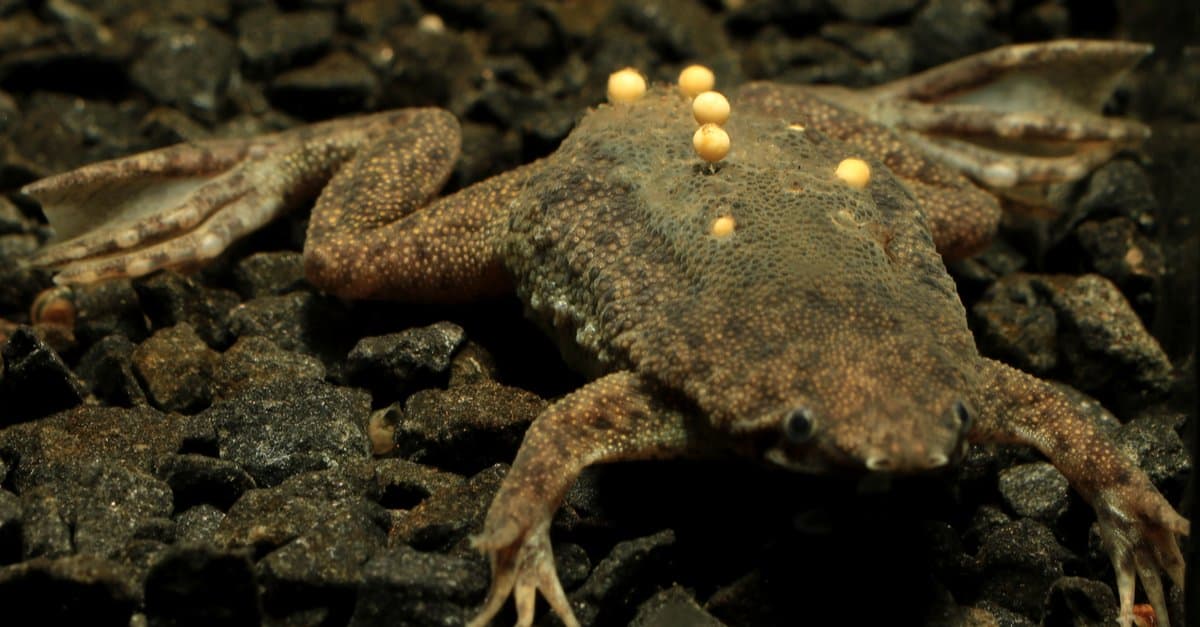
In the murky depths of rivers across the Amazon basin, a species of frog lies motionless, doing its best impression of a dead leaf. The frog, a Suriname toad, is not only nearly blind, but it also has no tongue.
But that doesn’t slow the toad down. The Suriname toad is a precision hunter that can suck an unsuspecting fish into its mouth in less than a second. So how does a toad that can’t see and hunts in water so cloudy that it can’t see its prey survive?
The secret was revealed in a new study just published in the Journal of Comparative Physiology A.
Continue reading
The Frog Disguised as Debris
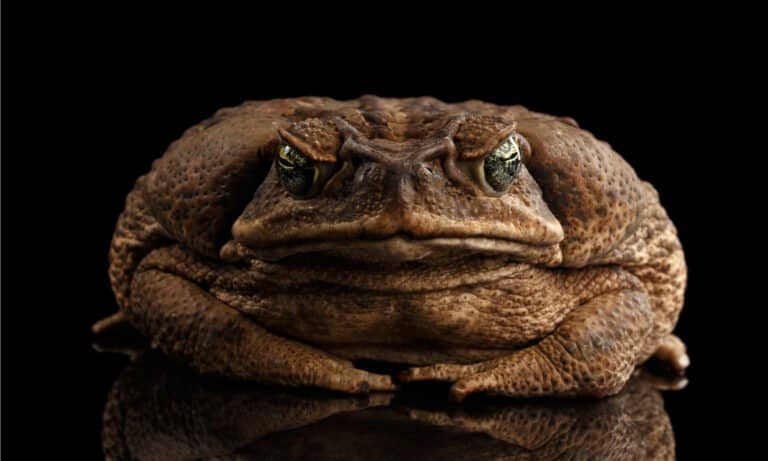
For the Suriname toad, Pipa pipa, beauty is in the eye of the beholder. Evolution has shaped the toad to mimic a fallen leaf or small piece of driftwood. With a flat body, tiny eyes on the top of a triangular head, and a brown-to-olive camouflage coloring, the Suriname toad is easy to miss.
It calls the slow-moving rivers and canals across the Amazon and Orinoco basins that run through Bolivia, Brazil, Colombia, Ecuador, the Guianas, Peru, and Venezuela home. You can also find the toads on the tiny Caribbean island of Trinidad.
But how does a toad without a tongue catch its prey? It turns out the toad catches its prey using powerful suction, not a tongue-flick like most other frogs. Once prey is in the toad’s mouth, it’s swallowed whole.
How Did This Toad Get Its Unusual Nickname?
Locals have a nickname for this unusual toad — star-fingered toad. The name describes the toad’s most remarkable feature. Each of its four fingers splits into four tiny lobes, and each of those lobes splits into an additional four smaller lobules. This gives the toad 16 lobes per finger and 128 lobes across its four fingers in total. The design of splitting into four and then four again is officially called “quadrification.”
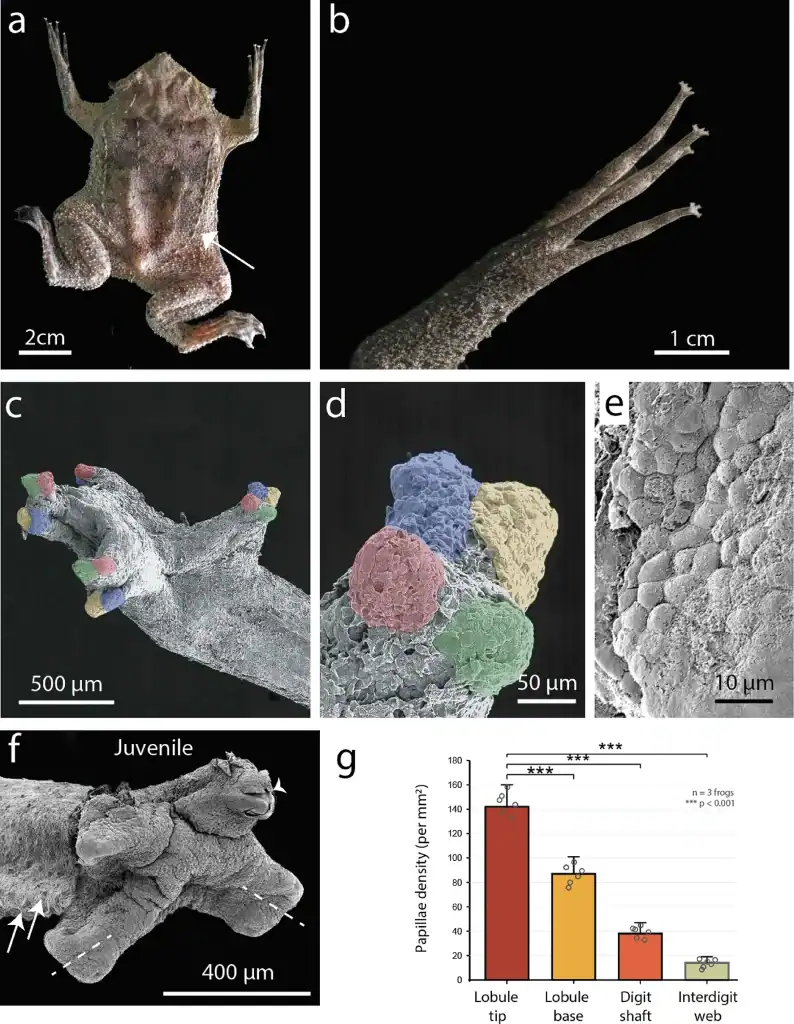
Above are illustrations of the Suriname toad, including details of its finger lobes and papillae.
Scientists who study Suriname toads have long wondered what purpose these many-lobed fingers serve. While the shape was originally described and drawn by scientists in the 1800s, nobody since then has ever determined if there is a purpose for the design.
“I was reading an anatomy report that described how the tips of the fingers of Surinam toads split into four, and each of those four little lobes split again into four,” Duncan Leitch, a corresponding author and UCLA assistant professor of integrative biology and physiology, said in a press release announcing the study. “It immediately seemed to me like these lobes might be somewhat analogous to antennae that the frogs extend so they can feel the space around them.”
He and a team of biologists set out to prove that hypothesis.
The Toad’s Fingers Are as Sensitive as Human Fingers
Underneath a microscope, researchers discovered that the surface of each lobe was covered in tiny bumps called papillae. Those bumps made the skin directly on each lobe about four times denser than skin just a little further down each finger.
Researchers then touched the lobes with ultra-fine calibrated filaments to measure the amount of force that would trigger a response. It turned out that it didn’t take much. The lobe tips were the most sensitive spot on the toad, nearly mirroring the sensitivity of human fingers. The lobes were also 70 times more sensitive than the frog’s own palm.
Even more interestingly, although the toad’s entire forelimb contains sensitivity receptors, the touch-sensors on the lobes accounted for more than 60 percent of the toad’s nerve connections. This is despite the tiny bumps covering only about eight percent of the entire arm’s surface.
The Sensor-Brain Connection
The researchers then tracked how the fingertip signals were transmitted to the toad’s brain. What they found was that the signals went to an area far larger than expected for such a small animal. It was about four times the size they expected to see.
This oversized brain signal-processing area had previously been identified only in mammals, like the star-nosed mole. This is the first time researchers have identified it in an amphibian. The region was identified as the “optic tectum.”
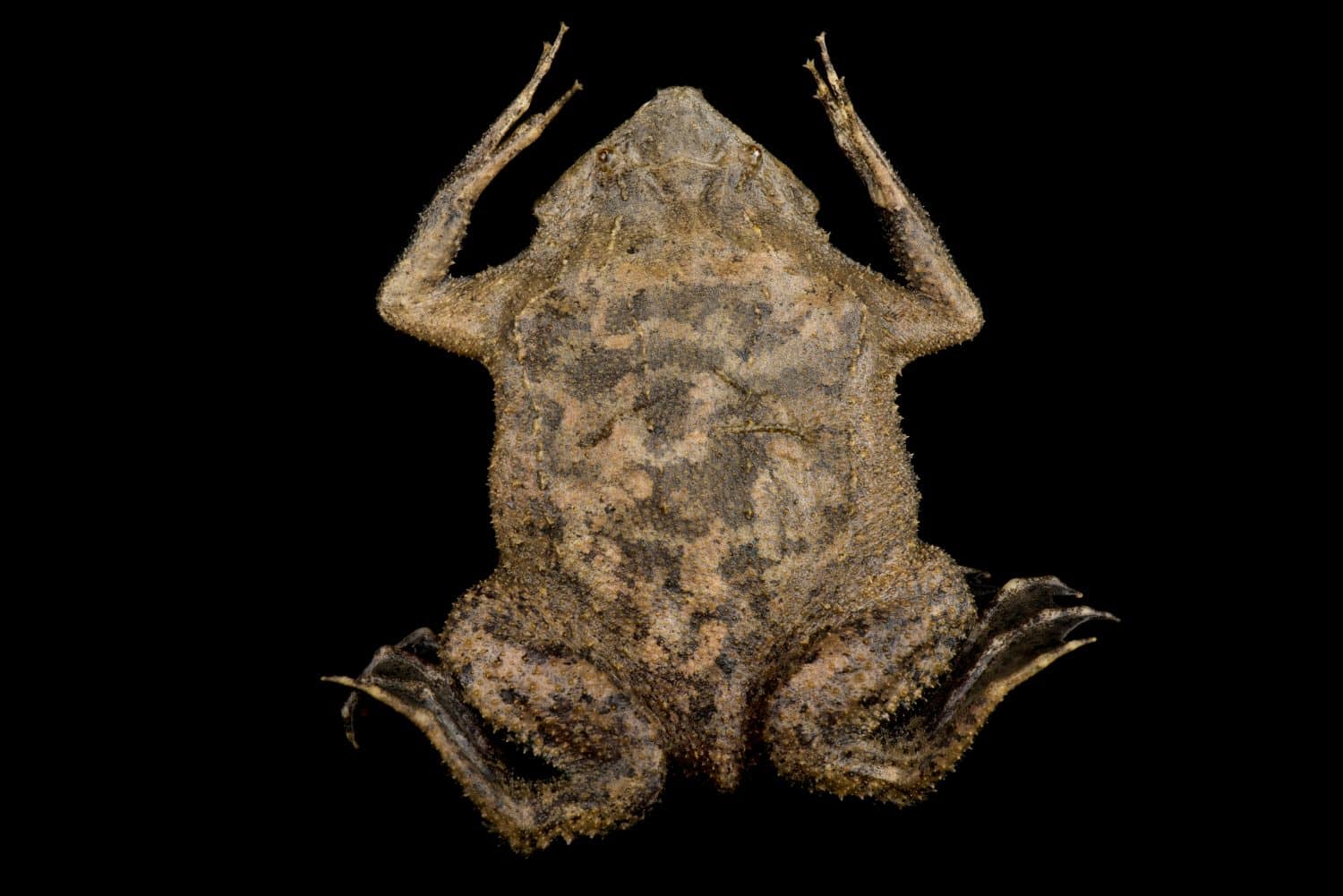
The Suriname toad, Pipa pipa, looks like a leaf or piece of driftwood when spotted on the river bottom.
©reptiles4all/Shutterstock.com
“It seems that mammals share some of these sensory processing properties with frogs, from whom they diverged evolutionarily a very long time ago,” Leitch said in the press release. “This is probably a much more ancient and widespread kind of system than previously believed. People may have thought that these are mammal-specific traits, but certainly frogs, and I expect birds and other animals also would have specialized sensing systems if you really look for them.”
How Did Researchers Record the Toad Hunting?
Researchers used high-speed camera experiments to identify the toad’s hunting strategy. Filming at 1,000 frames per second, researchers were able to capture the frogs hunting live fish.
The frogs began their suction stroke when a fish was still about one-half centimeter away, even before the prey touched the toad’s fingers. This happened even in total darkness.
To rule out other variables, the researchers blocked the toad’s separate water-sensing “lateral line” system with a chemical. Even with that sense blocked, the toads still caught fish most of the time. This proved that the toads were hunting by fingertip feel.
The entire hunting process took less than one-tenth of a second.