
It’s easy to assume that all snakes are alike but that isn’t true. While all snakes share a handful of common characteristics, like being carnivorous, every snake species is unique. What’s the difference between a coachwhip snake vs. a bull snake? Read on to find out!
Comparing Coachwhip Snake vs. Bull Snake
Coachwhips (Masticophis flagellum) are slender, bodied snakes which are endemic to the US and Mexico and there are six recognized subspecies. Bull snakes (Pituophis catenifer sayi) are a subspecies of the gopher snake and are one of the longest snakes in North America.
| Name | Coachwhip Snake | Bull Snake |
| Scientific Name | Masticophis flagellum | Pituophis catenifer sayi |
| Size | Up to 8 feet Up to 3 pounds | Up to 8 feet Up to 10 pounds |
| Location | Coast to coast in the US plus northern Mexico. Absent around the Mississippi River. | Southern Canada, the United States, and Mexico. |
| Habitat | Open prairies, sandhills, and pine forests | Open grasslands and farms |
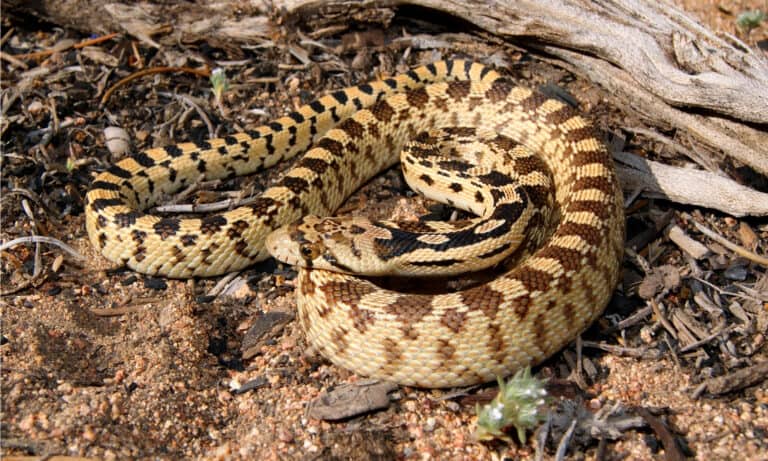
| Color | A black head tapers to a cream tail | Tan with dark patterning |
| Body Type | Slender | Bulky |
| Constrictor | No | Yes |
The Key Differences Between Coachwhip Snakes and Bull Snakes
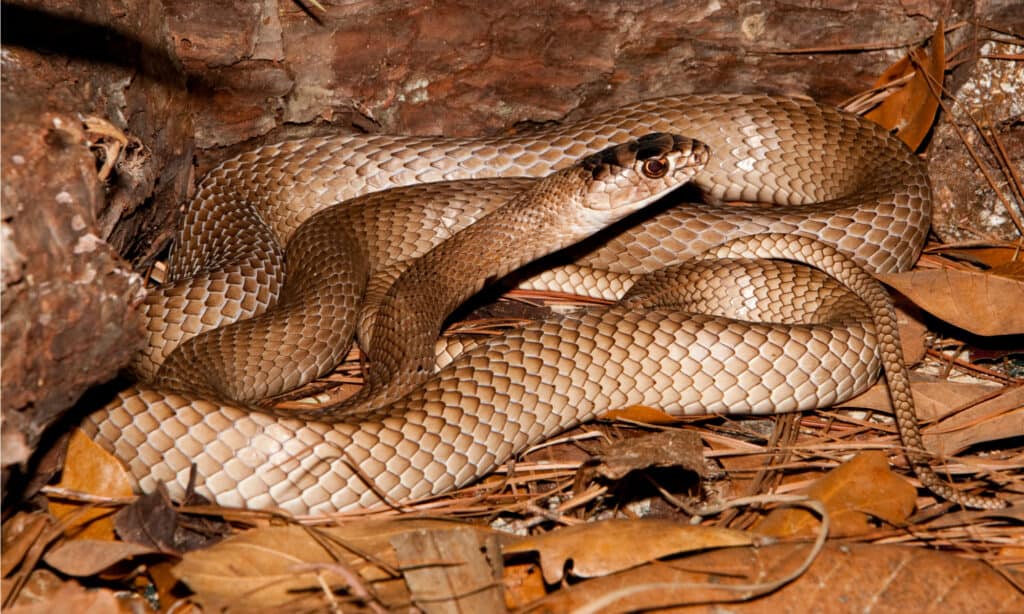
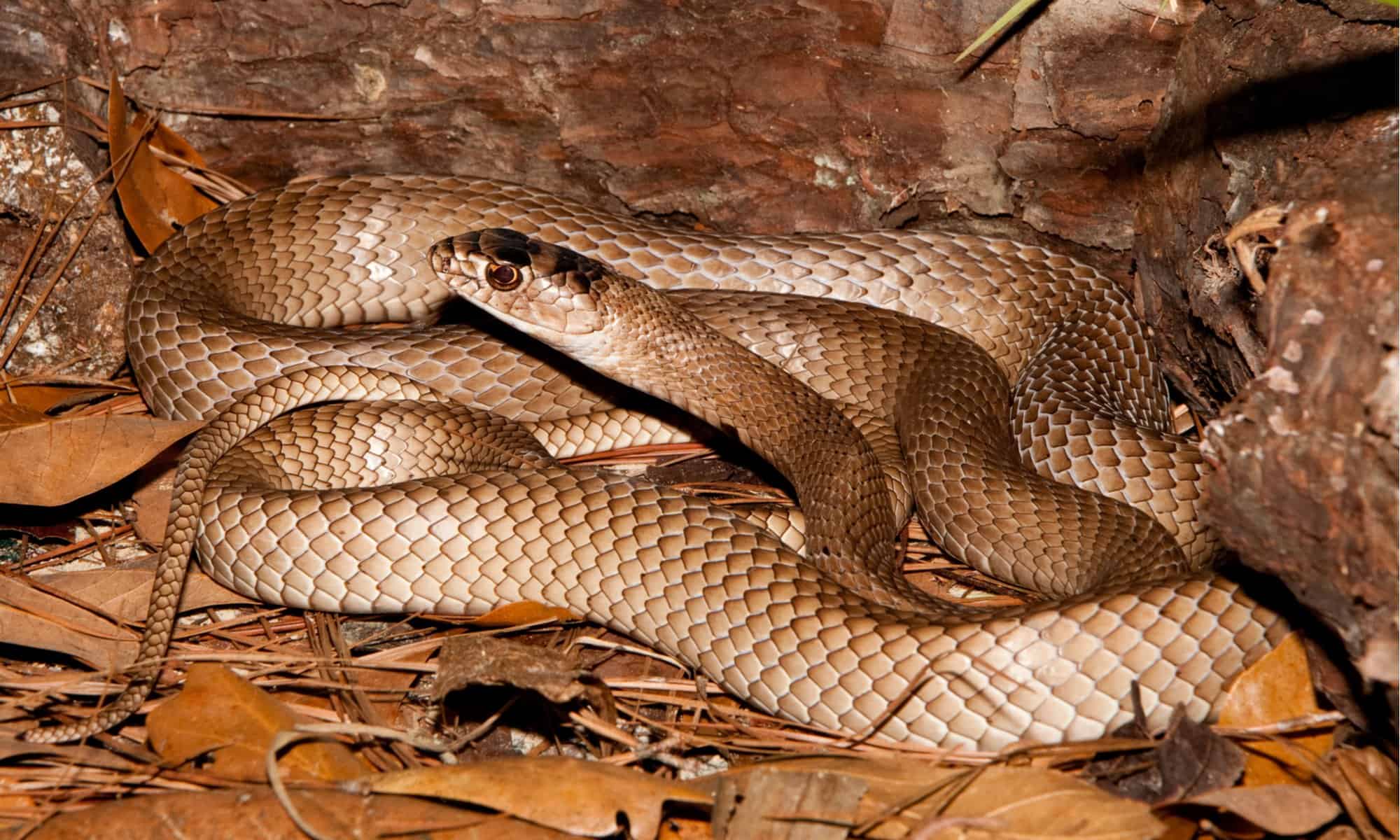
Coachwhip snakes have a slong, slender body and resemble a braided coachwhip after which they are named.
©Jay Ondreicka/Shutterstock.com
The main differences between bull snakes and coachwhip snakes are their size and appearance. Coachwhips have a slender, streamlined body while bull snakes have a thick, bulky body. Bull snakes are also tan with a dark patterned appearance, whereas coachwhips don’t have a pattern. The other differences between them include their native range and habitat.
Coachwhip Snake vs. Bull Snake: Appearance
Coachwhip snakes have a dark head that progresses in a gradient toward white or dark cream at the tip. While a dark-to-light color gradient always exists, their exact coloration varies by region. They are pink, red, black, or brown depending on their environment.
Coachwhips got their name because they look like stagecoach whips. These whips were used to direct horses and had a crosshatched pattern similar to the scaling on the coachwhip snake. These snakes have large eyes set in a small head.
Coachwhips make terrible pets but bull snakes are often kept in captivity. As a result, there are many color morphs of the bull snake. Bull snakes in the wild have a tan base color with a darker uniform pattern on top of it.
Coachwhip Snake vs. Bull Snake: Diet
Coachwhips and bull snakes eat small mammals, birds, lizards, and amphibians. They’re also capable of eating rattlesnakes and they regularly consume them when they’re juveniles.
Coachwhips hunt with their eyes because they have binocular vision. They cruise around with their heads held high so they can strike if the opportunity arises. Bull snakes rely on their Jacobsen’s organ to help them smell their prey by flicking their tongues.
Bull snakes are great climbers so they eat small ground prey as well as baby birds and eggs. Coachwhips will climb if they must but they prefer to reamin on the ground. Both coachwhips and bull snakes swallow their prey whole. However, bullsnakes are constrictors whereas coachwhips are not.
Coachwhip Snake vs. Bull Snake: Size
Coachwhip snakes are 3 to 8 feet long. Bull snakes are also long and they also reach 8 feet in length. Both the coachwhip and bull snake are some of the longest snakes in America. The longest coachwhip on record was 8.5 feet long. That’s the same length as the longest bullsnake on record. However, both snakes reach an average of 6 feet in length.
Bull snakes are exceptionally girthy because they are powerful constrictors. They weigh up to 10 pounds whereas coachwhips weigh up to 3 pounds.
Coachwhip Snake vs. Bull Snake: Speed
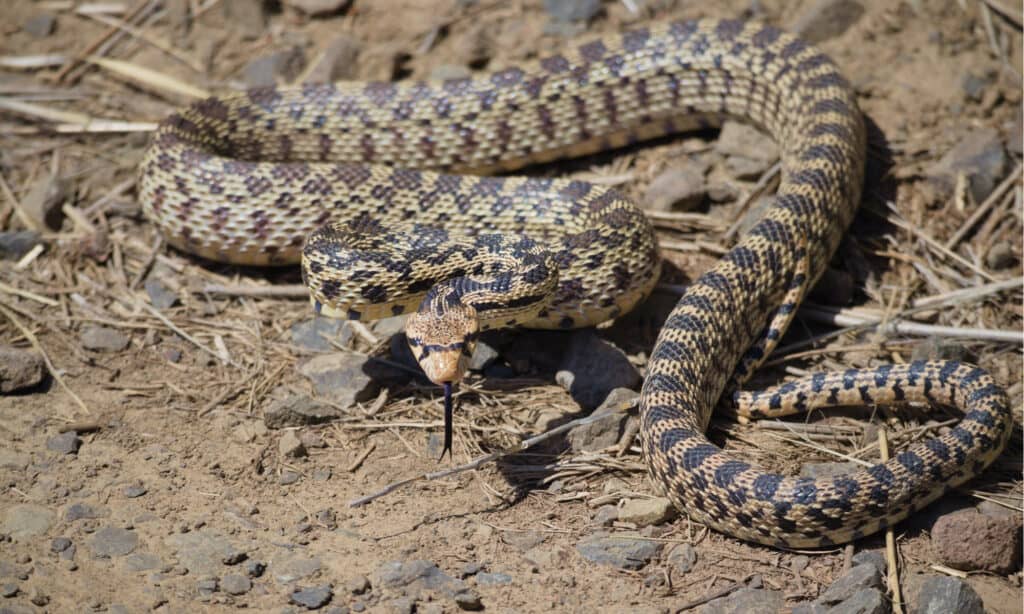
Bullsnakes are constrictors with large, powerful bodies
©Christopher Joe Brown/Shutterstock.com
Both bull snakes and coachwhips are exceptionally fast. However, coachwhips are the fastest and travel up to four miles per hour. Coachwhips are so fast because their musculature doesn’t need to be devoted to constriction. Instead, their most powerful muscles are on their stomachs which makes them skilled sidewinders.
Coachwhip Snake vs. Bull Snake: Habitat and Range
Bull snakes and coachwhips have overlapping territories but the bull snake’s range is larger. Coachwhip snakes are found in northern Mexico and the USA. They’re found coast to coast though they’re absent from the areas around the Mississippi River. Fields, prairies, sandhills, and pine forests are common habitats.
Coachwhips are found in southern Canada, the US, and Mexico. They don’t like areas with shady canopies because they prefer dry and hot conditions. Bull snakes also like open areas and they’re most common in grasslands and on farms. Both snakes are found in suburban environments but coachwhips are less likely to be seen. Bull snakes are a welcome sight to farmers because they eat vermin like rats and mice.
Coachwhip Snake vs. Bull Snake: Conservation Status
The coachwhip snake is an animal of the least concern which means it is not at risk of extinction. However, its numbers are reducing enough in Illinois that they are recognized as endangered within the state. It is plentiful in the core of its territory in Arizona, Texas, and Florida.
Bull snakes are also easy to find and are of the least concern from a conservation standpoint. They are not at risk of extinction.
Up Next
- Coral Snake vs. Milk Snake
- Do Snakes Hibernate?
- Discover Why Snakes Suddenty Emerge on Warm Winter Days