
Quick Take
- Some snake species are known for being gentle, laidback, and docile.
- The 10 species prioritize curiosity over aggression.
- As mild-mannered snakes that are relatively easy to care for, rosy boas are popular choices for anyone who wants to have a bigger snake for a pet.
- Corn snakes are very chill snakes, with a gentle disposition, and they’re very tolerant of being handled.
Snakes may not be known for wagging tails or greeting their owners at the door, but some species are thought to be surprisingly friendly. These snakes are calm, gentle, and easy to handle. While all snakes are instinct-driven reptiles rather than social pets, certain North American species have earned a reputation for being especially tolerant of human interaction. Their laid-back temperaments, manageable size, and predictable behavior make them popular choices among reptile owners.
In this article, we’ll take a closer look at some of the friendliest snakes found in America. These species are known more for curiosity than aggression. A range of snakes fall into this category, from colorful corn snakes to mellow boas and easygoing kingsnakes. Whether you’re considering adopting one as a pet or just want to better understand the gentler side of these misunderstood reptiles, checkout the most approachable snakes in the country.
Snake 101
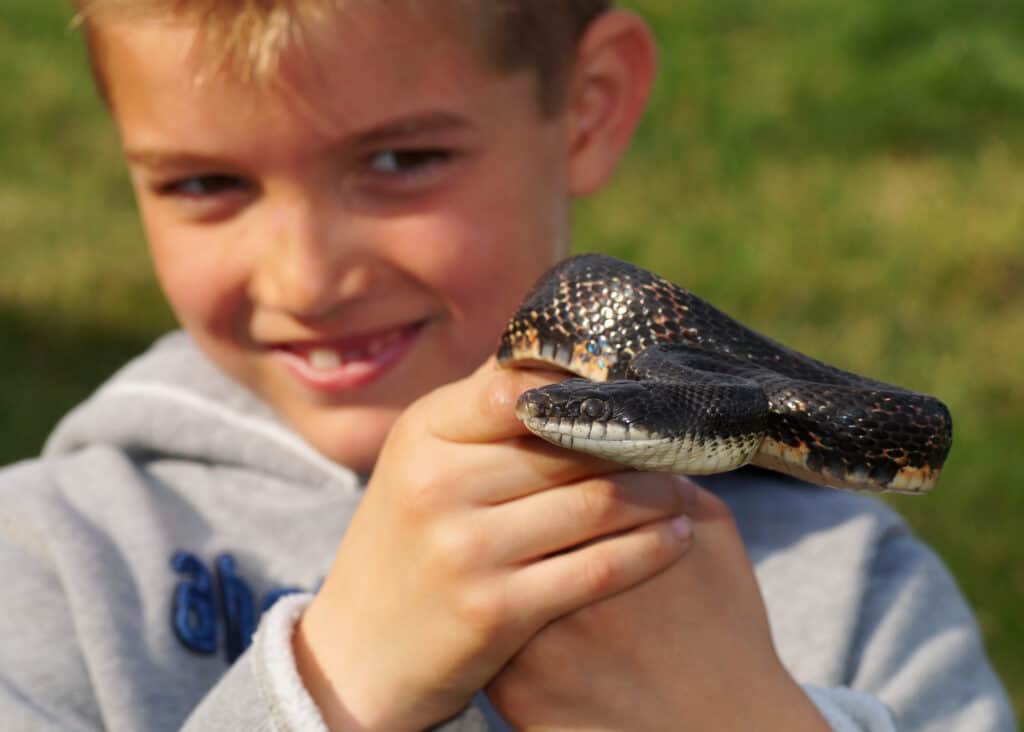
©Matt Jeppson/Shutterstock.com
- Don’t hassle wild snakes: Just because these species aren’t aggressive, that doesn’t mean they want to make friends with you. Observe from a distance and let them go about their business; don’t stress them out. Some may bite if they feel threatened, which can be painful even if they’re nonvenomous. They also might tag you with a funky-smelling musk.
- Don’t take wild snakes as pets: All the snakes on this list are available from breeders. A snake captured in the wild might be diseased or injured and will probably be more aggressive than a captive-bred snake. Plus, wild collection may be illegal, and bad for the local snake population.
- Give a new snake time to adjust: When you first bring a pet snake home, it’ll likely be more fearful, shy, or even aggressive than normal. Give your new friend at least two weeks to get acclimated to their new habitat before handling them. Start with brief contact and expand one-on-one time slowly as they get used to you.
1. Common Garter Snake, Thamnophis sirtalis
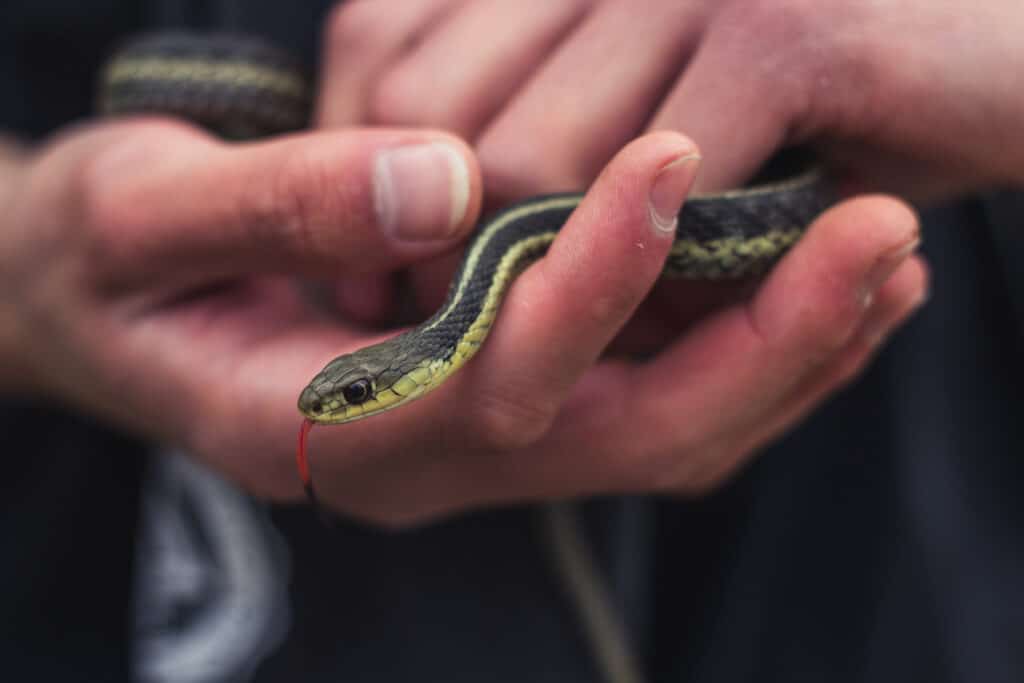
©Jeff Saelee/Shutterstock.com
If any snake has ever shown up in your backyard, there’s a good chance it’s this one. The 35 or so species of garter snakes are nonvenomous natives of North America, known for the body-length stripes that run down their sides. The common garter snake is probably the most widespread reptile on the North American continent. If you’re a gardener, you should be happy to see one of these critters, since they eat garden pests like grasshoppers and slugs.
Garter snakes turn up on most lists of snakes that make good choices for first-time snake owners. And as pets, garter snakes have a lot going for them: they don’t get very big (2-3 feet as adults), they’re active during the day, and they’re generally docile and easy to handle. However, some individual garter snakes don’t get used to handling and may even release a musk if they don’t like it (smelly but harmless).
Your best bet is to give your new snake time to get acclimated, and not handle it until it’s eating regularly. Start with 5-minute sessions at first, no more than once a day. Garter snakes don’t wrap around your fingers or hand the way some snakes do, so let the snake crawl onto your hand and support it from below. By the way, although these snakes are common, don’t take one from the wild as a pet. Wild garters are more likely to be aggressive.
2. California Kingsnake, Lampropeltis californiae
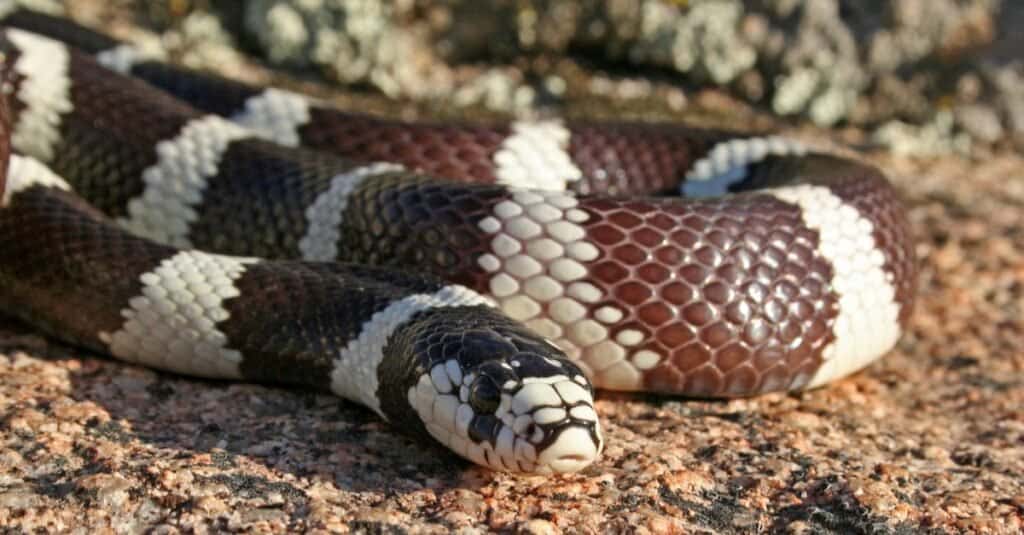
©Creeping Things/Shutterstock.com
These snakes are found in the wild not only in California, but also in Oregon, Nevada, Arizona, Utah, and northwestern Mexico. They’re an adaptable species that can live in woodlands, marshes, deserts, river bottoms, and even in suburban areas, farmland, and ranches. They’re famous for eating other snakes, including rattlesnakes. But their diet in the wild includes rodents, lizards, eggs, frogs, and birds.
Popular as pets, California kingsnakes come in a variety of colors and patterns, but they’re most known for a striking banded pattern of alternating dark brown and yellow or white. These non-aggressive snakes are generally docile and calm. But sometimes they will nip if nervous, especially hatchlings. A nervous or agitated kingsnake will hiss, roll into a ball, and even vibrate its tail like a rattlesnake.
3. Corn Snake, Pantherophis guttatus
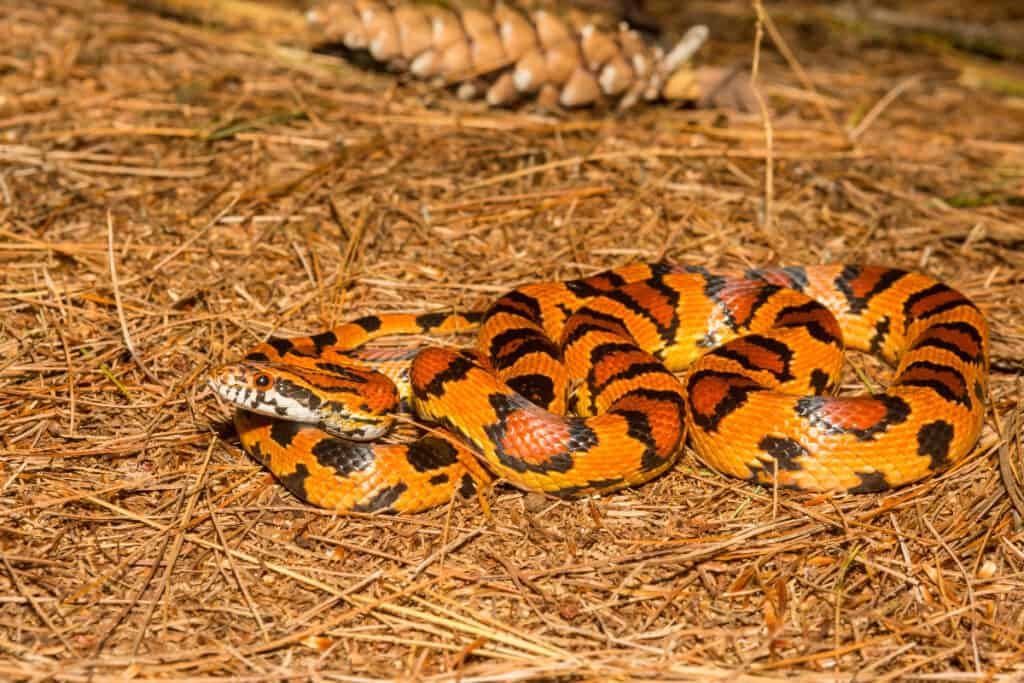
©Jay Ondreicka/Shutterstock.com
Any list of the friendliest snakes in North America would have to include this Halloween-hued serpent. The corn snake probably gets its name from the checkered pattern of its belly scales, which resembles that seen on an ear of heirloom corn. Or perhaps because these snakes hang out in cornfields. Or because it hangs out near stored grain that attracts rodents it can prey on. In any case, corn snakes are most abundant in Florida and the southeastern United States, but they can be found as far north as New Jersey. They inhabit woods, meadows, and open areas, and can also be found in man-made structures like barns and abandoned buildings.
Corn snakes are very chill snakes, with a gentle disposition, and they’re very tolerant of being handled. This makes them a popular choice for pet owners, especially people who’ve never owned a snake before. That popularity also means breeders have created lots of color and pattern variations, from pink and yellow, to gray and black, to a lovely gray-and-pastel lavender combo. Though frankly, the native orange/brown/black patterns are pretty sweet.
4. Black Rat Snake, Pantherophis obsoletus
©Psychotic Nature/Shutterstock.com
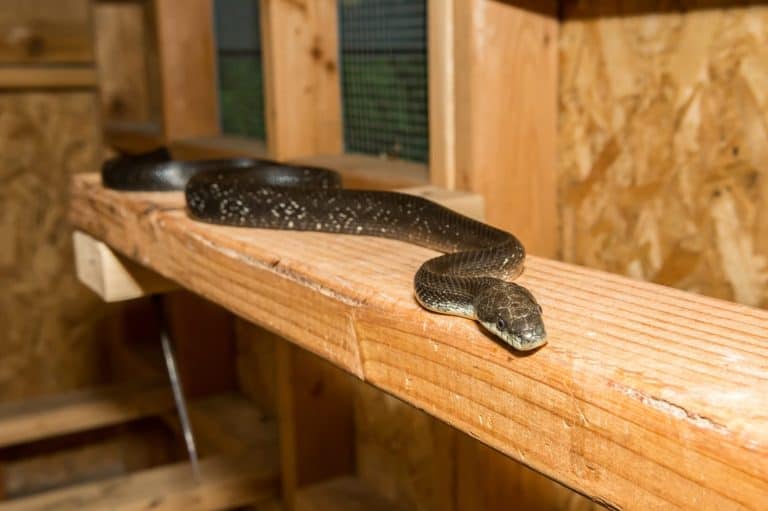
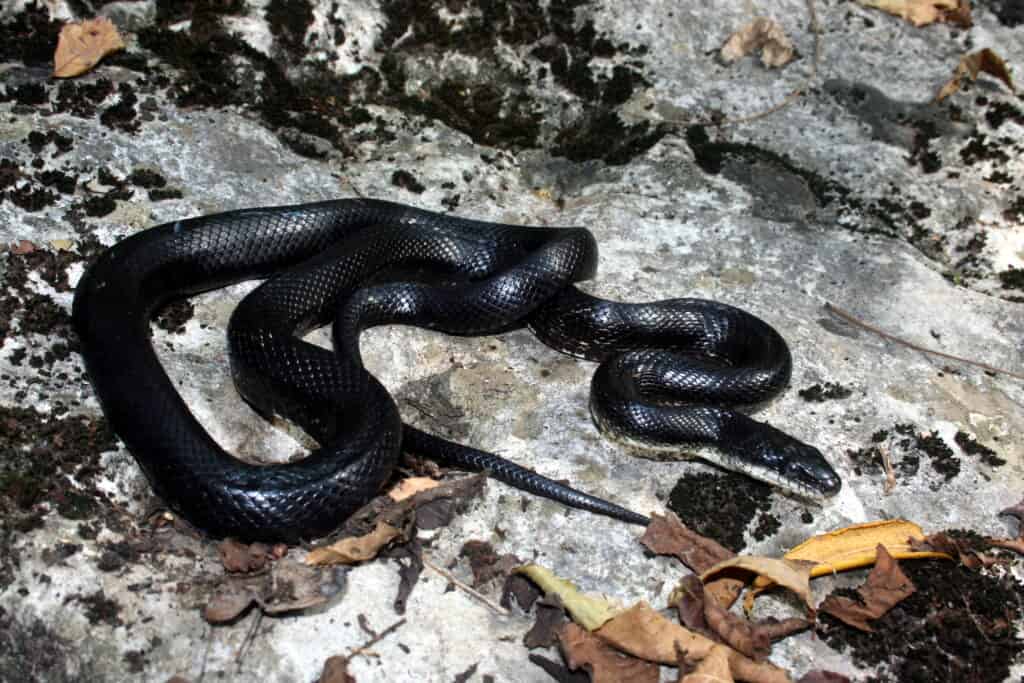
One of the longest snakes in North America, the black rat snake can grow to a length of nine feet. But three to five feet is more typical. In their central to eastern U.S. range, they live in a variety of habitats, including forests, grasslands, and fields. They’re attracted to places where rodents, their favorite meal, can be found, which includes abandoned buildings and trash piles. Black rat snakes are excellent tree climbers.
Their size and jet-black color may seem intimidating, but these snakes are very mellow and don’t mind being handled (the younger ones are a little more aggressive but will settle down over time). In the wild, the mild-mannered black rat snake will hide or flee from people, or even freeze into a bent position so it looks like a branch or stick. They’re a good snake for beginners, as long as you have room for a big enough enclosure to house them as adults.
5. Milk Snake, Lampropeltis triangulum

©Siarhei Kasilau/Shutterstock.com
These glossy-banded snakes have the widest range of any snake in North America. Milk snakes are found almost everywhere in the United States except the west coast. They live as far north as Quebec and as far south as Venezuela. Like other rodent-eating snakes, they’ll venture into barns, which may be how milk snakes got their name. Folktales claimed that these snakes like to drink milk from cows; we know it’s really mice and rats that they’re after.
The 24 subspecies of these snakes have different appearances, but milk snakes typically have alternating bands of red, black, and yellow or red, black, and white. They can resemble the venomous coral snake, except in that snake the red and yellow bands are next to each other. Milk snakes have their black bands between the yellow and red bands. Nevertheless, it’s a cool look. And their good looks plus their calm demeanor make them a popular pet among snake likers.
6. Rosy Boa, Lichanura trivirgata /Lichanura orcutti
©Jason Mintzer/Shutterstock.com
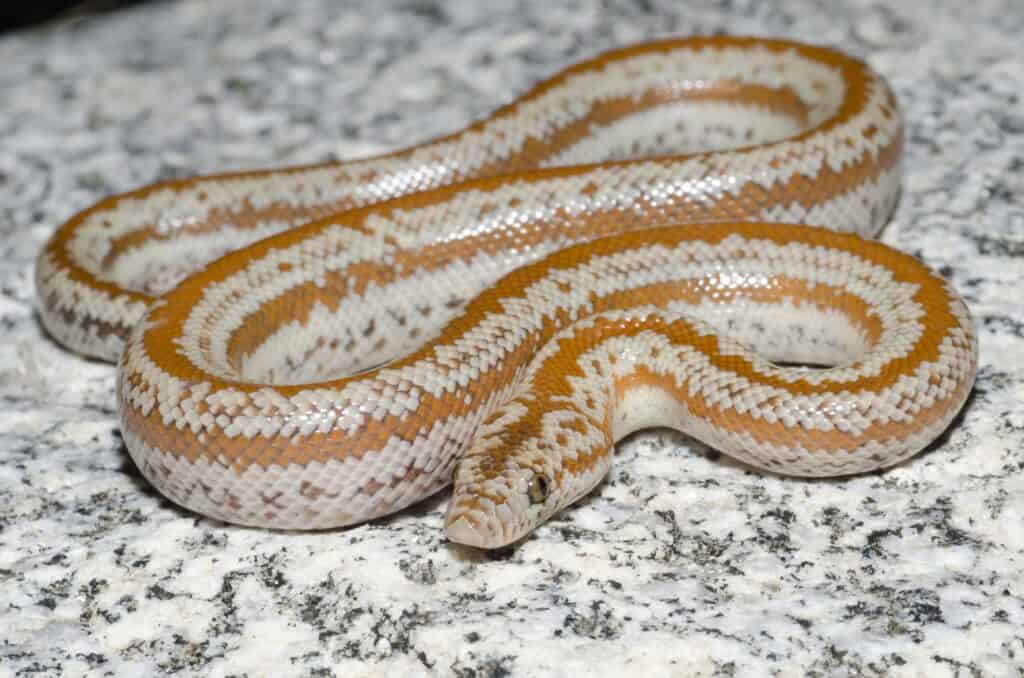
Large for a pet snake but small for a boa, the rosy boa is one of the few species of boa constrictors native to North America. The common name “rosy boa” actually applies to two species, both found in the southwestern U.S. They prefer to stay hidden in cracks and crevices or under rocks, avoiding trouble (and people) until prey comes near. They mostly eat small mammals. The rosy part of the rosy boa is its pinkish belly; up top, they usually have dark stripes running the length of their body against a lighter color ranging from gray or tan to yellow, cream, or white.
As mild-mannered snakes that are relatively easy to care for, rosy boas are popular choices for anyone who wants to have a bigger snake for a pet. They’re known for being easy to feed. Some snakes need convincing to eat non-living food, but not these guys, says MySnakePet.com.
7. Dekay’s Brown Snake, Storeria dekayi
©Jay Ondreicka/Shutterstock.com
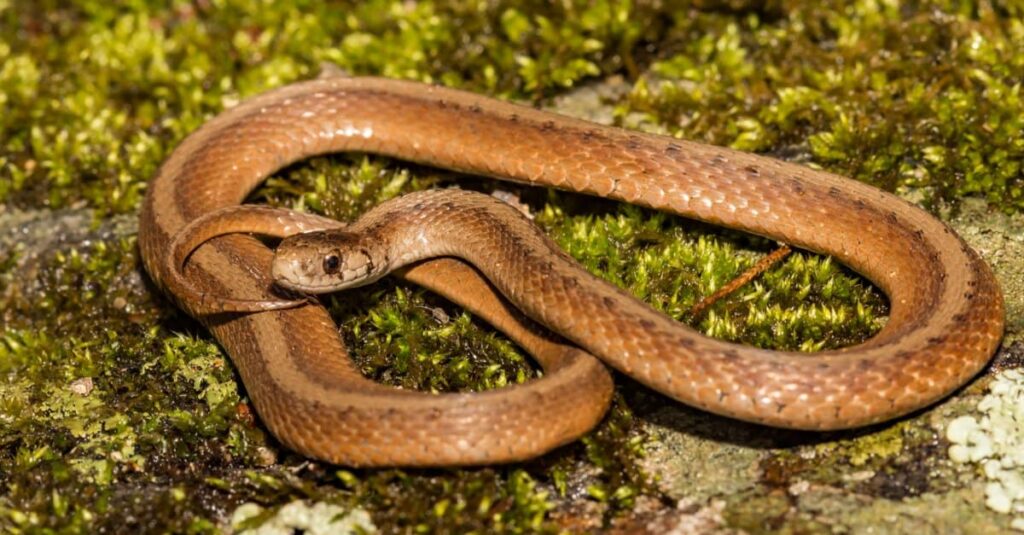
Small (12 inches or less), brown, and good at hiding, this is a snake that prefers moist habitats like wetlands and swamps, but Dekay’s brown snakes thrive in suburban areas, as long as they can stay hidden while hunting for worms and slugs. Its grayish-to-brown body has a faint stripe running along its back, bordered by dark spots, and the top of its head has a dark patch. Their small size and penchant for staying under rocks, leaf litter, and debris help these little reptiles coexist in gardens and other human-occupied spaces. If you’re anywhere east of the Rocky Mountains, from southern Canada into Central America, there might be one near you right now!
Dekay’s Brown Snakes (named for James Ellsworth De Kay, a 19-century naturalist) are nonaggressive and shy. They are gentle but not well suited to captivity and should generally be left in the wild.
8. Gopher Snake, Pituophis catenifer
©rawaccess/Shutterstock.com
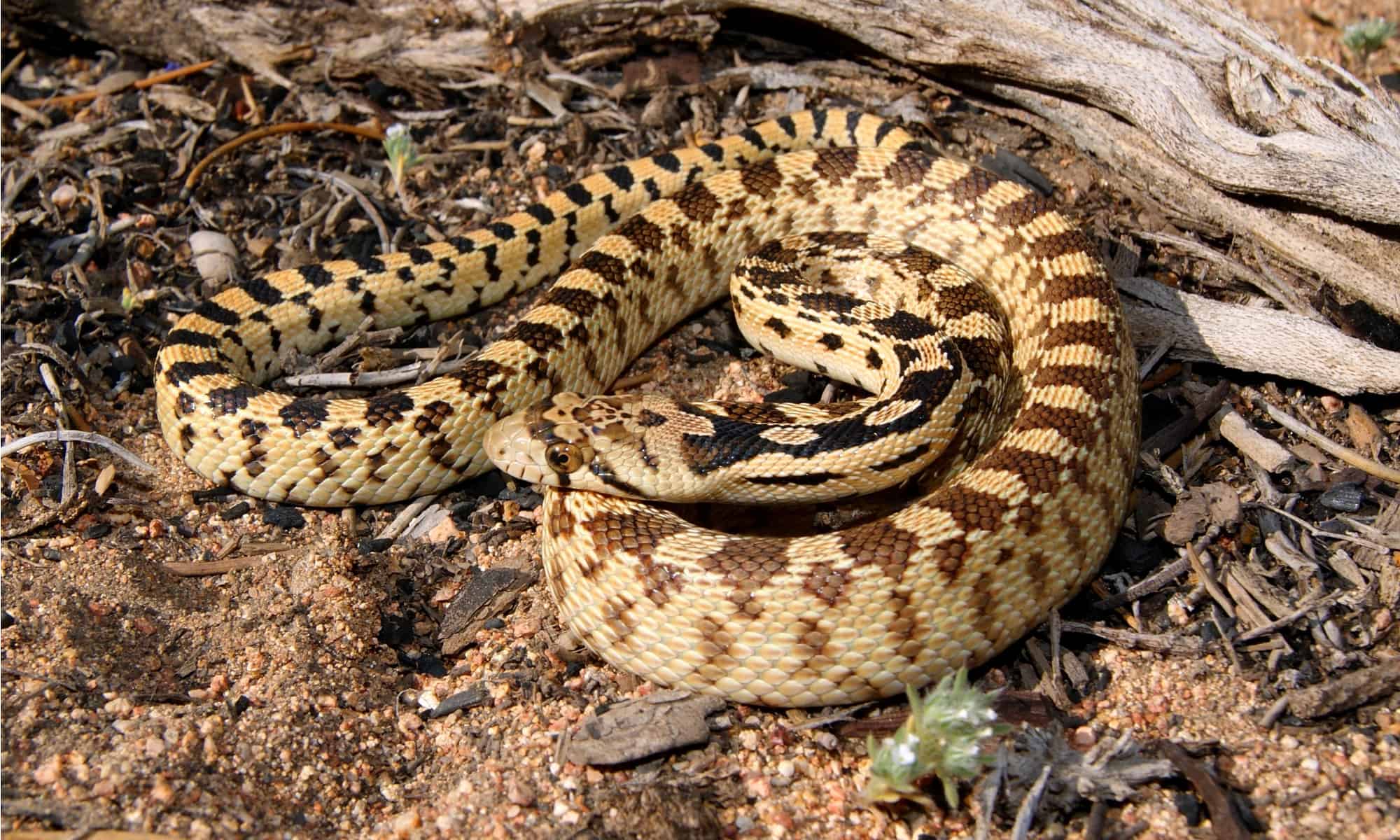
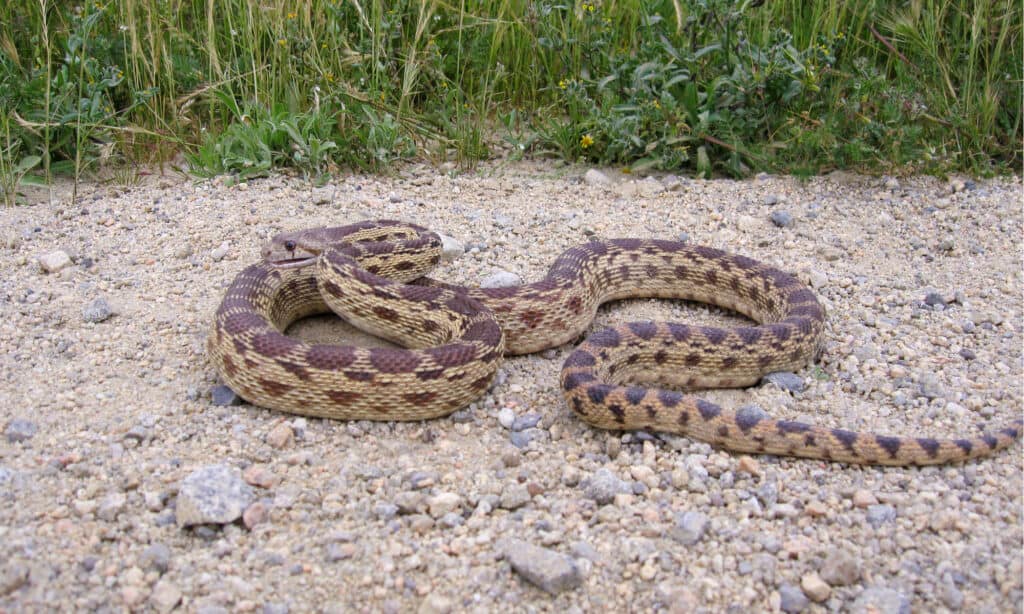
A long (4-5 feet on average), thick snake, the gopher snake has the distinction of being the loudest hisser of any snake on the North American continent. Their size and splotchy coloration cause these snakes to be mistaken for rattlesnakes, and they’ll even vibrate their tails to scare off potential predators. Also called bull snakes, these reptiles are native to the western half of North America, from Canada to Mexico, and as far east as Indiana. They prefer arid climates, and seven subspecies make their homes in different locations, including the Grand Canyon.
A snake this size can be a handful, in both senses of the word. But gopher snakes are calm, nonaggressive snakes that make good pets. Just be sure to plan for an enclosure that will accommodate them at full size.
A snake this size can be a handful in both senses of the word. But gopher snakes are calm, nonaggressive snakes that make good pets. Just be sure to plan for an enclosure that will accommodate them at full size.
9. Mexican Black Kingsnake, Lampropeltis getula nigrita
©iStock.com/Murilo Gualda
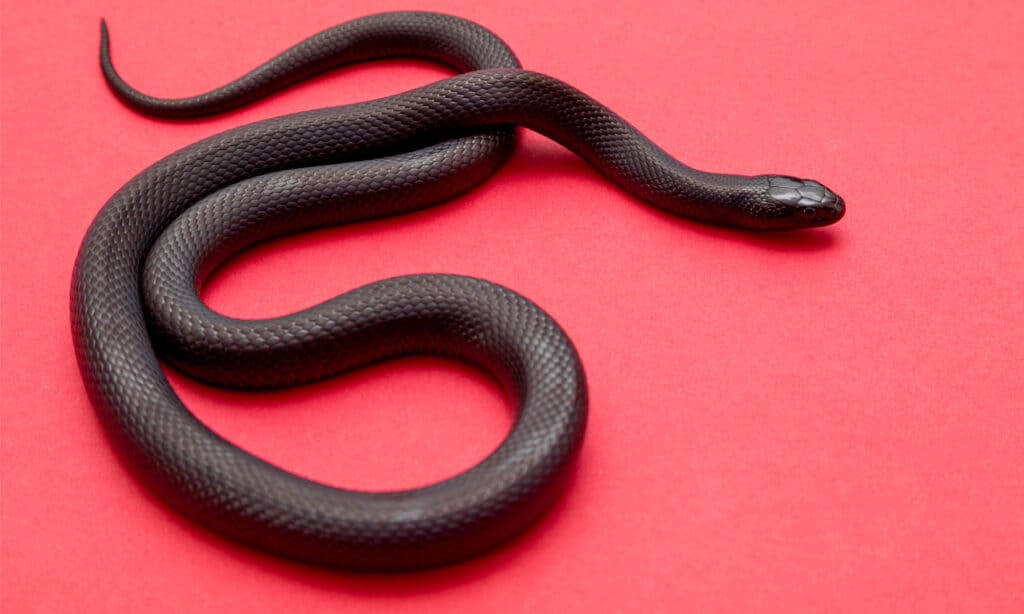
This kingsnake subspecies is a real beaut. The scales of a Mexican black kingsnake sport a dramatic all-black or deep brown coloration, with an iridescent rainbow sheen and a leather-like texture. They range from Mexico to California and parts of Arizona. They’ll hide under leaf litter or other cover but are also good climbers and swimmers. Like all kingsnakes, these reptiles eat other snakes, as well as birds, lizards, rodents, and eggs.
Generally docile, these snakes are popular as pets thanks to their mild temperament, ease of care, and exotic look. They can live for 30 years in captivity, and grow to five feet in length, so plan accordingly if you want to add one to your household.
10. Rubber Boa, Charina bottae
©yhelfman/Shutterstock.com
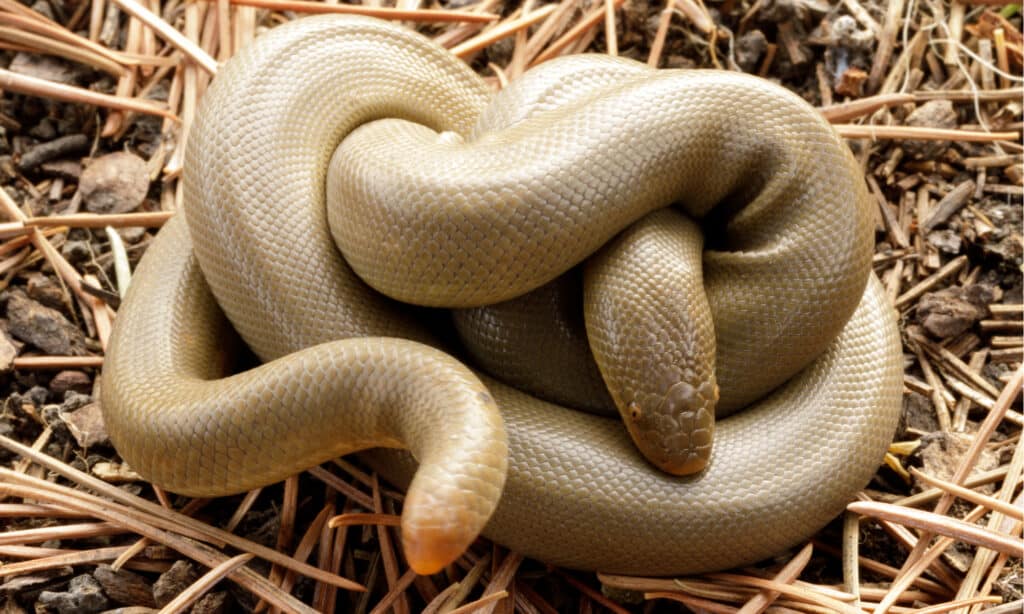
Our final example of the friendliest snakes in North America is another boa species native to the continent. You’ll find the rubber boa in the western portion of the U.S. and Canada, including Wyoming, Utah, Nevada, Washington, Montana, California, and British Columbia. They’re small (rarely longer than two feet), thick-bodied, and their brown or green-brown scales do indeed have a texture and shine that makes this snake look, and even feel, rubbery.
Their cute little heads are kind of blunt, making it hard to tell the head from the tail at first glance. In fact, when threatened the rubber boa will curl around its head so predators will mistakenly strike at the tail.
Rubber boas are slow-moving, gentle reptiles. Anecdotally, it’s been said that they’re good for helping people overcome their fear of snakes. I mean, it’s hard to be afraid of an animal that hides its own head, right?