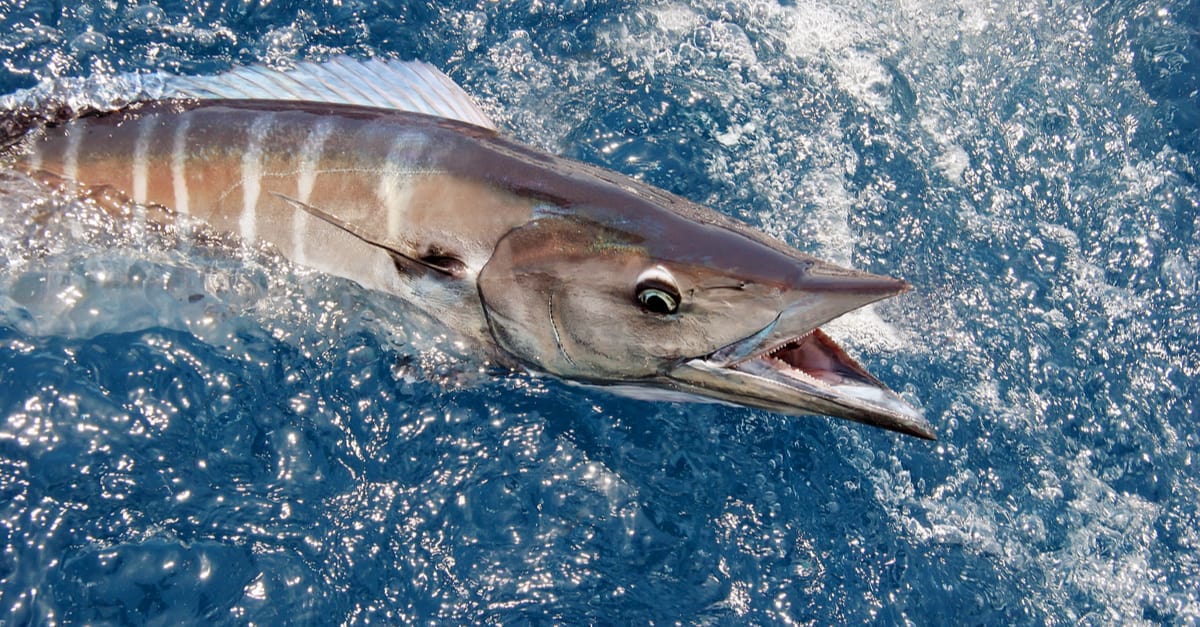

What Are Wahoos?
Wahoo (Acanthocybium solandri) are fish in the family Scombirdae and are relatives of the better-known mackerel. Wahoos tend to swim in tropical and subtropical waters around the world, though they do migrate into temperate waters during the summer. These solitary creatures tend to swim alone, but can occasionally be found in groups of fish called “schools.” You can often find them swimming near banks or around the natural debris that drifts through the ocean waters.
Wahoos are known for being among the fastest-swimming fish, which contributes both to their threat as predators and their popularity as game fish. Their speed helps them catch many different species to prey upon, including other fish and squid, which they devour. However, their speed is also a factor that can make them difficult to catch. Reported to reach up to 200 pounds in the wild, wahoo have immense strength and can put up a fight if caught by an angler’s hook. Both their speed and strength make them strong fighters, posing a challenge for any angler who sets out to catch a wahoo for sport and making them a prize catch for game anglers.
Wahoos primarily eat a diet of fish and squid, using their very sharp teeth to chomp large fish into smaller bite-sized pieces to devour.
Where Do Wahoo Swim?
Wahoos can be found throughout the world’s oceans. These fish tend to swim in subtropical and tropical waters. They are often found swimming near to the mainland shore or near islands. You can look for wahoo across a wide territory, from across the central part of the Pacific Ocean to the Indo-Pacific region and around North, Central, and South America. On the west coast of North America, they range from southern California to Mexico and south. On the east coast of North America, many people fish for wahoo from North Carolina to Florida and south. Elsewhere in the world, you may find wahoo in places such as the Mediterranean and Ionian seas, off of the coast of Africa, and in the Indian Ocean.
It is also a popular game fish in Hawaii. There, the fish is known as “ono” and is an important part of a traditional Hawaii diet.
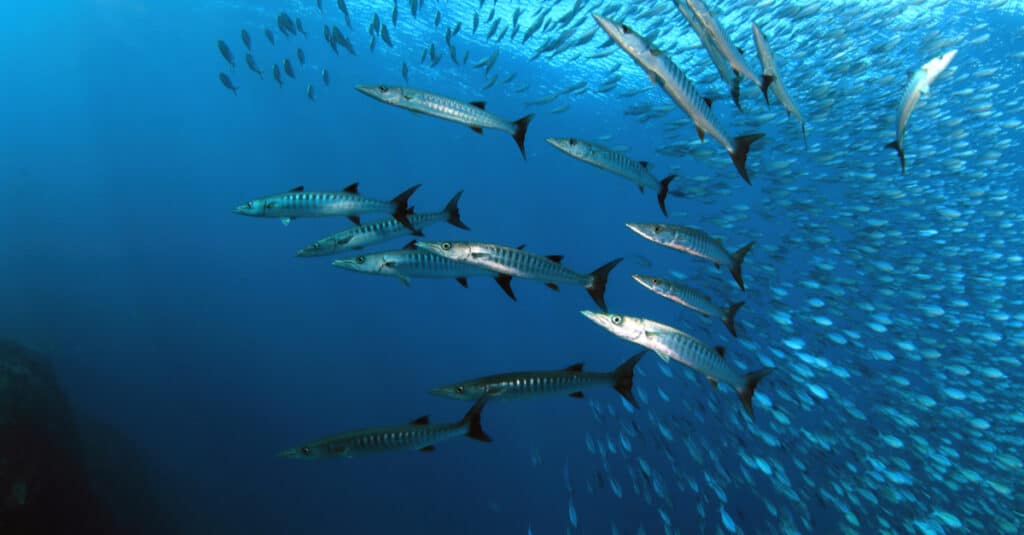
Since they swim in similar waters and can reach comparable sizes, wahoo fish and barracuda are sometimes mistaken for each other.
©orifec_a31/Shutterstock.com
What Do Wahoo Look Like?
You can identify a wahoo by looking for steel blue colors on top and pale blue, small scales on the bottom. They have large mouths, a movable upper jaw, and large, finely-serrated teeth that are laterally compressed. Wahoos may have up to 100 teeth in their mouths. These teeth are razor-sharp and allow the wahoo to consume food quickly and feed constantly.
Like other fish in their family, such as tuna and mackerel, wahoo has sleek, torpedo-like, streamlined body shapes. This helps them swim quickly and attack their prey rapidly. Wahoos have well-defined lateral lines that dip near the middle of the first dorsal fin, long snouts, and a wavy back at the tail.
Wahoos grow quickly, reaching sizes of up to 8 feet long and weighing between 100 and 200 pounds. The average wahoo will be between 3 and 5.5 feet long.
Like other members of fish in their family, the wahoo reproduces by spawning. This means that they release their eggs and sperm into the water. From there, fertilization of the eggs occurs outside of the body. Though these fish have a short life span and only live 5 or 6 years, they can reproduce prolifically during their lifespan. In fact, the female fish can release between half a million to 45 million eggs each year. This enormous amount of eggs helps to compensate for the many eggs that do not survive to become adult fish. The young fish typically reach sexual maturity at around 12 months of age.
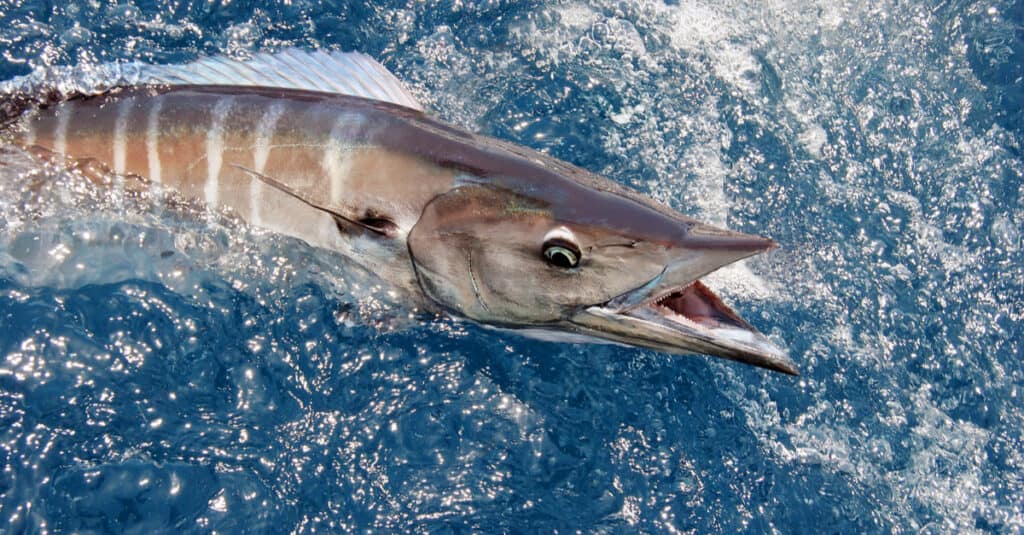
Wahoos may have up to 100 razor-sharp teeth in their mouths.
©Neophuket/Shutterstock.com
What Does Wahoo Taste Like?
Throughout the world, wahoo is a popular edible fish. In fact, the word for wahoo in Hawaiian is “ono.” In addition to referring to the fish, “ono” means “good to eat” or “delicious” in Hawaiian. Wahoo has a mild flavor, firm and lean texture, and flaky flesh. It has a low fat content and tends to have a sweet, delicate flavor that does not taste “fishy.” Because of this, the taste of wahoo is sometimes compared to that of chicken or veal. Wahoo is also sometimes compared to tasting similar to other white fish, such as cod or halibut, though with a firmer texture. Compared to its relative, the king mackerel, wahoo have a more mild flavor.
People often cook wahoo by grilling it, cooking fillets in the oven, or searing it in a pan. As a popular fish to eat, there are numerous recipes and instructions for how to prepare wahoo with other vegetables, lemon, or garlic.
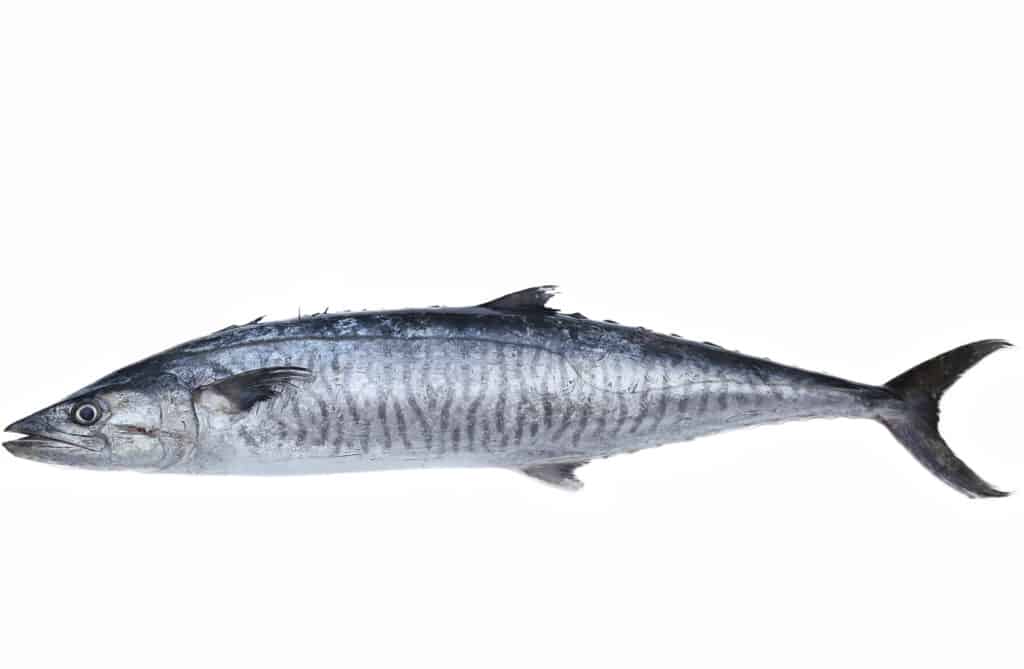
Wahoo has a mild flavor, firm and lean texture, and flaky flesh.
©Bignai/Shutterstock.com
How to Catch Wahoo
Wahoo is a popular species sought for commercial fishing and sport (recreational) fishing. Thankfully, this fish has a stable population and they are considered a species of Least Concern of extinction. With that in mind, you can try your hand at fishing for this fast, powerful fish!
There are multiple different approaches to try to catch wahoo. In fact, some anglers fish for wahoo by high-speed trolling, slow trolling dead bait or lures, trolling live bait, or even kite fishing. Be on the lookout for wahoo anywhere with warm water — from North Carolina further south to Florida, or into the Gulf of Mexico and states such as Louisiana.
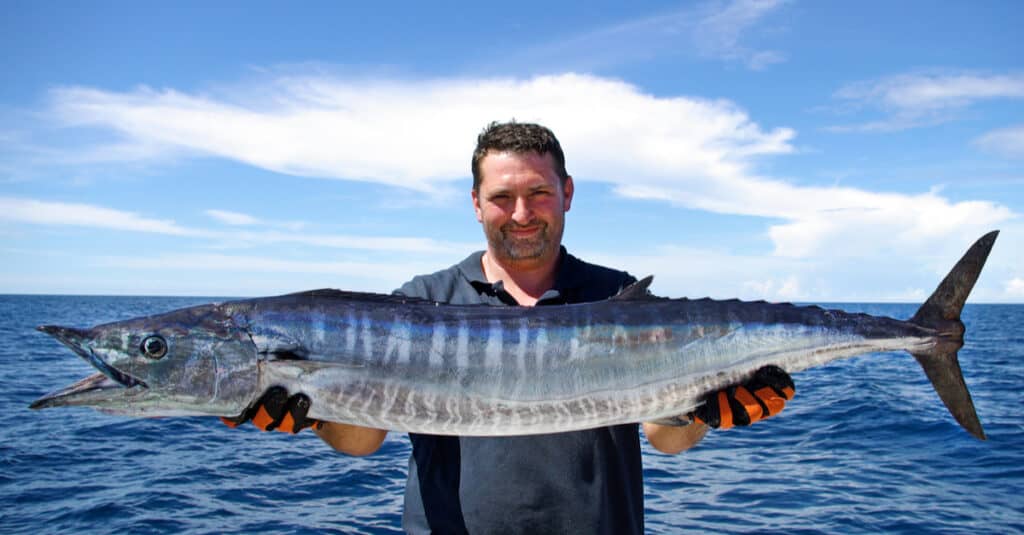
Wahoo fish can reach 8 feet long and weigh more than 180 pounds, but most are much smaller.
©Fabien Monteil/Shutterstock.com
The Largest Wahoo Ever Caught in Louisiana
The largest wahoo ever caught in Louisiana was caught in the West Delta by an angler named Myron J. Fischer. In April 1976, Fischer caught a wahoo that weighed a whopping 139.25 pounds. This fish was incredibly almost 15 pounds heavier than the second-largest wahoo ever caught in Louisiana. That record was still huge, with the fish weighing 124.50 pounds! It had been caught almost two years earlier, in May 1974.
The Biggest Wahoo Ever Caught in the World
The largest wahoo caught in Louisiana is still significantly smaller than the biggest wahoo ever caught. For a long time, the largest wahoo ever caught weighed an astonishing 184 pounds. That record-breaking catch was in the waters off of Cabo San Lucas, in Mexico, in July 2005. It took 45 minutes for a young woman named Sarah Hayward to finally bring her catch in. When she finally brought in the fish, she realized that the wahoo weighed more than she did! However, that record could have been upended in 2016 when an angler fishing off of Palm Beach in Florida landed a whopping 202-pound wahoo. The catch? It did not qualify for the world record because it took three anglers working together to bring the massive fish in. Still, the feat of finding and catching such an enormous fish is still one for the history books.
Fun Facts About Wahoo
- As a member of the Scombridae family, wahoo are closely related to other famous fish such as tuna, bonito, mackerel, and others.
- Wahoo are often confused with king mackerel but can be differentiated by looking at their teeth and dorsal fins. Their coloring also leads some people to confuse wahoo with barracuda, due to the light blue stripes or barring on the side of the wahoo’s body.
- Wahoo are among the fastest fish in the sea! In fact, they are capable of swimming speeds up to 60 miles per hour.
- Swimming so quickly helps wahoo to travel over great distances. One fish was recorded traveling 1,700 miles in only six months!