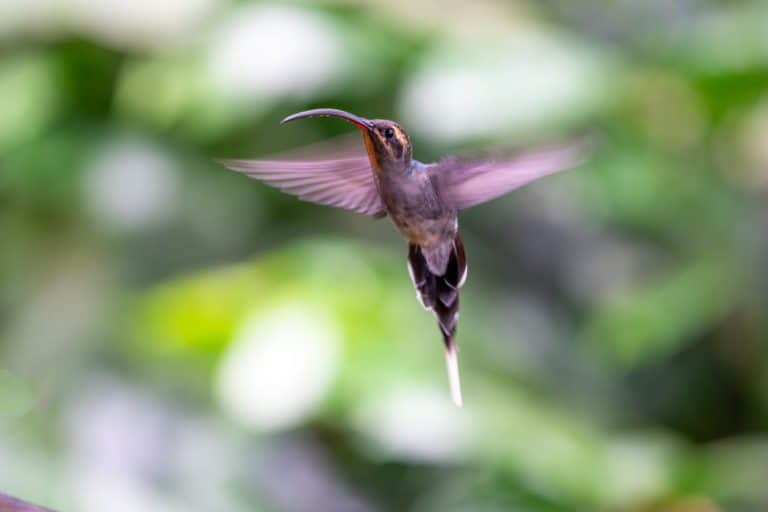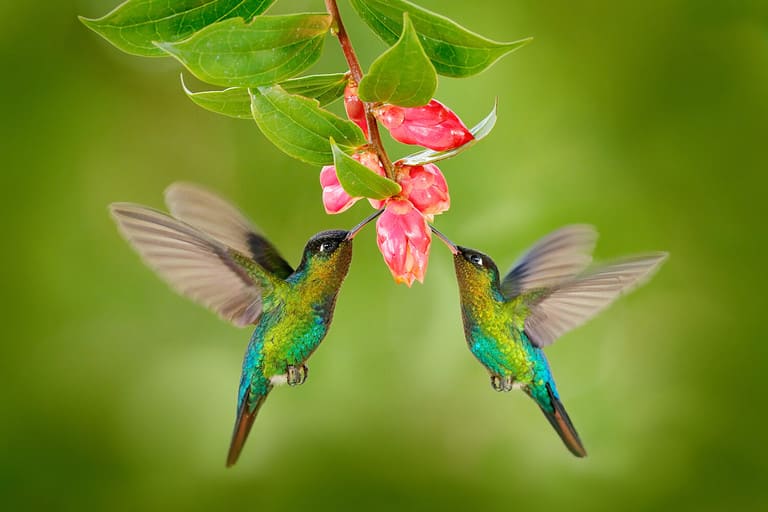

Whether you’re a bird watcher or not, you’ve probably seen a hummingbird. These tiny birds are easy to identify thanks to their long beaks and fast-beating wings. They’re also very pretty due to their iridescent feathers, so it isn’t surprising that these birds are well-loved and known throughout Oregon. However, their disappearance in the winter leaves many people wondering when hummingbirds leave Oregon.
Because these birds rely on blooming flowers, they must leave Oregon in the winter to find food in warmer climates. Many individuals can’t survive in Oregon’s chilly climates.
While migration might conjure images of geese flying in V-formations across the sky, this isn’t what hummingbird migration looks like. Instead, when a bird decides it’s time to leave, it does. They don’t make a dramatic procession out of it.
Therefore, figuring out when hummingbirds migrate and where they go is a bit more challenging.
In this article, we’ll look at when hummingbirds leave Oregon and where they go.
When Hummingbirds Leave Oregon
Hummingbirds typically follow specific seasonal patterns, which vary somewhat from bird to bird.
As the days grow shorter, the abundance of flowers starts to wane in the state. This change signals for many hummingbirds that it is time to leave. Because they have to consume extra calories to store food for the journey ahead, these hummingbirds tend to be more active in the weeks leading up to their migration.
Towards the end of summer, hummingbirds will begin their journey southward. They typically leave Orgeon in late August to early September. However, the exact timing can vary. It’s recommended that you leave up your feeders until the end of September to ensure there aren’t any stragglers left.
Hummingbirds will stop at several refueling points on their journey to eat and regain their strength. In some cases, hummingbirds north of Oregon may stop at your feeder.
The earlier migrators will return to Oregon in late March to early April. Other hummingbirds may not arrive until the end of April, though. Weather patterns and individual differences can affect the return date, just like it affects when the hummingbirds migrate in the fall.
Where Oregon’s Hummingbirds Migrate To
Hummingbirds that migrate from Oregon typically fly thousands of miles southward to Central and South America. While that may seem like a long way for these tiny birds, it’s absolutely necessary as they have to travel far to escape the cold winter temperatures.
Luckily, the countries of Mexico, Costa Rica, Panama, and others in the area provide a constant supply of flowers (which supply the hummingbirds with the nectar they need to eat).
That said, different species and individuals will end up in different areas. Some travel very far into South America, while others may hang out in southern Mexico.
Of course, hummingbirds face many challenges while migrating. On top of the huge amount of land they have to pass, they must also travel through severe weather and contend with predators and habitat loss. It’s not easy being a migrating hummingbird.
Non-Migratory Hummingbirds in Oregon
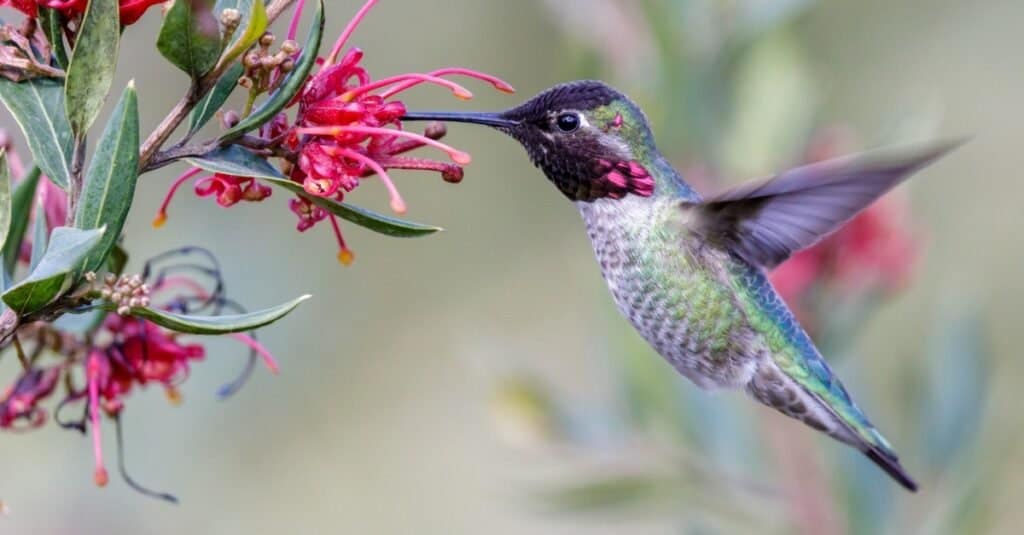
Anna’s Hummingbird is aggressive in protecting its territory and can dive to attack at up to 60 mph.
©iStock.com/yhelfman
While most hummingbirds migrate, some species don’t (or don’t go very far, if they do). Several hummingbird species do not make the migration trek we commonly associate with hummingbirds. Instead, they have adapted to the challenges of winter in colder areas.
Among the non-migratory hummingbird species commonly found in Oregon is the Anna’s Hummingbird. Named after Anna Masséna, the Duchess of Rivoli, this species exhibits remarkable adaptability. It withstands the cooler temperatures by entering a state of torpor during the night, during which its metabolic rate drops significantly, allowing it to conserve energy.
Furthermore, this species also finds sheltered roosting spots that may offer some protection from the elements. They can also consume insects that remain active during the cooler months.
Leaving up your hummingbird feeders through the winter can help these non-migratory hummingbirds, especially if they’ve been using your feeder during the winter months. You can also plant winter-blooming plants that are suitable for hummingbirds.
Migratory Hummingbird Species in Oregon
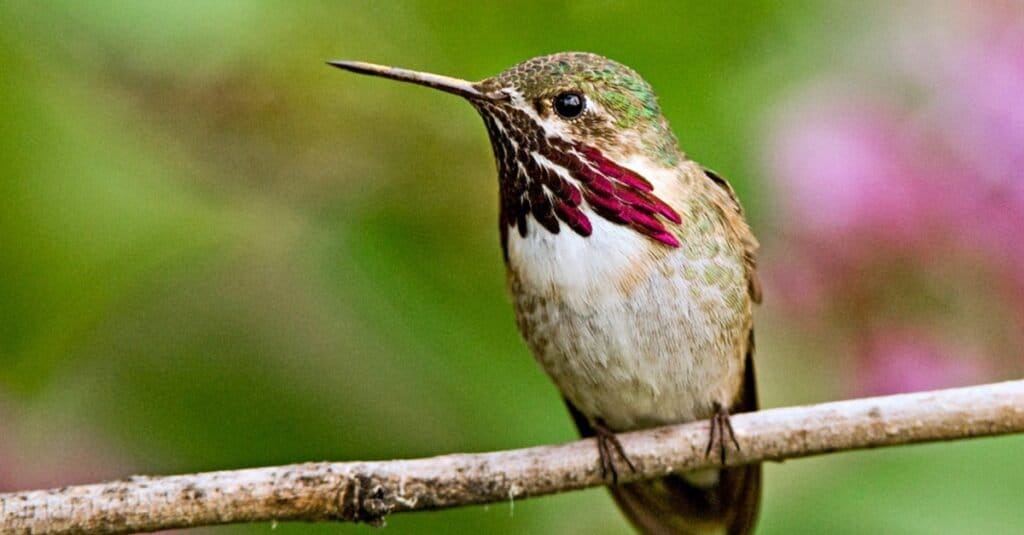
The Calliope Hummingbird is the smallest bird native to the United States and Canada. It has a western breeding range mainly from California to British Columbia.
©MTKhaled mahmud/Shutterstock.com
While Anna’s Hummingbird doesn’t migrate, other species do. Here is a list of the most common migratory hummingbirds found in the state:
- Rufous Hummingbird: One of the migratory species, it visits Oregon during its northward and southward journeys. Their fiery orange plumage and bold nature make them a striking sight. They have one of the longest migration routes of any North American hummingbird, traveling between Alaska and Mexico.
- Calliope Hummingbird: This species is the smallest hummingbird in North America. They are a summer visitor to Oregon’s higher-elevation areas. You can recognize them due to the bright magenta markings on the males’ throats.
Oregon’s diverse geography provides various areas for hummingbirds to thrive in. Coastal areas provide a mild climate supporting year-round Anna’s hummingbird populations. On the other hand, the alpine environments are frequented by Calliope hummingbirds.
There are many native flowers that all hummingbird species have come to rely on. These include the red-flowering currant, Indian paintbrush, and cardinal flower. These provide a consistent supply of nectar. It’s thought that these plants evolved next to hummingbirds, who work as one of their main pollinators.
You can add these plants to your yard to help support these hummingbirds year-round. Remember that some more northern hummingbird species may end up in Oregon while migrating southward (or northward). Therefore, you should plant flowers that bloom at different times throughout the year.
Conserving Hummingbirds in Oregon
Urbanization can be a problem for migratory hummingbirds, in particular. These hummingbirds often stop at specific refueling points along their migration route. If these are turned into urban areas or don’t produce the food they need, the hummingbirds may have a harder time migrating.
Luckily, there is a lot you can do to help. Putting out feeders and thoughtfully planting hummingbird-safe flowers can help support the local population, especially if you live in an urban or suburban area.
Planting native plants is an easy way to encourage hummingbirds to visit during migration. Preserving wild spaces in your yard can also be helpful, as native plants may grow there naturally.
When it comes to hummingbirds, small actions often make a very big difference.
However, it’s also important for larger organizations to play a role in conservation. You can look for hummingbird conservation organizations in your area and coordinate how to protect hummingbirds in Oregon. Often, these organizations participate in research, habitat restoration projects, and education campaigns.
Research is essential for protecting hummingbirds. After all, there is still a lot to find out about their behaviors and migration.
Studying Hummingbirds in Oregon
Oregon has been a hotbed of research on hummingbirds. For instance, it was one of the locations used for a citizen science project that involved tracking and tagging hummingbirds.
It was only recently that we learned much about bird migration, and studies in Oregon have played a big role in what we know today.
We’ve also learned about hybridization between hummingbird species in Oregon, where the Allen’s hummingbird and rufous hummingbird sometimes interbreed. We’re still learning about how hybridization affects migration patterns.
We know that Oregon appears to be one of the migration areas for the rufous hummingbird. Therefore, the area is often utilized to study these birds and their migration pattern.
Most studies of hummingbird migration involve tagging, either by paper or electronic tracker. Simply put, a hummingbird is typically tagged at one end of its range and then caught at the other end (hopefully, there is a lot of chance involved). When electronic trackers are used, researchers can see exactly where these birds go.
Sadly, trackers only recently got small enough to fit on hummingbirds, and it is surprisingly hard to get an electronic tracker to actually stay on a hummingbird throughout the whole migration.