
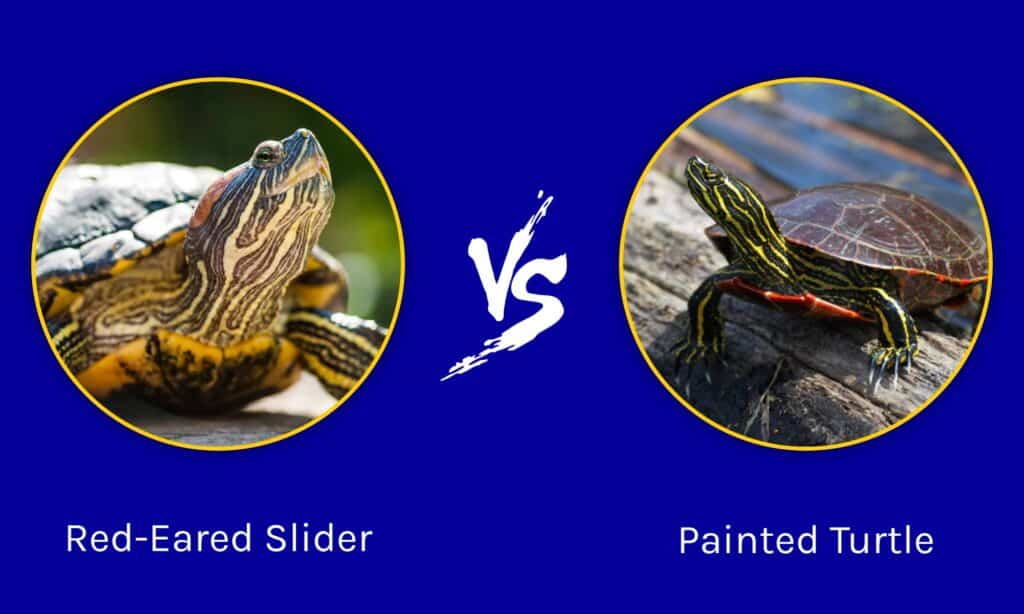
The red-eared slider and the painted turtle are both fascinating turtles that are popular pets around the world, with the painted turtle being second in popularity only to the red-eared slider. If you’re considering getting one as a pet, then you might be wondering what the differences are between them, so in this article, we’ll outline everything you need to know. Let’s get started!
Comparing a Red-Eared Slider and a Painted Turtle
| Red Eared Slider | Painted Turtle | |
|---|---|---|
| Size | Length: 5-8 inches Weight: 8.5 ounces | Length: Up to 8 inches for males and 12 inches for females. Weight: 11-18 ounces |
| Appearance | Red streak behind the eye; shell divided into upper parts (carapace) and lower parts (plastron) Green heads, legs, and tails; webbed feet with claws | Omnivorous; duckweed, algae, flowers, seeds, and stems from complex plants, animals, including mollusks, insects, small amphibians, etc. |
| Location and Habitat | Location: Asia, Africa, Central America, Europe, North America, and Oceania Habitat: non-turbulent rivers, ponds, creeks, lagoons, streams, and swamps. | Location: North America Habitat: ponds, marshes, streams, and other slow-moving water sources |
| Diet | Omnivorous; duckweed, algae, flowers, seeds and stems from complex plants, animals, including mollusks, insects, small amphibians, etc. | Omnivorous; insects, small fish, plants, water algae, etc. |
| Predators | Humans, snakes, coyotes, armadillos, foxes, mustelids, skunks, etc | Foxes, otters, raccoons, and birds of prey, amongst others. |
Key Differences Between the Red-Eared Slider and Painted Turtle
The key differences between red-eared sliders and painted turtles can be found in their location as well as size. While red-eared sliders are located on several continents, including North America, the painted turtle is only located in North America. Also, red-eared sliders only weigh about 8.5 ounces on average, while painted turtles weigh between 11 and 18 ounces. Let’s look into a detailed breakdown of their differences below.
Red-Eared Slider vs. Painted Turtle: Size

Red-eared sliders weigh an average of 8.5 ounces while measuring between 5 to 8 inches in length.
©effective stock photos/Shutterstock.com
According to the numbers, painted turtles are larger than red-eared sliders on average. Male painted turtles measure up to eight inches long, while females can be as long as 12 inches. Not to mention the weight of painted turtles, which ranges from 11 to 18 ounces. Red-eared sliders, on the other hand, weigh an average of 8.5 ounces while measuring between five and eight inches in length.
Red-Eared Slider vs. Painted Turtle: Appearance

Painted turtles have a round-shaped shell, which can be either jet-black or other colors.
©KARI K/Shutterstock.com
Red-eared sliders and painted turtles also differ in physical appearance. For the red-eared sliders, distinguishing physical features include a red streak behind the eye and a shell divided into the upper part (carapace) and lower parts (plastron). The upper parts are covered in green-colored scutes, and the lower parts (plastron) are light yellow with green and wavy markings.
Painted turtles also come with their fair share of unique physical characteristics including a round-shaped shell, which can either be jet-black or other colors including dark green with bright-colored bottoms (western turtles), fully yellow plastrons (southern and eastern painted turtles), and orange with a black spot in the middle (midland painted turtles).
Red-Eared Slider vs. Painted Turtle: Location and Habitat
Red-eared sliders and painted turtles also differ in terms of the variety of their locations. While red-eared sliders are native to the southeastern United States, they can now be found on every continent except Antarctica due to their popularity in the pet trade and their status as an invasive species.
However, painted turtles reside strictly across North America, and subspecies are determined by regions and geographical locations. For instance, eastern painted turtles reside in the east while southern painted turtles dwell in the south.
As far as habitats are concerned, red-eared sliders and painted turtles have very similar preferences. Their habitats include slow rivers, streams, creeks, ponds, and marshes. They basically want to be in a controlled aquatic environment where they are less likely to be swept away by rushing water currents.
Red-Eared Slider vs. Painted Turtle: Behavior

The red-eared sliders are highly social.
©iStock.com/:Marina Vedernikova
Red-eared sliders are highly social, and groups will often gather on logs or rocks to sunbathe as a way of regulating their body temperature, especially since they spend a lot of time in the water. When they perceive a threat, they slide into the water, which is where the name “slider” came from. They do not mark territories and are not aggressive, which is why many consider them good pets.
Much like the sliders, painted turtles are also known to congregate for joint sunbathing sessions, and they also live together in shallow ponds and streams. They will often pop out of their habitats to engage humans in a friendly manner. Basically, red-eared sliders and painted turtles have similar behaviors, and they both get along well with humans.
Red-Eared Slider vs. Painted Turtle: Diet
Red-eared sliders and painted turtles are both omnivorous animals. The red-eared sliders are aptly called “opportunistic omnivores” because of their proclivity to eat anything they find appetizing. Baby sliders are predominantly carnivorous, and they consume a lot of meat given their need for protein. Their diet includes beetles, spiders, snails, slugs, and small aquatic animals. The adults eat animals like mollusks, insects, small amphibians, and plants like duckweed, algae and flowers, seeds, and stems from plants.
Painted turtles have a similar diet comprising small fish, insects, water algae, plants, and any aquatic animal they can eat.
Red-Eared Slider vs. Painted Turtle: Predators and Threats

Painted turtle predators include raccoons, otters, foxes, and other such carnivores.
©Jonathan Novack/Shutterstock.com
The red-eared slider and painted turtle both have shells that protect them from predators to some extent. However, they all still suffer attacks from predators across the animal kingdom. Common predators of red-eared sliders include alligators, snakes, coyotes, armadillos, foxes, and skunks. They are also frequently targeted by humans.
For painted turtles, their predators include raccoons, otters, foxes, and other such carnivores. Experts, however, believe adult painted turtles do not suffer as many predatory attacks. They mostly suffer loss of their eggs in their vulnerable nests, with some losing up to 90% of eggs during the breeding season.