





M
Species Profile

Mexican Black Kingsnake

Lampropeltis nigrita

The glossy black king of snakes
BikerPhoto/Shutterstock.com

Mexican Black Kingsnake Distribution

Click a location to explore more animals from that region

Endemic Species
Loading map...
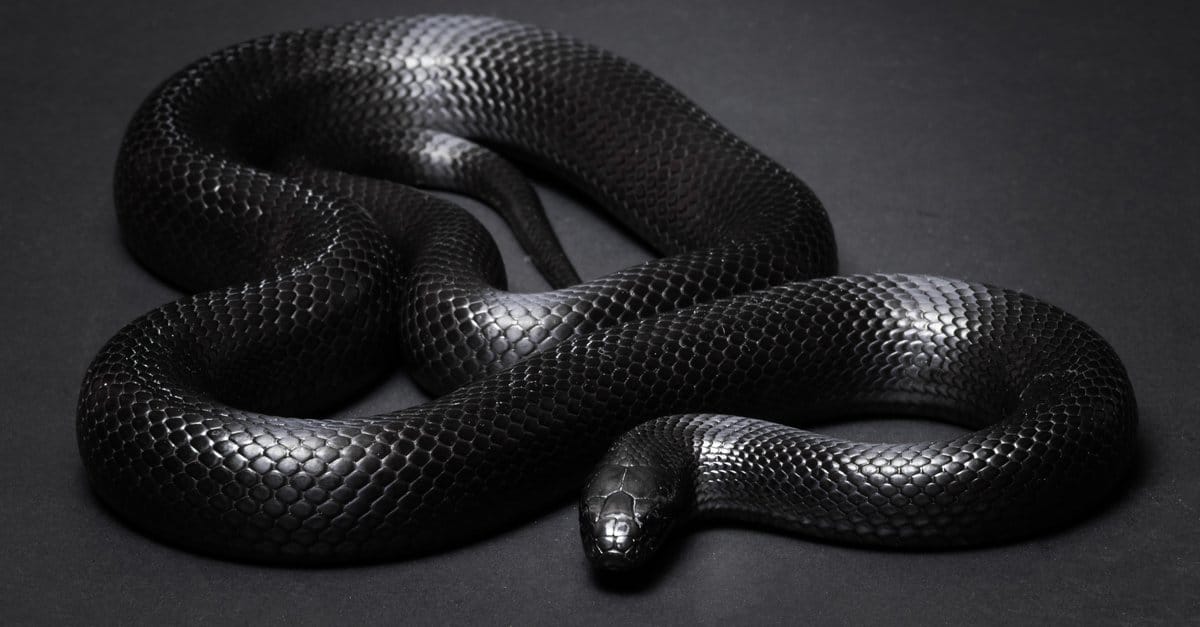
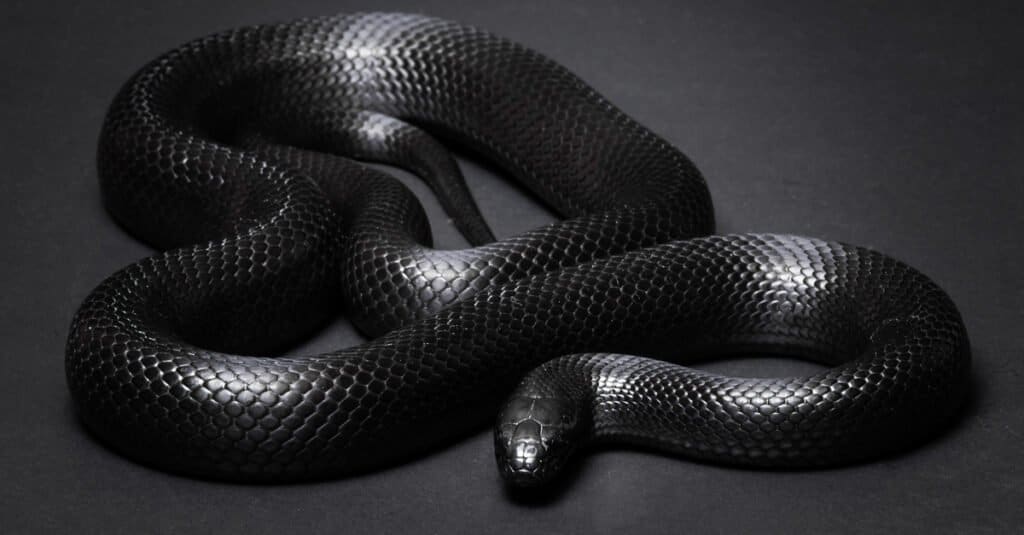
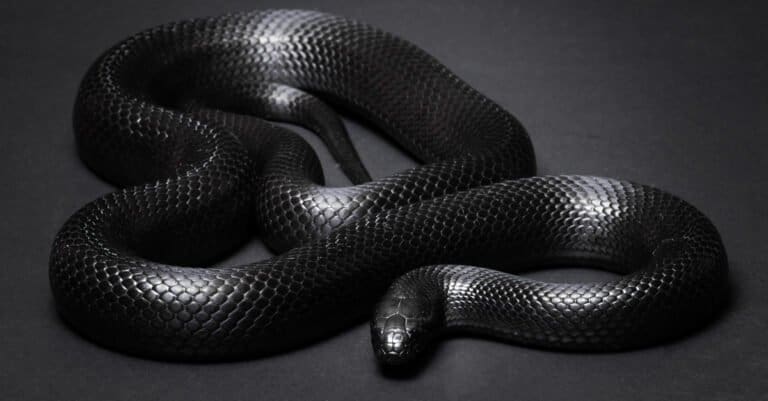
mexican black king snake on black background

At a Glance

Wild Species
Also Known As Black kingsnake, Black king, Kingsnake, King snake, MBK, Culebra real negra
Diet Carnivore
Activity Crepuscular+
Lifespan 8 years
Weight 1.2 lbs
Status Not Evaluated
Did You Know?

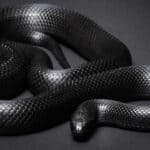
Color is the headline trait: adults are typically near-uniform, glossy black (often with faint or obscured banding), unlike the strongly banded look of many other L. getula forms.

Scientific Classification

A predominantly glossy-black kingsnake form from Mexico within the common kingsnake (Lampropeltis getula) complex; a nonvenomous constrictor known for preying on rodents, lizards, and other snakes (including venomous species). Popular in the pet trade for its uniform dark coloration and generally tractable disposition.

Kingdom
Animalia
Phylum
Chordata
Class
Reptilia
Order
Squamata
Family
Colubridae
Genus
Lampropeltis
Species
Lampropeltis getula

Distinguishing Features

  • Uniform or near-uniform glossy black coloration (often with minimal pattern)
  • Nonvenomous colubrid constrictor with a relatively robust body
  • Kingsnakes are notable for ophiophagy (snake-eating) and resistance to some snake venoms

Did You Know?

Color is the headline trait: adults are typically near-uniform, glossy black (often with faint or obscured banding), unlike the strongly banded look of many other L. getula forms.

Typical adult total length is commonly reported around 91-122 cm, with large individuals sometimes reaching about 152 cm in the broader L. getula complex.

Like other kingsnakes, it is an effective ophiophage (snake-eater) and will take other snakes-including venomous species-using constriction and a degree of venom resistance documented in Lampropeltis generally.

Reproduction is oviparous: kingsnakes lay eggs; clutch sizes across the L. getula complex commonly fall in the mid-single digits to low teens, with incubation often around ~55-70 days under warm conditions (widely reported in herpetoculture; exact values vary by temperature).

Captive longevity is a major reason for its popularity: Lampropeltis getula complex animals are routinely kept 15-20+ years, with exceptional longevity records reported beyond 25 years for kingsnakes in general husbandry literature.

Despite the name "kingsnake," it's nonvenomous-its "royal" reputation comes from preying on other snakes (a naming tradition found in English and Spanish common names).

Unique Adaptations

  • Smooth, glossy scales and uniform dark pigmentation: the black coloration can enhance heat absorption during cool mornings/evenings-an advantage for a wide-ranging predator that may be active outside peak heat.
  • Relative resistance to certain snake venoms: Lampropeltis species have physiological resistance that can reduce the effects of some pitviper venoms, supporting their ophiophagous niche (resistance is not absolute and varies).
  • Powerful axial musculature: kingsnakes generate strong constriction pressure for their size, enabling them to subdue comparatively robust prey (including other snakes).
  • Broad diet flexibility (rodents, birds/eggs, lizards, snakes): typical of the L. getula complex and helps them persist across varied habitats from scrub to agricultural mosaics.
  • Skull/jaw mobility typical of snakes (high cranial kinesis): allows ingestion of relatively large prey items compared to head size-useful for rodent prey and other snakes.

Interesting Behaviors

  • Ophiophagy (snake-eating): will actively seize and constrict other snakes; in the L. getula complex this includes predation on rattlesnakes, which helped drive the "king" reputation.
  • Constrictor feeding sequence: rapid strike → firm jaw hold → tight coils; kingsnakes often re-adjust coils repeatedly to maintain pressure as prey exhales.
  • Crepuscular/nocturnal activity tendency in warm seasons: frequently most active at dusk/night in hot climates, while becoming more diurnal in cooler conditions (pattern broadly documented across Lampropeltis).
  • Strong chemosensory tracking: heavy tongue-flicking and ground-trailing behavior when hunting rodents, lizards, and other snakes.
  • Defensive repertoire: may vibrate the tail in dry leaf litter (audible "buzz"), musk, and attempt to flee; many captive-bred individuals become notably tractable with consistent handling.
  • Seasonal rhythm: in parts of its Mexican range, activity and breeding are often tied to cooler/drier vs warmer/wetter seasonal shifts (timing varies locally).

Cultural Significance

The Mexican Black Kingsnake (Lampropeltis nigrita) is useful for eating rodents and sometimes venomous snakes. Its shiny black color makes it popular in snake keeping and the pet trade within the Lampropeltis getula group. Snakes hold major roles in Mesoamerican art and religion.

Myths & Legends

Mexican Black Kingsnake (Lampropeltis nigrita) is called 'king of snakes' in folk stories. People say kingsnakes beat rattlesnakes and protect homes and ranches from dangerous snakes.

Feathered Serpent deity in central Mexican tradition: a major creator and culture-hero figure associated with wind, learning, and renewal, part of broader serpent symbolism across Mexico.

The Fire Serpent in Aztec myth is a strong serpent weapon tied to the war and sun god, the 'Hummingbird of the South.' Serpent images show force, protection, and holy power shaping views of snakes.

"Serpent Skirt" mother goddess in Aztec tradition: an earth and mother deity depicted with serpent elements; symbolism connects to fertility, life and death cycles, and the earth.

Ranch and countryside anecdotes (regional oral tradition): kingsnakes are sometimes left unharmed because of the belief that their presence discourages venomous snakes-an intergenerational practical superstition tied to their snake-eating habits.

Conservation Status

NE Not Evaluated

Has not yet been evaluated against the criteria.

Population Unknown

Protected Under

  • Mexico: Ley General de Vida Silvestre (general protection/regulation of native wildlife; collection and possession require permits depending on purpose and locality)
  • Mexico: SEMARNAT permitting framework for wildlife capture/transport (applies broadly; this taxon is not known to be specifically listed under NOM-059 at subspecies level)

Life Cycle

Birth 8 hatchlings
Lifespan 8 years

Lifespan

In the Wild
4–15 years
In Captivity
12–30 years

Reproduction

Mating System Promiscuity
Social Structure Solitary
Breeding Pattern Seasonal
Fertilization Internal Fertilization
Birth Type Internal_fertilization

Adults are largely solitary and come together briefly in spring for courtship and mating; males may engage in competition and can mate with multiple females, and females may mate with multiple males. Females lay eggs and provide no post-oviposition parental care.

Behavior & Ecology

Social None (solitary) Group: 1
Activity Crepuscular, Nocturnal, Diurnal
Diet Carnivore Rodents (mice) are typically the most frequently taken prey where abundant; kingsnakes are widely documented as rodent-focused generalist predators (regional stomach-content/field observations for Lampropeltis getula complex).
Seasonal Hibernates

Temperament

Across the Lampropeltis getula complex, adults are mainly solitary; pairing is brief during breeding, with occasional den aggregations where climate forces shared refugia.
Defensive behaviors when handled include rapid escape attempts, cloacal musking, and hissing; tail vibration may occur (Ernst & Ernst, 2003).
Strong ophiophagy and opportunism can produce conspecific aggression/cannibalism; co-housing is generally unsafe even outside breeding contexts (Ernst & Ernst, 2003).
Seasonal activity shifts: more diurnal in cooler periods, more crepuscular/nocturnal during hotter weather-typical for kingsnakes in warm regions (Ernst & Ernst, 2003).
Longevity (species-level data): captive records commonly reach 15-20+ years for L. getula; maximums reported in herpetoculture exceed 20 years, while wild longevity is less well quantified (Ernst & Ernst, 2003; Bartlett & Bartlett, 2005).
At species level, Lampropeltis getula can reach 208.3 cm total length. The Mexican black form, L. nigrita, is usually smaller in captivity, about 90–150 cm long.

Communication

Hiss Audible exhalation) during defensive arousal; no complex vocal repertoire (Ernst & Ernst, 2003
Chemical: tongue-flicking to detect prey and conspecific pheromones via vomeronasal organ; mate-trailing by males in breeding season Ernst & Ernst, 2003
Chemical: cloacal gland secretions/musk released under stress, deterring predators and handlers Ernst & Ernst, 2003
Tactile: courtship involves body alignment, chin-rubbing, and coiling; copulation includes hemipenial insertion General colubrid pattern; Ernst & Ernst, 2003
Visual/postural: defensive S-curving of neck/body, head elevation, and tail vibration to appear more threatening Ernst & Ernst, 2003

Habitat

Biomes:
Desert Hot Tropical Dry Forest Temperate Grassland Temperate Forest Freshwater Wetland
Terrain:
Plains Hilly Valley Riverine Rocky Coastal
Elevation: Up to 8202 ft 1 in

Ecological Role

Terrestrial mesopredator and intraguild predator within arid-to-seasonally dry ecosystems of Mexico (Lampropeltis getula complex); regulates small-vertebrate populations and can suppress other snake populations through ophiophagy.

Rodent population control (potentially reducing crop/food-store losses and rodent-borne disease risk) Intraguild predation on other snakes (including venomous species), influencing local snake community structure Energy transfer from small-vertebrate prey to higher trophic levels (prey for raptors/mammalian predators)

Human Interaction

Domestication Status

Wild

Danger Level

Low
  • Bites: small punctures/lacerations from defensive feeding/handling mistakes (nonvenomous; no medically significant venom).
  • Zoonoses: Salmonella risk typical of reptiles if hygiene is poor (handwashing recommended).
  • Allergic reactions/asthma triggers from bedding or feeder insects/rodents in the household.
  • Escape risk: potential nuisance and ecological risk if released outside native range (responsible containment required).

As a Pet

Suitable as Pet

Legality: Mexican Black Kingsnake (Lampropeltis nigrita) is usually legal as a captive-bred pet. Not CITES-listed often, but import, export, and local rules vary; some places ban reptiles or need permits. Taking from the wild may be illegal.

Care Level: Moderate

Purchase Cost: $150 - $600
Lifetime Cost: $2,000 - $7,000

Economic Value

Uses:
Pet trade (captive breeding and retail) Education/outreach animals Research/model organism for husbandry and behavior (genus-level) Ecosystem services (rodent predation where native) Wildlife/ecotourism interest (limited, localized)
Products:
  • captive-bred live animals (hatchlings/juveniles/adults)
  • husbandry supplies sold in association (enclosures, heating, feeders)
  • educational programming/appearances (live-animal demonstrations)

Relationships

Predators 9

“A subspecies of the common kingsnake.”


The Mexican black kingsnake is one of the most popular snakes to keep as a pet due to how easy it is to take care of and the patent-leather beauty of its black scales. Even when it’s not in the house, residents of Arizona and the Sonoran Desert are grateful that it eats its share of rodents and rattlesnakes. Read on to learn more about this reptile.

Four Mexican Black Kingsnake Amazing Facts

Here are four amazing facts about Mexican black kingsnakes.

  • The scales have an irridescent sheen to them and if examined under light reveal all the colors of the rainbow.
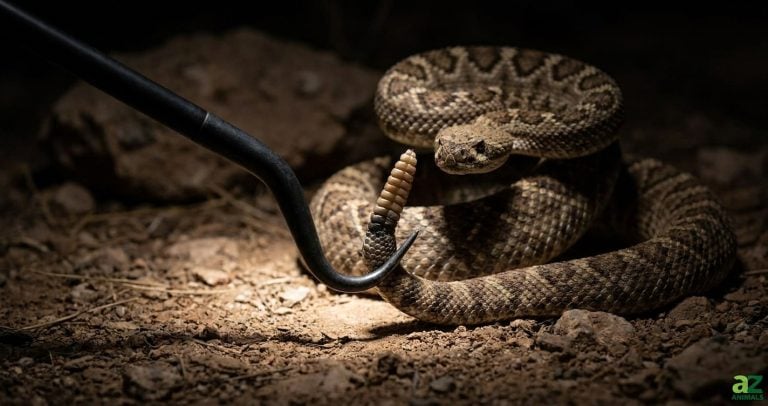
  • It’s called the kingsnake because it comes from a family of snakes that eat other snakes, including venomous ones. The Mexican black kingsnake also eats birds, eggs, lizards and rodents.
  • Wild Mexican black kingsnakes sometimes breed with the California kingsnake or the desert kingsnake.
  • Because it is ophiophagous, a pet Mexican black kingsnake shouldn’t be kept in an enclosure with other snakes, even those of its own species.

Where To Find Mexican Black Kingsnakes

The Mexican black kingsnake is found in the Sonoran Desert and parts of Arizona in habitats where there is lush vegetation. It is popular as a pet and can live happily and healthily if it is housed in a large size tank or enclosure and its dietary and environmental requirements are taken care of.

Mexican Black Kingsnake Scientific Name

The scientific name of the Mexican black kingsnake is Lampropeltis getula nigrita. The Lampropeltis genus includes a great variety of snakes, including the rainbow colored scarlet kingsnake and milk snake. Lampropeltis comes from the Greek words lampros, which means “shiny” and pelte which means “shield.” This refers to the porcelain-like gloss of the snake’s dorsal scales. Getula refers to the Gaetuli of North Africa, who wore either clothes with a chain pattern or chain mail that reminded people of the snake’s shiny scales. Nigrita is Latin for “black color.”

The Different Types of Mexican Black Kingsnake

The Mexican black kingsnake is itself a subspecies of the common kingsnake, L. getula. This makes it one of nine subspecies. The others are the California kingsnake, the Florida kingsnake, the eastern kingsnake, the speckled kingsnake, the black kingsnake, the desert kingsnake, Brooks’ kingsnake and the Apalachicola Lowlands kingsnake.

Mexican Black Kingsnake Population & Conservation Status

The exact numbers of the Mexican black kingsnakes are not known, but the snake seems to be fairly common in its range. Its conservation status is not evaluated. However, conservationists consider the parent species, the common kingsnake, under concern due to the declining numbers of the Florida kingsnake.

How To Identify Mexican Black Kingsnakes: Appearance and Description
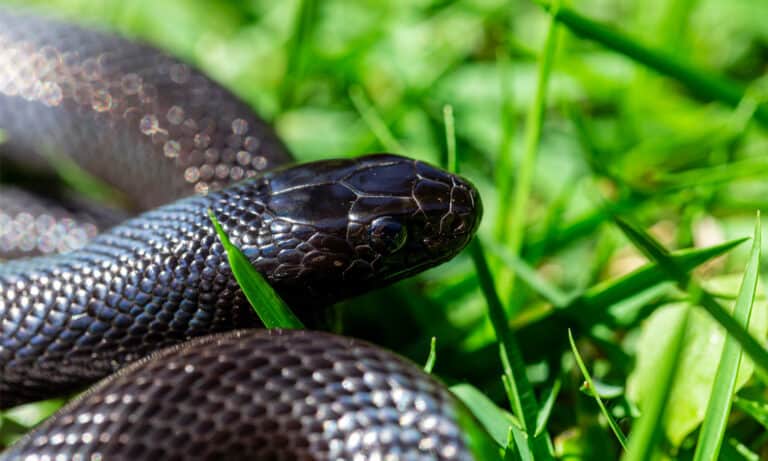
mexican black kingsnake on grass

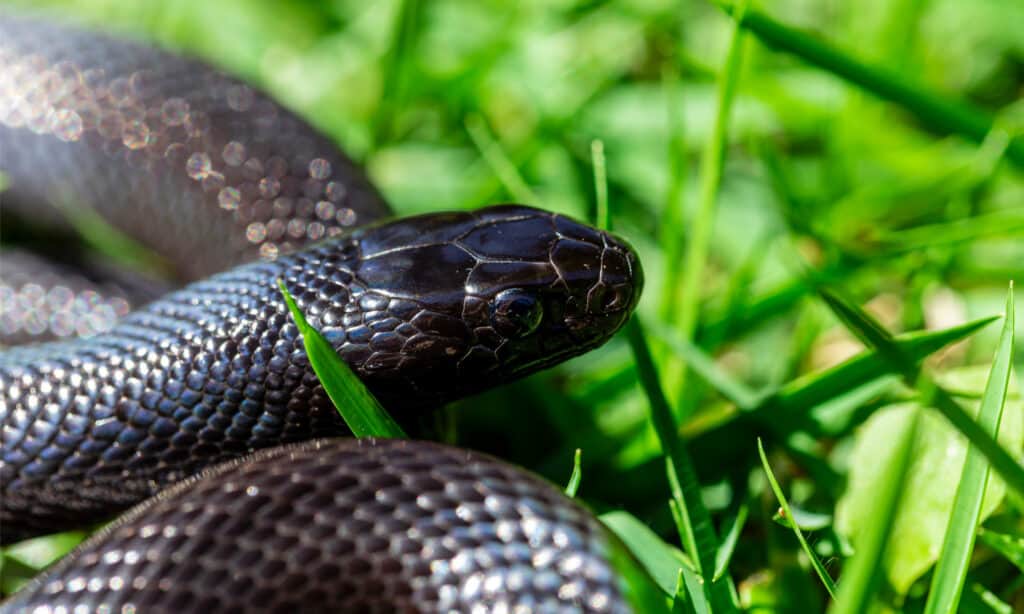
Mexican black kingsnakes have iridescent scales

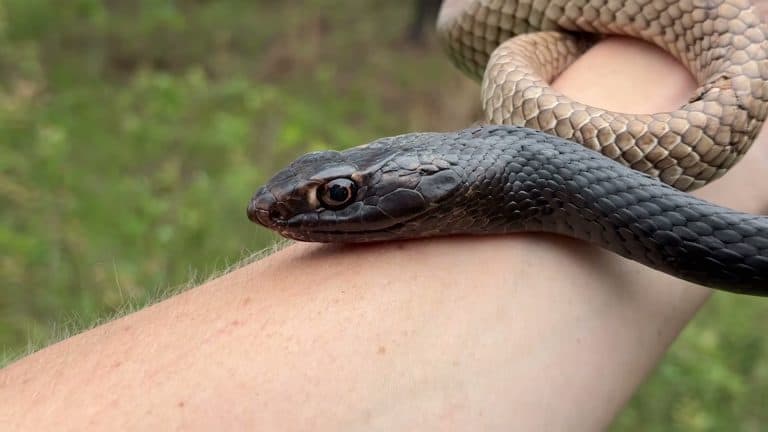
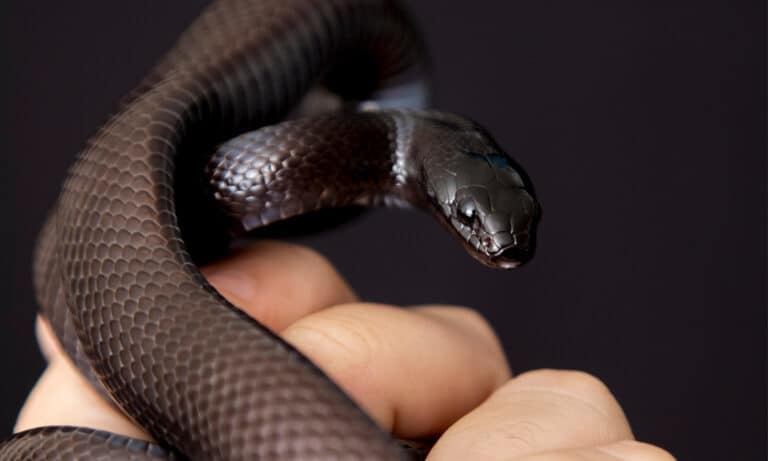
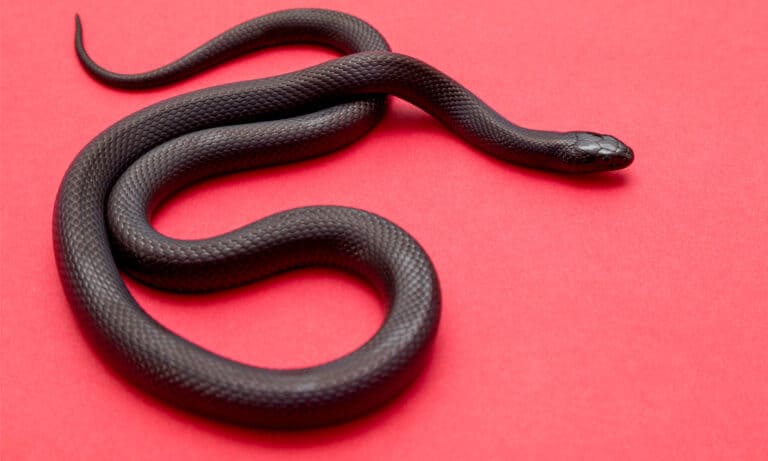
These beautiful snakes are deep, dark brown all over, both dorsally and ventrally. The scales are wonderfully irridescent under the light, and if you look, you will see flashes of rainbow colors. Baby snakes have yellow spots, but these fade and are gone by the time the snake is mature. Full grown snakes are 3 to 4 feet in length and weigh 3 to 4 pounds. They have smallish oval heads that aren’t distinct from the neck, small black eyes and a slender body.

Mexican Black Kingsnake Venom: How Dangerous Are They?

Mexican black kingsnakes lack venom and are not dangerous to humans. They kill their prey by constricting them to death as opposed to envenomating them. They make good pets and can live as long as 30 years with the proper care.

Mexican Black Kingsnake Behavior and Humans

Mexican black kingsnakes are, like other kingsnakes, diurnal. This means they’re active during the day, especially during earliest spring to late fall. After this, they hibernate in protected places, including tree stumps, hollow logs, burrows, crevices and caves. They are known to bask in the sun to regulate their body temperature, but they mostly hide under fallen leaves. The snake glides gracefully over the ground but can also climb trees and is a competent swimmer.

Mexican black kingsnakes are known to be docile, but if they are handled when they don’t want to be, they may discharge foul-smelling substances or bite. Because no venom is present in the bite, the bite is harmless and simply needs to be cleaned and dressed.

Even if it’s not kept as a pet, the Mexican black kingsnake is beneficial, for it keeps down the population of rodents and dangerous rattlesnakes. L. g. nigrita is resistant to the venom of rattlers and other poisonous snakes.

Like a lot of snakes, male Mexican black kingsnakes fight over females by entwining their bodies and trying to pin their rival to the ground. The winner mates with the waiting female and the loser lies there with his head down. The female can mate with more than one male and not all of her babies necessarily have the same father. The breeding season begins in March and lasts till August.

About 40 to 65 days after mating, the female lays between three and 24 eggs in a rotting tree stump, a pile of sawdust or a decaying log. If food is abundant, she may lay more than one clutch in a season. The baby snakes hatch after about 60 to 62 days, and though neither parent cares for them they stay in their nest until their first molt. This happens after about a week. After molting, the baby snake goes off on its own.

Female Mexican black kingsnakes are ready to breed when they’re between two and four years old, and males are ready when they’re between one and four.

Though the snake isn’t the cuddliest of animal companions, it does beguile with its ease of care, mild disposition and the glossy beauty of its scales. The price of one full grown snake is a bit high at around $200, and a prospective owner will need to factor in the price of a tank or enclosure, the price of food, which is usually a steady supply of mice or chicks and the price of other necessities such as sources of heat and light, substrate, decor that replicates the snake’s preferred habitat and veterinary care.

Similar Animals

View all 329 animals that start with M

Sources

  1. Wkipedia
  2. Everything Reptiles
  3. Weebly
  4. ITIS
Austin S.

About the Author

Austin S.

Growing up in rural New England on a small scale farm gave me a lifelong passion for animals. I love learning about new wild animal species, habitats, animal evolutions, dogs, cats, and more. I've always been surrounded by pets and believe the best dog and best cat products are important to keeping our animals happy and healthy. It's my mission to help you learn more about wild animals, and how to care for your pets better with carefully reviewed products.
Connect:

Thank you for reading! Have some feedback for us?


Mexican Black Kingsnake FAQs (Frequently Asked Questions)

Mexican black kingsnakes are not venomous and are harmless to humans.