
Quick Take
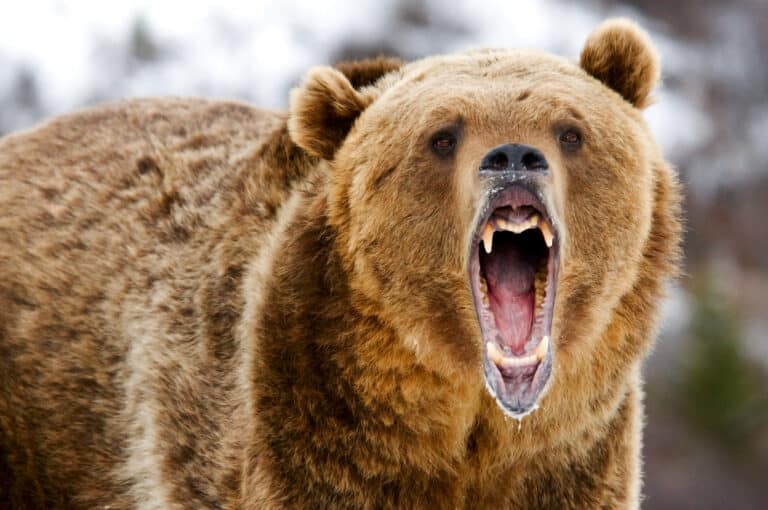
- Successfully capturing a 790-pound beast requires managing dimensions equivalent to a grizzly bear.
- The 4,500-calorie daily requirement forces these animals to create massive destruction across local Texas agricultural lands.
- Counter-intuitively, this record-breaking specimen was successfully delivered to a cattle corral while still alive.
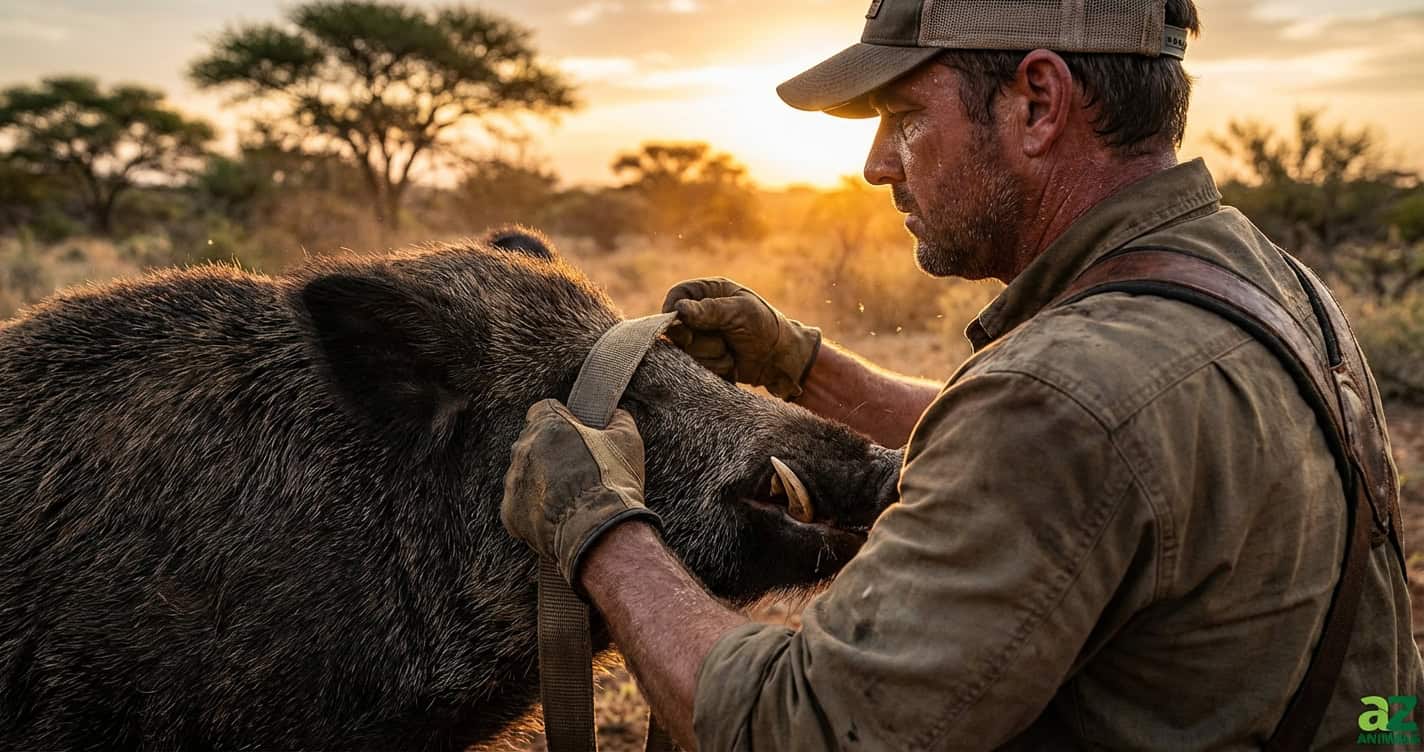
- The leg-tying stage was required by Boar Collector professionals to ensure safety during the live relocation.
Wild hogs, commonly known as wild boars, are large animals native to Eurasia and North Africa. They are aggressive and can wreak havoc on farms and other rural areas. Wild hogs are also a favorite for many hunters. They aren’t easy to hunt, but they are well worth the challenge. The biggest wild hog ever was tracked by two Texas boys and was the size and weight of a grizzly bear. Keep reading to learn more about this massive beast.
The Biggest Wild Hog Ever Harvested
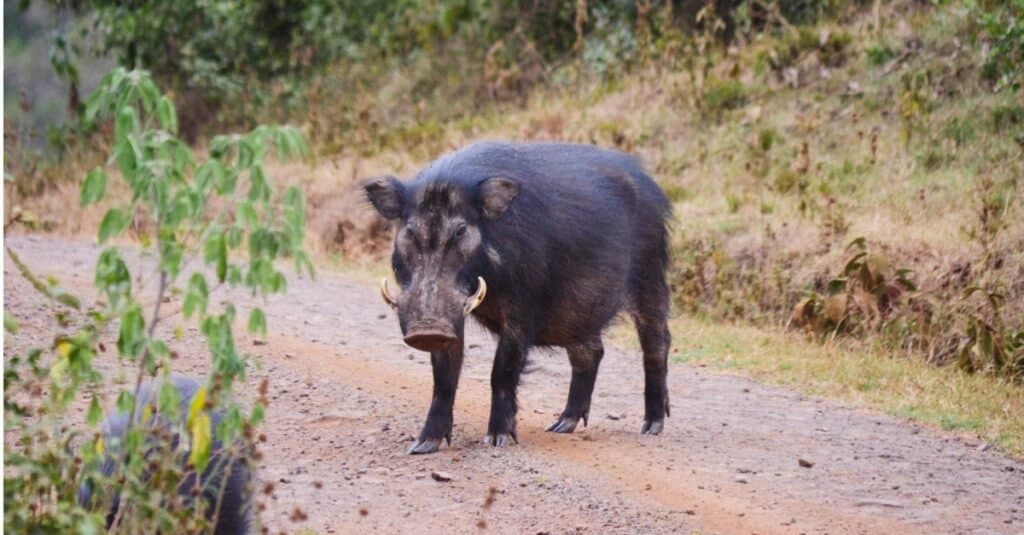
The biggest wild hog ever weighed about 790 pounds.
©iStock.com/chingkai huang
On January 16, 2015, Blaine Garcia and Wyatt Walton in De Leon, Texas, tracked a massive wild hog the size of a grizzly bear. The biggest wild hog ever weighed about 790 pounds. The two Texas men used two bulldogs to help them track the animal and tie its legs. After catching and weighing the big hog, it was sent to a cattle corral—alive.
The two boys own a business, Boar Collector Feral Hog Removal, where they remove feral hogs all over Texas. Although this massive beast made the record, it might not be the largest ever. Some hunters in Texas swear they’ve seen or hunted 1,000-plus-pound hogs, but they have never officially been recorded.
About Wild Hogs
Wild hogs are not to be messed with. Although they are commonly confused for pigs, they are very different. There are also about 16 recognized subspecies, all with their own unique traits.
Size and Description
While there are multiple subspecies of wild hogs, they all have a similar appearance. Most have large bulky bodies with short, thin legs. They also have short trunks and humps in between their shoulder blades. Their necks are so short that it’s almost impossible to move them. They have large heads, making up about a third of their length. The head is large because it acts like a plow and is good for digging.
These massive animals can dig up to 3.1–3.9 inches deep in frozen ground. They also use their strong neck muscles to upturn 88- to 110-pound rocks. Adult male wild hogs also have sharp and long canines that protrude from their mouths.
Wild hogs are heavy and big, but their weight and height depend on their environment and subspecies. For example, wild hogs in arid areas are generally smaller than those in areas with abundant resources. Wild hogs in Europe weigh about 165–220 pounds. They are about 59 inches long and 30-31 inches in shoulder height. Some of the largest, though, are from Northeastern Asia.
They can easily be mistaken for brown bears. They usually weigh about 600 pounds with a shoulder height of 43-46 inches. Some living in Ussuriland and Manchuria surpass 700 pounds and are not preyed upon by wolves.
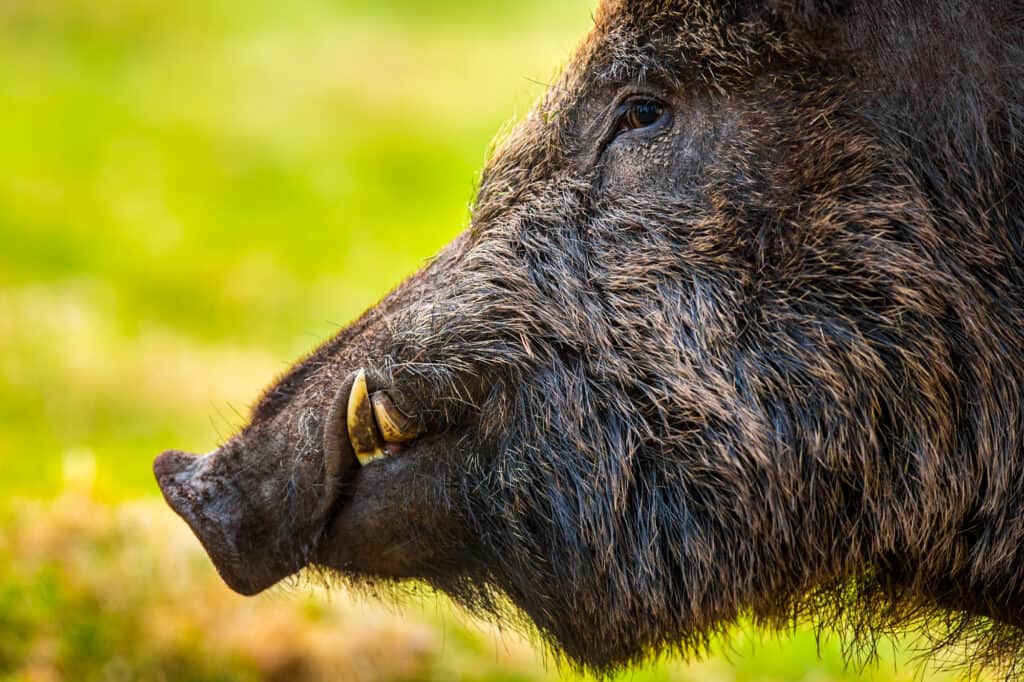
The two main predators of a wild hog are humans and wolves.
©iStock.com/JMrocek
Diet
Wild hogs are a lot like humans. They are highly versatile omnivores and aren’t picky eaters. They eat roots, vegetables, garbage, birds, lizards, insects, nuts, berries, seeds, and leaves. Their diet depends on the season and where they live. They also need a lot of food to survive. For instance, a 110-pound adult wild hog eats about 4,000-4,500 calories of food per day. The calorie amount, however, increases when one is pregnant or during winter. Although not as common, they sometimes hunt small vertebrae like newborn fawns and galliform chicks. Interestingly, the wild boars inhabiting the Volga Delta mainly feast on carp and Caspian roaches.
Predators
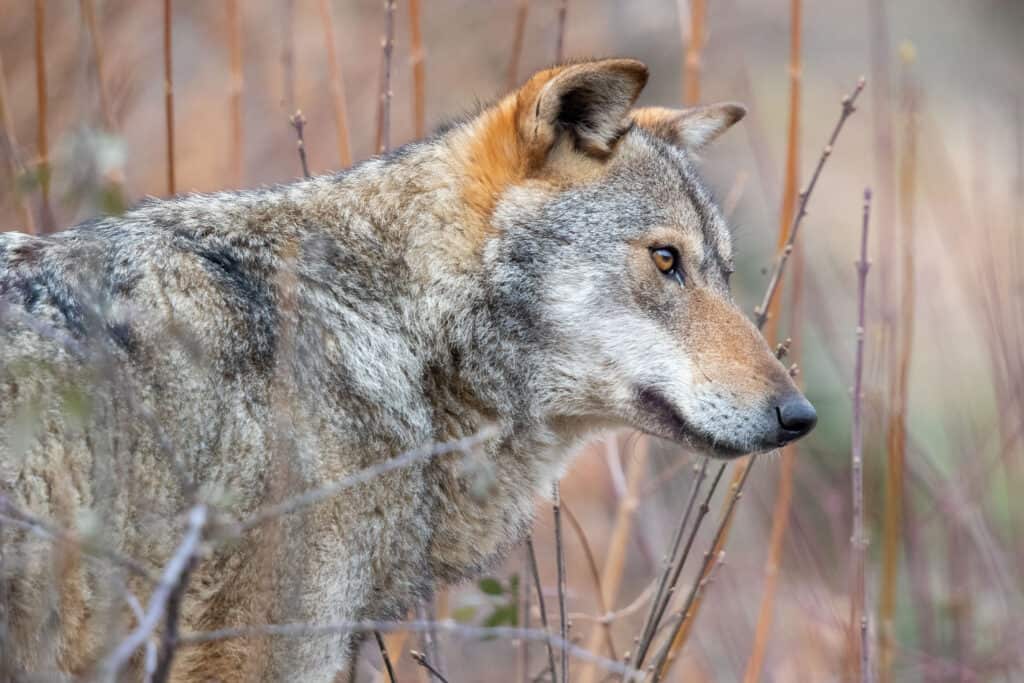
Wolves will kill and eat boars.
©iStock.com/Ciro de Simone
Some species are so large that there aren’t many natural predators. Instead, the two main predators of a wild hog are humans and wolves. It’s more common for a piglet, a young wild hog, to become the next meal for Eurasian lynx, brown bears, snow leopards, yellow-throated martens, and swamp cats. Wild boar in the Caucasus fall easy prey to large leopards. They are most consumed by leopards in Iran’s Sarigol National Park. Tigers also consume wild hogs, especially in the Amur region, where a tiger can kill about 30–34 a year.
Distribution
Although native to much of Eurasia and North Africa, they are found across the Americas and are invasive in most parts of the world. Pure wild hogs were introduced to North America in the 19th century. They are found throughout the United States and South America, including Brazil. Because of their worldwide distribution, they have destroyed many environments and compete with native species for resources. Since they trample and dig frequently, this kills many saplings. Their bodies also host about 20 different parasitic worm species. Some of these parasites can also infect humans.