
There are around 350 species of parrots in the world today. Most live in the tropical and subtropical regions of Australia, Africa, and Central and South America. Parrots have long been kept as pets and are as famous for their exceptionally bright and stunning colors as they are for their talking abilities. Read on to discover the most beautiful parrots in the world and where they’re found.
10. Dusky Lory
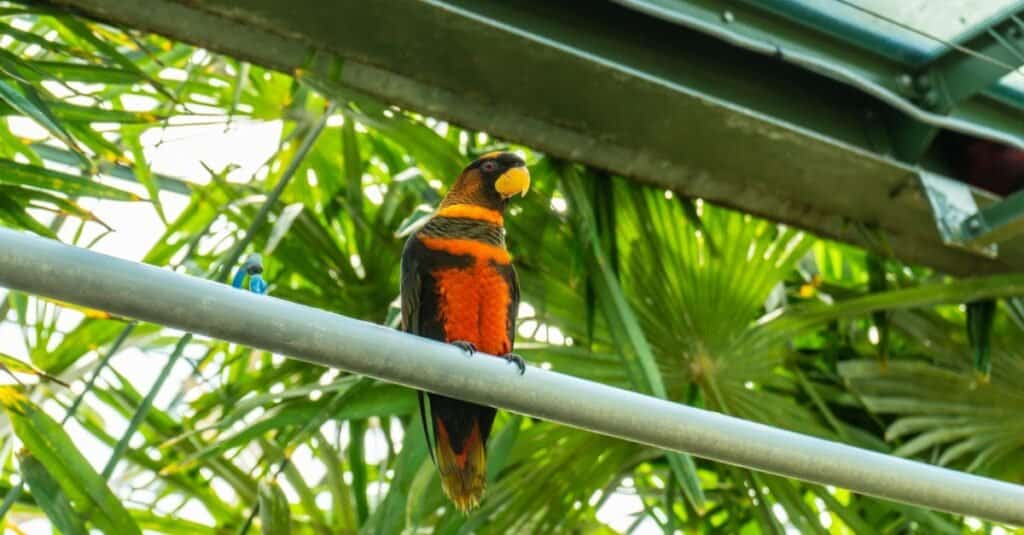
The dusky lory may travel up to 30 miles a day in search of food.
©iStock.com/Powerofflowers
Dusky lories are stunning parrots with brown, orange, and white plumage and an orange beak. They are native to New Guinea but are also found on the nearby islands of Salawati and Yapen. Their primary habitat is tropical and subtropical lowland and mangrove forests.
They eat a mixture of fruit, seeds, nectar, and buds and have a specialized tongue that allows them to feed on nectar. Their tongues have tiny structures like hairs on the end of it that stand on end so that the nectar can be soaked up. Incredibly, dusky lories often travel around 30 miles per day while searching for food.
9. Blue And Gold Macaw
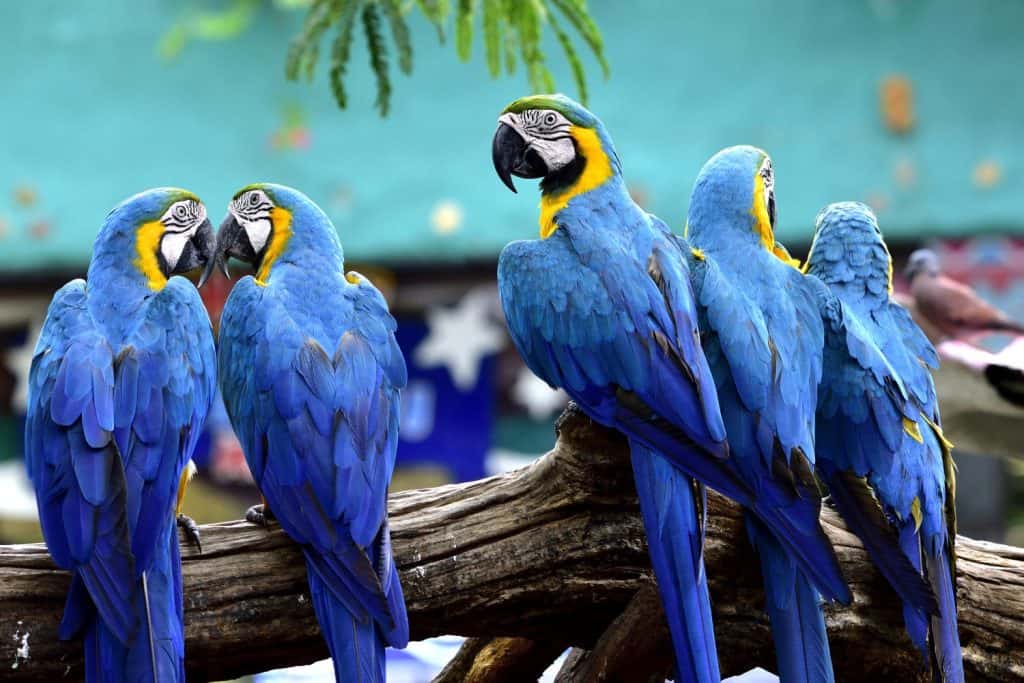
Blue and gold macaws typically bond for life.
©Super Prin/Shutterstock.com
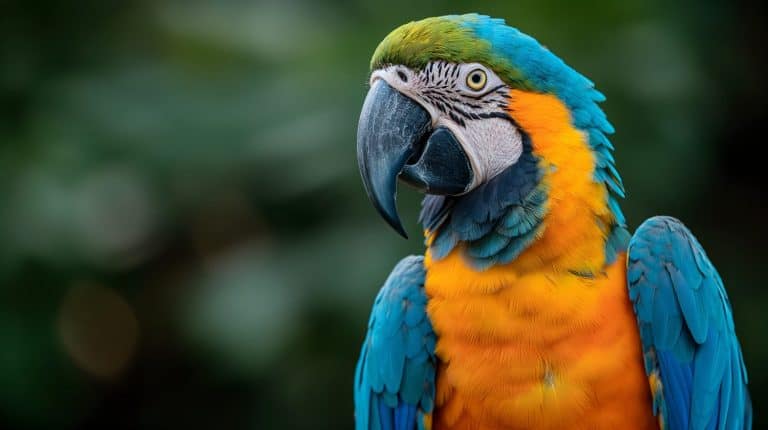
One of the most popular species of parrot is the blue and gold macaw. Blue and gold macaws are easily recognizable by their brilliant blue upper bodies and tail feathers. They also have yellow lower bodies and legs and a green forehead.
Blue and gold macaws are native to the forests and woodlands of Central and South America. They bond for life, and although they are usually seen in large flocks, bonded pairs stick close together. Blue and gold macaws have inquisitive natures and are known for being able to mimic humans extremely well.
8. Hyacinth Macaw
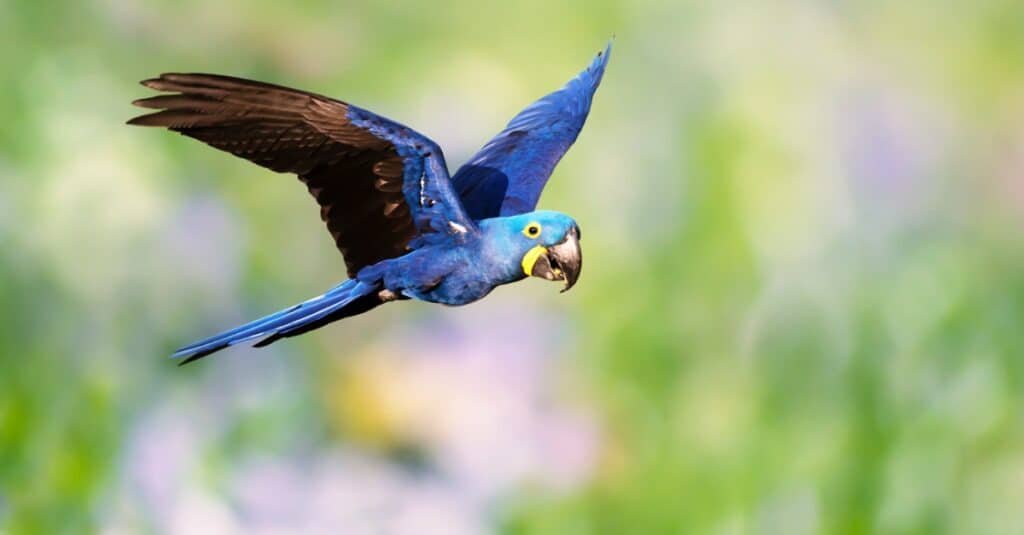
The hyacinth macaw is the longest parrot in the world.
©iStock.com/Dgwildlife
Hyacinth macaws have rich, royal blue plumage with vibrant yellow eye rings and chins. These birds also have a long, pointed tail. They are found in southern Brazil and western Bolivia. They prefer palm swamps and open woodland habitats, although they usually avoid dense and humid forest regions.
Unfortunately, hyacinth macaws are classed as a vulnerable species due to habitat loss and capture for the pet trade. They are the longest parrots in the world with a length of over three feet. Hyacinth macaws are known for having calm temperaments and are often called the gentle giants of the parrot world.
7. Grand Eclectus
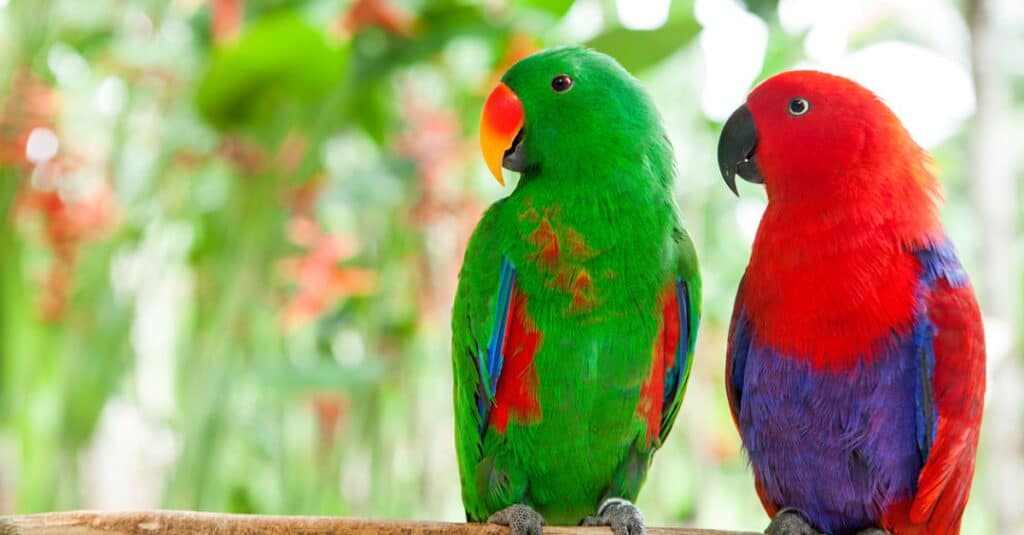
Male and female grand eclectus parrots look completely different.
©iStock.com/redchanka
The grand eclectus is native to Australia, the Solomon Islands, Sumba, New Guinea, and the Maluku Islands, where they favor tropical rainforests. They are particularly unusual because the male and female are completely different colors. For a long time, people thought that they were two different species. Males are bright green with red under their wings and on the sides of their bodies, while females are mostly a rich red with purple across their backs, abdomens, and undersides of their wings.
Grand eclectus parrots make their nests in hollows in large trees. During the breeding season, females spend extended periods in the nest and fiercely defend it against other parrots. They rely on the male to bring them food while incubating eggs and raising chicks.
6. Scarlet Macaw
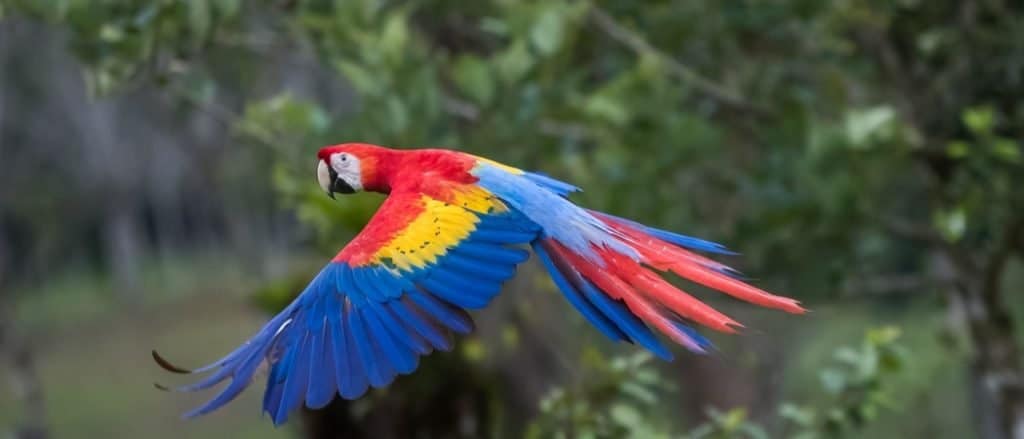
Scarlet macaws are the national bird of Honduras.
©Jeff Schultes/Shutterstock.com
Native to Central and South America, the scarlet macaw is a stunning bird and a popular pet. They prefer humid evergreen forests and are the national bird of Honduras. Scarlet macaws are large parrots with red, yellow, and blue plumage. They are around 32 inches long, but more than half of their length is due to their long tails.
Scarlet macaws use incredibly loud squawks and screeches to communicate. These calls are intended to reach other members of their group over a distance of several miles. Scarlet macaws mate for life and can be extremely aggressive during the breeding season.
5. Green-Winged Macaw
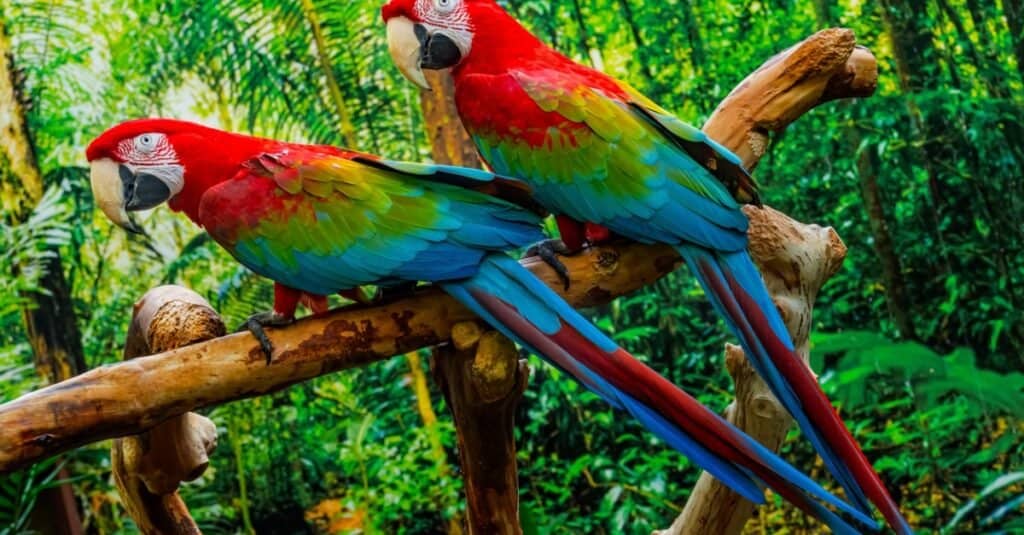
The second largest species of parrot is the green-winged macaw.
©iStock.com/bpperry
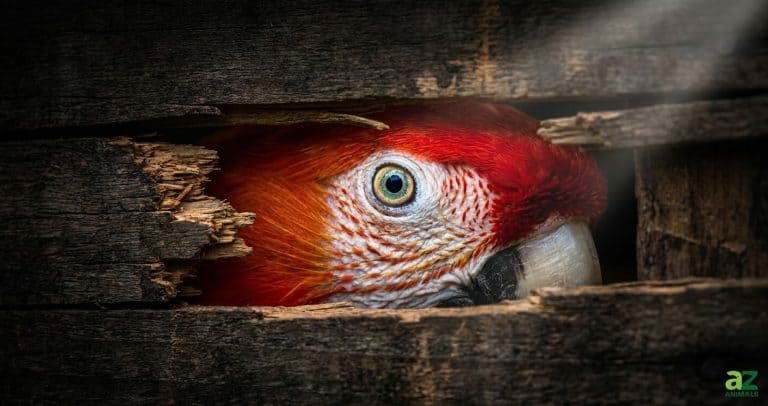
Green-winged macaws are recognized by their appearance. They are mostly red across their head and body and have vibrant green and blue wings and tail feathers. Green-winged macaws are the second-largest species of parrot, with a length of around 37 inches.
They are widespread throughout South America and prefer tropical rainforests and savannas. Green-winged macaws lay three eggs that take 28 days to hatch. The young parrots are fully fledged after 100 days. These parrots also have an incredibly long lifespan, with some sources noting they can live up to 80 years.
4. Blue-Fronted Amazon
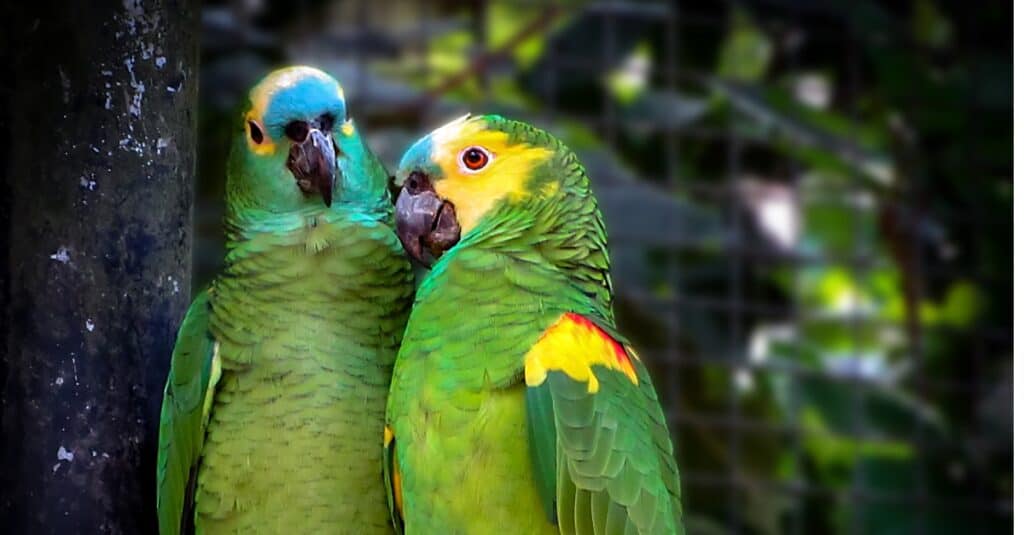
Blue-fronted Amazons prefer to nest in tree cavities.
©iStock.com/Lucas Pacheco
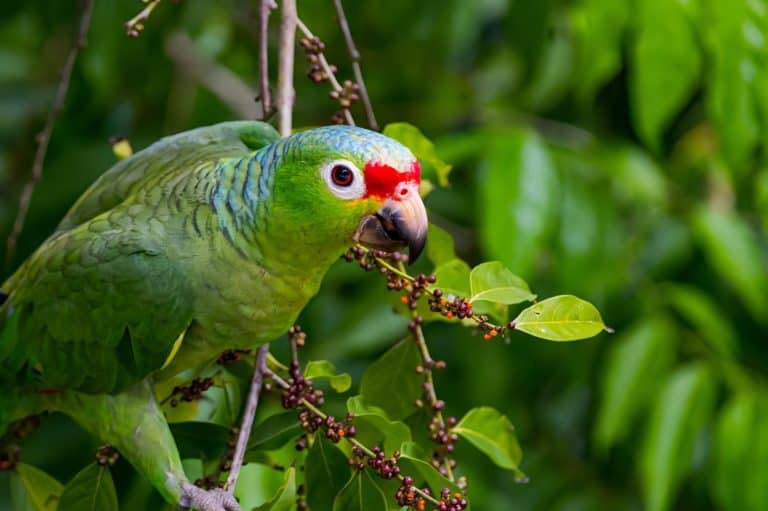
Also known as turquoise-fronted Amazons, these parrots are found across Argentina, Bolivia, Brazil, and Paraguay. Blue-fronted Amazons are named for the light blue feathers on their foreheads. The rest of their bodies are green, and they have yellow around their eyes.
Blue-fronted Amazons prefer tropical and subtropical forests where they nest in tree cavities. Females lay between three and five eggs, and chicks leave the nest approximately 60 days after hatching. Blue-fronted Amazons are particularly noisy birds, known for their loud screeches. However, they do have some ability to mimic speech.
3. Sun Conure
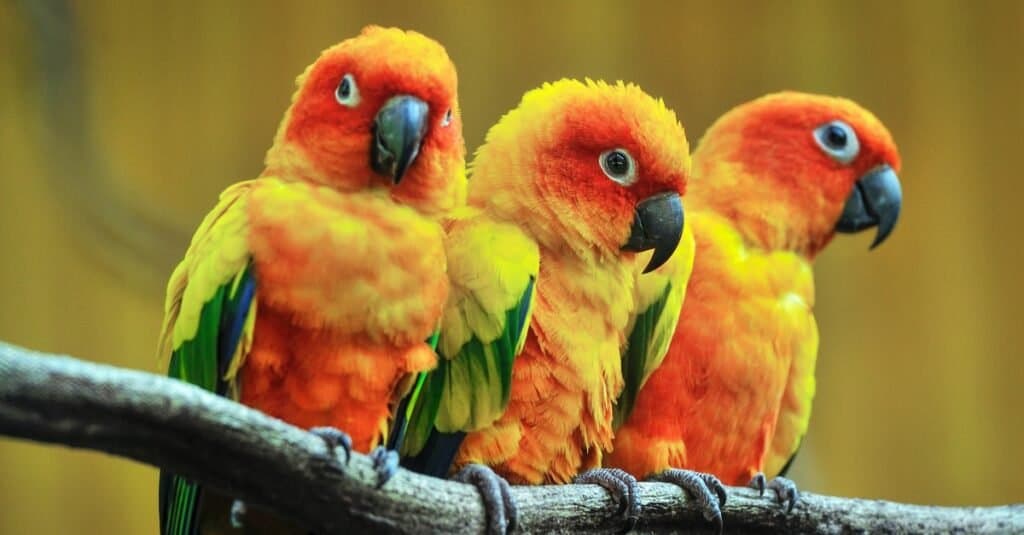
Sun conures are known to be very social birds.
©Yatra/Shutterstock.com
As one of the most vibrantly colored parrots around, sun conures are easily recognized by their stunning yellow-orange bodies and green wings and tails. Sun conures are native to specific regions of South America. They are predominantly found in northern Brazil, southern Guyana, southern Suriname, and southern French Guiana, where they prefer a tropical habitat.
These parrots are extremely social and are often seen in large flocks of up to 30 birds. Sun conures usually remain with their flock at all times and are very fast flyers. They often cover many miles in a day while searching for food, and they are extremely vocal when flying. Unfortunately, they are an endangered species due to habitat loss, and many of them have been captured for the pet trade.
2. Crimson Rosella
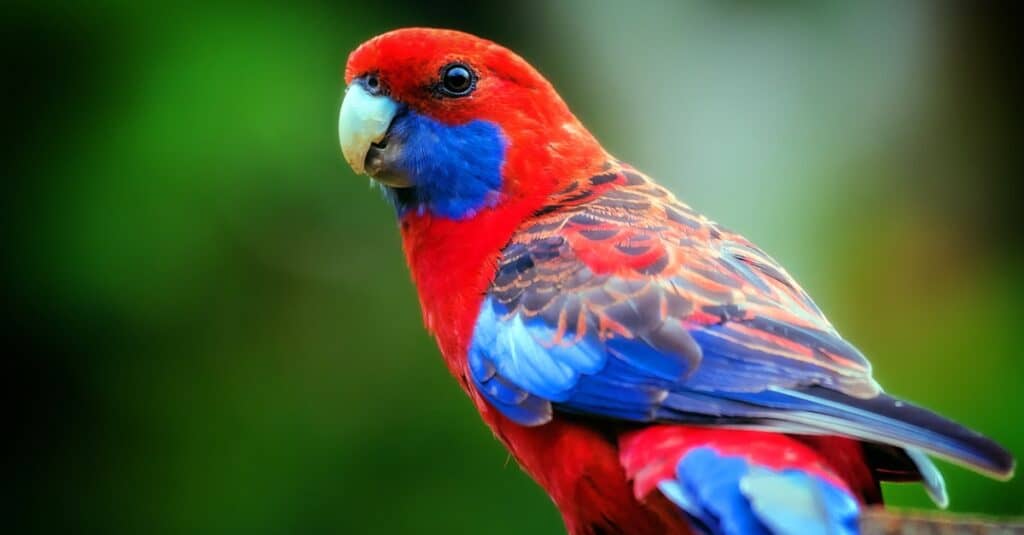
Crimson rosella parents share in feeding their offspring.
©iStock.com/tracielouise
The crimson rosella is native to Australia and is an introduced species in New Zealand and on Norfolk Island. They are medium-sized parrots with extremely long tails. Crimson rosellas have striking red bodies with purple-blue wings and tail feathers. They are mainly found in coastal and mountain forests and woodlands, where they usually prefer wetter forest areas.
Although crimson rosellas roost on some of the highest tree branches during the night, they forage in trees, bushes, and on the ground during the day. Crimson rosellas nest in hollows of tree trunks. For the first six days of their lives, only the female feeds the chicks. However, after the first week, both parents share the feeding duties.
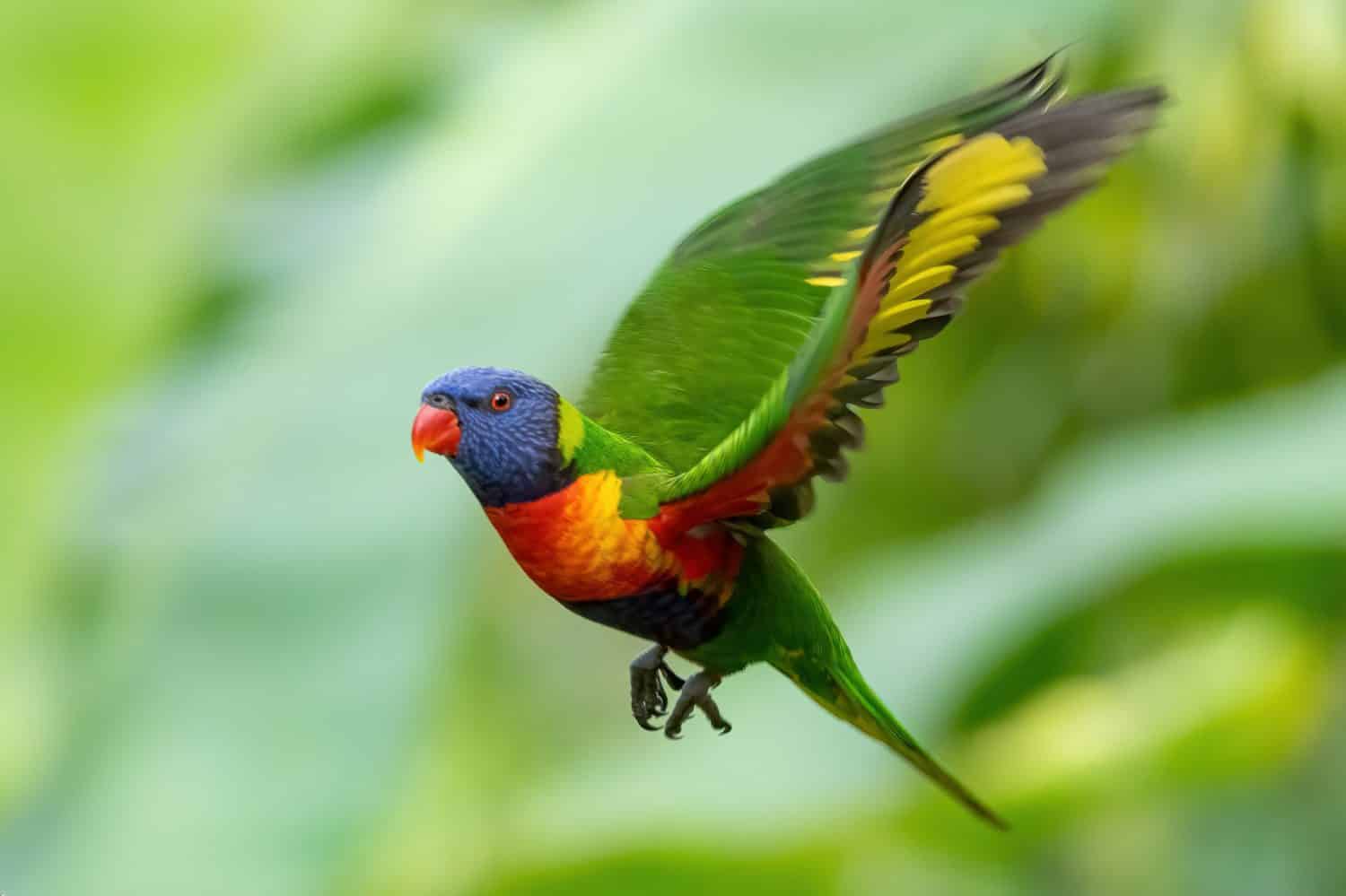
1. Rainbow Lorikeet
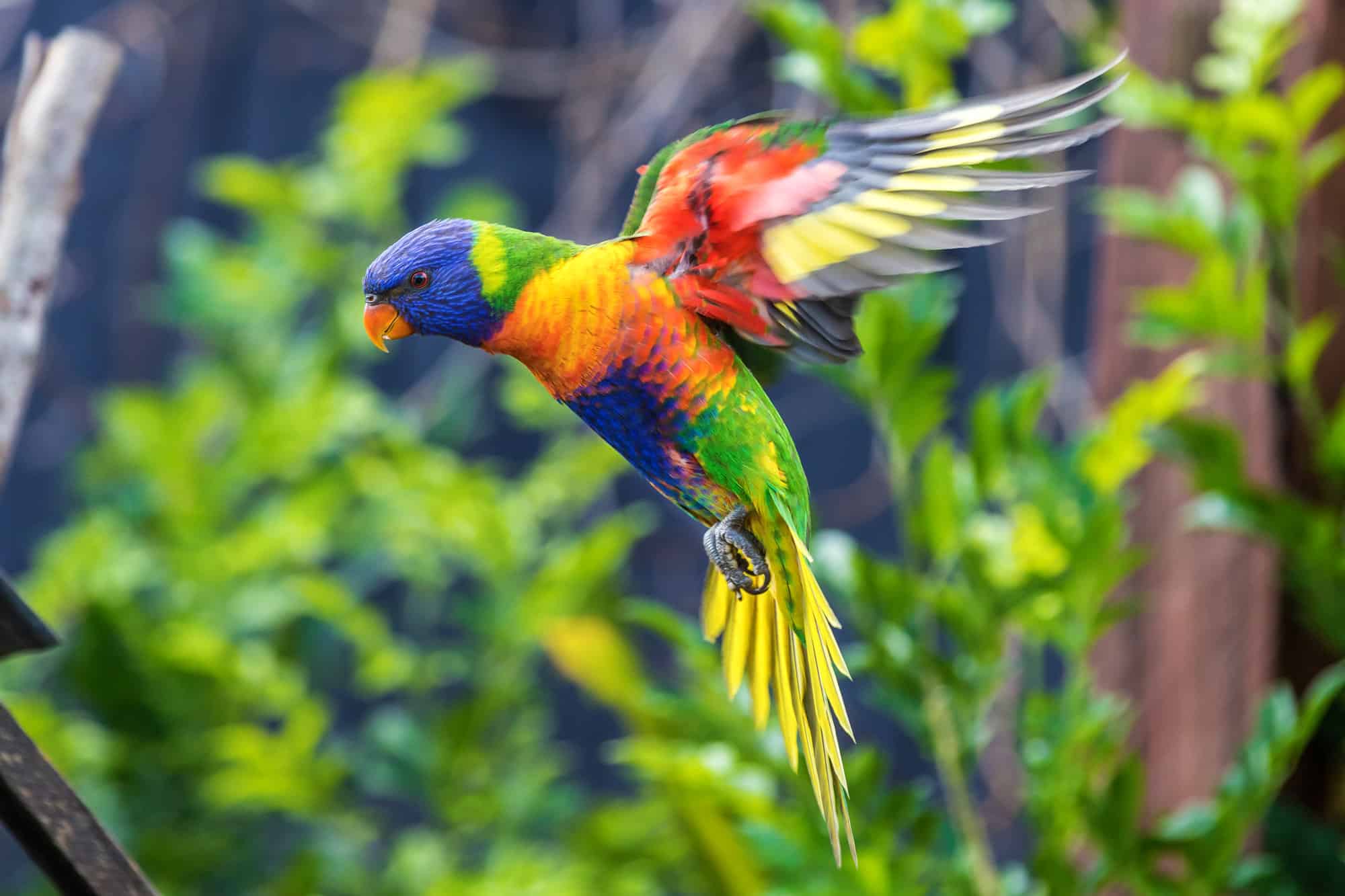
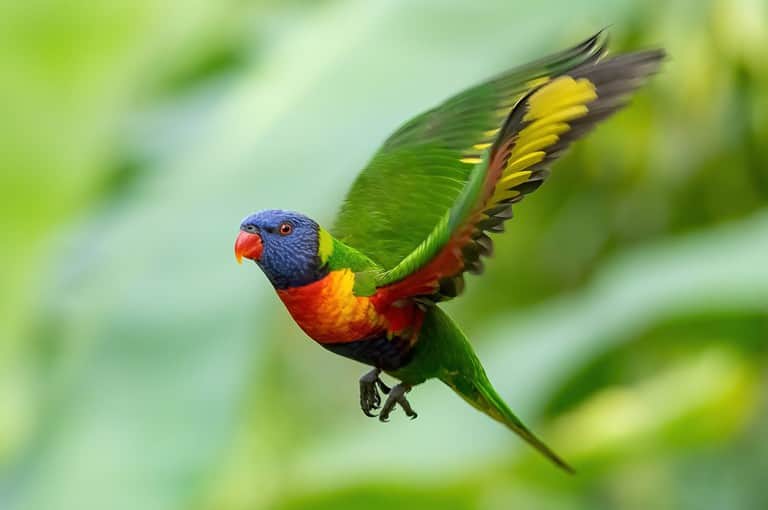
Rainbow lorikeets have stunning plumage.
©Guillem Lopez Borras/Shutterstock.com
Easily one of the most beautiful parrots in the world, the rainbow lorikeet has stunning green, orange, and blue feathers. It is easy to see where they get their name. Rainbow lorikeets are native to Australia. However, they are an introduced species in Tasmania, New Zealand, and Hong Kong, where they live in rainforests and coastal woodlands.
They usually live and travel in pairs. They are known for fiercely defending their nesting and feeding areas against all other birds. Rainbow lorikeets nest in hollows in eucalyptus and palm trees, and only the female incubates the eggs.