Quick Take
- One bird species has completely lost the ability to build nests or raise its own young, and it is thriving because of it. Meet the cowbird →
- Some brood parasites don't just sneak eggs into nests. They also come back to punish hosts who reject them. See the cuckoo's tactics →
- One parasitic chick is born with a built-in weapon specifically designed to eliminate the competition. Discover the honeyguide chick →
- Not all brood parasites are ruthless. One species leaves the host's nest so peacefully that no harm is done to anyone. Explore the peaceful parasite →
Many bird species lovingly care for their eggs and go to great lengths to protect them. Females may sit on a nest for weeks, while males work to protect the nest and search for food. However, several bird species take a different approach. Instead of brooding their own eggs, these birds rely on other birds to hatch and raise their young. Known as brood parasites, these birds that lay eggs in other birds’ nests employ numerous tactics. Some will rely on deception to trick other birds into raising their young, while others bully birds into caring for their eggs. In fact, some will go so far as to destroy the host bird’s eggs. While rare, such behavior is well documented. Continue reading to learn about five brood parasites.
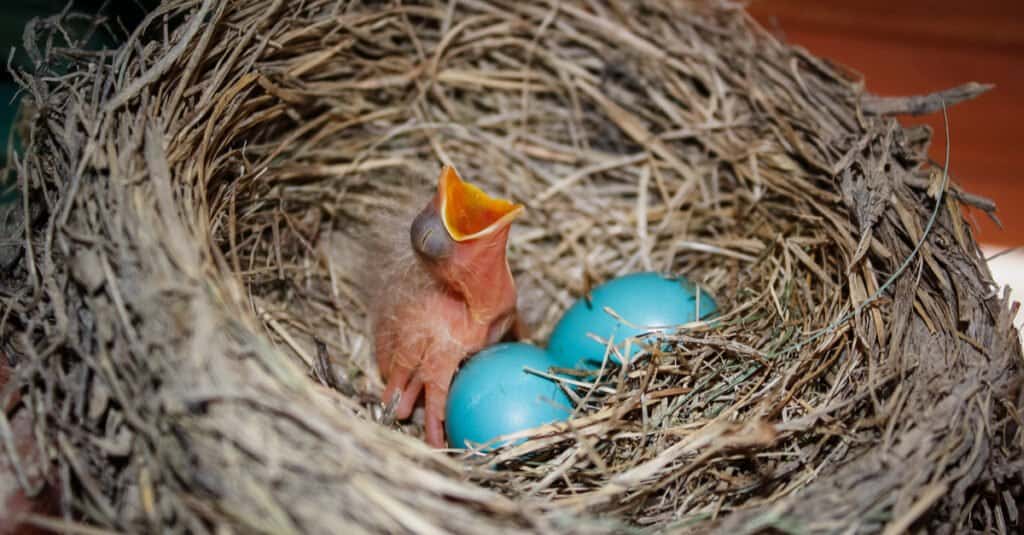
Robins are excellent mothers who are targeted by brood parasites.
©Melinda Amburgy/Shutterstock.com
Brown-headed Cowbird
The brown-headed cowbird (Molothrus ater) is a small brood parasite native to North America. It is a member of the Icteridae family of New World blackbirds.

Brown-headed cowbirds have wingspans of up to 14 inches.
©iStock.com/BrianEKushner
Brown-headed cowbirds lay their eggs in the nests of other small birds such as American robins, yellow warblers, sparrows, and eastern phoebes. While most brood parasites target one or a few species, brown-headed cowbirds take a more general approach. According to field research, they target the nests of approximately 220 host species, making them one of the most prolific brood-parasitic species worldwide.
When the host bird is away from its nest, the female brown-headed cowbird will sneak in to lay her eggs. If the host bird rejects the cowbird eggs, the brown-headed cowbird female may destroy the host’s eggs in retaliation. Those hosts that do not notice the cowbird’s egg will unwittingly hatch and feed the cowbird’s offspring. Because cowbird offspring incubate quickly, they often hatch before the host’s eggs. They also grow quite quickly, which gives them an advantage over the host’s hatchlings in securing food. This can often lead to the host’s hatchlings dying of starvation. However, some species such as the brown thrasher, grey catbird, and yellow warbler almost always reject the eggs or expel the cowbird hatchlings. The brown-headed cowbird hatchlings that do survive grow to recognize the calls of other cowbirds. This allows them to return to cowbird flocks once they leave the host’s nest.
Indigobird
Indigobird refers to an entire genus of small, brood-parasitic African birds. All species in the genus Vidua, a group of indigobirds and whydahs, are obligate brood parasites. These birds completely lack the ability to build nests, incubate eggs, or raise their own young.

Indigobirds vary significantly in size.
©iStock.com/Alfie Curling
Indigobirds are similar in appearance to finches, although they sport black or indigo coloring in their plumage. Indigobirds lay their eggs in the nests of estrildid finches, particularly firefinches and related species.
Unlike some parasitic birds, indigobirds do not destroy their host’s eggs. Instead, females simply add their eggs to their host’s clutch. Since the eggs of indigobirds and finches are very similar, the host birds can rarely tell which eggs belong to which species. Indigobird eggs are slightly larger, but not significantly so.
Honeyguide
Honeyguides belong to the Indicatoridae family of birds, comprising roughly 16 species across four genera. Most honeyguides are native to Africa, although a couple of species are found in Asia.
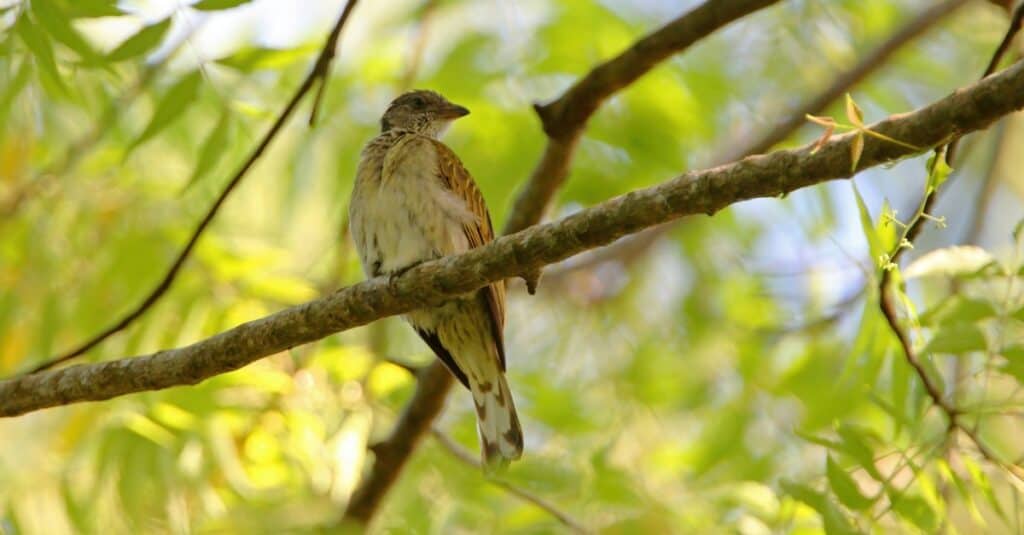
Honeyguide species are different sizes.
©iStock.com/neil bowman
Approximately half of all honeyguide species are brood parasites. They specifically target birds such as warblers, swallows, bee-eaters, barbets, and starlings.
In the eight parasitic species, the female honeyguide lays a single egg in multiple nests. By doing so, she spreads out the risk to multiple hosts and ensures more of her eggs will survive. At times, female honeyguides may destroy the host’s eggs before laying their own egg.
Female honeyguides retain the fully formed egg inside their oviduct for an extra 24 hours before laying it. They do this so that their offspring will hatch before the host’s eggs. The bigger honeyguide chick will then either destroy the host’s eggs or kill the host’s hatchlings after those eggs hatch. It does this using a sharp hook on its beak to stab the host’s young.
Black-headed Duck
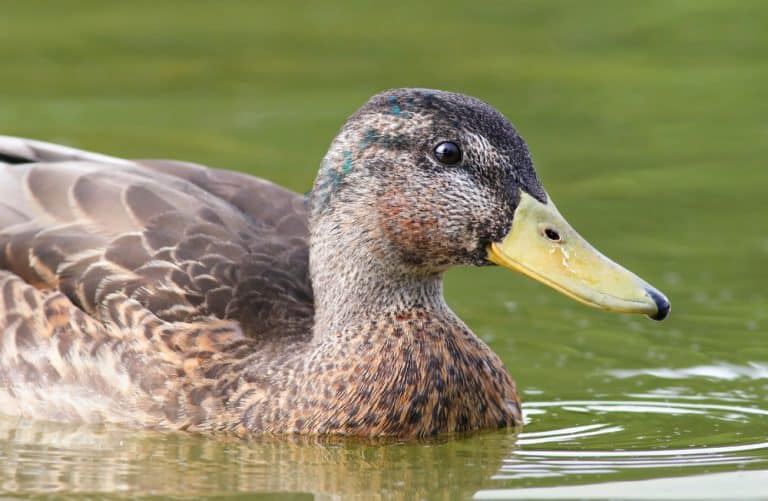
The black-headed duck (Heteronetta atricapilla) is found in the swamps and lakes of Chile, Paraguay, Uruguay, Argentina, and Brazil. Unlike the closely related stiff-tailed duck, black-headed ducks have a soft tail and a flat bill. The species gets its name from the male, which grows black feathers on its head and mantle. Although relatively small and plain-looking, black-headed duck females are surprisingly bold. Rather than building a nest, they lay their eggs in the nests of other birds. They target pochards, coots, and other ducks, although they will also occasionally use the nests of gulls and some raptors.

Black-headed ducks have an average wingspan of 20 to 24 inches.
©iStock.com/hstiver
Unlike some brood parasites, black-headed duck females are not aggressive toward their hosts. Instead, they simply allow their eggs to peacefully incubate with the host’s eggs. Moreover, black-headed duck offspring do not prey on the host’s hatchlings. By the time they hatch, black-headed duck young can mostly fend for themselves. Since they leave the host’s nest soon after hatching, there is no need for them to kill the host’s offspring to improve their own chances of survival.
Common Cuckoo
The common cuckoo (Cuculus canorus) is easily one of the better-known and most studied brood parasitic bird species. It belongs to the cuckoo family, which includes roadrunners, coucals, koels, couas, malkohas, and anis. Common cuckoos are found in Asia and Europe and migrate to Sub-Saharan Africa and South Asia for the winter. Their name comes from the distinctive onomatopoeic calls made by the males.
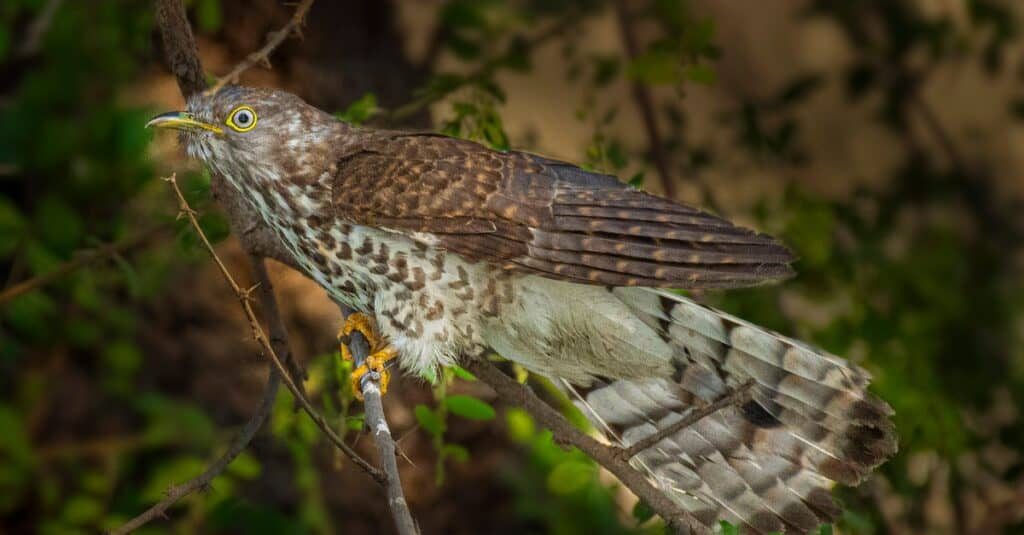
The average wingspan of the common cuckoo is 22 to 24 inches.
©iStock.com/Rajukhan Pathan
Male cuckoos are typically entirely grey, while females may be grey with pink highlights or reddish-brown. With their hawkish appearance, common cuckoos rely on mimicry to help them target the nests of host birds. By mimicking a predator such as the European sparrowhawk, females gain access to a host’s nest to lay their eggs. Using this tactic, they invade the nests of over 100 different host species, including warblers, redstarts, pipits, robins, and dunnocks.
During the breeding season, a female cuckoo may lay eggs in dozens of different nests. Sometimes a female common cuckoo will target hosts whose eggs appear similar to her own. This increases the chances that the host bird will not reject the cuckoo’s eggs or abandon the nest. Once cuckoo offspring hatch, they will typically push the host’s eggs out of the nest. If the host’s eggs hatch first, cuckoo chicks will similarly push the host’s young out of the nest. By eliminating the competition, the cuckoo chick ensures it receives all the food it needs to grow.