Quick Take
- Blue birds don't actually have any blue pigment. Their color is an optical trick your eyes fall for every time.
- One of Ohio's blue birds shows up on every continent on Earth, including Antarctica. Can you guess which one? Meet the worldwide traveler →
- Some of these blue birds pull a seasonal disappearing act, swapping their vivid plumage for brown camouflage when it suits them. See the seasonal color shift →
- One species on this list has a trick for raiding bird feeders that involves perfectly faking another bird's call. Discover the feeder raider →
Birds that look blue do not have any blue pigment in their feathers. Instead, their vibrant color is an optical illusion created by tiny structures inside the feathers, made of air pockets and a protein called keratin, that scatter light. When sunlight hits these microscopic layers, red and yellow wavelengths pass through to be absorbed by a dark layer of brown melanin underneath, while only the blue light waves are reflected, making the birds appear blue. Female birds look less vibrant because their feathers are adapted to scatter less light, a camouflage adaptation that keeps them safely hidden from predators while nesting. Ohio is home to over 400 resident, breeding, and migratory bird species, a handful of which are blue. Continue reading to learn about 8 blue birds in Ohio.
Eastern Bluebird
The Eastern bluebird (Sialia sialis) is a small thrush native to North America. These petite birds measure 6.3 to 8.3 inches long, with a wingspan of 9.8 to 12.6 inches. Male Eastern bluebirds have cobalt heads, backs, wings, and tails, which contrast beautifully with their white undersides and brownish-red breasts. These birds make soft warbles and low-pitched, melodious songs.
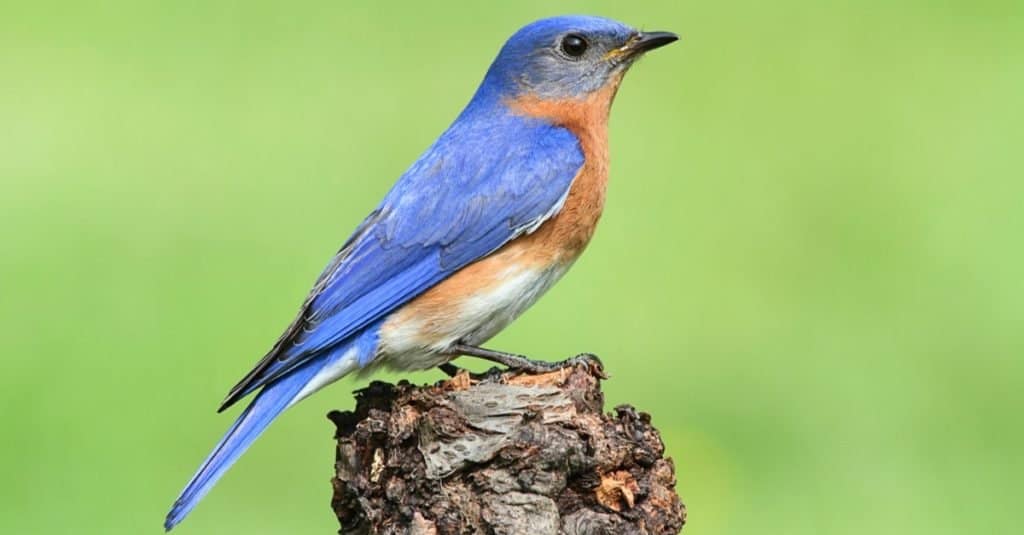
Eastern bluebirds inhabit the eastern half of the United States, with patchy distributions in Mexico and Central America.
©Steve Byland/Shutterstock.com
Eastern bluebirds inhabit the eastern half of the United States, with their range extending through much of central Mexico and south into Central America, including Guatemala, El Salvador, Honduras, and Nicaragua. They can be found in open country near trees. Their preferred habitats include pine savannas, pastures, agricultural fields, parks, and backyards.
Eastern bluebirds perch on wires and fence posts near open fields. They also fly low to the ground with fast, irregular wingbeats.
Barn Swallow
Barn swallows (Hirundo rustica) are the most widespread swallow species in the world, occurring on all continents and boasting one of the most extensive natural distributions of any swallow.

Among the most widely distributed birds globally, barn swallows are between 5.9 and 7.5 inches long with a wingspan of 11.4 to 12.6 inches.
©Kunal Chakravertti/ via Getty Images
Barn swallows occur on all continents, including as vagrants even in Antarctica, and you can find them in most areas except deserts and the coldest regions in the north. They have wide-ranging habitats, but you can primarily find them foraging in parks, agricultural fields, beaches, and over open water, like ponds and lakes.
Barn swallows have shimmering steel-blue heads and upperparts, white undersides, and rufous foreheads, chins, and throats. They also have a deeply forked tail with a row of white spots.
These birds spend much of their time in the air, flying with smooth wingbeats low to the ground or skimming the water’s surface. Barn swallows catch insects in mid-air but also occasionally forage by plucking prey from the ground.
Blue Jay
The blue jay (Cyanocitta cristata) is a large songbird native to North America. It measures between 9.8 and 11.8 inches long with wingspans of 13.4 to 16.9 inches. Blue jays have a pronounced crest typically flattened against the head, rising when the bird is excited or aggressive. Their plumage is a mix of medium blue to pale baby blue, and their undersides and faces are white with black markings.
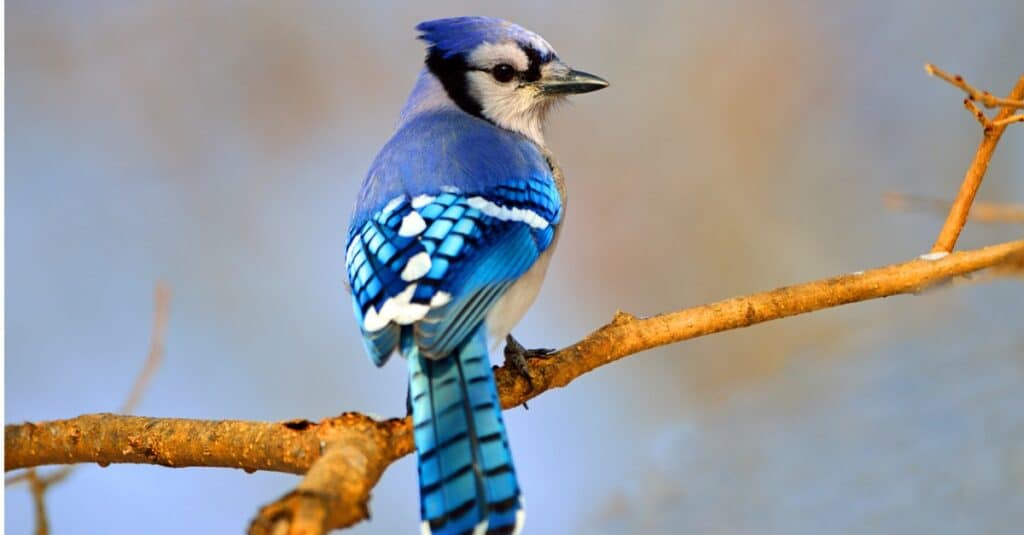
Blue jays can perfectly imitate the calls of hawks, especially the red-shouldered hawk. They do this to warn other jays of danger or to trick other birds into fleeing a bird feeder so they can have it all to themselves.
©iStock.com/BrianEKushner
Blue jays live year-round in the eastern half of Canada and the United States, with some populations dispersing to the Northwest during nonbreeding seasons. They live in forests, especially near oak trees. You can also find them in urban and suburban areas at bird feeders. These birds flock to backyard feeders stocked with peanuts, sunflower seeds, and suet.
Belted Kingfisher
Belted kingfishers (Megaceryle alcyon) are large water kingfishers native to North America. These stocky birds measure between 11 and 14 inches long, with wingspans of 19 to 23 inches. Belted kingfishers have a shaggy crest and a large head. Adults are a subtle greyish blue on their heads, backs, and wings. They have white undersides and white collars around their necks.

Kingfishers are a subtle greyish blue on their heads, backs, and wings.
©Harry Collins Photography/Shutterstock.com
Belted kingfishers live throughout most of Canada, the United States, Mexico, and Central America. You can also find them in the northern tip of South America. Their preferred habitats include streams, rivers, lakes, ponds, and estuaries. Belted kingfishers nest on the banks near the water and fish from nearby perches. In the winter, you can also find them in swamps, mangroves, and brackish lagoons. Belted kingfishers occasionally make their way into backyards that contain fish ponds.
Indigo Bunting
The indigo bunting (Passerina cyanea) is a small bird from the cardinal family native to North and South America. Indigo buntings average between 4.5 and 5 inches in length, with wingspans of 7.5 to 8.7 inches. Males are bright indigo in the summer and brown during winter, while females are brown year-round. They make sharp chirps and high-pitched buzzy calls while in flight or when threatened.

Males are bright indigo in the summer and brown during winter, while females are brown year-round.
©Bonnie Taylor Barry/Shutterstock.com
Indigo buntings breed in the Eastern United States and winter in Central America, the West Indies, and the northern tip of South America. Their preferred habitats include open deciduous woods, farmlands, and forest edges. Indigo buntings forage for insects, seeds, and berries on the ground or in shrubs and trees. Their summer diet consists of insects, while they primarily eat seeds in winter.
Black-throated Blue Warbler
Black-throated blue warblers (Setophaga caerulescens) are small passerines native to North America. They measure 5 inches in length with 7-inch wingspans. As their name suggests, adult males have black throats, faces, and flanks. Their upper plumage is a deep ocean or midnight blue, while their undersides are white. Females are olive brown above and yellow below.

Their upper plumage is a deep ocean or midnight blue.
©iStock.com/BrianLasenby
Black-throated blue warblers breed in Southeastern Canada and the Northeastern United States and overwinter in Southern Florida, the West Indies, and Central America. They live in mature forests in temperate climates, inhabiting the thick understory. In their breeding grounds, you can find them in mountainous regions. During the winter, they inhabit tropical woodlands. Look for them in low vegetation foraging for invertebrates, seeds, berries, and fruits.
Blue Grosbeak
Blue grosbeaks (Passerina caerulea) are medium-sized songbirds from the cardinal family. Their length varies between 5 and 7 inches, with an average wingspan of 10 to 12 inches. Male blue grosbeaks are vivid blue with brown and black on their wings, while females are brown with black on their wings and tails.

You will often find blue grosbeaks near the edge of an open area.
©Bonnie Taylor Barry/Shutterstock.com
Blue grosbeaks breed in the Southern United States and Mexico and winter in Central America, although some populations in warm habitats are non-migratory. Blue grosbeaks inhabit woodlands, scrub, overgrown fields, and thickets. They forage on the ground, searching for insects, snails, spiders, seeds, and fruits.
Cerulean Warbler
Cerulean warblers (Setophaga cerulea) are small songbirds in North and South America. They average 4 inches long with 8-inch wingspans. Males are larger than females and have white bellies, dark bills, and white breast bands.
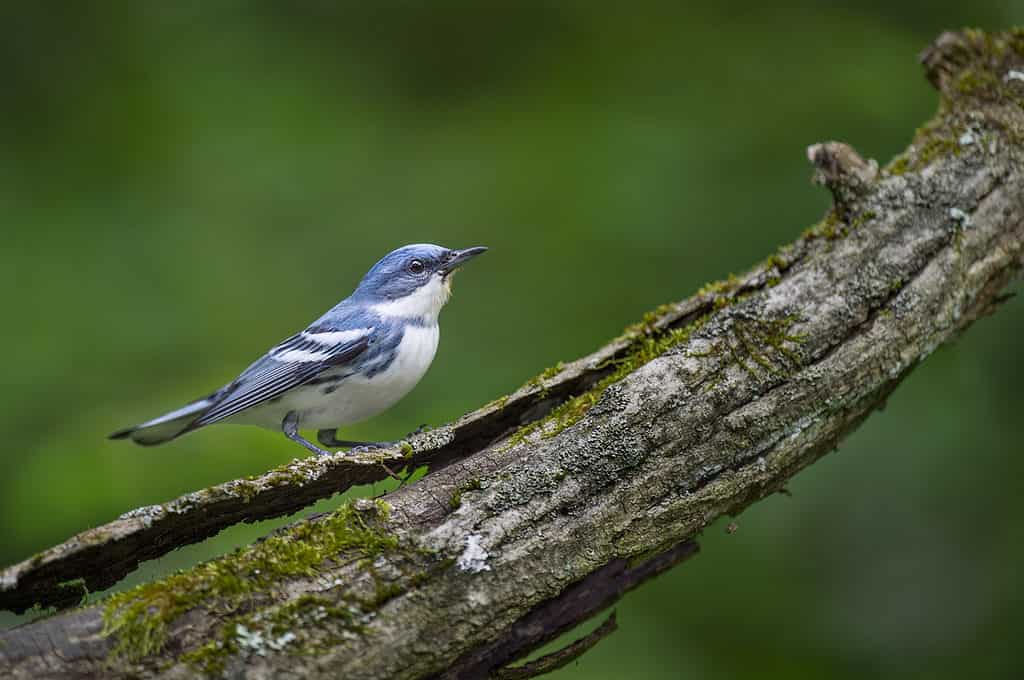
Aptly named, the cerulean warbler’s top feathers are an electric cerulean blue!
©iStock.com/ps50ace
Cerulean warblers breed in the Northeastern United States before migrating through the Central US and Central America to overwinter in South America. They live on large tracts of land in mature deciduous forests. In their winter habitats, you can find them in woodlands, evergreen forests, and on coffee plantations.