Quick Take
- Red birds are actually unable to make their own red color. They rely on a chemical trick that starts with an entirely different hue. See the color chemistry →
- One Texas red bird owes its presence on the East Coast to a federal crackdown and a hasty decision by New York City pet shop owners. Read the East Coast origin story →
- Some of these red birds live in Texas year-round yet are nearly impossible to find, so knowing where to look makes all the difference. Find this elusive Texas bird →
- The most strikingly colored red bird in Texas feeds on prey most songbirds would never dare approach. Meet the bee-eating tanager →
Texas has between 629 and 672 total bird species. Approximately half of these species are migratory, while the remainder are year-round residents, seasonal visitors, or breeding inhabitants. Bird colors result from a mix of structural properties that reflect light to create blues and iridescent greens, and pigments like melanin and carotenoids.
Although they are quite noticeable, birds with predominantly red plumage are actually quite rare and found in very few of the world’s 10,000 bird species. Birds like the Northern Cardinal and Scarlet Tanager cannot produce red pigments from scratch; they must ingest yellow carotenoids found in foods such as seeds, berries, and fruits, which their bodies then enzymatically convert into vibrant red ketocarotenoids. Because these bright colors serve primarily as a mating signal, striking red plumage is usually a trait of male birds, while females exhibit muted, camouflaged shades of brown or yellow to stay safe while nesting. Continue reading to learn about red birds found in Texas.
Northern Cardinal
Northern cardinals (Cardinalis cardinalis) are well-loved across the US and easily identifiable. This bird has a red body, head, and tail, with black around its beak. Only males sport the famous red plumage; the females are a rusty color with splashes of red on their wings, tail, and crown.
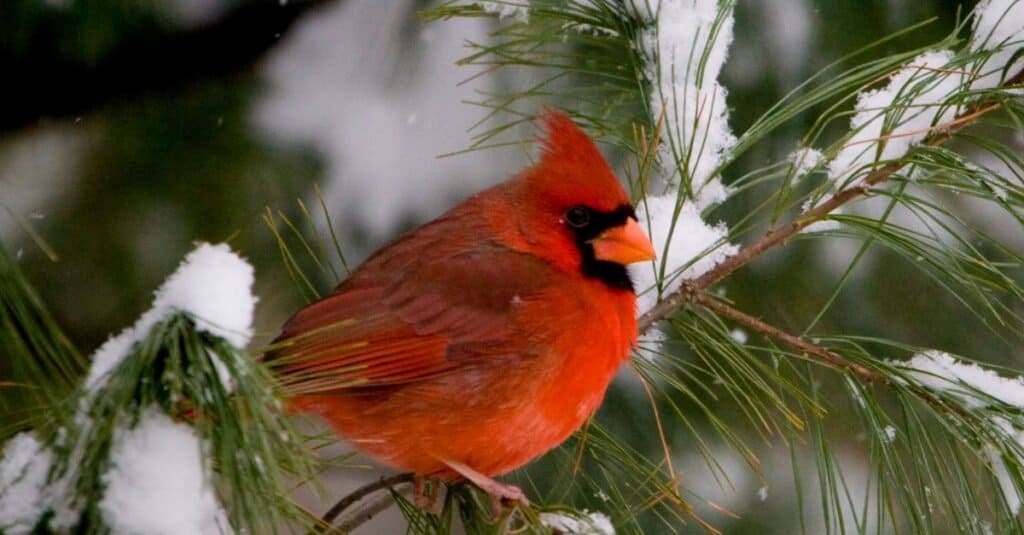
Attract Northern cardinals to your birdfeeder with sunflower seeds, peanut hearts, milo, and millet.
©iStock.com/BeyondMyLens
Northern cardinals are active songbirds that are relatively social and often serially monogamous, forming pair bonds for one or more seasons and raising their young together. They are known to frequent backyard feeders and will eat fruit, grains, seeds, insects, and sap. Northern cardinals do not migrate and are common in warm climates in the Southeast.
House Finch
The common house finch (Haemorhous mexicanus) is native to Mexico and the Southwestern United States, and its history involves one of the most successful avian expansions in North American history.
In the early 1940s, house finches were captured and brought to the East Coast to be sold illegally as pets under the moniker Hollywood Finches. Around 1940, when federal authorities began cracking down on violations of the Migratory Bird Treaty Act, pet shop owners in New York City released their inventory into the wild to avoid prosecution.
This small, introduced Eastern population adapted rapidly, multiplying and spreading across the Eastern half of the country over the next several decades. Although the common house finch is endemic to the arid habitats of West Texas, the Eastern population, which has expanded into East Texas, is considered an introduced species.
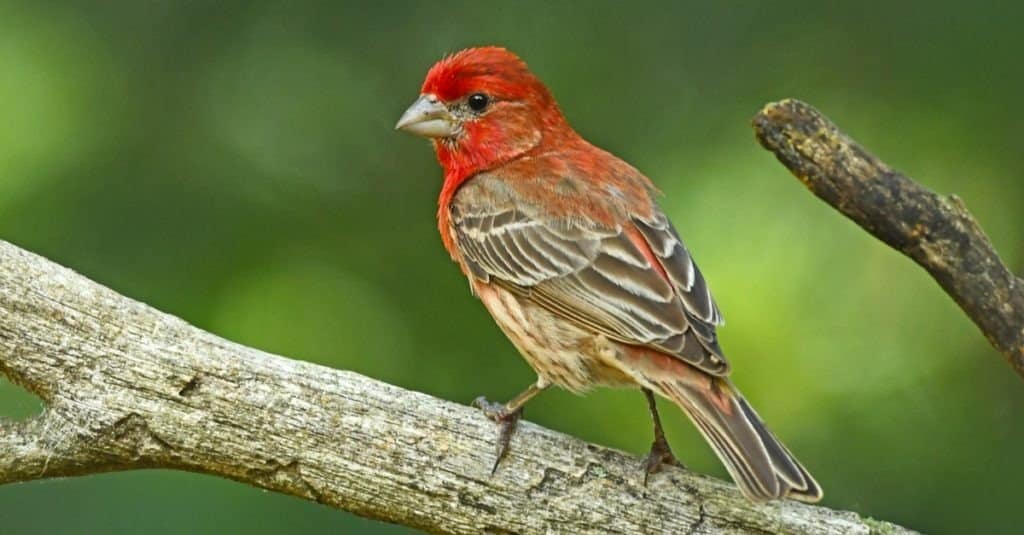
The house finch resides in almost every state.
©Brian A Wolf/Shutterstock.com
The common house finch has a long, notched tail, short wings, and a small bill. Its chest and head are red, and its belly is white with dark streaks. The house finch frequents suburban areas and is attracted to birdfeeders. Its diet includes weed seeds, flower parts, berries, and insects. You can attract these beautiful birds by placing black oil sunflower seeds in your feeders.
Purple Finch
The purple finch (Haemorhous purpureus) is actually a rose-red color and is a migratory bird found mainly in the Northeast and the Pacific Coast. They prefer less-populated habitats and can be found in Texas during winter, from October to April. The purple finch is short and stocky, with a notched tail.
Its body is primarily red, with the head and rump being the brightest. The back and tail are brownish with streaks of pale pink. The purple finch mainly eats seeds, berries, buds, and insects. You can attract this species with black oil sunflower seeds.

The purple finch migrates to Texas in the winter from October to April.
©Fiona M. Donnelly/Shutterstock.com
Summer Tanager
The summer tanager (Piranga rubra) is a spectacularly colored bird with strawberry-red feathers found in Texas year-round. However, you can see them more often during the spring migration and throughout the summer.

You can find summer tanagers in Texas year-round, but more commonly during the spring and summer.
©iStock.com/SteveByland
Summer tanagers are forest songbirds usually found in woodlands, feeding on bees and wasps. Plant berry bushes and fruit trees to attract summer tanagers to your yard.
Vermillion Flycatcher
Male vermillion flycatchers (Pyrocephalus obscurus) have a bright red breast, a brown eye mask, and a brown back. Females are brownish-gray with pale red breasts. Vermillion flycatchers are year-round residents of Texas, but they are more common in South Texas. They prefer desert habitats where they hunt for insects and sit on perches. You can use mealworms to attract these red birds to your backyard feeders.
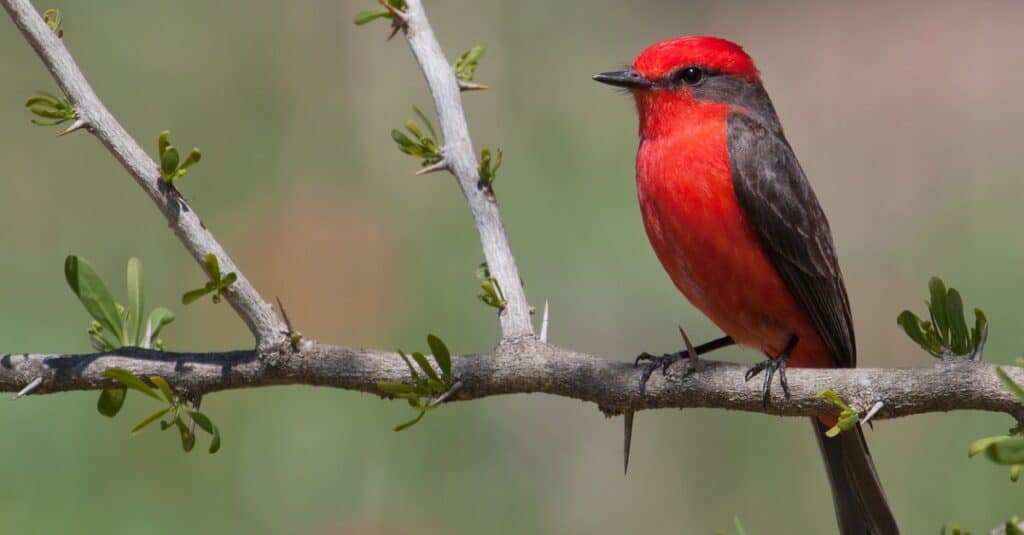
The vermilion flycatcher is frequent in South Texas throughout the year.
©iStock.com/jsdeoliv
Cassin’s Finch
The Cassin’s Finch (Haemorhous cassinii) has a red crown and a red breast with a brown-and-pink-streaked neck and back. These finches are slightly larger and have longer wings than the purple finch. Cassin’s Finches are often seen in small flocks near pine forests. They will join house finches at a bird feeder.
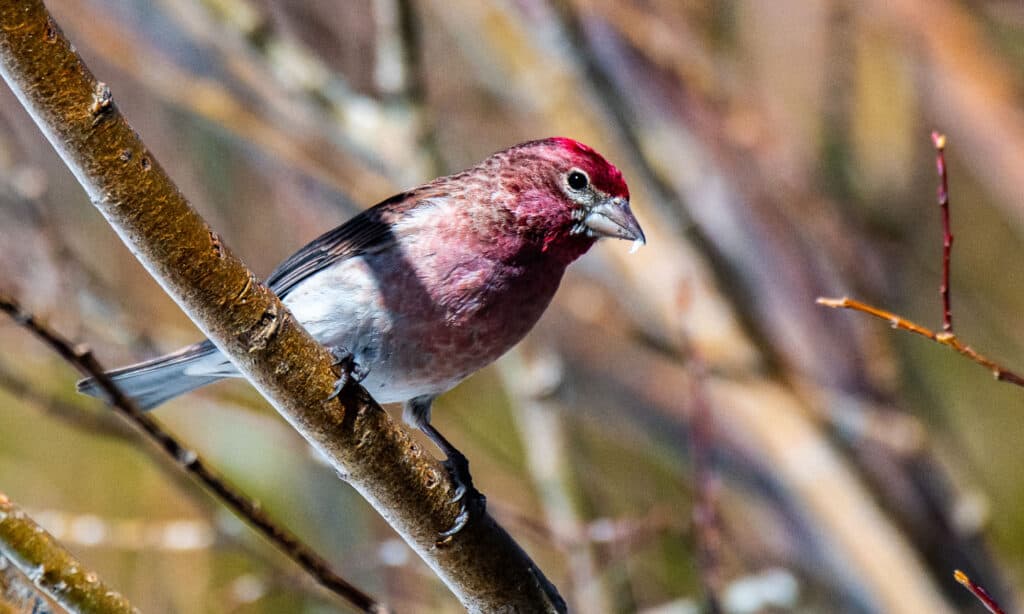
You can find the Cassin’s Finch in West Texas during the winter.
©Kerry Hargrove/Shutterstock.com
The best time to spot one is in the winter on the west side of the state. They eat seeds and fruit, and you can attract them with sunflower seeds or fruit shrubs.
Scarlet Tanager
The scarlet tanager (Piranga olivacea) is striking with its bright red body, jet-black wings, and tail. These brilliant birds migrate to Eastern Texas in April and May, and some may stay during the winter, leaving in January or February.
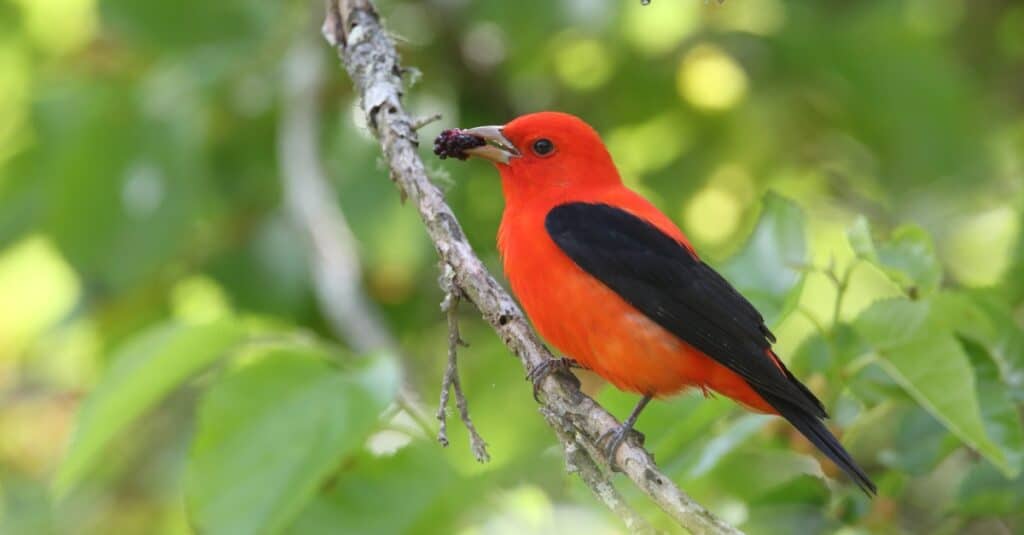
Scarlet tanagers migrate to East Texas in the spring, and some stay during the winter.
©iStock.com/BrianLasenby
They like to remain high in the forest canopy while eating fruit and may be hard to spot. Attract these colorful birds to your property by planting berry plants like blackberry, huckleberry, and juneberry.
Hepatic Tanager
The hepatic tanager (Piranga hepatica) has a red-orange plumage over most of its body, except for its back and wings, which are rusty.
This tanager is scarce in Texas, but you may be able to spot it during the summer in Big Bend National Park and the Davis Mountains. Hepatic tanagers breed in the Southwestern United States and spend winters in Mexico, Central America, and South America. They are found in mountain ranges and woodland habitats where they can freely feed on spiders, berries, and insects.
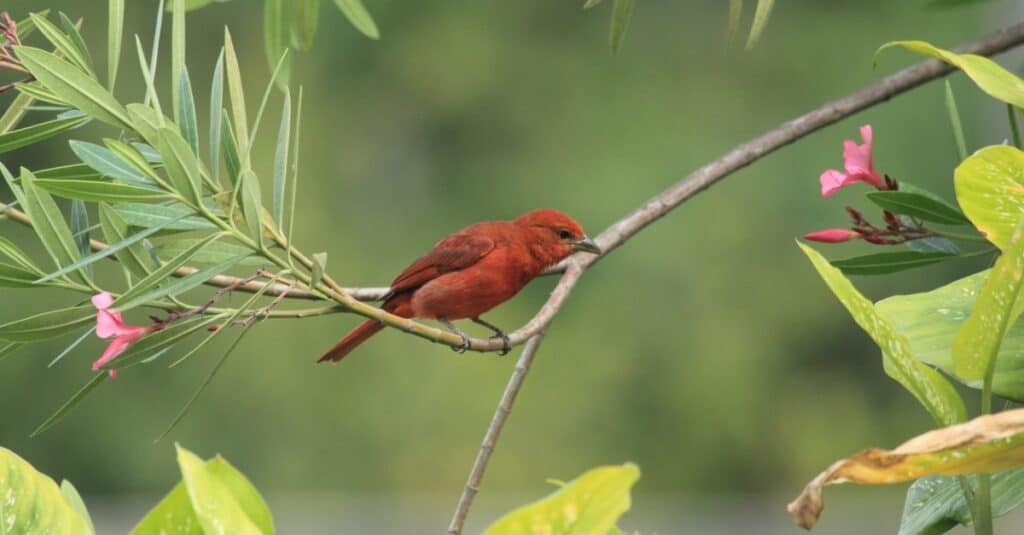
The hepatic tanager lives in the Texas mountains during the summer.
©iStock.com/emarys
Red Crossbill
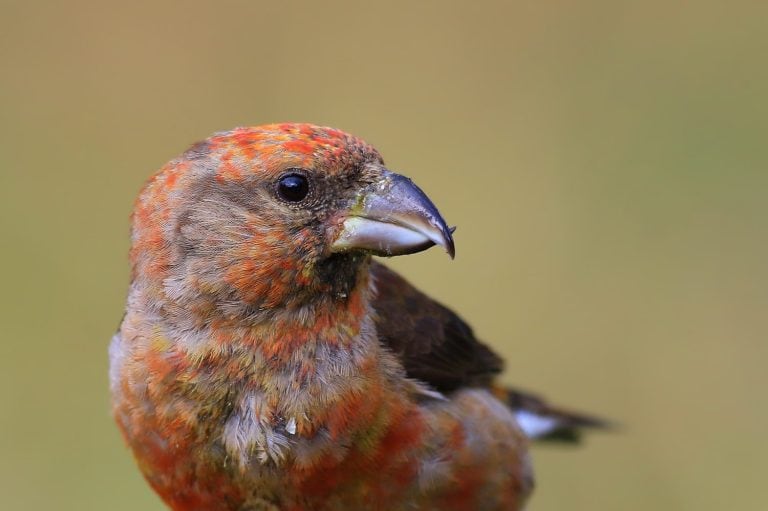
The red crossbill (Loxia curvirostra) is part of the finch family and has a distinctive beak crossed at the tips. It has dark red coloring on most of its body, with darker wings and tail. It lives in forest environments and forages with its flock from tree to tree.
The red crossbill’s unusually shaped bill allows it to extract seeds from cones and fruit with ease. While they live in the state all year, they are hard to find. Your best chance to spot one is in West Texas.
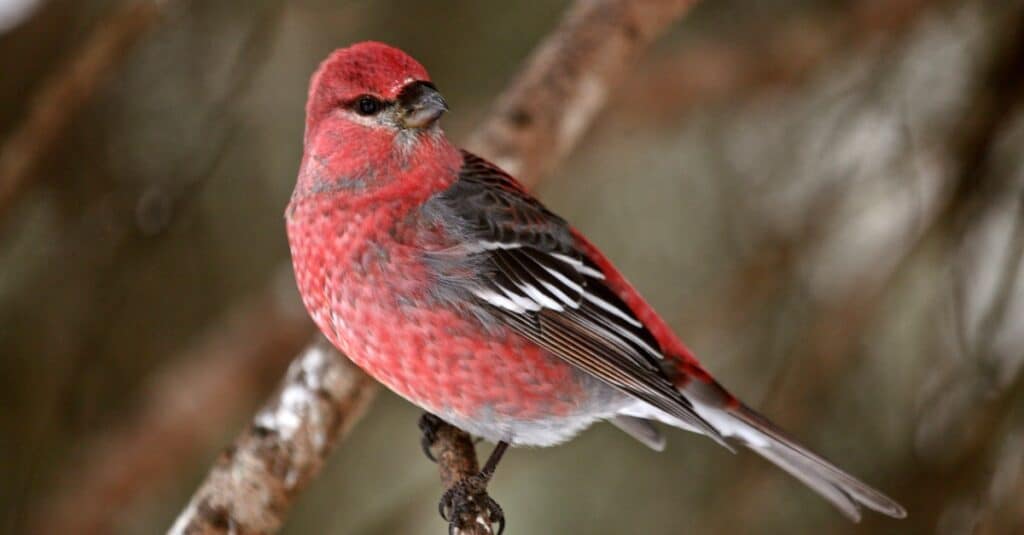
The red crossbill is hard to find. Try West Texas for a rare sighting.
©iStock.com/bobloblaw