
Quick Take
- One red-breasted bird looks gentle but fights its own kind to the death. Meet the aggressive bunting →
- A tiny bird drills holes in trees for a very specific reason, and other species benefit. See why sapsuckers drill →
- Cotton farmers adore one of these birds. Find out what it does for them.
- Spotting a red breast isn't enough, and some females look nothing like their mates. Compare male and female →
People recognize the most colorful birds based on their plumage, such as the flamingo or the scarlet macaw. Birds also rely on these colorful feathers to recognize each other. Of course, plumage differs between species, which helps birds spot members of their own species. Males and females often look different so they can identify each other.
Among the many species of birds out there, you can find a certain group of birds that share a trait: these birds have bright red plumage on their breasts. In this article, we’ll cover 8 different birds with red breasts. We’ll examine where these birds live and some of their common behaviors. We’ll also explain how you can distinguish them from other birds with red breasts.
#8: Scarlet Robin
The scarlet robin (Petroica boodang) is a small songbird in the family Petroicidae. Like members of its family, the scarlet robin is confined to Australasia. Scarlet robins live near the coasts of southern Australia and throughout Tasmania. They typically prefer to build their nests in eucalyptus forests, but you can also find them in scrublands and urban areas. Scarlet robins range in size from 4.7 to 5.3 inches long and feature large, bulbous heads.
They primarily feed on insects and spiders, which they catch on the ground. Known to be highly territorial, scarlet robins will fiercely protect their nests from other birds and fellow robins. Their name comes from the plumage of the males, as these birds feature scarlet-colored breasts. As for the rest of their plumage, their heads, backs, and tails appear black, while their bellies, foreheads, and underparts are white.

Male scarlet robins have scarlet feathers on their breasts.
©iStock.com/phototrip
#7: Rose-Breasted Grosbeak
Also known as the cut-throat, the rose-breasted grosbeak (Pheucticus ludovicianus) is a member of the cardinal family Cardinalidae. During summer, they range throughout southern Canada and the eastern United States. Meanwhile, they overwinter in Mexico, Central America, and the Caribbean. You can most often find rose-breasted grosbeaks living in open woodland areas such as forests, parks, or gardens. Typically, they measure between 7.1 and 8.7 inches long.
Their diet primarily consists of insects, which they catch in flight, although they also eat seeds and berries. Compared to most songbirds, rose-breasted grosbeaks can live quite long, with the oldest known specimen living to 24 years old. They get their common name and nickname from the v-shaped, rose-red patch on the males’ chests. Males also feature black heads, backs, tails, and wings, while their bellies are white.
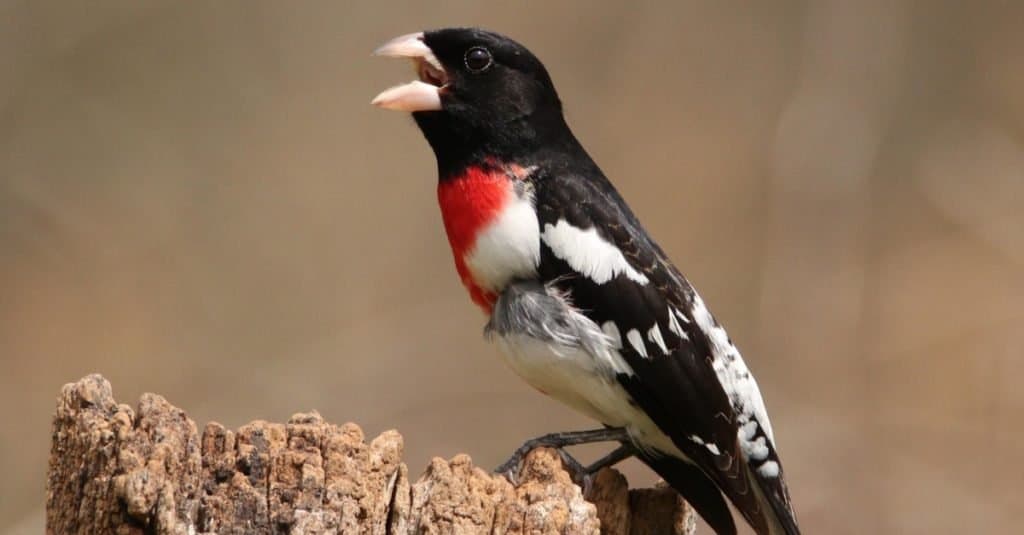
Rose-breasted grosbeaks are also known as cut-throats due to the v-shaped red patch on their breasts.
©Mark W. Holdren/Shutterstock.com
#6: Painted Redstart
Sometimes called the painted whitestart, the painted redstart (Myioborus pictus) is a member of the New World warbler family Parulidae. Most painted redstarts live in mountainous regions of inland Central America, particularly near streams and forested canyons. Compared to most warblers, they measure quite large, with the average specimen measuring between 5.1 and 5.9 inches long.
While hunting, they hop along branches and spread their wings and tails to flush out insects. Unlike most songbirds, these birds nest on the ground, and both males and females frequently sing songs, particularly during courtship. In similarly rare fashion, both females and males feature the same plumage. Their backs, heads, tails, and wings appear glossy black, with white strips on the wings. Their bellies are bright scarlet, which stands out in stark contrast to the rest of their bodies. The name “painted” truly fits these red-breasted birds.

Painted redstarts’ red breasts stand in stark contrast to their black and white plumage.
©Frode Jacobsen/Shutterstock.com
#5: Vermilion Flycatcher
The vermilion flycatcher (Pyrocephalus obscurus) belongs to the tyrant flycatcher family Tyrannidae, and is a striking example among birds with red chests. Vermilion flycatchers live year-round in the southern United States, Mexico, Central America, and northwestern regions of South America. On average, they measure 5.1 to 5.5 inches long.
Like other flycatchers, they hunt for insects in midair and feed predominantly on flies, grasshoppers, beetles, and bees. They tend to live solitary lives, and will only rarely gather in small groups of a few individuals outside of the breeding season. The other half of their name refers to the bright vermilion plumage worn by the males of the species. Males feature red, spiky crowns, necks, breasts, and underparts, while their backs and wings are brownish-gray. Females lack red feathers and look rather nondescript, which helps them hide from predators.
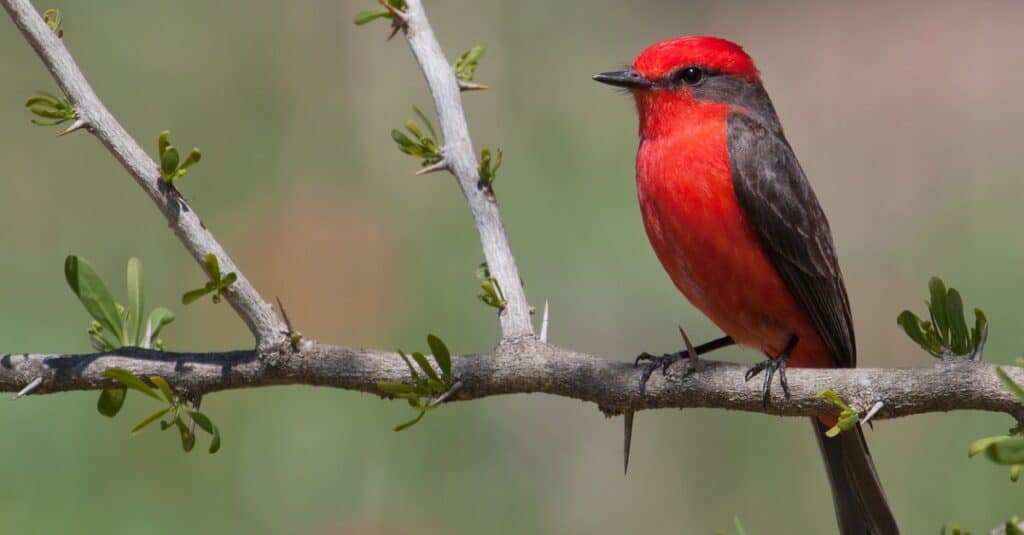
Male vermilion flycatchers feature both a bright red breast and crown.
©iStock.com/jsdeoliv
#4: Red-Breasted Sapsucker
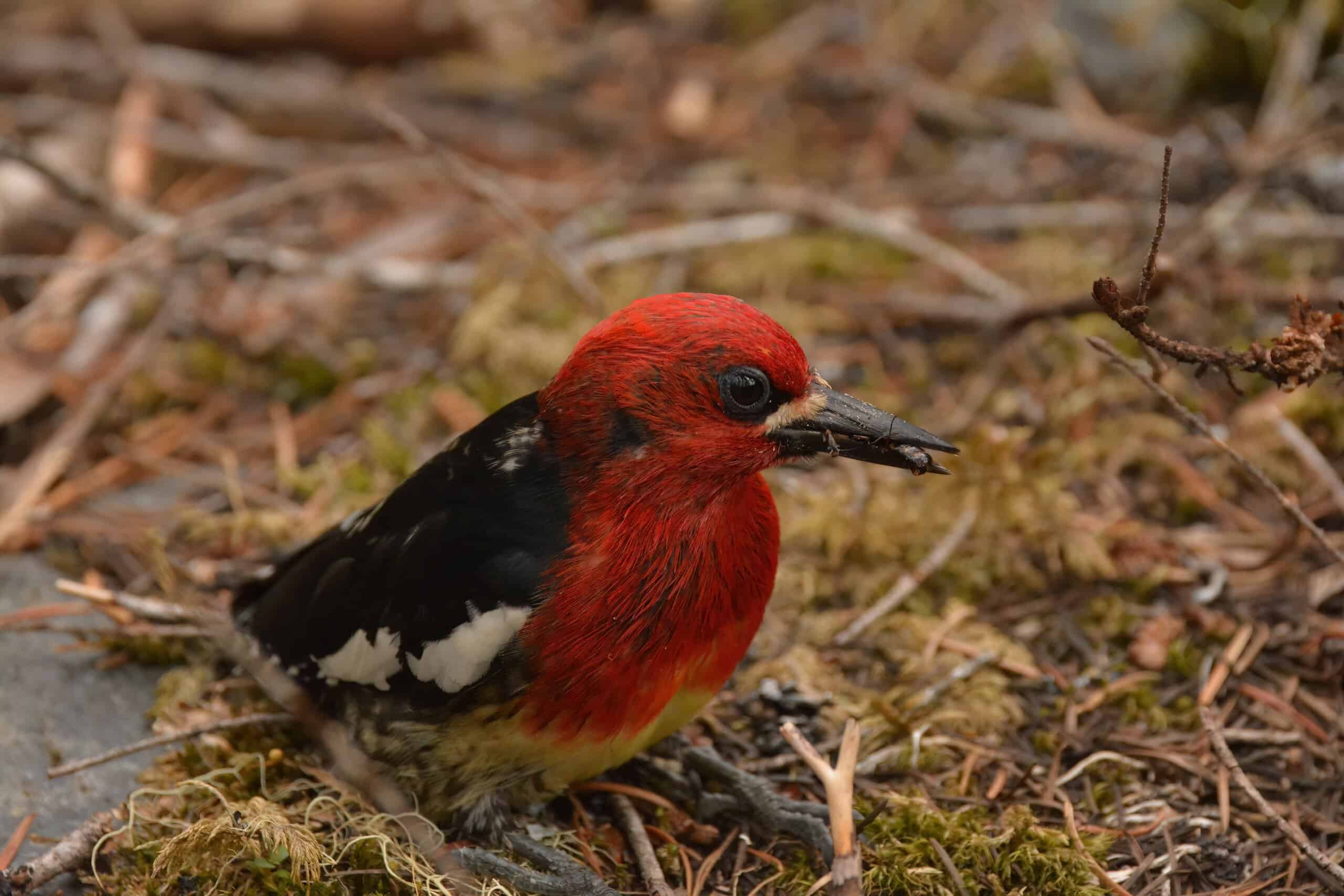
The red-breasted sapsucker (Sphyrapicus ruber) belongs to the sapsucker genus Sphyrapicus, which is part of the woodpecker family Picidae. These birds live in forests along the west coast of Canada, the United States, and Baja California. Male red-breasted sapsuckers feature a red breast and also a red head. The remainder of their plumage is black on the back and white on the belly and underparts. They generally measure 7.9–8.7 inches in length.
As their name implies, sapsuckers drill holes in old-growth trees in order to feast on the sap inside. After drilling a hole, they use their long, hairy tongues to lap up the sap inside. In addition, they dine on seeds, berries, and the insects drawn to the sap holes they create with their beaks. They also drum their beaks to create sounds that they use to mark their territory and attract mates.

Red-breasted sapsuckers were named for their red breasts and their habit of sucking the sap from trees.
©iStock.com/jamesvancouver
#3: Pyrrhuloxia
The pyrrhuloxia (Cardinalis sinuatus) is a member of the cardinal family. It is nicknamed the “desert cardinal,” as it is distributed throughout arid regions of Arizona, New Mexico, Texas, and Mexico. Their preferred habitats include dense scrublands, as well as mesquite thickets. Most pyrrhuloxias measure around 8.3 inches long and have short, stout beaks and tall crests.
Pyrrhuloxias use their strong beaks to eat seeds and fruits, although they also eat a wide variety of insects. In fact, cotton farmers love pyrrhuloxias, as they frequently eat pests that feed on cotton plants such as weevils. The plumage of the males appears mostly gray-brown. However, their crests, faces, and breasts are dark red, and they also have red streaks on their tails and wings.
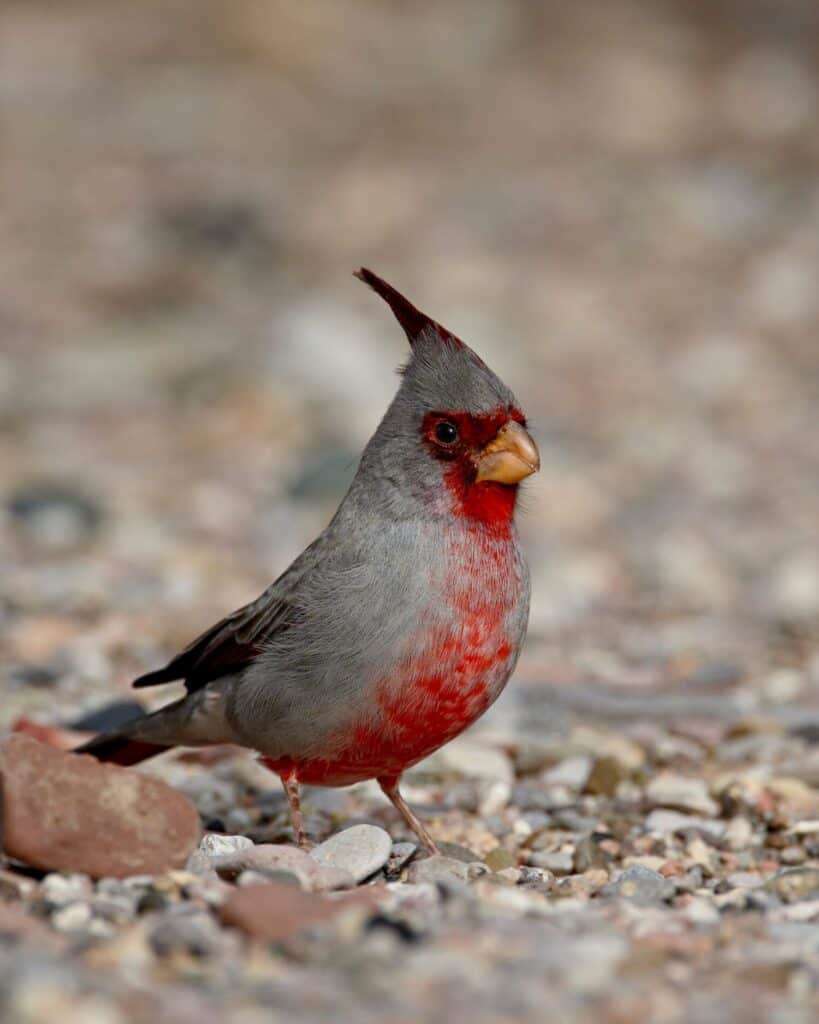
The pyrrhuloxia lives in the arid regions of Arizona, New Mexico, Texas, and Mexico.
©Robert Harding Video/Shutterstock.com
#2: Painted Bunting
The painted bunting (Passerina ciris) is one of the most colorful songbirds in North America. During summer, they breed in woodlands and thickets near water in the eastern and southern United States. In winter, they migrate to the borders of tropical forests in southern Florida, the Caribbean, Mexico, and Central America. Generally, they measure 4.7 to 5.5 inches long with a wingspan between 8.3 and 9.1 inches.
While feeding, they hop along the ground eating seeds and insects like spiders, snails, grasshoppers, and caterpillars. After they turn one year old, males develop bright plumage including a blue head, green back, and red chest and underparts. While normally shy and secretive, male painted buntings can act quite aggressive, and may even kill each other during fights.

Painted buntings are one of the most colorful songbirds in North America.
©Danita Delimont/Shutterstock.com
#1: American Robin
Of all the birds with red breasts, the American robin (Turdus migratorius) is arguably the most recognizable. A member of the thrush family Turdidae, it is one of the most common birds in North America. Depending on the time of year, they range throughout Canada, the United States, Mexico, and Central America. Their preferred habitats include open woodlands, cultivated landscapes like farmland and parks, and urban areas.
They eat a diet of mostly fruits and berries, but also eat a significant amount of insects. Most robins measure 9.1 to 11 inches long. These birds lay blue eggs. Males feature a gray-black head, gray-brown back and wings, and orange to brick-red colored underparts. Due to their widespread distribution and penchant for singing, they are often featured in songs, books, and films, and is part of both traditional and modern stories and legends.
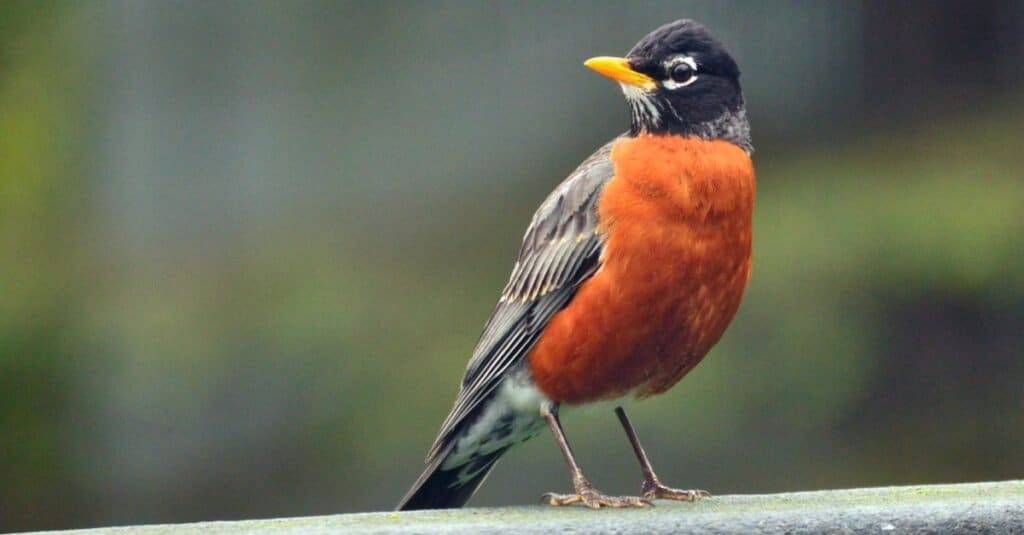
The male American robin is one of the most recognizable birds due to its reddish-orange breast.
©iStock.com/PhotosByMSA