
Birds are some of the most interesting animals in the world, whether they are stunning us with colorful plumage or fascinating us with unusual courtship rituals. However, although many species are abundant, there are actually some extremely rare birds. It’s important to note that there’s a difference between what is considered rare and what is considered endangered. Endangered animals are those that are at risk of becoming extinct in the near future, whether through habitat loss, low birth rates, or other such threats. However, many rare birds can also be endangered because of habitat fragmentation or destruction, pollution, and climate change. While they aren’t all endangered, conservation efforts to protect them are still crucial for them to thrive in the years to come. So, let’s take a look at some rare and unique birds!
1. Vogelkop Superb Bird-of-Paradise
Some of the most magnificent types of rare birds are birds-of-paradise. One of the most extraordinary of these birds is the Vogelkop superb bird-of-paradise. This 10-inch-long bird is known for its mating ritual. In this ritual, the male throws up his black feathers in a semicircle, highlighting his turquoise blue eyespots and breastplate, and struts around the female. Found only on Vogelkop Island in New Guinea, this little bird was once thought of as a subspecies of the superb bird-of-paradise and became its own species, Lophorina niedda, in 2018. Fortunately, this bird is not endangered, though its rarity puts it at risk.
2. Rufous-Headed Hornbill
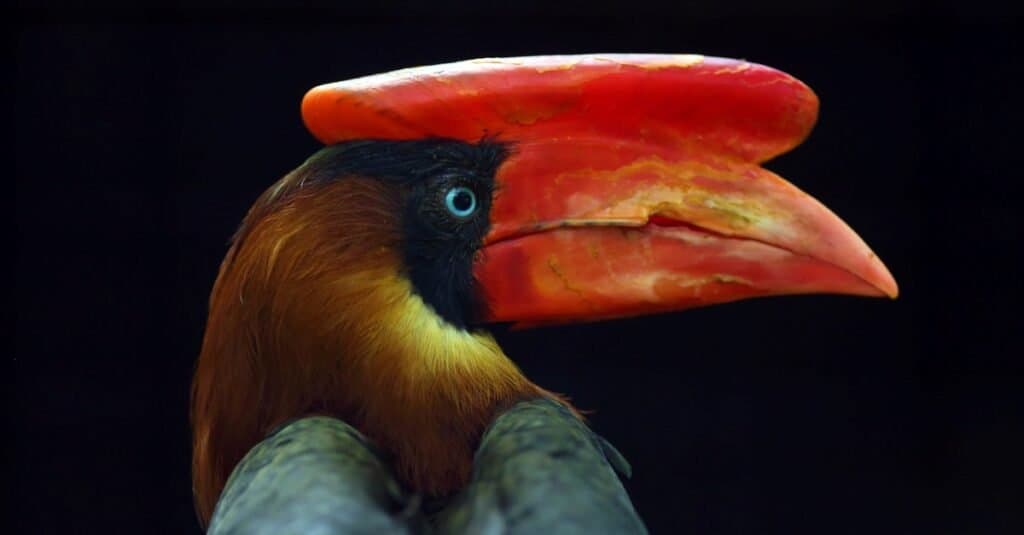
Female rufous-headed hornbills hole up in a tree cavity with their chicks, while the male feeds them all.
©Karel Bartik/Shutterstock.com
Though this hornbill can’t be called one of the more beautiful rare birds, it is both rare and endangered. Identification of the rufous-headed hornbills (Rhabdotorrhinus waldeni) can be made because their bill, topped by a huge casque, is red, and the lower part of the bill is curiously wrinkled. This contrasts beautifully with the bird’s blue eyes and copper and black plumage. Like many hornbills, this large bird holes up the female and eggs in a tree cavity. The male feeds the female and the chicks, and the female removes waste from the cavity. Also called Walden’s hornbill, dulungan, and Visayan wrinkled hornbill, this bird is found in the rainforests of only two islands in the Philippines. It is critically endangered due to the intensive logging of the forests where it lives.
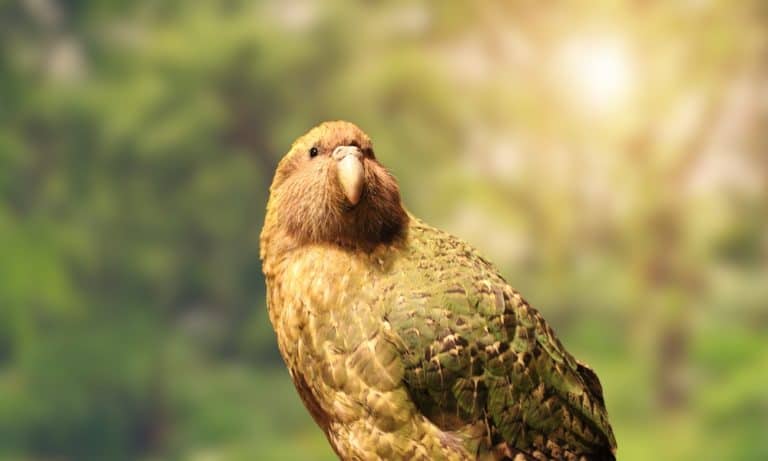
3. Kakapo
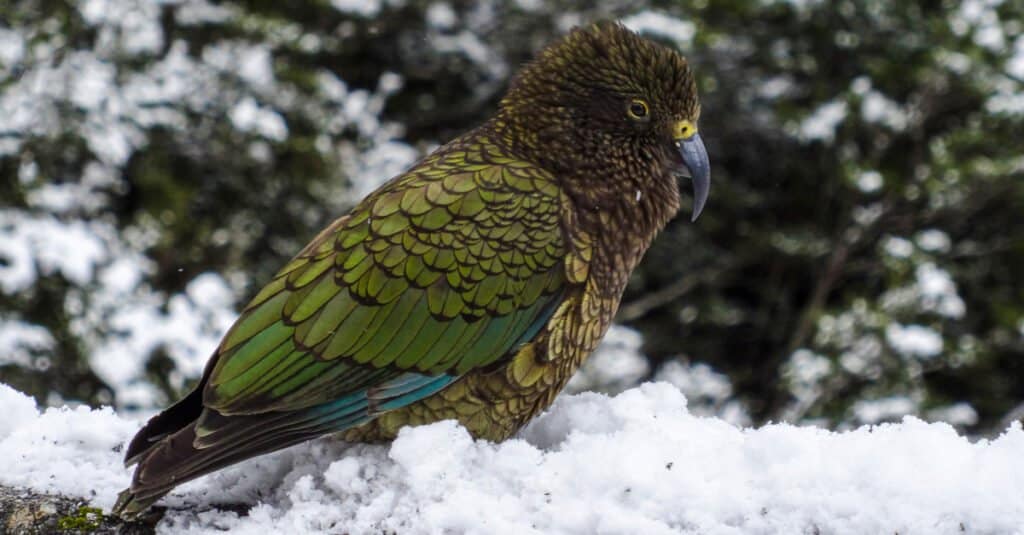
Also called an “owl parrot,” the Kakapo can live up to 100 years.
©heather_p/Shutterstock.com
The kakapo (Strigops habroptilus) is a 25-inch-long flightless parrot, which is only found in New Zealand. The kakapo is mossy green with brown colors to camouflage it as it creeps along the ground looking for pine cones, fruits, seeds, and flowers. Not only is this parrot flightless, but it’s also nocturnal. Males form leks during the breeding season, which is also unusual for birds. They gather in a certain area, dig hollows for themselves, and call to females.
As they’re flightless, kakapos face threats from predators such as rats, resulting in them being classified as a critically endangered species. As a result, they’re now only found on a few isolated islands where there are no predators at all.
4. Imperial Amazon Parrot
Amazons are a large family of parrots, but some are more at risk than others. One of the most endangered amazons is the imperial amazon (Amazona imperialis). Also called the sisseroi, it is found only in Dominica, where it is Dominica’s national bird. It is so critically endangered that there are only around 40 to 60 individuals left. This devastation was blamed on habitat loss and exacerbated by Hurricane Maria.
The imperial amazon is a big parrot, about 19 inches long, with males weighing about 32 ounces and females about 23 ounces. The sensational purple, green, orange, black, and red colors of its plumage make it one of the most beautiful Amazon birds. Interestingly, the explosion of colors actually helps camouflage the bird in its forest habitat.
5. Cebu Flowerpecker
The Cebu flowerpecker is one of those types of rare birds whose colors don’t seem quite real. Indeed, the scientific name of this little bird, Dicaeum quadricolor, was inspired by the four main colors found on the male. Those are red, blue, black, and yellow, not including its bright white throat and belly. As with other types of rare birds, this one is endemic to only a small area, in this case, the Philippines’ Cebu Island. These birds are fairly small at only 4.3 to 4.7 inches long. They were believed to be extinct before they were rediscovered in 1992 in a limestone forest on the island. It is estimated that there are only 85 to 105 of these birds left, meaning they are unfortunately critically endangered.
6. New Zealand Rockwren
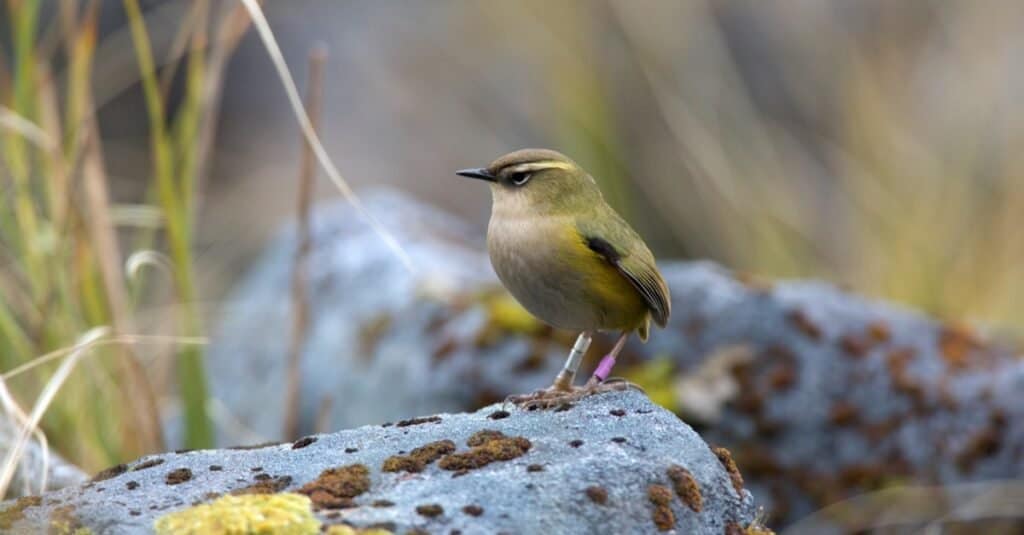
The New Zealand rockwren is a small New Zealand wren endemic to the South Island of New Zealand.
©Andrej Chudy/Shutterstock.com
This tiny green and yellow bird of New Zealand’s South Island is not the showiest, but it is one of only two wrens native to New Zealand. The other one is the rifleman. One of the more unique bird species, the New Zealand rockwren (Xenicus gilviventris) is the only New Zealand bird with an alpine habitat, and it’s endangered thanks to the introduction of non-native animals. The rockwren seemed on its way to becoming flightless because its tail is stubby, and its wings are round and can barely get the bird off the ground. As a result, the rockwren prefers to run and hop. Females are a bit browner and heavier than males. Its three-note call, often shared by two birds, gave the wren the Maori name of pīwauwau, or “little complaining bird.”
7. Golden Pheasant
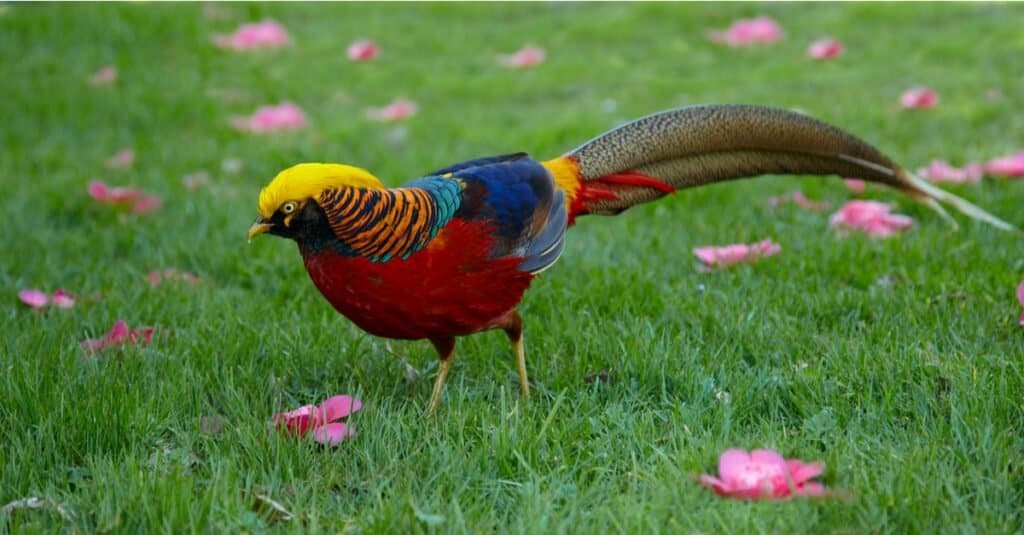
The golden pheasant is native to western China.
©Maksym Gorpenyuk/Shutterstock.com
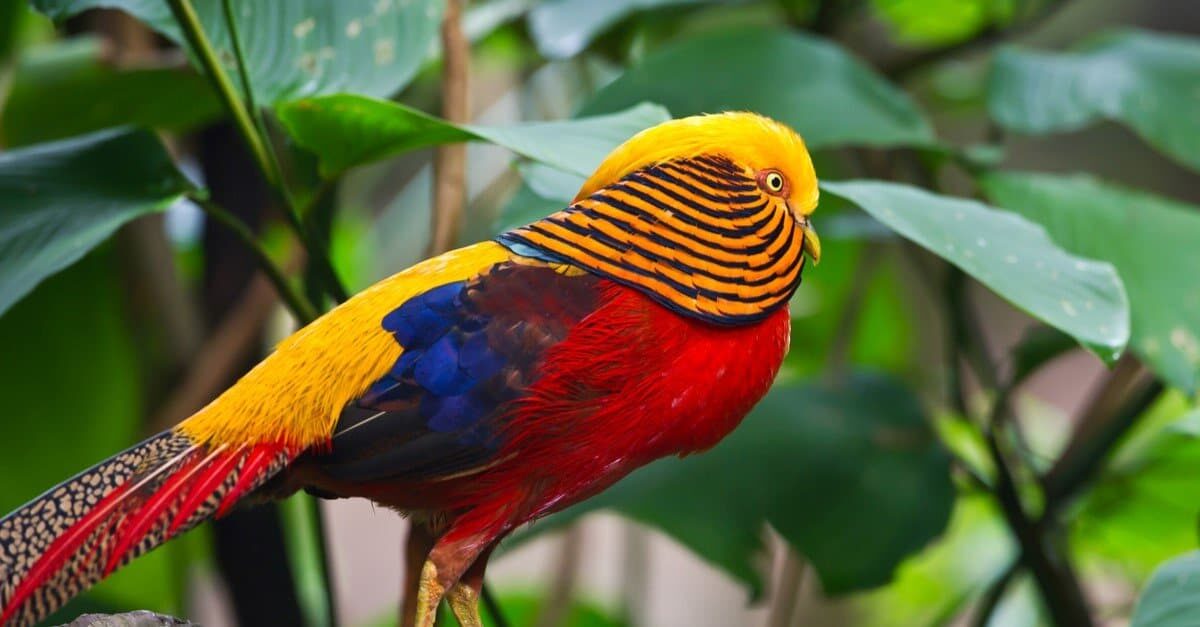
One of the most beautiful of these rare birds is the golden pheasant (Chrysolophus pictus), which is native to western China (although populations are found in other countries around the world). They are known for the breathtaking beauty of the males, which are between 35 and 41 inches long. Much of that length is made up of its mottled tail. However, the identification of this bird is unmistakable, as it also has a crest and rump that seem made of molten gold, a brilliant red body, and a tiger-striped cape. The females are so much duller that they sometimes don’t look like they belong to the same species. Females are a bit smaller than the males, and their tails don’t take up as much of their overall length.
Golden pheasants are bred in captivity, and they have different color mutations that include peach, mahogany, silver, cinnamon, and splash. Though rare, this bird is not considered endangered, and its conservation status is least concern.
8. South Philippine Dwarf Kingfisher
First described in 1848, this little kingfisher with red, orange, white, and lilac plumage was first photographed only in 2020. There are three subspecies, and all of them are found only in the Philippines. The South Philippine dwarf kingfisher (Ceyx mindanensis) prefers a rainy forest habitat, and its population is decreasing because of clear-cutting. Though the bird is protected in some areas, there is no concerted conservation effort on behalf of the Philippine government as of 2025. The current population is estimated to be a maximum of 10,000 individuals.
9. Madagascar Pochard
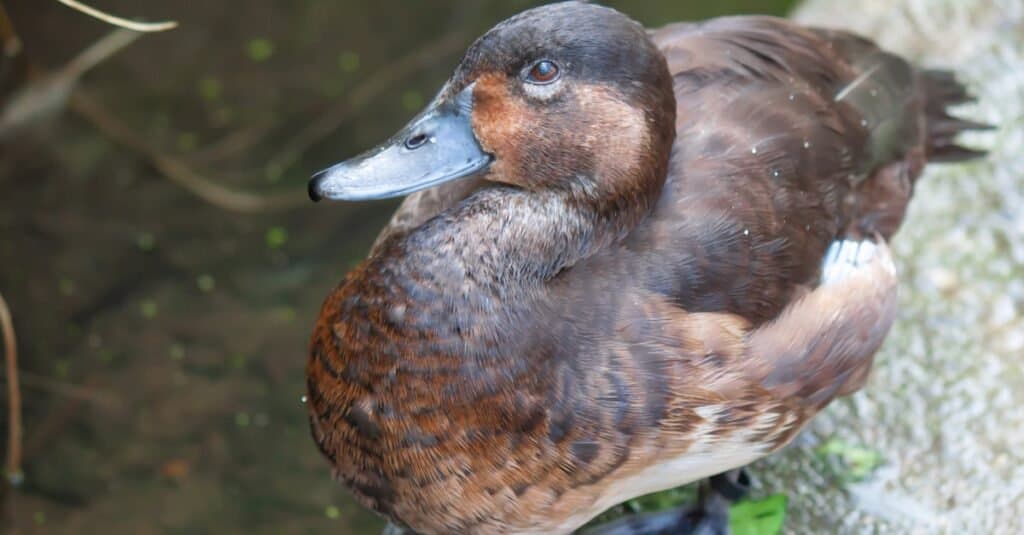
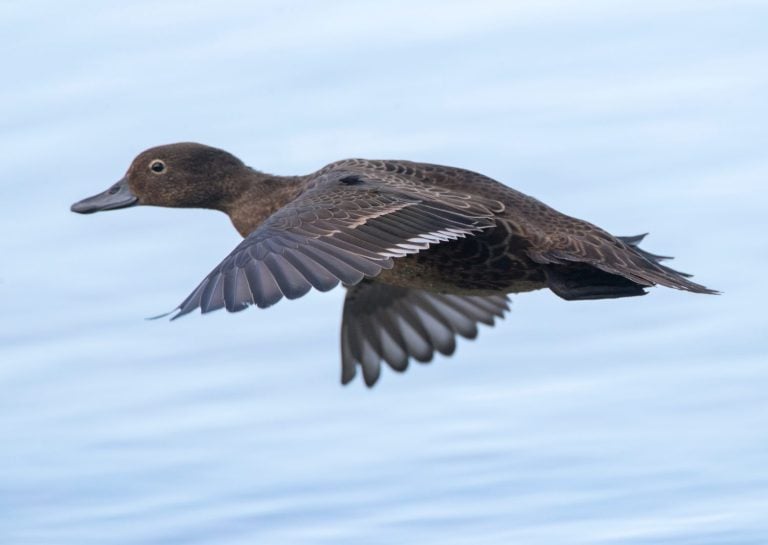
The Madagascar pochard was once thought to be extinct.
©Wirestock Creators/Shutterstock.com
This rather ordinary-looking brown diving duck was once in so much trouble that it was considered extinct until some were discovered swimming in Madagascar’s Lake Matsaborimena in 2006. A captive breeding program was established, and the resulting ducks started being released into the wild in 2018. Still, the Madagascar pochard is considered critically endangered.
The Madagascar pochard (Aythya innotata) is between 16.5 and 22 inches long and is only found in the shallow waters of Madagascar’s wetlands, where it mostly eats insects. The decline in the population of the Madagascar pochard is actually blamed on the introduction of fish that killed the chicks and destroyed the nests, as well as rats, hunting, and converting the wetlands into rice paddies.
10. Blue-Eyed Ground-Dove
Another unique bird species, this lovely dove is only found in Brazil’s Cerrado region. Around six inches long, the male has a magenta head, neck, breast, and wing coverts and is browner around the back of its body, though the coverts beneath the wing are white. Identification can be made through its sapphire blue eyes, which match the blue spots on the wings and give the bird its name. Like many colorful birds, the female is a little paler.
The blue-eyed ground dove (Columbina cyanopis) seems to have always been rare, and very little is known about how it breeds or even what it eats, though scientists assume it eats seeds like other doves. It was thought to be extinct for many years until about a dozen birds were found in 2015. Now, habitat loss has rendered it critically endangered.