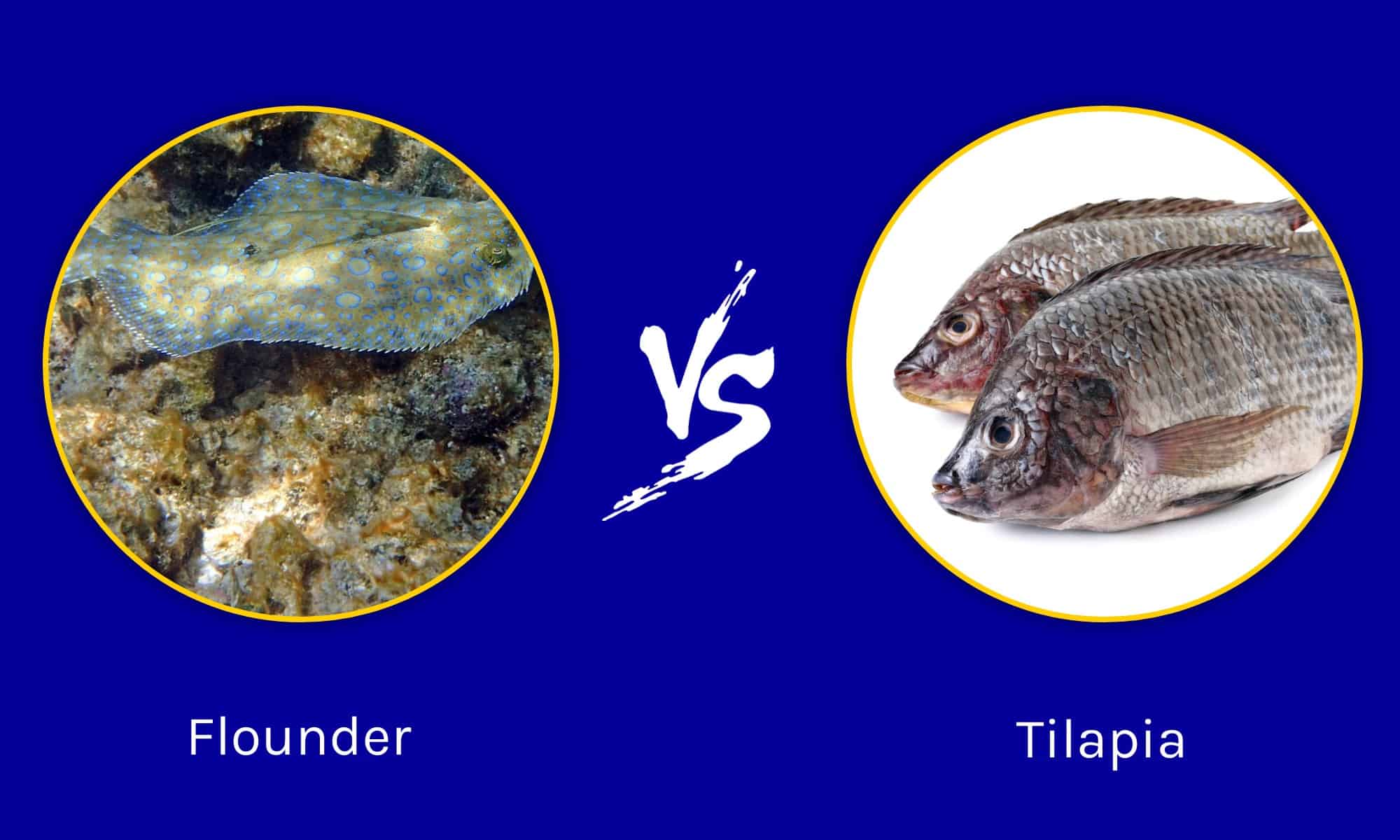

Flounders swim along the salty seafloor, with strange body adaptations and a penchant for disguise. Tilapia are native to the freshwater habitats of Africa, but they have become one of the most widely farmed fish. These fish live in unique habitats and have individual features and diets to which they are well-adapted. They also have unique textures and culinary uses. Let’s explore these differences in detail.
Flounder vs. Tilapia Comparison
| Flounder | Tilapia | |
| Classification | Order: Pleuronectiformes, Families: Achiropsettida, Bothidae, Pleuronectidae, Psettodidae | Order: Perciformes, Family: Cichlidae, Genus: Tilapia, Coptodon, Oreochromis, Saratherodon |
| Habitat | Saltwater, bottom-dwelling | Freshwater, mid-level, and bottom-dwelling |
| Appearance | Up to 22 lbs, round & flat bodies, camouflage, both eyes on one side of the body | Up to 10 lbs, deep & laterally compressed bodies, color depends on species, interrupted lateral line. |
| Diet | Carnivores | Omnivores |
| Aquaculture | Highly successful, farmed worldwide | One of the most widely farmed and commercially successful fish species worldwide. |
| Culinary Use | Delicate, sweet, flaky, mild | medium-firm, flaky, sweet, mild |
Classification

Various species of flounder are popular sport fish and are highly sought after by recreational anglers for both sport and food, especially along the Atlantic coast.
©Parilov/Shutterstock.com
Flounders are contained within the Pleuronectiformes order. They fall into this order along with other bony flatfish such as halibut and turbot. Flounders are flatfish within the families of Achiropsettida (Southern flounders), Bothidae (left-eye flounders), Pleuronectidae (right-eye flounders), and Psettodidae (spiny flounders).
Tilapias are part of the order Perciformes, perch-like fishes. Tilapia is the common name for many species of cichlids, which are fish within the Cichlidae family. They share their family name with close to one hundred species of fish within distinct genera. In the past, all tilapia shared the genus Tilapia, but they are now placed in other genera, including Coptodon, Oreochromis, and Sarotherodon.
Habitat
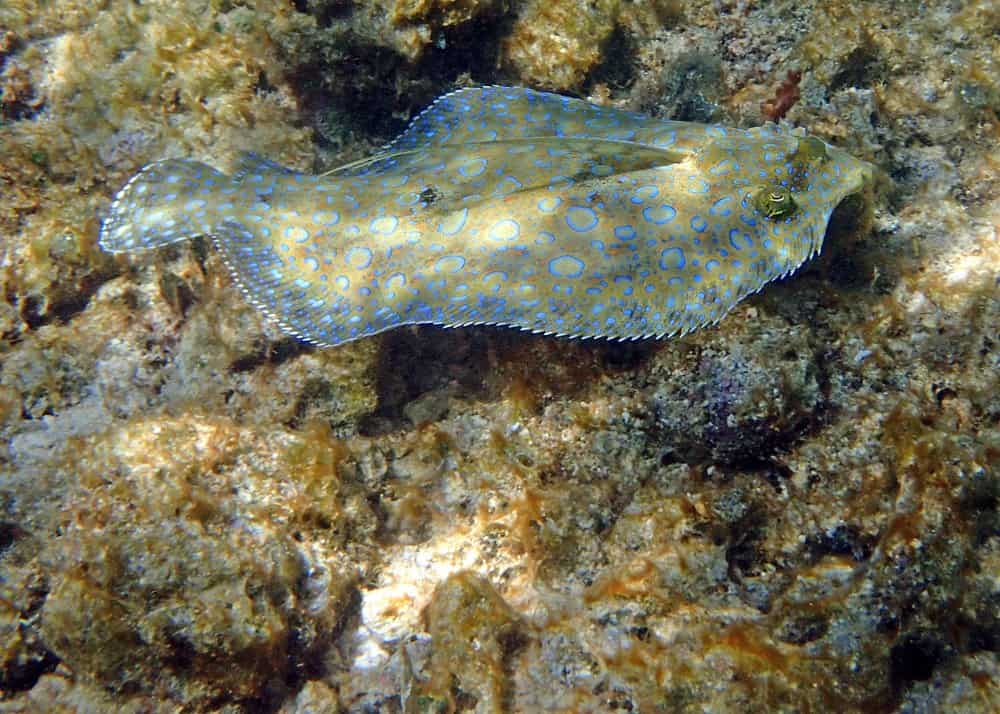
Flounders are found in temperate and some tropical waters, including along the coasts of Europe.
©CT Johnson/Shutterstock.com
Primarily freshwater fish, tilapias are native to Africa. They’re now widespread through many tropical, subtropical, and temperate regions of the world. They arrive in new areas through fish farms as a productive food source. Tilapia live in shallow streams, ponds, rivers, and lakes. These fish sometimes inhabit brackish water, like the slightly salty water of estuaries. While they’re often labeled bottom-feeders, they tend to spend time in the middle portion of the water. If they can’t find food there, they’ll seek it near the bottom or wherever they can find it.
As saltwater bottom dwellers, flounders are masters of disguise. They’re able to change their coloration rapidly to match the ocean floor. They burrow almost entirely in sand or soft mud, making them virtually invisible. Tropical and temperate waters along the coasts of Europe, North America, Africa, and Asia are the main regions where these flat-finned fish live. Some species reach north into the Arctic and tend to prefer the shallow zones.
Appearance
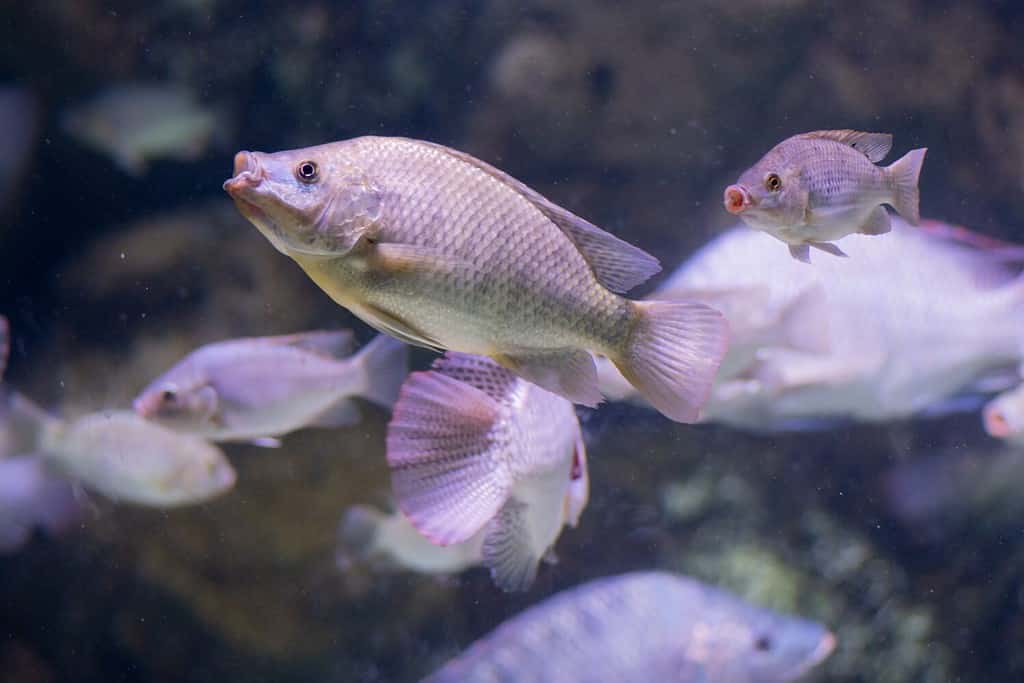
Blue Tilapia, fish in the family Cichlidae, are native to Northern and Western Africa, and the Middle East.
©SingerGM/Shutterstock.com
Flounders weigh up to 22 pounds. Their round and flat bodies make them well adapted to life at the bottom of the sea. They have both eyes on one side of their body. This unique feature allows flounders to dwell on the ocean floor with both eyes on the top side. These eyes can move independently of one another and give the flounder a good vision of the sea above. Against the background of a sandy ocean floor, their scales act as camouflage, making detection by predators difficult. Some species can shift color in response to the seabed in further disguise. Their coloring shifts among orange, brown, green, white, and tan. It is also dependent on their emotional state, changing in response to threats.
Tilapias can grow to be up to 10 pounds. They’re easily identified by their interrupted lateral line, a characteristic of the Cichlid family. They have deep and laterally compressed bodies with long dorsal fins. They exhibit a range of colors from white to gold, pink, brilliant red, dark blue, and black, depending on the species. Blue tilapia (Oreochromis aureus) is typically blue-gray. The original red tilapia were genetic mutations. They’ve become popular because of their similarity to red snapper, giving them increased market value.
Diet
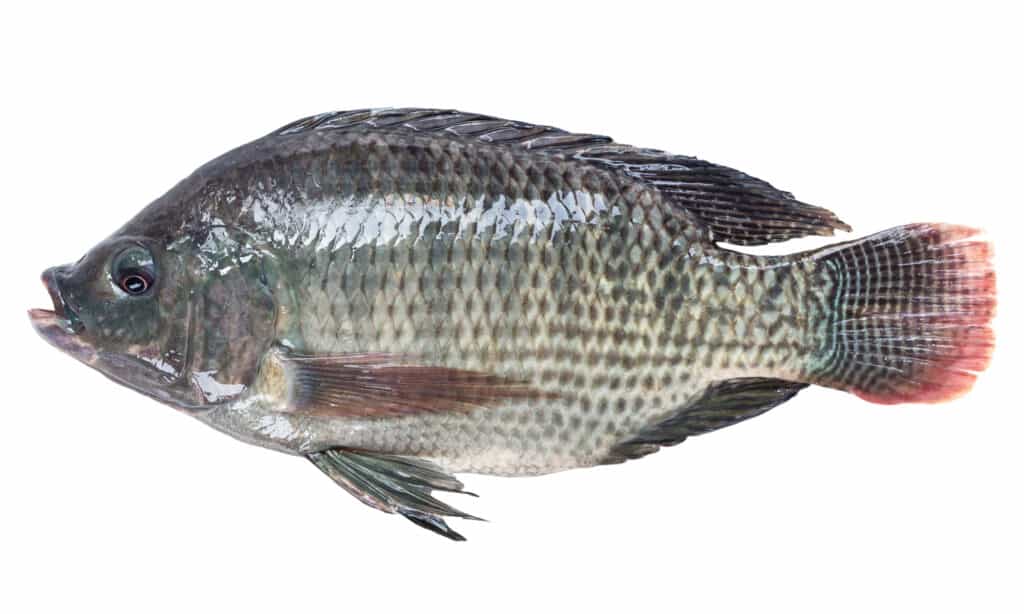
Tilapias are omnivores that feed on soft aquatic vegetation, plankton, and algae.
©nednapa/Shutterstock.com
Flounders are primarily nocturnal carnivores who ambush their prey, blending into their surroundings before their sharp teeth snap, surprising their prey. Their diet consists of fish spawn, crustaceans, and small fish. Smaller species take advantage of worms and plankton as food sources. They feed on the ocean floor in muddy areas near bridges, docks, and coral reefs.
Tilapias are omnivores that feed on soft aquatic vegetation, plankton, algae, and aquatic invertebrates. They also eat larval fish, decomposing organic matter, and detritus. Often, they’re considered filter feeders because they can harvest plankton from the water. Their gills secrete a mucus that traps the plankton. They swallow this plankton-rich mucus and then digest it in their long intestines.
Aquaculture
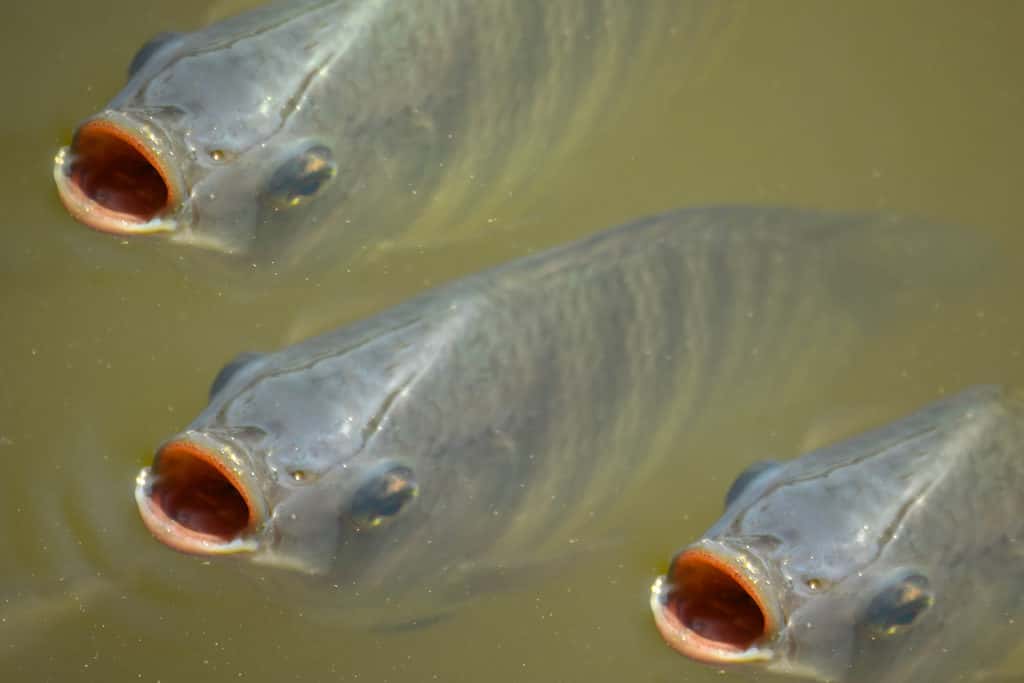
Nile tilapia at the surface of a pond.
©neenawat khenyothaa/Shutterstock.com
Tilapias are hugely popular for aquaculture, the practice of farming in water. They’re the second most farmed fish for aquaculture cultivation globally, after carp. Many species of tilapia are excellent farm fish. Their rapid growth rate, adaptability to a range of environmental conditions, and resistance to stress and disease make tilapia thrive in aquaculture.
Freshwater species like carp, tilapia, and catfish have been the main focus of aquaculture systems in the past. Saltwater systems are harder to maintain, and flounders are more sensitive to environmental changes. So far, flounder are far less common than tilapia in aquaculture, but interest is growing. The olive flounder (Paralichthys olivaceus) is a candidate species for the U.S. aquaculture industry. This flounder species has proven to be commercially viable and is presently farmed in Korea and Japan. Summer flounder (P. dentatus) are also being farmed and are showing a high potential for success as aquaculture species.
Flounder vs Tilapia: Culinary Use
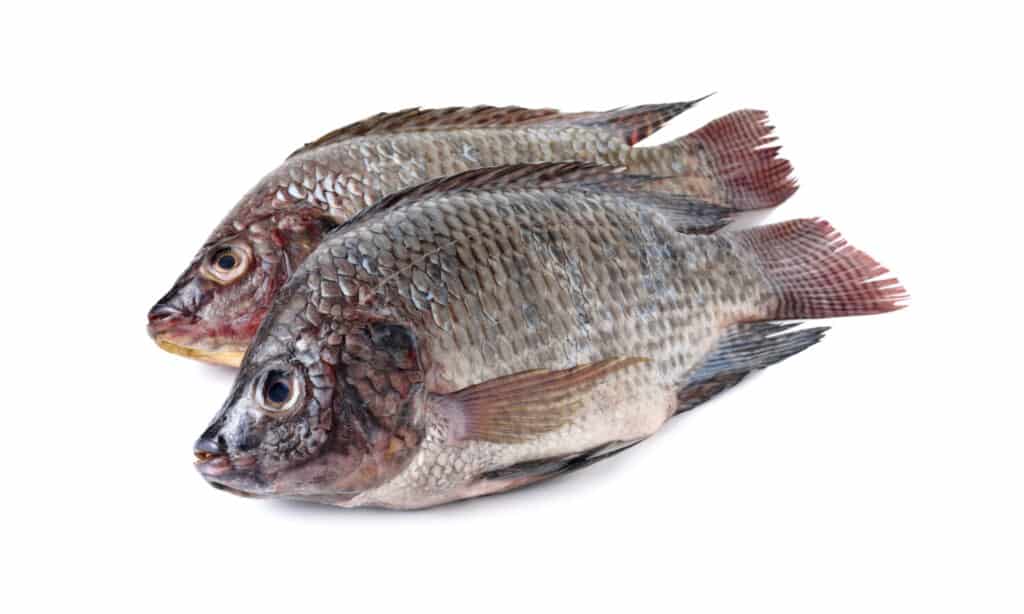
Tilapia filets are firmer than the delicate flesh of flounder.
©Yossi James/Shutterstock.com
Overall, flounders have an incredibly delicate texture. They’re very versatile and can be prepared in many ways. Common methods include broiling, baking, steaming, deep-frying or pan-frying. If grilling, wrap the fillets in foil so that the delicate flakes don’t crumble and fall between the grates.
Flounder fillets are sweet, flaky, and mild. Common flounder species prepared for food include the winter flounder (lemon sole), summer flounder (fluke), witch flounder (gray sole), gulf flounder, and peacock flounder.
Tilapia has a sweet and mild taste that lends itself to a wide variety of recipes and cooking methods. Its flesh is lean and has a medium-firm, flaky texture. It’s protein-rich and low in fat. Raw flesh is white or pinkish-white and sometimes has a darker muscle layer on the skin side of the fillets. It cooks up to a white color. Some of the most popular tilapia species for culinary use are the Nile tilapia (Oreochromis niloticus), the blue tilapia (Oreochromis aureus), and the Mozambique tilapia (Oreochromis mossambicus).