
Quick Take
- These two cats look nearly identical to the untrained eye. Yet a single detail in their coat pattern gives one away every time.
- One of these big cats shatters the oldest stereotype about felines and turns it into a killing advantage.
- Their jaws look similar, but one delivers a bite so powerful it punches through armor. The reason comes down to what it eats.
- If these two cats ever crossed paths and fought, the outcome isn't as obvious as the size difference suggests.
Sleek, powerful, and fierce are a few words to describe leopards and jaguars. The sight of these magnificent big cats instills both awe and fear in humans and animals alike. These big cats share a number of adjectives, attributes, and characteristics, but they are hardly the same animals. While leopards and jaguars are powerful and fierce predators and protectors of their habitats and solitary in character, their similarities end there.
©Ondrej Chvatal/Shutterstock.com
Leopard vs. Jaguar: Key Differences
So what distinguishes the leopard and jaguar? What follows is a definitive breakdown of seven differences that separate these animals.
1. Leopard vs. Jaguar: Taxonomy
The Panthera genus is composed of the five big cat species that roar and are apex predators. Leopards and jaguars meet these criteria, as do lions, tigers, and snow leopards.
The species name for the leopard is Panthera pardus. The Cat Classification Task Force (CCTF) of the IUCN Cat Specialist Group recognizes eight subspecies of the leopard. Their conservation status according to the IUCN Red List varies depending on the subspecies. The leopard (P. pardus) is listed as vulnerable.
The eight subspecies, their geographical range, and their IUCN Red List status (if different from P. pardus) is as follows:
- African leopard, P. p. pardus, Africa
- Persian leopard, P. p. tulliana, Turkey, Caucasus, Turkmenistan, Uzbekistan, Iran, Iraq, Afghanistan, and Pakistan, Endangered
- Indian leopard, P. p. fusca, India, Near Threatened
- Sri Lankan leopard, P. p. kotiya, Sri Lanka
- Indochinese leopard, P. p. delacouri, Southeast Asia and probably southern China, Critically Endangered
- Amur leopard, P. p. orientalis, Eastern Asia from the Russian Far East to China, Critically Endangered
- Javan leopard, P. p. melas, Java
- Arabian leopard, P. p. nimr, Arabian Peninsula
2. Leopard vs. Jaguar: Habitat
Since they live in completely different global regions, the two animals are unlikely to ever run into each other. The jaguar is native to Central and South America and most of the species populate the Amazon. Historically, they also populated North America, primarily in the US southwest. However, loss of habitat forced them out of their northern territories over time. Small populations still live in Mexico, but the majority of the population doesn’t settle past Argentina.
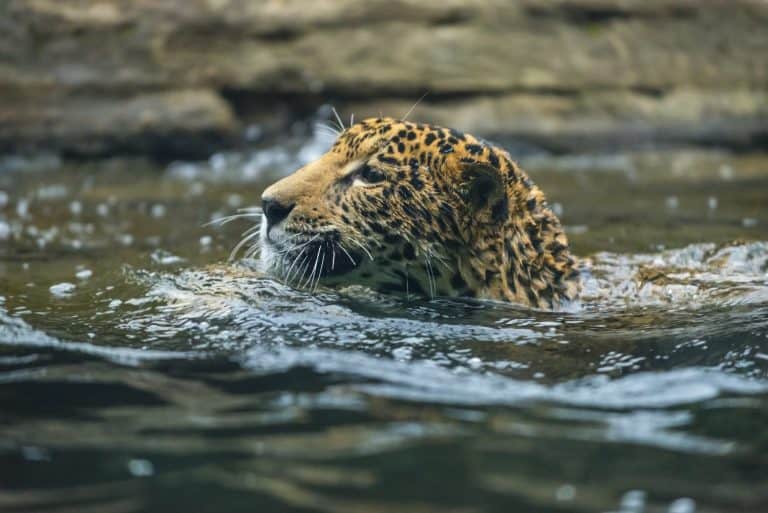
Jaguars live in many different habitats. They are strong swimmers and one of the few species of big cats adept at hunting underwater, so it’s most common to find them settled in areas with streams, rivers, lakes, wetlands, and other bodies of water.
Meanwhile, leopards are more widespread, with 9 different subspecies spread out in different areas. They reside in parts of the Middle East, Africa, and Asia, with populations inhabiting parts of Sri Lanka, India, and China.
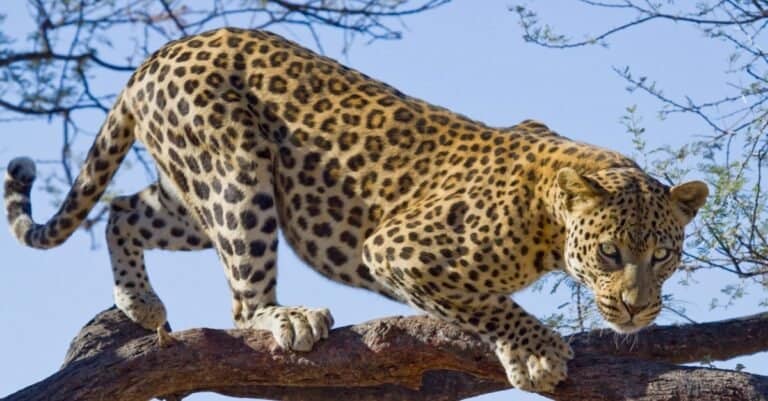
Leopards thrive in a wide range of different habitats. While they prefer forested areas with an abundant supply of trees, they have also been known to settle in grassland and desert areas as well. They are excellent climbers and spend much of their time in trees. As ambush predators, it’s not uncommon for them to stalk and pounce on their prey from the branches above.
3. Leopard vs. Jaguar: Weight
While the animals share the same general height, the jaguar is a bit taller at the shoulder. The jaguar is the noticeably bulkier feline. Male jaguars can weigh up to 265 pounds. The male leopard tops out at 175. Female jaguars tend to be at least 10 percent lighter than males. The female leopard is about 30 percent lighter than the males.
The leopard is the smallest of the big cats in its region, which it shares with tigers and lions. On the other end, jaguars are the largest felines (big cat) in their world.
4. Leopard vs. Jaguar: Appearance
Leopards carry angular, smallish heads with clear lines and definitive cheekbones. The jaguar’s head is larger and the face is rounder. Their ears are also less prominent than the leopard
The jaguar has a wider jaw and broader forehead to accommodate its killing method. Their bite—reinforced by massive teeth and jaw muscles—is the strongest in the world of mammals. They can pierce the shell defenses of the tortoise and the armor of the caiman.
4. Leopard vs. Jaguar: Body Length & Shape
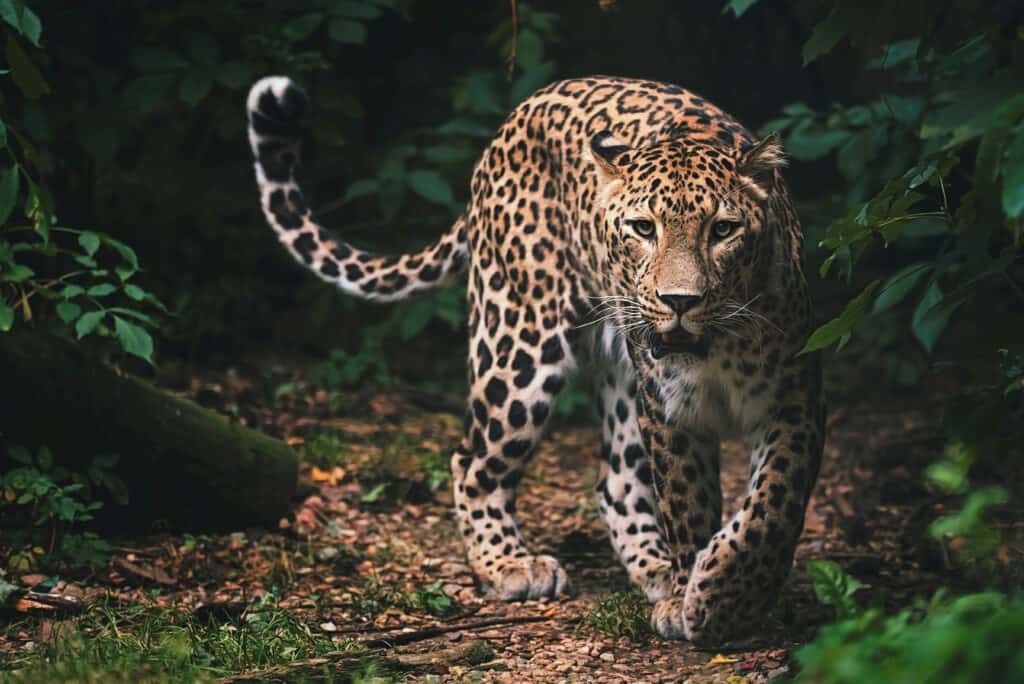
Leopards have leaner, longer bodies. A slender build that’s slighter than the jaguar. With their long tail and body slenderness, the leopard has greater agility, is better at climbing, and tends to run faster.
Jaguars are stocky, broad-shouldered, and muscular. But they are more compact with barrel abdomens that make them appear well fed or pregnant.
More arboreal than the jaguar, leopards have long tails that help maintain balance in trees. The jaguar’s shorter tail matches their stockier build.
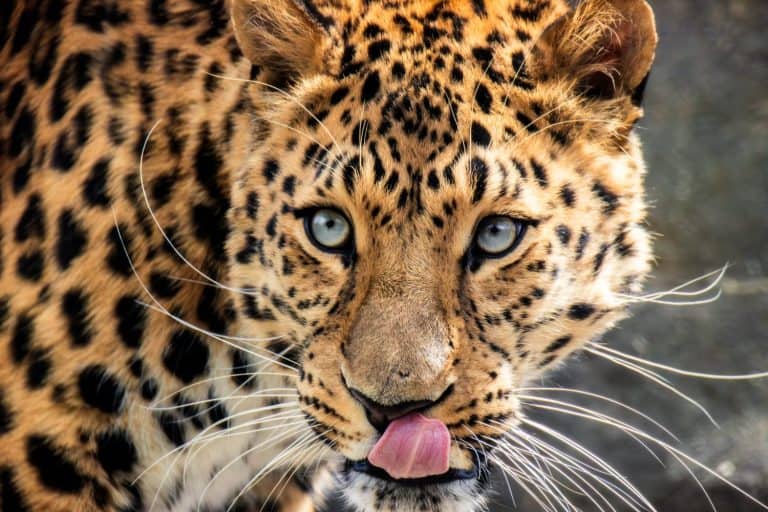
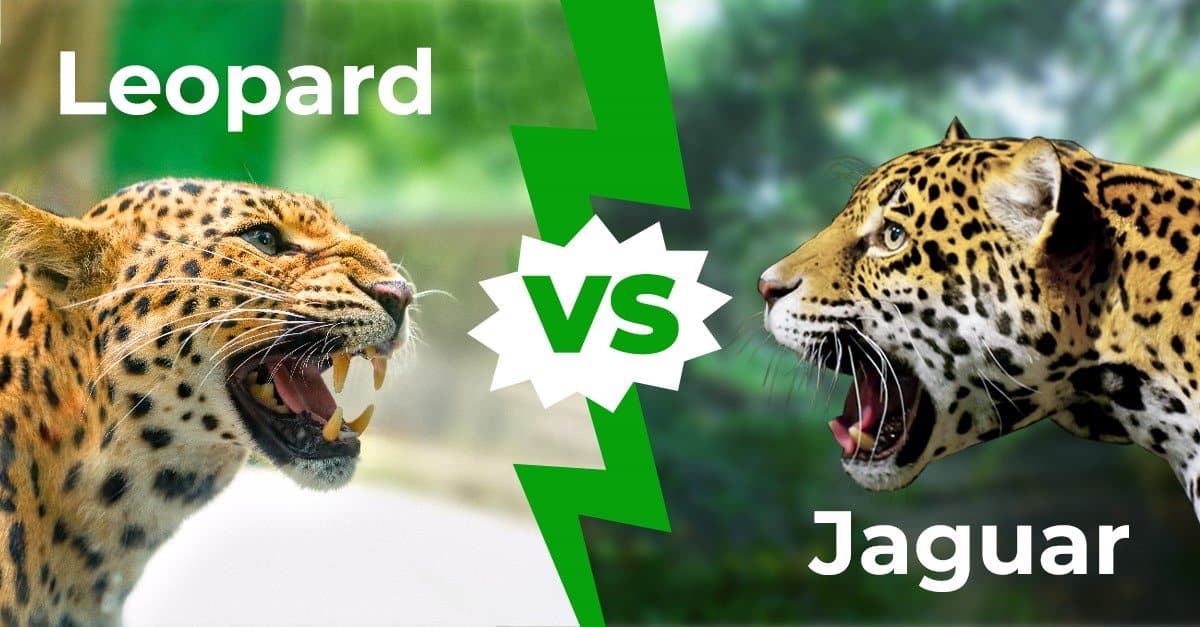
Both animals have a distinct rosette pattern across the fur. A jagged burst of black circles with tawny centers.
On close inspection, you’ll find the rosettes on each cat differs. On the leopard, they’re less complex and smaller. The patterns are grouped closer.
Rosettes on the jaguar are bigger. In the center of each rosette is one or more small black spots. Both cats may have golden fur. It’s rare but they may also be completely black.
5. Leopard vs. Jaguar: Diet
The jaguar diet is predominantly reptilian. They go after turtles, tortoises, snakes, and caimans. The leopard has a more varied diet. The cat chows on birds, gazelle, fish, lizards, antelope, and dung beetles. In other words, the leopard is capable of eating whatever it finds.
The jaguar is an apex predator. An apex predator is a species at the top of the food chain. And though occasionally attacked by lions, the jaguar has no natural predators in its ecosystem.
5. Leopard vs. Jaguar: Behavior
While these two big cat species are both solitary, territorial, nocturnal, and ambush predators, they differ behaviorally in other ways. Leopards are generally shy, kill their prey by biting their throats, are excellent climbers, and live much of their lives in trees. Jaguars, contrary to the reputation that cats do not like the water, are quite skilled swimmers. They are bold in character and kill their prey by leaping on it and delivering a fatal bite to the prey’s skull/neck area.
Leopard vs. Jaguar
At a glance, here’s a table delineating what separates the two species.
| Trait | Leopard | Jaguar |
|---|---|---|
| Scientific Name | Panthera pardus – Eight subspecies | Panthera onca – Nine subspecies |
| Habitat | Africa and Asia; tropical rainforest to temperate deciduous and alpine areas, savanna grasslands, bushland, dry and coastal scrubs, and deserts, forests | Americas; tropical forests, swampy and pampas grasslands, evergreen forests, wet savannas, mangrove swamps |
| Weight | Depends on subspecies: range 37-200 pounds for adult male; adult females about 30% lighter | Depends on subspecies: range 80-325 pounds for adult males; adult females about 10% lighter |
| Appearance | Long body and tail that assist in tree-climbing; muscular, short legs with broad paws; large, angular skull with defined cheek bones; yellowish to olive fur with black spots | Stocky build, unusually large head, short legs compared to body, pale yellow or tawny base color with black broken-edged rosettes around small black spots; some are black |
| Diet | Opportunistic feeders; prefer large ungulates, but prey on a variety of small mammals, birds, reptiles, fish, insects | Opportunistic feeders; mammals such large-sized ungulates, birds, reptiles, fish; diet depends on region and availibility |
| Behavior | Solitary, territorial, nocturnal, shy; ambush hunters that bite the throats of prey; excellent climbers; lives in trees | Solitary, territorial, nocturnal; bold in character; excellent swimmers; kill prey by jumping on them and then piercing skull/neck with its canines |
Leopard vs. Jaguar: Who Would Win in a Fight?
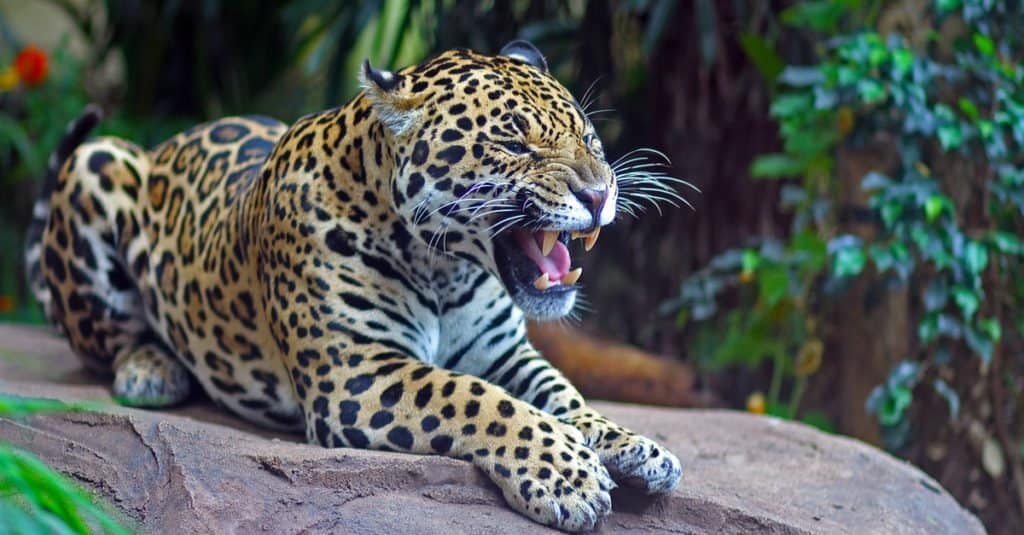
Jaguars are larger, faster, and deadlier overall than a leopard.
©GoWildPhotography/Shutterstock.com
A jaguar would beat a leopard in a fight. Both creatures could wait in ambush for one another, and that could spell a quick end to any conflict between them. However, in a typical one-on-one fight, the statistics support the jaguar.
Jaguars are larger than leopards and have a serious advantage in terms of biting power and sheer strength. Jaguars are also significantly faster than a leopard.
A fight between these two would feature the jaguar and leopard clashing, biting, and scratching each other. With their more powerful jaws and sharper claws, a the jaguar would overcome the leopard’s defenses and go for a killing blow at the throat.
The jaguar would probably come away from the fight with several deep cuts and some uncomfortable puncture wounds, but it’s clear that the larger cat would also be the last one standing.