Quick Take
- Baby dragonflies have a bizarre body part that does double duty as both lung and engine.
- Their prey never sees the weapon coming until it's too late.
- Tiny pond dwellers are quietly helping scientists measure a hidden danger to fish, wildlife, and people.
- Years of underwater life end in a dramatic transformation, and the adult's time to enjoy it is startlingly short.
One of the most beautiful flying creatures is the dragonfly, of the Anisoptera infraorder. Their ancestors have been on this earth since before dinosaurs roamed. Dragonflies exhibit several distinct appearances as they mature from larvae to adults. You might not even know you are looking at a baby dragonfly, because of its habitat and the way it grows. The facts and, even more so, the photos, of a baby dragonfly’s life are fascinating.
Dragonfly Larvae Live Underwater
Dragonfly larvae, or nymphs, are fully aquatic. A dragonfly may spend the first three years of its life there. In rare cases in very cold climates, baby dragonflies have actually spent the first six years of life in aquatic habitats. Dragonfly nymphs hatch from eggs that have been laid either on the surface of water or on underwater vegetation. As you might imagine, dragonflies need unpolluted water to live. Some live on plants near the surface of water, while others live at the bottom of the body of water.

A dragonfly has a long abdomen so it can lay eggs underwater.
©Hans Viveen/Shutterstock.com
The Strange Way Dragonfly Larvae Breathe
Believe it or not, dragonfly nymphs breathe through their rear ends. Yes, they breathe with their behinds, which can also serve as jet engines. While fish breathe through gills near the front of their bodies, dragonfly larvae have rectal gills inside their abdomens. They pull water in through their rear ends, but they can also quickly propel themselves forward by forcefully pushing the water out the same way.

Dragonfly larvae breathe through their rear ends.
©asturfauna/Shutterstock.com
How Dragonfly Larvae Eat
Baby dragonflies are voracious underwater predators with jaws that extend out to grab prey. A dragonfly nymph can even eat a tadpole. They also may eat mosquito larvae, small fish, or worms. The jaw of a dragonfly nymph (pictured below) has hooks that grab and drag food into the its mouth. Prey may not know the nymph’s jaw can extend so far, so they frequently swim too close and get caught.

Dragonflies belong to the order Odonata, from the Greek for “toothed one.”
©Holger Kirk/Shutterstock.com
Dragonfly Larvae Are Bioindicators
Dragonfly larvae are good indicators of mercury in water. The Dragonfly Mercury Project (DMP) works with volunteers to collect dragonfly larvae so scientists can analyze their mercury content. The mercury concentrations in dragonfly larvae give scientists a good estimate of the amounts of mercury in amphibians and fish in the same habitat.
When the larvae undergo metamorphosis and turn into dragonflies, all of the mercury they accumulated remains in their bodies. Since the larvae and dragonflies are also food for amphibians, fish, birds, and arthropods, knowing how much mercury the larvae contain can tell us the risks to humans and other animals.

Dragonflies and dragonfly larvae can tell scientists how much mercury is in the environment.
©K A STUDIO/Shutterstock.com
How Dragonfly Larvae Become Adults
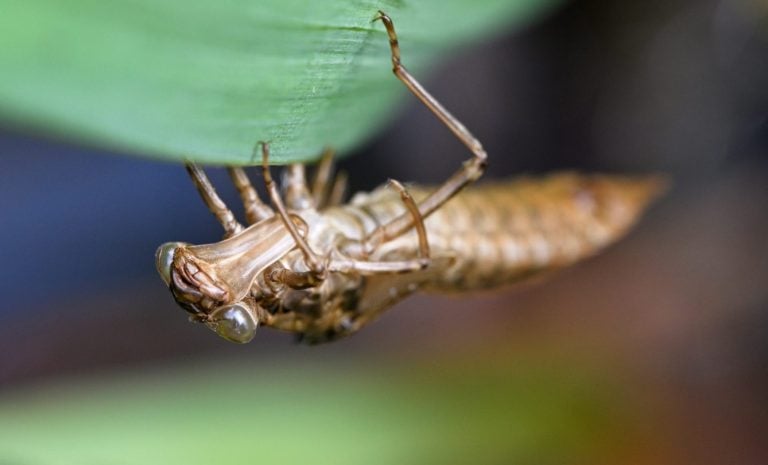
Dragonflies do not exit the water to become adults until their “teenage” years, so to speak. As nymphs grow, they molt as many as 17 times. The time it takes them to grow, as well as the number of times they molt, may be affected by habitat or climate. Food availability matters, too.
When a larva is ready to breathe air, it climbs out of the water and attaches to a twig or plant. Dragonfly emergence looks a little like how a butterfly comes out of a pupa. As with butterfly wings, it may take several hours for dragonfly wings to be ready for flight. An adult dragonfly, unlike a nymph, may survive only a few weeks to a few months.

Dragonfly nymphs molt up to 17 times.
©Michal Hykel/Shutterstock.com