
Foxes are members of the Canine family, but sometimes they act more like felines. They hunt similar prey like birds and rodents, a particular favorite of your average house cat. Foxes also stalk and ambush their prey using finely tuned hearing and motion-based eyesight. They even have long whiskers and vertical pupils like cats to see in near darkness. But do foxes have one more thing in common with cats? Can foxes climb trees?
Are Foxes Able to Climb Trees?
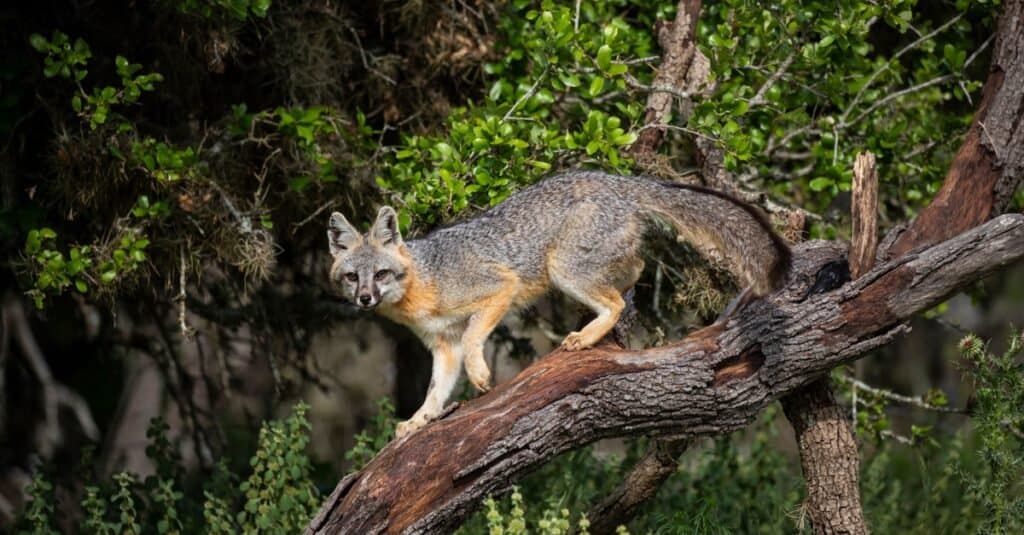
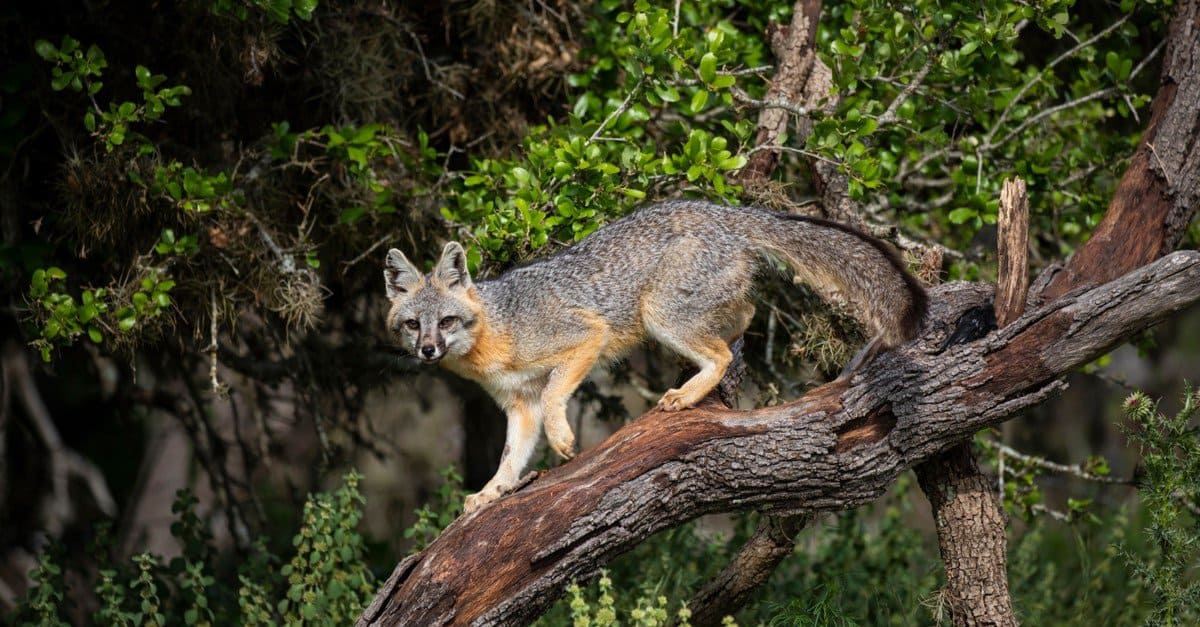
Grey foxes are one of only two species of foxes that can climb trees.
©Danita Delimont/Shutterstock.com
The short answer is no, true foxes are not considered to be tree climbers. Only two members of the Canidae family of doglike canines are considered proficient in climbing trees. These are the raccoon dog found in East Asia and the grey fox.
Grey foxes are not true foxes; they are a separate genus with the species name Urocyon cinereoargenteus. There are sixteen recognized subspecies of the grey fox found in North America and the northern part of South America. While they appear remarkably like true foxes, there are key differences. These include a stockier build and coarse black guard hairs, including the tip of the tail. Grey foxes also have a mostly black and grey coat with distinctive patches of rust red.
The grey fox is also distinct from the true fox species because of its flexible rotating wrists and partially retractable claws. These characteristics are why the grey fox can climb a tree with remarkable efficiency. They can capture and drag prey while climbing and are even known to have burrowed in tree hollows.
Red Foxes Can Climb (Kind Of!)
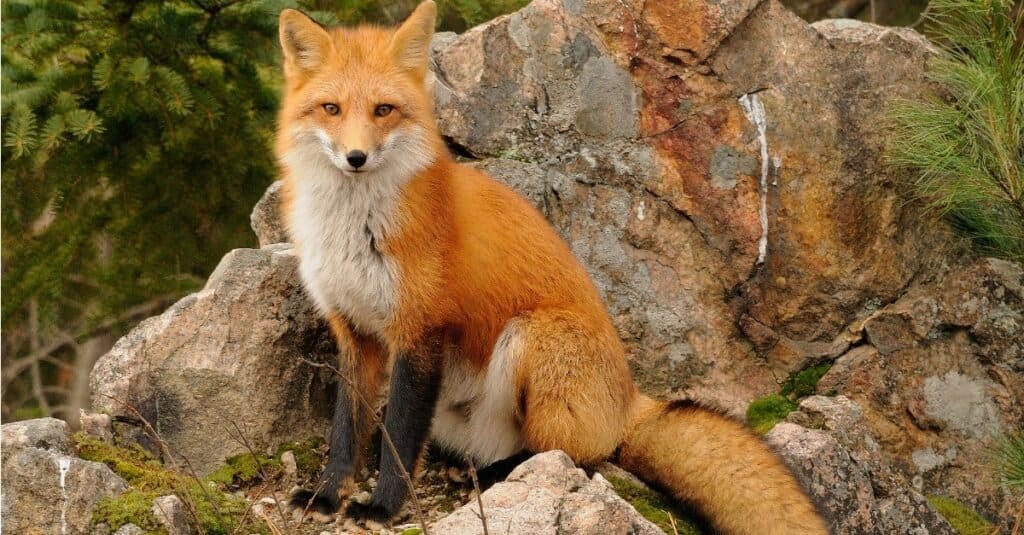
Red foxes can’t climb trees the way grey foxes can, but they can jump very high and leap from branch to branch.
©iStock.com/Rejean Bedard
The red fox, the largest species of true fox, is not as skilled at climbing as the grey fox. However, they are incredibly agile and known for being quite clever. Red foxes can jump up to six feet in the air, using their long and bushy tail for balance. They can clear high walls and fences and can leap from branch to branch instead of traditional climbing.
The red fox is not able to use its claws like the grey fox to scale vertically. This is because red foxes have claws more suitable for digging, so they do not retract. They are also less likely to climb to avoid larger predators. In contrast, grey foxes will seek higher ground in trees or shrubs where their common predator is the coyote.
Can Any Other Species of Fox Climb?
A 2002 study of San Juan kit foxes was published in the Southwestern Naturalist. Researchers conducting a behavioral study in Bakersfield, CA, observed the species climbing trees on two occasions. Before this study, there was no record of San Juan kit foxes being able to climb.
On both occasions, researchers observed a male and female fox pair. The female stayed primarily on the ground while the male traveled up and down the tree. This was to be more like a mating display, as no foraging behavior was observed. He climbed from the ground vertically for eight feet and then climbed in a vertical path back to the base.
San Juan kit foxes are thought to have evolved in arid grasslands with little to no trees. Therefore, the possibility that they were capable of climbing was not previously considered. It is important to note that researchers have not conclusively determined that the San Juan kit fox species can climb trees.
Experts who conducted the Bakersfield study hypothesize that the fox developed this adaptation in response to their changing environment. They are considering a similar adaptation that red foxes developed to survive in urban environments. Foxes are known to be accomplished foragers and highly adaptable, after all.
If a Fox Can Climb by Jumping, Can Other Canidae?
The grey fox and the raccoon dog are the only members of the Canidae family that are considered true climbers. However, some of these dog-like canines can jump quite high, and one may be a third tree climber.
Coyotes are only able to leap up to three feet, like the red fox, but can use their powerful back legs to get over rock walls and fences. However, they are often no match for the grey fox, as we stated above.
While dingos are a subject of much controversy, they are currently classified as Canis lupus dingo and are considered by many to be a subspecies of the grey wolf. They are the only native canines in Australia, and like the grey fox, they have rotating wrists. They use this adaptation not only to hold onto prey but to climb trees as well.
In general, most members of the Canidae family can jump at least one to three times their own height. This also includes domestic dogs, though some breeds are more skilled at this than others.