






G
Species Profile

Gordon Setter

Canis lupus familiaris

Black-and-tan bird dog with heart
iStock.com/Volha Maksimava

Gordon Setter Distribution

Click a location to explore more animals from that region

Origin Location

This map shows the native origin of the Gordon Setter. As a domesticated species, they are now found worldwide.

Loading map...

Found in 1 country

Size Comparison

Human 5'8"
Gordon Setter 2 ft 1 in

Gordon Setter stands at 36% of average human height.

Gordon Setter

At a Glance

Domesticated
Also Known As Gordon, Black-and-tan Setter
Diet Omnivore
Activity Diurnal+
Lifespan 5 years
Weight 36 lbs
Status Not Evaluated
Did You Know?

The Gordon Setter is the largest of the four "setter" breeds (Gordon, English, Irish, Irish Red & White).

Scientific Classification

The Gordon Setter is a large, athletic setter breed developed in Scotland as a gun dog for locating and pointing upland game birds. It is a domesticated dog breed within the gray wolf lineage.

Kingdom
Animalia
Phylum
Chordata
Class
Mammalia
Order
Carnivora
Family
Canidae
Genus
Canis
Species
Canis lupus

Distinguishing Features

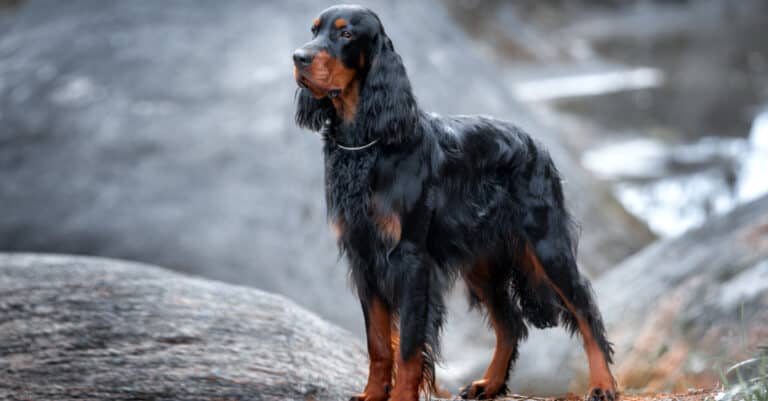
  • Black-and-tan coat pattern (typically black with rich tan markings)
  • Long, feathered ears and coat fringes on legs, chest, and tail
  • Setter/pointing behavior: freezes/‘sets’ to indicate game
  • Sturdy, muscular build compared with some other setter breeds

Physical Measurements

Males and females differ in size

Height
2 ft 2 in (2 ft – 2 ft 3 in)
1 ft 12 in (1 ft 11 in – 2 ft)
Length
3 ft 7 in (3 ft 3 in – 3 ft 11 in)
Weight
66 lbs (55 lbs – 79 lbs)
55 lbs (44 lbs – 64 lbs)
Tail Length
1 ft 1 in (12 in – 1 ft 3 in)
Top Speed
30 mph
Fast long distance runner

Appearance

Primary Colors
Secondary Colors
Tan
Skin Type Mammalian canine skin with typically dark pigmentation; covered by a medium-long, weather-resistant coat with soft feathering; moderate undercoat seasonally. Skin can be sensitive to moisture trapped in feathering/ears if not maintained.
Distinctive Features
  • Domesticated dog breed (Canis lupus familiaris) within the gray wolf lineage; selectively bred for cooperative work with humans rather than wild survival behaviors typical of the base species (wolf).
  • Origin/development: Scotland; historically used as a gun dog for locating, pointing, and holding upland game birds-strong pointing/'setter' behavior and stance.
  • Key ID trait: the only setter breed classically standardized as black-and-tan (distinguishes from Irish Setter's solid red coats and English Setter 'belton' speckling).
  • Large, athletic, slightly heavier-boned setter with substantial head and strong neck/shoulders; built for endurance over moorland terrain.
  • Long, pendant ears with feathering; requires routine ear checks/cleaning due to reduced airflow (predisposition to otitis externa).
  • Feathered tail carried level or slightly below topline; coat feathering on legs/chest can collect burrs and mats after field work.
  • Temperament/working style: steady, confident, people-oriented; typically slower and more methodical than some lighter setters, with strong scenting and persistence.
  • Grooming/care: brush 2-3x weekly (more during shedding) to prevent mats in feathering; regular trimming/cleanup of feet, ears, and sanitary areas; prompt drying after wet field conditions to reduce skin irritation/hot spots.
  • Exercise/mental needs: high; thrives with daily aerobic exercise plus scent work/field training; under-stimulation can lead to restlessness or destructive behavior.
  • Health concerns: hip and elbow dysplasia (screening advised); bloat/gastric dilatation-volvulus—feed slowly, avoid heavy exercise after meals, ask vet about preventive gastropexy; hypothyroidism; inherited eye diseases (PRA, cataracts)—regular eye exams.
  • General species-context difference from wild canids: shorter muzzle and more refined facial expression than many wolves, reduced wariness/aggression selection, and coat/markings fixed by breed standards rather than environmental camouflage.

Sexual Dimorphism

Males are typically larger and more heavily boned with a broader head and chest; females are slightly smaller and more refined while retaining the same coat pattern and working posture.

  • Greater overall height and weight; broader skull and stronger muzzle
  • Heavier bone and more pronounced chest/neck musculature
  • Often more profuse feathering as maturity develops (individual variation)
  • Slightly smaller frame with a finer head and lighter bone
  • Often a sleeker outline while maintaining athletic build
  • Same black-and-tan markings and feathering pattern, typically a bit less heavy in appearance

Did You Know?

The Gordon Setter is the largest of the four "setter" breeds (Gordon, English, Irish, Irish Red & White).

Its signature black-and-tan coat and heavy feathering make it easy to identify in the field and in portraits of sporting estates.

"Setting" predates firearms: early setters worked with hunters using nets, crouching/holding game for capture-later evolving into the modern pointing style.

The breed name is linked to the Duke of Gordon's kennels at Gordon Castle in Scotland, which helped standardize the type.

Gordons are known for a deliberate, methodical hunt-often covering ground with a strong nose rather than pure speed.

The breed was recognized early by major kennel organizations (e.g., American Kennel Club recognition dates to the 1890s).

Their long, low "setter stance" is an instinctive freeze-and-point behavior, not a trained trick.

Unique Adaptations

  • Purpose-built scenting ability and stamina for long days on Scottish moors and upland cover.
  • Weather-resistant double coat with feathering that helps shed water and insulate, but requires maintenance to prevent matting.
  • Athletic build and deep chest for endurance-an advantage in field work but also a reason to manage bloat risk.
  • Biddable, cooperative temperament shaped by domestication: compared with the gray wolf (Canis lupus), Gordons are selected for reduced fear/aggression, strong human social bonding, and responsiveness to cues.
  • Soft, controlled movement in cover: selected to work close enough for a gun while staying steady on birds.

Interesting Behaviors

  • Quartering: sweeping back and forth across the wind to find scent efficiently.
  • Hard point ("set"): freezing with head and tail aligned, indicating hidden birds.
  • Scent-checking and re-locating: cautiously advancing and re-freezing as scent shifts.
  • "Backing"/honoring: pausing to point when another dog is already on point (common in pointing breeds).
  • Velcro companionship: strong people-focus at home, often shadowing family members.
  • Adolescent "bounce": long puppyhood with bursts of energy; benefits from structured training and outlets.
  • Vocal alerting: may announce visitors with deep barks, then settle when introduced.

Cultural Significance

The Gordon Setter is closely tied to Scotland's sporting-estate tradition and the development of modern gun dogs. Often depicted in 19th-century sporting art and literature, it represents the upland bird-hunting partnership between handler and dog-an intentionally domesticated working role within the gray-wolf lineage (Canis lupus familiaris).

Myths & Legends

Gordon Castle origin lore: sporting histories commonly credit the Duke of Gordon's kennels in the late 18th-early 19th century with consolidating the black-and-tan "Gordon Castle Setter" type that became today's breed name.

The old "netting dog" story: traditional accounts describe early setters that would "set" (crouch/freeze) so hunters could cast nets-an origin tale often repeated when explaining why the breed points so dramatically.

Victorian shooting-party anecdotes: period sporting writings describe black-and-tan setters as a gentleman's moorland companion-steadiness and style in the field became part of the breed's cultural image.

Naming tradition: older British references often called them "Black and Tan Setters," a historical label preserved in field lore and early kennel records before "Gordon Setter" became standard.

Gamekeeper tales from Scottish estates frequently praised the breed's 'sense'-a reputation for working methodically and sticking to a line of scent even in rough heather, reinforcing its legendary persistence among upland hunters.

Conservation Status

NE Not Evaluated

Has not yet been evaluated against the criteria.

Population Stable

Life Cycle

Birth 7 pups
Lifespan 5 years

Lifespan

In the Wild
2–10 years
In Captivity
8–13 years

Reproduction

Mating System Polygynandry
Social Structure Managed Domestic
Breeding Pattern Transient
Fertilization Managed Selective
Birth Type Internal_fertilization

Gordon Setter (Canis lupus familiaris) breeds like other dogs: dogs may mate with multiple partners (polygynandry). Breeding is usually people-managed and selective, with planned, brief matings, health screening, and no lifelong pair bonds.

Behavior & Ecology

Social Pack Group: 4
Activity Diurnal, Crepuscular
Diet Omnivore Meat-forward foods (commonly chicken or turkey; many also show strong preference for fatty/odorous meats and meat-based training treats).

Temperament

Affectionate and loyal with family; strong human bonding relative to gray wolves (base species) and typically more handler-oriented than many independent hunting breeds
Confident, steady field temperament; can be reserved with strangers-benefits from early, positive exposure to varied people, dogs, and environments
High stamina and athletic drive; requires substantial daily exercise plus scent/field-style enrichment (tracking, retrieves, structured off-leash in safe areas)
Strong prey drive for birds and small wildlife; reliable recall often requires long-term reinforcement training and management around game
Sensitive to harsh corrections; responds best to consistent, reward-based training and clear routines
Potential for boredom-related behaviors (chewing, digging, vocalizing) if under-exercised or under-stimulated
Breed-typical care: coat requires regular brushing (feathering mats easily) and ear care due to drop ears; needs mental work as much as running
Gordon Setters: hip and elbow dysplasia may limit exercise; bloat risk needs careful feeding; avoid hard exercise at mealtimes; retinal disease may affect night confidence; hypothyroidism changes energy and weight; cancer risk—regular vet checks help.

Communication

Alert barking toward novel people/animals or environmental changes Often less 'yappy' than small breeds but can be persistent if bored
Excitement vocalizations (whines/whimpers) during anticipation of work, feeding, or separation
Play growls and low grumbles during social play Typically relaxed body language accompanies this
Olfactory investigation and scent-marking (urine marking more common in intact males); strong nose drives exploratory 'checking' behavior
Body posture and tail carriage: still, forward-leaning stance and intense gaze when locating scent; pointing behavior is a key breed-distinguishing communication signal in the field
Mouthy carrying (soft mouth when trained) used to pick up dummies/game; may carry objects to solicit interaction
Pawing/leaning and close contact to solicit attention; uses proximity and eye contact frequently with familiar handlers
Ear and facial expressions: soft eyes/relaxed ears when affiliative; pinned ears/averted gaze when uncertain-important for reading their often-reserved initial approach

Habitat

Biomes:
Temperate Forest Boreal Forest (Taiga) Temperate Grassland Tundra Mediterranean Desert Hot Desert Cold Wetland Freshwater Marine Savanna Tropical Dry Forest Tropical Rainforest Temperate Rainforest +8
Terrain:
Hilly Mountainous Plains Valley Coastal Riverine
Elevation: Up to 14763 ft 9 in

Ecological Role

Domesticated mesocarnivore/omnivore and specialized hunting companion (gun dog) within human-managed ecosystems; when free-ranging, an opportunistic predator/scavenger influencing local wildlife.

assists humans in locating/pointing upland game, supporting managed hunting and retrieval activities companion animal role (social/therapeutic value) with indirect effects on human well-being in free-ranging/feral situations, can suppress some small-mammal populations but may also negatively impact ground-nesting birds and native wildlife scavenging of anthropogenic food waste/carcasses in feral contexts (can also increase human-wildlife conflict risk)

Diet Details

Main Prey:
Upland game birds Small mammals Waterfowl and other birds Fish Human-provided animal foods
Other Foods:
Berries and fallen fruit Grasses Roots, tubers and plant scraps Human-provided plant foods

Human Interaction

Domestication Status

Domesticated

The Gordon Setter (Canis lupus familiaris) is a Scottish gun dog bred to find upland game birds by scent and set. Gordons are athletic, have stamina, use scent, focus on their handler, and have a black-and-tan coat and steady style. They are family pets, hunting and competition partners, need daily contact and exercise, and dislike long isolation.

Danger Level

Low
  • Accidental knocks/impact injuries due to size and exuberant movement, especially in adolescents
  • Mouthing or nipping in poorly trained young dogs
  • Bite risk increases with fear, pain, poor socialization, or resource guarding (not breed-unique)
  • Zoonotic/parasitic risks common to dogs (e.g., roundworms, ticks) if preventive care is neglected
  • Allergy/asthma triggers from dander and shedding

As a Pet

Suitable as Pet

Legality: Generally legal as a companion animal where domestic dogs are permitted; subject to standard local rules (licensing, leash laws, vaccination/rabies requirements, breeding regulations, and HOA/landlord restrictions). Not typically targeted by breed-specific legislation.

Care Level: Experienced

Purchase Cost: $800 - $2,500
Lifetime Cost: $20,000 - $45,000

Economic Value

Uses:
Companion animal services Sporting/hunting work Breeding and showing Training and behavior services Veterinary and preventive care markets
Products:
  • puppies from registered breeders
  • stud services and breeding rights
  • hunting/field trial participation and related spending
  • professional training (gun dog, obedience, scent work)
  • grooming supplies/services (coat care, ear care)
  • specialized equipment (crates, e-collars where legal, long lines, boots, outdoor gear)

Relationships

Quick Take

  • Attaining full physical maturity requires 36 months for this heaviest of setter breeds.
  • Reaching 80 pounds of body mass contributes to the frequent development of gastric torsion.
  • Counter-intuitively, this elite bird dog lacks the speed typically exhibited by other setters.
  • Limiting puppy exercise to 5-minute increments is necessary to protect sensitive developmental stages.

The Gordon Setter, also called Black and Tan Setter, is the largest and heaviest breed of setters. It was originally developed in Scotland for bird hunting, using its scent to find game birds but without killing them, instead standing on point while waiting for their owners, or retrieving game as necessary. Categorized as a sporting dog or gundog depending on the kennel club or council, it was first mentioned in print in the 19th century, and is believed to be descended from the English Spaniel, Land Spaniel, and Spanish Pointer. The breed has an excellent sense of smell and endurance, though it’s not as fast as other setters or pointers. It is described as patient, loyal, independent, affectionate, curious, confident, sensitive, athletic, and energetic, whether as a hunting companion, companion animal, or family pet.

An infographic about Gordon Setters highlighting their weight up to 80 pounds, 36-month maturity period, and health risks such as hip dysplasia and bloat.
From a grueling 36-month puppy phase to high-stakes health risks, raising the world's heaviest setter is a marathon of endurance for any owner. © A-Z Animals

3 Pros and Cons of Owning Gordon Setters

ProsCons
Stable personality: This breed is versatile enough to be a hunting companion, companion animal, or family pet. It’s dependable and sensible around anyone.Demanding: The Gordon Setter loves to run. This high-energy breed has separation anxiety as well as a great need for daily exercise to burn off excess energy. If you cannot provide the companionship and play it needs, you’re better off with a more low-key or smaller dog.
Great learner: The earlier this dog is trained, the better it will remember good habits. It loves having tasks to do.Jealousy and prey instinct: The Gordon Setter gets attached to mainly one person. It is jealous of other pets and can act hostile towards strange dogs. As a setter, it has the instinct to chase smaller animals, so having smaller pets around is risky.
Watchdog: As the most alert of the setters, this breed is the most discriminating of strangers, and so also makes a great tracking, guarding, and watchdog.Grooming: With a generally long, silky coat, the Gordon Setter needs regular brushing along with bathing. Doing so will cut down on shedding, but it’s still a moderate shedder, which isn’t good for people who are looking for a hypoallergenic dog.
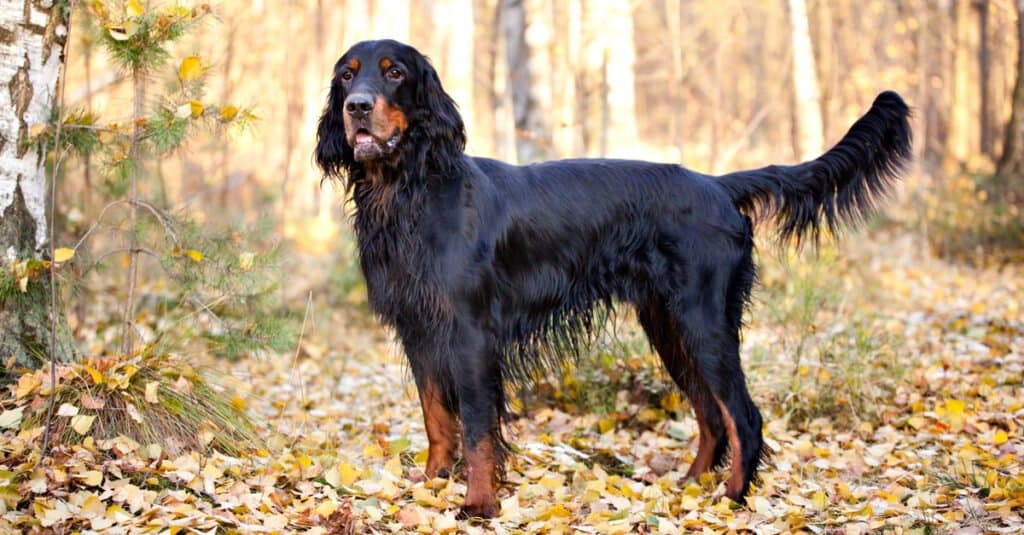
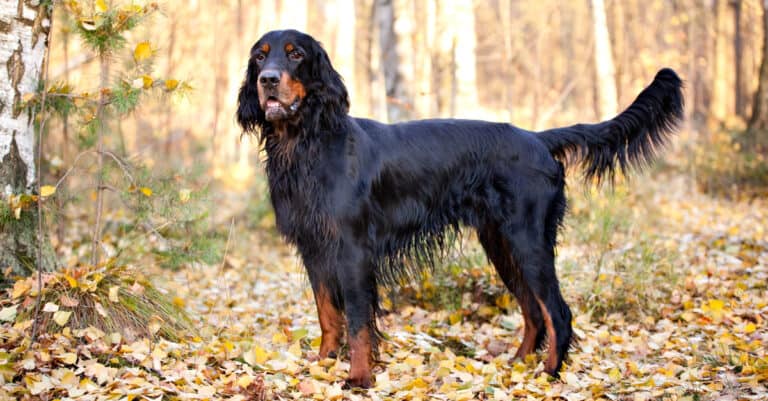
Gordon Setter in Autumn Leaves

Athletic and high-energy, the Gordon Setter loves to be outdoors.

Size and Weight

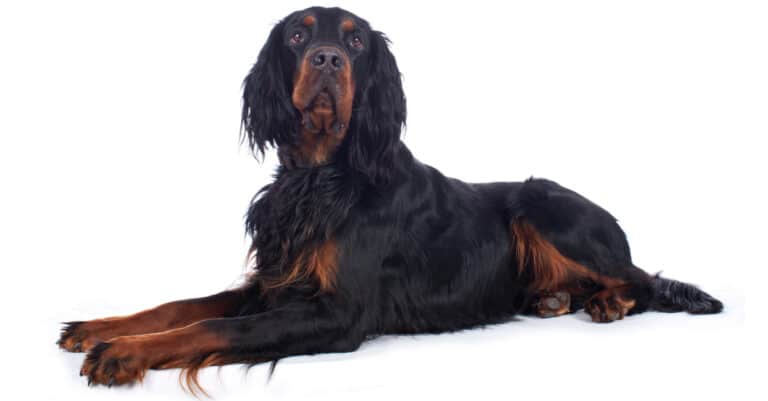
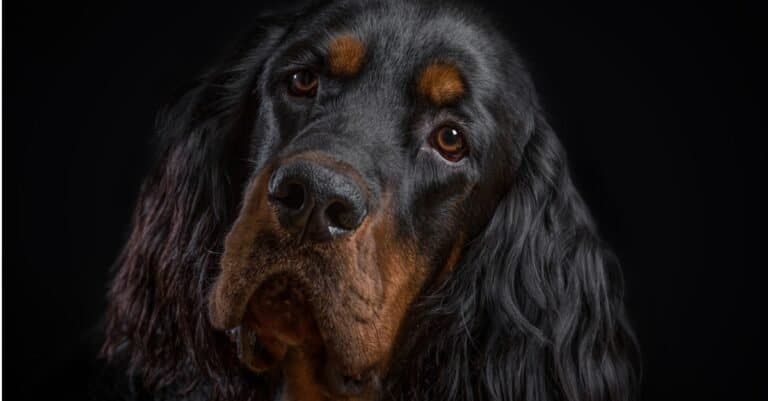
The Gordon Setter is a medium to large dog with a silky, straight to wavy coat in black and tan color, with short hair on its head. Adult male height is 24 to 27 inches, and adult female height is 23 to 26 inches. Adult male weight is 55 to 80 pounds, with an average weight of 66 pounds, and adult female weight is 45 to 70 pounds, with an average of 55 pounds. Gordon Setter puppies weigh an average of 9 pounds at 8 weeks and are considered fully grown at 36 months.

Common Health Issues

The Gordon Setter is an athletic, high-energy breed with an average lifespan. As a result, many health issues have to do with joint wear, like hip dysplasia. It’s also a large breed, so it needs space to be able to move freely in daily life, other than for exercise. Large breeds also tend towards gastric torsion (bloat). The Gordon Setter’s lifespan is 10 to 12 years.

Temperament

The Gordon Setter’s temperament is described as dignified and calm. Its traits are patience, loyalty, independence, affection, curiosity, confidence, and sensitivity, with a silly, energetic, and demanding personality. A family-oriented dog, it is vulnerable to having separation anxiety. It will become attached mainly to one person and stay on alert for strangers, but it also does not tend to get along with other pets and enjoys chasing smaller animals.

How To Take Care of Gordon Setters

Like other dog breeds, the Gordon Setter has its own needs for health and care. Every potential Gordon Setter owner should be aware of their unique traits. If you want to know upfront how your dog will behave, it’s best to either purchase as a puppy from a breeder or as an adult from a rescue. The price of your Gordon Setter is not only the initial purchase or adoption price, but the cost of food, toys, and veterinary care over time.

The Best Dog Food

Whether you have a Gordon Setter puppy or adult dog, the food you choose to provide your pet is one of the most important factors for satisfying their nutritional needs and keeping them healthy. Regardless of their age, their food should be approved by the AAFCO (Association of American Feed Control Officials).

Puppy food: Never feed your puppy adult dog food. The food must say it’s formulated for puppies, growth, or all life stages. It should have high-quality meat as the first and predominant ingredient, which will provide all the amino acids they need for their development. Also, large breeds grow quickly, and excessive growth is a concern, so their puppy food should have less fat, calcium, phosphorus, and vitamin D than other puppy foods. Hence, it should specify that it is for large breeds.

Adult dog food: Like puppy food, Gordon Setter adult dog food should be AAFCO-compliant, with premium ingredients, and animal protein should be the predominant and one of the first ingredients on the list. Make sure the food states it’s formulated for large breeds, which will help to minimize the risk of developing orthopedic disease, obesity, and bloat.

Maintenance And Grooming

The Gordon Setter does not have short hair, but a type of mixed-length coat. Instead, its coat has straight to wavy hair, with long hair on its legs, tail, under the stomach, chest, and ears, and short hair everywhere else. It is not hypoallergenic, either, and is a moderate shedder. For this reason, it needs regular brushing of one to three days a week and bathing every 1 to 6 weeks (2 weeks on average), depending on how dirty or messy it gets. Besides toenail clipping, you’ll also want to trim the hair on its feet and between its toes. To resemble the breed standard, you’ll want a variety of shears and brushes. Straight shears, thinning shears, and a medium/coarse comb, a slicker brush, and a wire pin brush are all useful to best handle tangles and groom your Gordon Setter.

Training

Crate training is a great way of training your Gordon Setter, especially when you and your family can’t be at home to keep it company. Since it’s a large breed, the crate size should be 42 inches. This crate size makes sure it easily has enough room to sit, stand, and turn around. In the wild, dogs seek refuge in dens for sleep and safe haven, so a crate acts similar when you get your pet comfortable with it. Crate size is just as important in training your dog as to minimize separation anxiety-related destruction. It’s also great for potty training.

Exercise

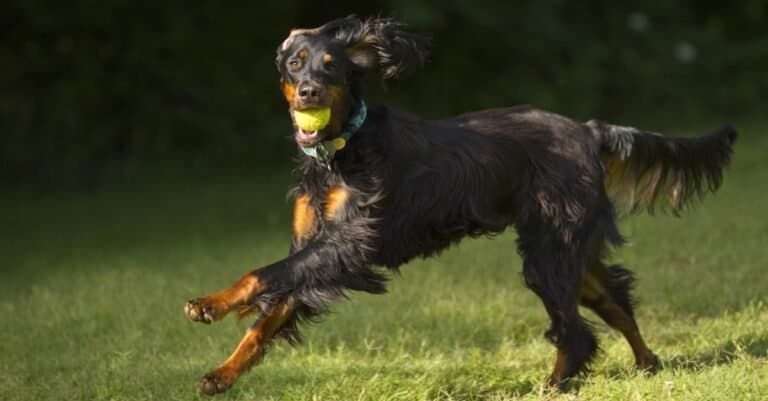
Gordon Setters need one to two hours of activity and exercise every day. They should at least have a long, brisk walk in addition to a stimulating activity.

Puppies

Gordon Setter puppies are very energetic and will engage in exuberant jumping as soon as possible. However, you should limit their playtime to 5 minutes per month of age. Their growth plates stay soft and don’t close until 18 to 14 months of age, so avoid strenuous activity.
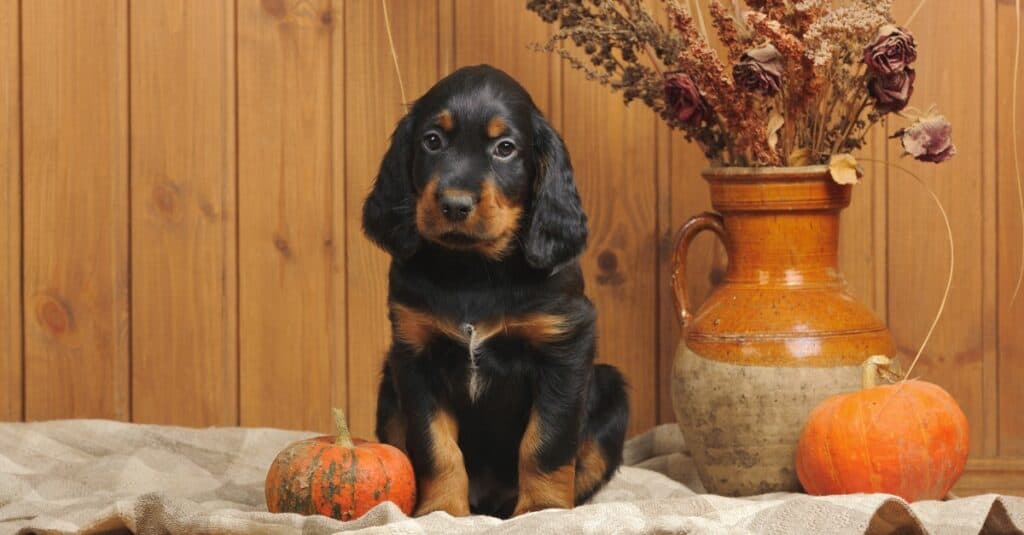
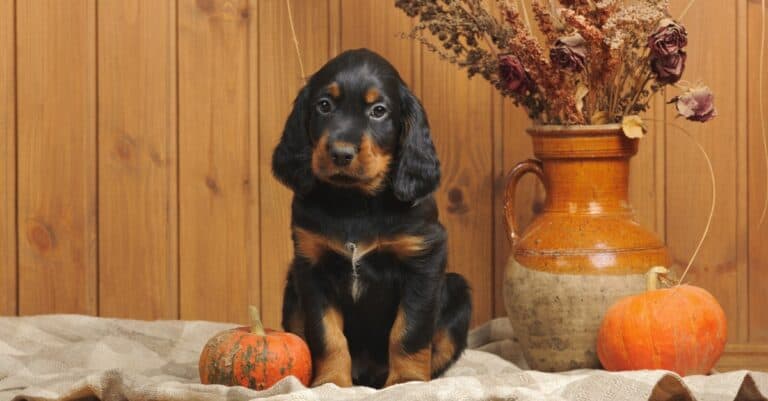
Gordon Setter Puppy

Avoid strenuous exercise with your Gordon Setter Puppy.

Gordon Setter And Children

This breed is excellent with children. It is playful, energetic, and affectionate enough for children of all ages, although it should be supervised around small children due to its large size. The earlier you include children in your dog’s socialization, the better.

Dogs similar to Gordon Setters

  • Black and Tan Virginia Foxhound: Boasting a similar color, this breed is a scenthound from the United States that also makes a great tracker, watchdog, or guard dog.
  • English Pointer: This breed is another gundog. Like other pointers, it has short hair. The biggest difference in hunting behavior is only pointing, whereas setters are also retrievers.
  • English Springer Spaniel: Another long, wavy-haired breed as well as a high-stamina hunting dog, this spaniel was originally used for flushing or “springing” game birds.

Famous Gordon Setters

Gio and Nati were award-winning Gordon Setters. Gio was a Hillock Kennel dog that won Best in Specialty Show at the 2016 Gordon Setter National Specialty as well as a spot in the AKC’s Top 20 Sporting Dogs. Nati was another Hillock Kennel dog who won the title of Number One Gordon Setter Female in the United States in 2007 and 2009. She also won number six Gordon Setter overall, Best Bred by Exhibitor, and Best of Opposite Sex in 2009, and several Sporting groups and Best in Specialty Show contests.

View all 261 animals that start with G

Sources

  1. Wikipedia / Accessed September 2, 2021
  2. Dog Breed Info / Accessed September 2, 2021
  3. The Spruce Pets / Accessed September 2, 2021
  4. Gordon Setter Expert / Accessed September 2, 2021
  5. Your Purebred Puppy / Accessed September 2, 2021
  6. Puppy Weights / Accessed September 2, 2021
  7. Dog-Care-Knowledge / Accessed September 2, 2021
  8. PawDiet / Accessed September 2, 2021
  9. American Kennel Club / Accessed September 2, 2021
  10. Gordon Setter Expert / Accessed September 2, 2021
  11. Pet Crates Direct / Accessed September 2, 2021
  12. Terrific Pets / Accessed September 2, 2021
  13. Gordon Setter Expert / Accessed September 2, 2021
  14. Pet ID Register / Accessed September 2, 2021
  15. Wag Walking / Accessed September 2, 2021
  16. Dog House Times / Accessed September 2, 2021
  17. Project Upland / Accessed September 2, 2021
  18. Animal Care Tip / Accessed September 2, 2021
  19. American Kennel Club / Accessed September 2, 2021
  20. Gordon Setter Expert / Accessed September 2, 2021
  21. The Dog Visitor / Accessed September 2, 2021
  22. Pet Keen / Accessed September 2, 2021
  23. Pet ID Register / Accessed September 2, 2021
  24. Pet Calculator / Accessed September 2, 2021
  25. Next Day Pets / Accessed September 2, 2021
  26. Wag Walking / Accessed September 2, 2021
  27. Pet ID Register / Accessed September 2, 2021
  28. Dogell / Accessed September 2, 2021
  29. Pet Your Dog / Accessed September 2, 2021
A-Z Animals Staff

About the Author

A-Z Animals Staff

AZ Animals is a growing team of animals experts, researchers, farmers, conservationists, writers, editors, and -- of course -- pet owners who have come together to help you better understand the animal kingdom and how we interact.
Connect:

Thank you for reading! Have some feedback for us?


Gordon Setter FAQs (Frequently Asked Questions)

The price of a Gordon Setter from a breeder can cost anywhere from $600 to $4,000, with an average of $1,225 and a median of $750. Pedigree papers are a minimum, while breeding rights and show quality cost more. Gordon Setter puppies typically cost $950 to $1,500. Dogs of any age from a rescue have the same price as the adoption fee.