Quick Take
- One hawk in New Jersey is more closely related to eagles than to other hawks, and most people would never guess which one it is. Meet the eagle-related hawk →
- Three of these hawks look so similar that even experienced birders struggle to tell them apart, but there are specific features that actually set them apart. See how to tell them apart →
- One species only visits New Jersey during a single season, and timing your search wrong means missing it entirely. Plan your fall visit →
- Not all of these hawks hunt from the sky. One hunts in a way that's far closer to an owl than a typical hawk. Discover its owl-like hunting →
Hawks are widely distributed birds of prey in the order Accipitriformes. They vary in behavior, habitat, shape, size, and color. There are about 65 species of hawks globally, all of which are classified as raptors or birds of prey.
Hawks are powerful birds. They have sharp, curved talons for catching prey and hooked beaks for tearing it apart. They also have an excellent sense of hearing and some of the sharpest vision in the entire animal kingdom; their visual acuity is eight times that of humans.
Hawks thrive in coastal regions, mountains, grasslands, savannas, forests, prairies, and marshes. Whether you’re driving, hiking in the woods, or relaxing in your backyard, spotting a hawk is always a treat. Continue reading to learn about hawks in New Jersey and where to find them.
Northern Goshawk
| Scientific name | Astur atricapillus |
| Color | Brown, grey, red, black, and white |
| Weight | 1.4-3.4 pounds |
| Height | 18-27 inches |
| Wingspan | 43-50 inches |
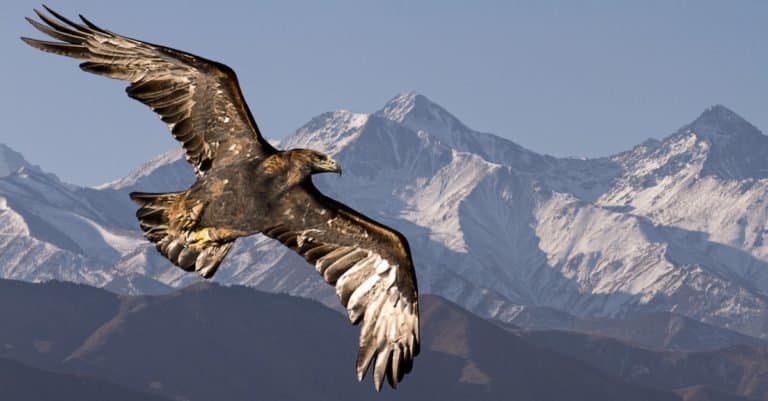
The Northern goshawk (Astur atricapillus) is a wild, fierce, and large bird of prey more closely related to eagles than to most typical hawks. Northern goshawks are most often spotted in New Jersey during winter. They live in the deepest parts of the forests, where they are difficult to find. They are secretive but become aggressive when disturbed or confronted.

The American Northern goshawk is a winter visitor to Southern New Jersey, but a resident bird farther north in the state.
©Raju Creative pro/Shutterstock.com
These birds consume rabbits, doves, crows, squirrels, wood pigeons, and other birds. The Northern goshawk watches for prey from tall perches in coniferous or mixed forests.
Northern goshawks are highly territorial and aggressively guard areas they consider their own. Females lay two to four eggs per season and are solely responsible for incubation.
An adult Northern goshawk has very few predators. Nestlings and juveniles are often hunted by other eagles, wolves, and owls.
Cooper’s Hawk
| Scientific name | Astur cooperii |
| Color | Brown, grey, white |
| Weight | 7.8-14.5 ounces |
| Height | 14-20 inches |
| Wingspan | 24.4- 35.4 inches |

A Cooper’s hawk is a medium-sized bird of prey that spends most of its time at the edge of the forest.
©Aussiemandias/Shutterstock.com
Cooper’s hawks (Astur cooperii) are medium-sized birds of prey that spend most of their time at the edge of the forest, where they can easily ambush elusive prey species. They are very similar to the northern goshawk and sharp-shinned hawk, and it can be hard to distinguish among them, as they all share black-banded tail feathers, red-orange breasts, and blue-gray backs.
Cooper’s hawks consume quails, plump fowl (such as pheasants), chickens, and smaller mammals. These birds often spend hours perched in woodland canopies waiting for prey. Their camouflaged feathers help them blend in among tree branches. They prefer taking prey by surprise rather than engaging in lengthy pursuits.
Generally, Cooper’s hawks’ predators include only eagles and other larger birds of prey. Their primary threat is the widespread use of pesticides, which has killed thousands of hawks and other birds of prey.
Cooper’s hawks are seasonally monogamous, pairing with one mate per breeding season. Females lay two to six eggs per clutch.
Broad-winged Hawk
| Scientific name | Buteo platypterus |
| Color | Black, white, reddish-brown |
| Weight | 9.3-19.8 ounces |
| Height | 13.4-17.3 inches |
| Wingspan | 29.0-39.0 inches |
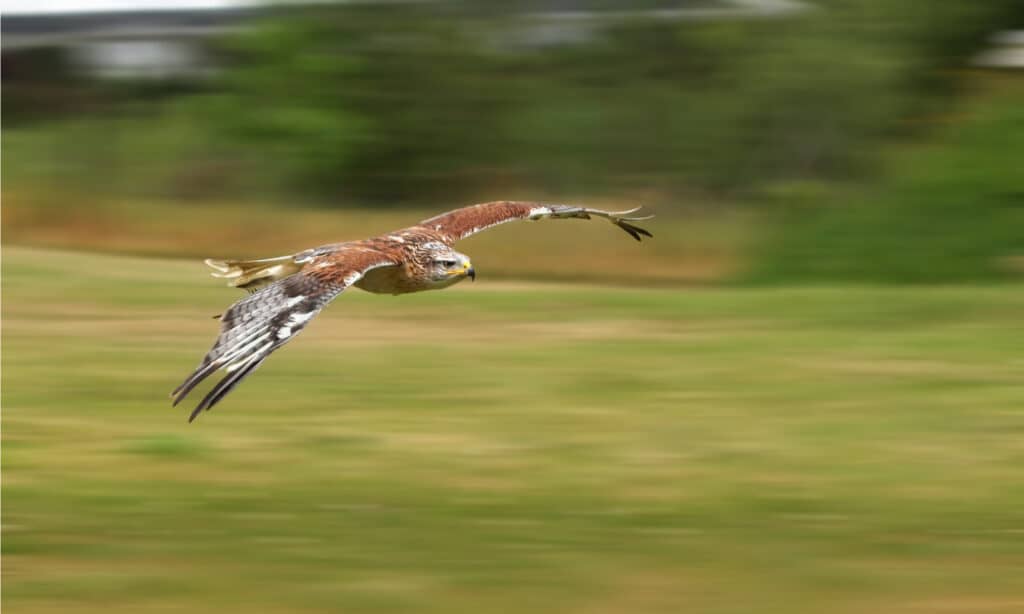
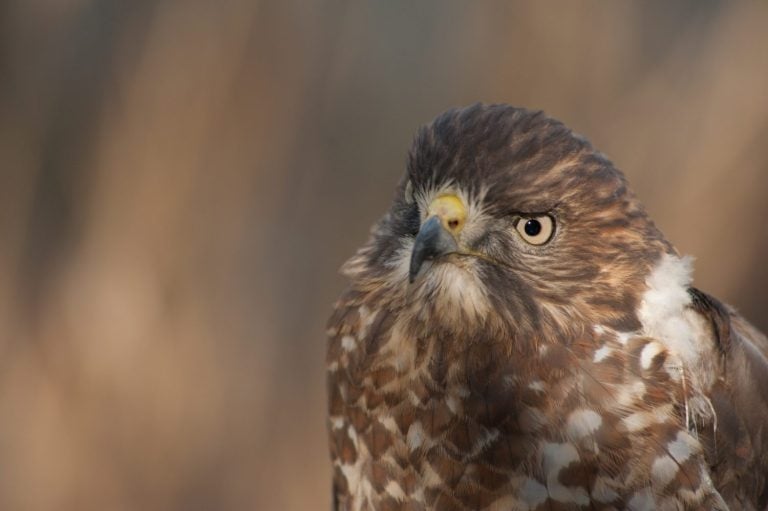
Broad-winged hawks are medium-sized birds of prey with compact, stocky bodies like those of geese and crows.
©pr2is/Shutterstock.com
Migratory visitors to New Jersey, the best time to see broad-winged hawks (Buteo platypterus) is in the fall when they migrate in large numbers.
Broad-winged hawks are medium-sized birds of prey with compact, stocky bodies like those of geese and crows. Their diet mainly consists of snakes, lizards, young turtles, frogs, and other small mammals.
Adult broad-winged hawks are sometimes preyed upon by other hawks, eagles, and great horned owls. Other threats include collisions with vehicles, poisoning, hunting, and habitat destruction.
Female broad-winged hawks lay two to three eggs, and both parents protect the nest and young from potential predators.
Red-shouldered Hawk
| Scientific name | Buteo lineatus |
| Color | Dark, white, red |
| Weight | 1-1.7 pounds |
| Height | 15-24 inches |
| Wingspan | 35-50 inches |
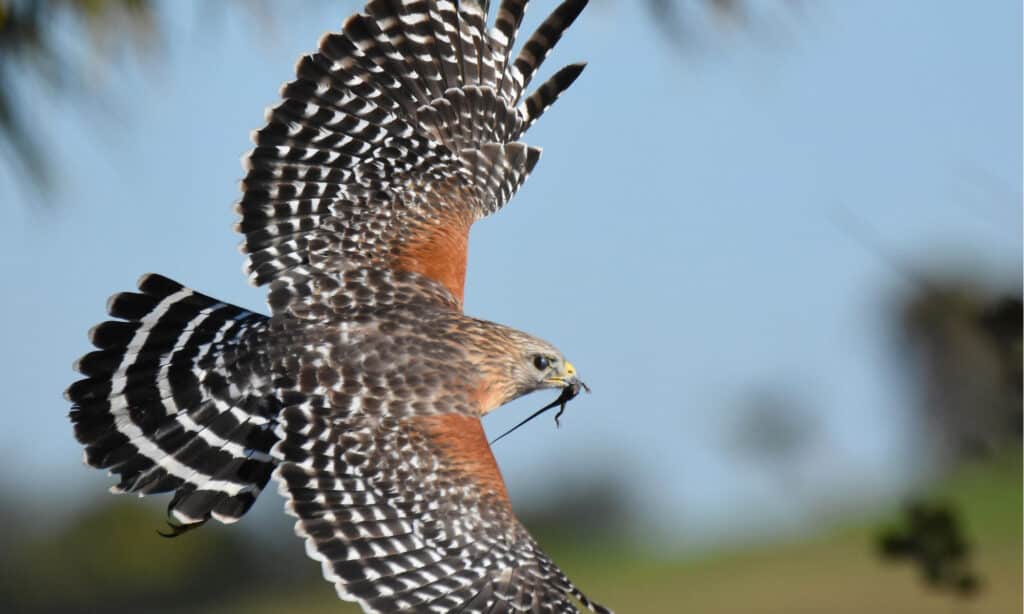
Red-shouldered hawks prey on reptiles, rodents, rabbits, crayfish, amphibians, and other small mammals.
©MTKhaled mahmud/Shutterstock.com
Year-round residents of New Jersey, Red-shouldered hawks (Buteo lineatus) are unique hawks with distinctive dark-and-white checkered wings. They live near wet forests because they hunt along ponds, swamps, and streams, but they also soar high along coasts and ridges.
Red-shouldered hawks prey on reptiles, rodents, rabbits, crayfish, amphibians, and other small mammals. However, red-shouldered hawks are themselves preyed upon by snakes, peregrine falcons, fishers, and humans.
These birds are monogamous, and they start breeding once they are two years old. Female red-shouldered hawks lay two to five white or bluish eggs. The female incubates the eggs for about five weeks, while the male provides food.
Red-tailed Hawk
| Scientific name | Buteo jamaicensis |
| Color | Brown, pale, cinnamon-red, and dark |
| Weight | 1.5-3.5 pounds |
| Height | 18-26 inches |
| Wingspan | 43-56 inches |
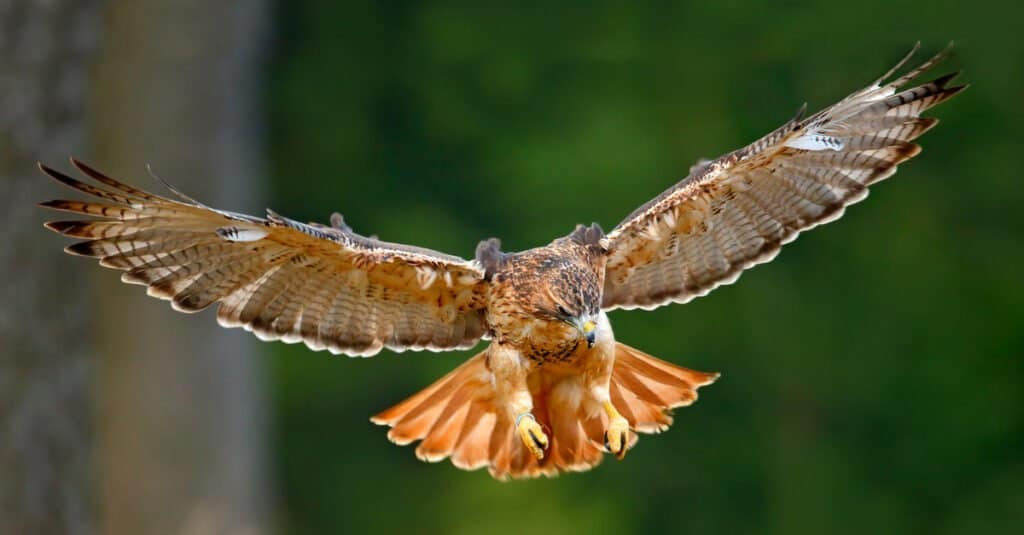
The best place to see red-tailed hawks is in an open field, where they spend most of their time circling in search of prey.
©Ondrej Prosicky/Shutterstock.com
Red-tailed hawks (Buteo jamaicensis) are commonly seen throughout New Jersey all year. You can find them almost anywhere, as they are comfortable in virtually any habitat. The best place to see red-tailed hawks is in an open field, where they spend most of their time circling in search of prey.
As the name suggests, they have a distinctive short, wide red tail. They also have a brown back and pale underside with a streaked belly. Their wings are large and rounded like those of a goose.
Red-tailed hawks have a varied diet. They feed on moles, ground squirrels, rabbits, small raccoons, mice, and voles. Great horned owls and bobcats often prey on red-tailed hawks.
Red-tailed hawks build their nests on top of the tallest buildings, cliff ledges, and tall trees. Females lay two to three whitish, brown-blotched eggs.
Sharp-shinned Hawk
| Scientific name | Accipiter striatus |
| Color | Blue-gray, red-orange, brown, and dark |
| Weight | 2.9-7.7 ounces |
| Height | 9.1-15 inches |
| Wingspan | 17-27 inches |
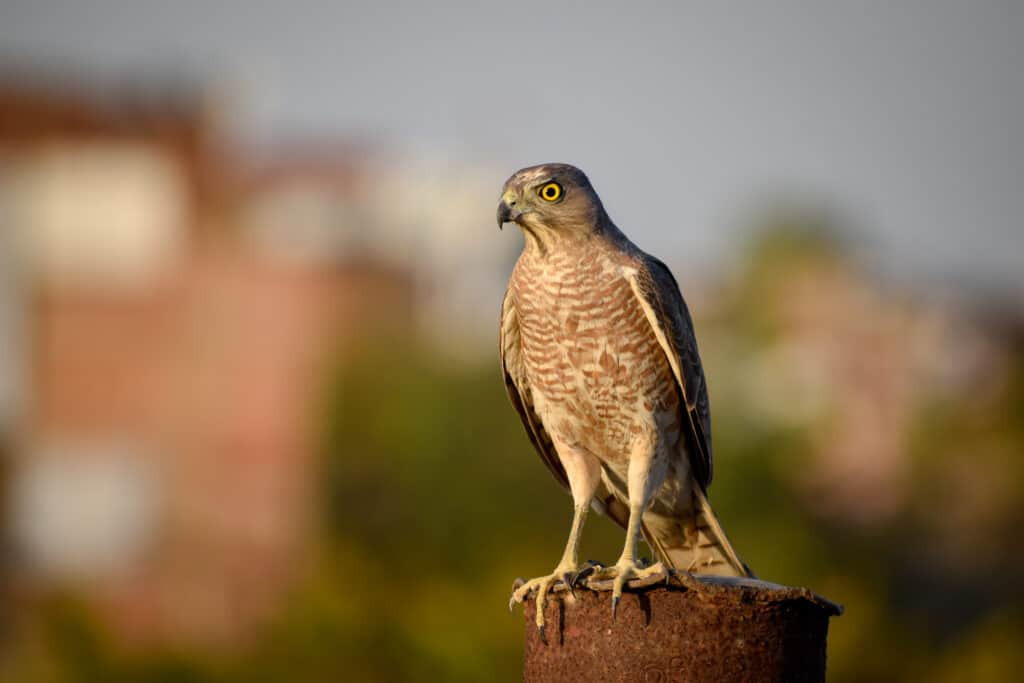
Sharp-shinned hawks are between 11 and 15 inches long, weigh between 5.5 and 8 ounces, and have a wingspan of 23 to 27 inches.
©Vizz Effect/Shutterstock.com
Among the smaller hawks found in New Jersey, sharp-shinned hawks (Accipiter striatus) have rounded wings and square-tipped tails. They have tiny heads that appear barely noticeable when the bird is viewed from below. Female sharp-shinned hawks are bigger than males.
Adult sharp-shinned hawks are grayish-blue on top with red-orange breasts. Their young are brown with broad dark tail bands similar to those of adults.
Sharp-shinned hawks can fly at high speed through dense forests to surprise prey. They display a distinctive flap-and-glide flight style. Their diet consists mainly of small birds like songbirds and quails. They also feed on large insects, snakes, frogs, squirrels, and rodents.
Sharp-shinned hawks inhabit deep forest interiors and venture into open habitats only during migration. They build their nests in conifer trees, usually on top of the tallest trees with dense cover. Females lay between 3 and 8 white or pale-blue mottled eggs.
Rough-legged Hawk
| Scientific name | Buteo lagopus |
| Color | Dark-brown |
| Weight | 1.32-3.66 pounds |
| Height | 18-24 inches |
| Wingspan | 52-54 inches |
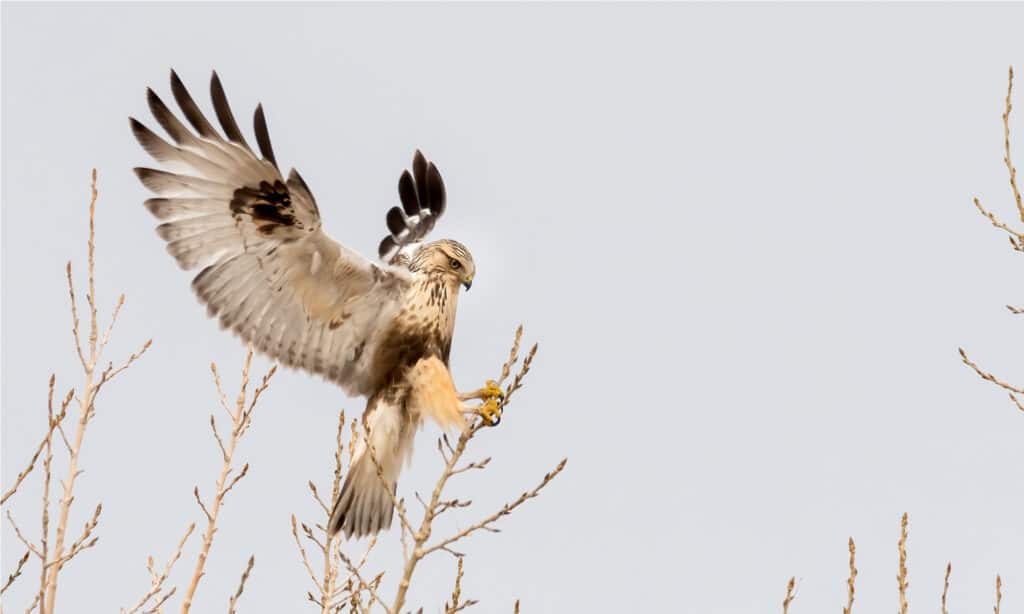
Wide wings with wingtips usually swept back slightly from the wrist are hallmarks of the rough-legged hawk.
©Eivor Kuchta/Shutterstock.com
Rough-legged hawks (Buteo lagopus) are uncommon in New Jersey year-round. You can only spot them in winter. They can be spotted perched on poles or soaring over open fields and marshes.
Rough-legged hawks have wide wings and wingtips that are usually swept back slightly from the wrist. They are dark brown with dark belly patches. They occur in light and dark morphs.
Rough-legged hawks feed mainly on small rodents, such as voles and lemmings. They breed in the Arctic and migrate south in winter to open areas like deserts, prairies, and fields. Females lay three to five pale bluish-white eggs.
Northern Harrier
| Scientific name | Circus hudsonius |
| Color | Gray, white, black, and brown |
| Weight | 11-27 ounces |
| Height | 21-25 inches |
| Wingspan | 41-46 inches |
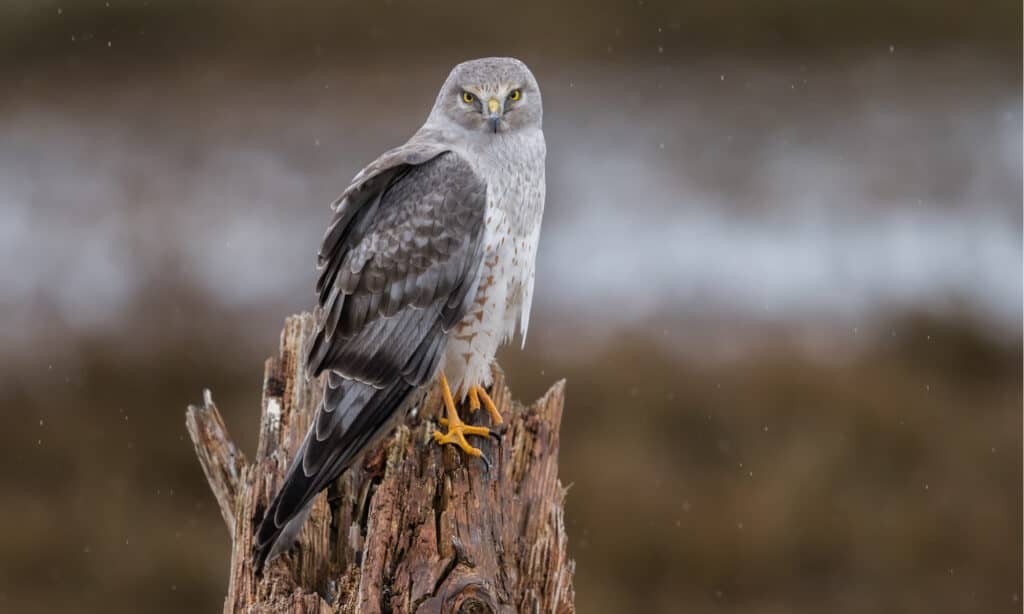
Found in marshes, prairies, and the Arctic tundra, Northern harriers are year-round residents of New Jersey.
©Harry Collins Photography/Shutterstock.com
Northern harriers (Circus hudsonius) are widespread in New Jersey all year. They can be easily sighted gliding low over grasslands or marshes. Northern harriers are slender, medium-sized birds of prey with rounded tails and broad wings. They have distinctive owl-like faces.
Northern harriers feed on small birds and small mammals. They can also carry bigger prey like ducks and rabbits. They fly low back and forth over the ground, watching and listening for small animals.
Northern harriers live in marshes, prairies, and Arctic tundra. They conceal their ground-level nests in wetland vegetation or grass. Females lay 2-4 bluish-white eggs.