
Quick Take
- One of these black bugs is the leading cause of insect bite-related anaphylaxis in the United States, though its name gives no warning of that fact. See the dangerous biter →
- One bug on this list actively hunts bed bugs inside your home, though handling it carelessly comes with a painful price. Meet the bed bug hunter →
- Not every insect is actually a 'bug,' and knowing the scientific distinction changes how you should think about everything on this list.
- One species hides a secret color that only appears when it takes flight. Discover the hidden color →
Although the word bug can be used to describe almost any tiny, crawling creature, including non-insects like spiders and centipedes, scientists define a true bug as a specific type of insect belonging to the order Hemiptera. These true bugs, such as stink bugs and cicadas, are distinguished by their piercing, sucking mouthparts and a life cycle that does not include a pupal stage. Therefore, while every true bug is an insect, not every insect (such as beetles or butterflies) is a true bug. Continue reading to learn about nine black bugs found in the United States.
Common Ebony Bug
The Common Ebony Bug (Corimelaena pulicaria) is a tiny, dome-shaped true bug native to North America and Central America. Common ebony bugs have a hard, shiny black thoracic shield (scutellum) that extends to cover most of their back and abdomen. Common ebony bugs are exceptionally small, measuring only 1/10 to 1/5 of an inch in length. The common ebony bug presents no physical danger to humans, though it can release foul-tasting secretions if threatened. They are generally considered minor garden herbivores rather than destructive agricultural pests.
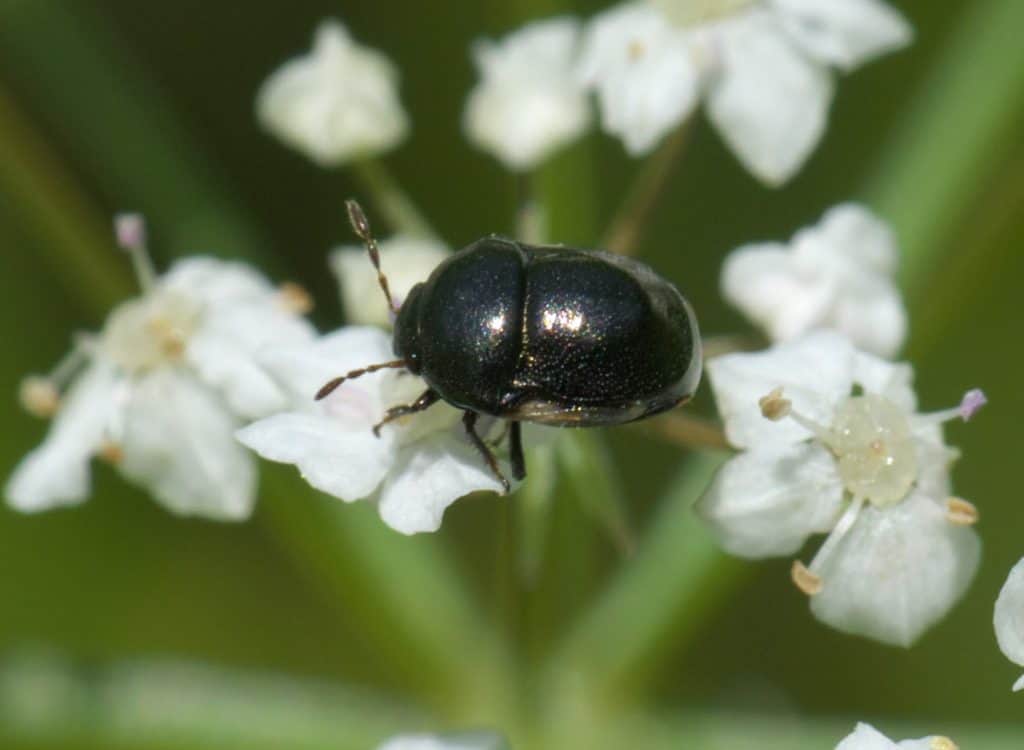
The common ebony bug is widespread across the United States, though it is most often encountered throughout the Eastern and Midwestern U.S.
Ebony Bug
The Ebony Bug (Corimelaena incognita) is a small true bug found in Central America and North America, specifically in the U.S. Southwest, primarily in Southern New Mexico. The ebony bug has a dome-shaped profile, dark coloration, and an extensive scutellum that acts as a protective shield, covering most of its abdomen and wings. Adult ebony bugs are extremely small, typically measuring approximately 0.11 inches long. Despite their somewhat imposing name, these bugs do not present any danger to humans and are not considered significant agricultural pests.
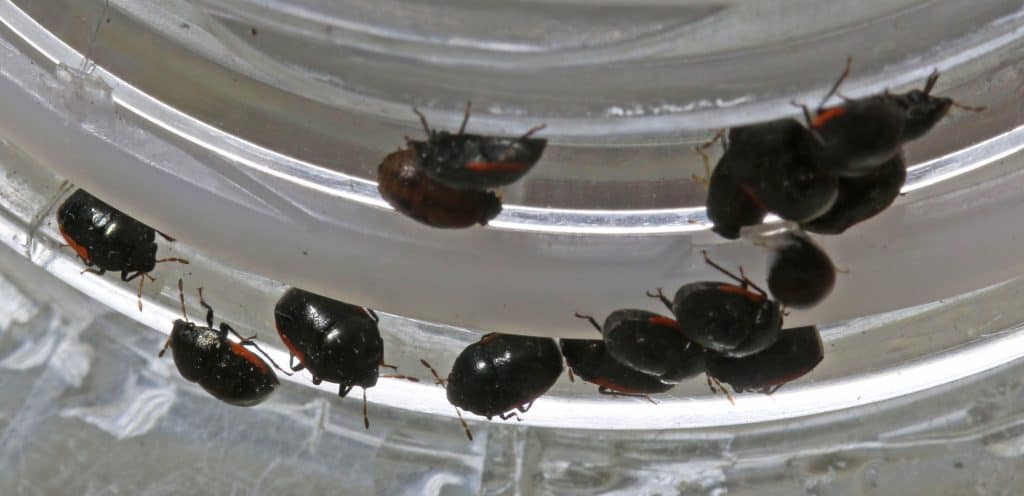
©Andrey Zharkikh from Salt Lake City, USA – Original / License
Adult ebony bugs are incredibly tiny, typically measuring approximately 0.11 inches long. Despite their somewhat imposing name, these bugs do not present any danger to humans and are not considered significant agricultural pests.
California Kissing Bug
The California Kissing Bug (Triatoma protracta), also known as the western bloodsucking conenose, is primarily distributed throughout the Southwestern United States and Mexico, particularly in California.
As adults, these insects exhibit a flattened, dark brown to black body with a long, cone-shaped head, a three-segmented beak folded underneath, and wings held flat across the back. They are medium-sized bugs, typically ranging from 0.5 to 0.75 inches in length, though some individuals can reach up to 0.9 inches.
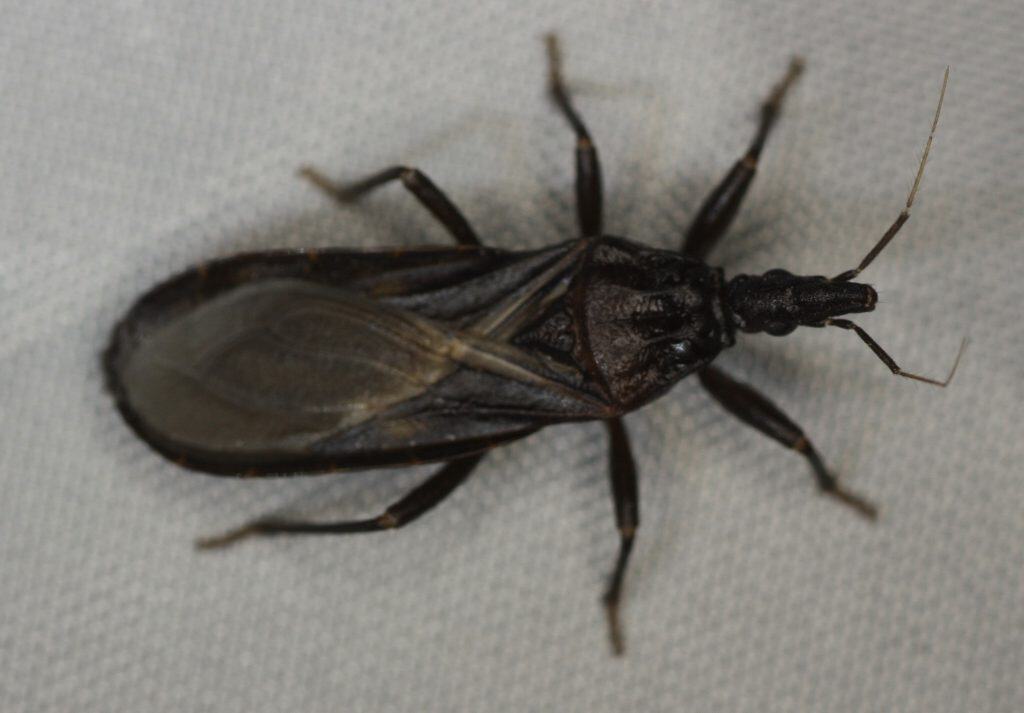
The most common type of kissing bug found in California is Triatoma protracta.
They are not considered agricultural pests because they do not feed on crops or plants. However, they do present a significant medical danger to humans. California kissing bugs are strictly blood-feeding insects that naturally live in the nests of wild animals.
While their nocturnal bites are generally painless, they can prompt severe allergic reactions or life-threatening anaphylactic shock. Anaphylactic shock generally occurs only after multiple bites over time. Anaphylaxis is an allergic reaction that occurs when the immune system recognizes the kissing bug’s salivary proteins as a threat. Kissing bug bites are the most common cause of insect bite-related severe allergic reactions (anaphylaxis) in the United States, particularly in areas such as Arizona and California where these bugs are prevalent; however, anaphylaxis remains a rare outcome overall.
Kissing bugs also serve as vectors for Trypanosoma cruzi, the parasite responsible for Chagas disease. Although some California kissing bugs are infected with the parasite that causes Chagas disease, the risk of local transmission to humans remains very low. This is because a kissing bug usually defecates after leaving the host, making it unlikely for the parasite-laden feces to enter the bite wound.
Florida Predatory Stink Bug
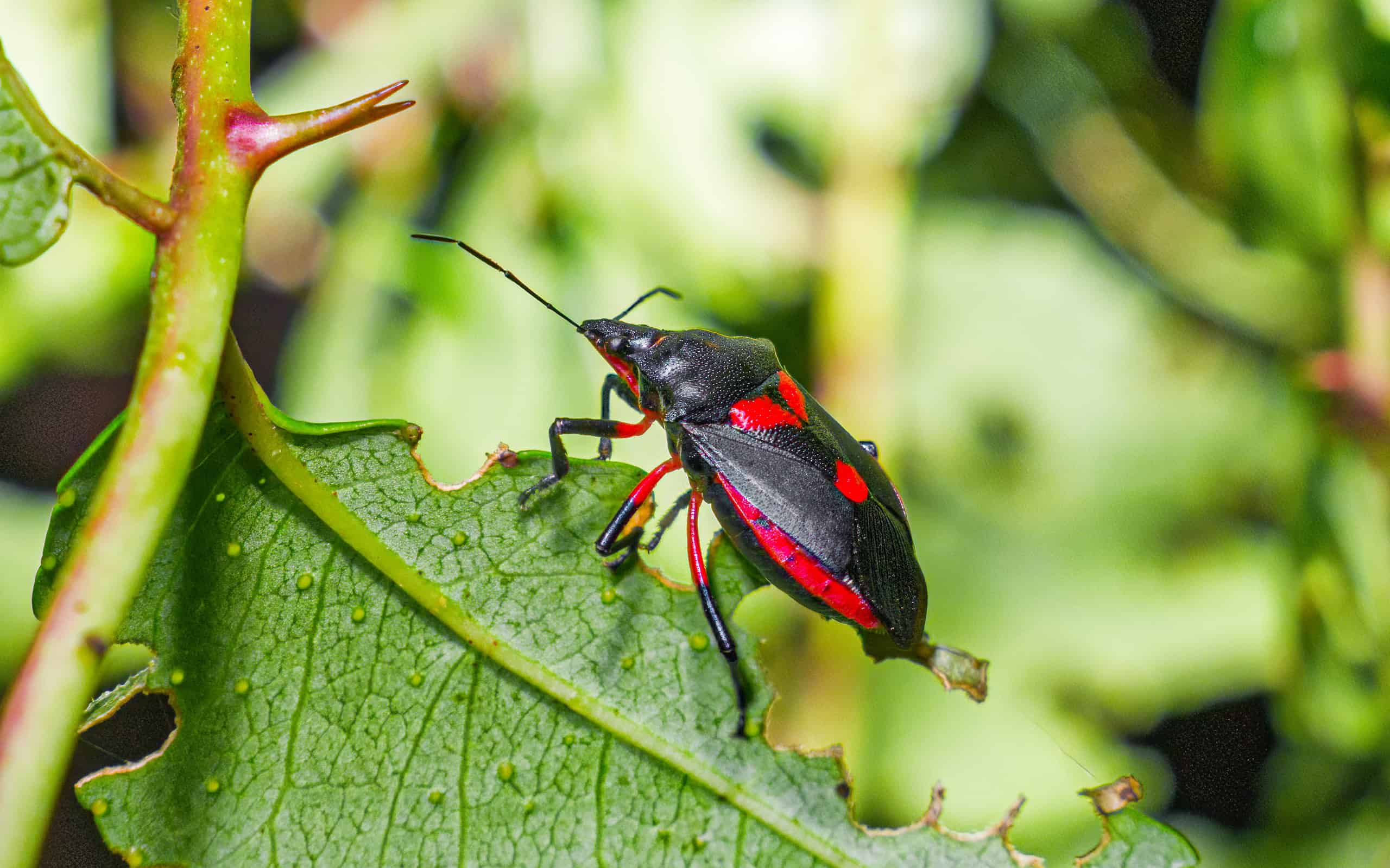
The Florida predatory stink bug (Euthyrhynchus floridanus) is a beneficial, carnivorous shield bug native primarily to the Southeastern United States. Visually, they feature a dark bluish-black color with vivid red-to-orange markings and prominent shoulder spines.
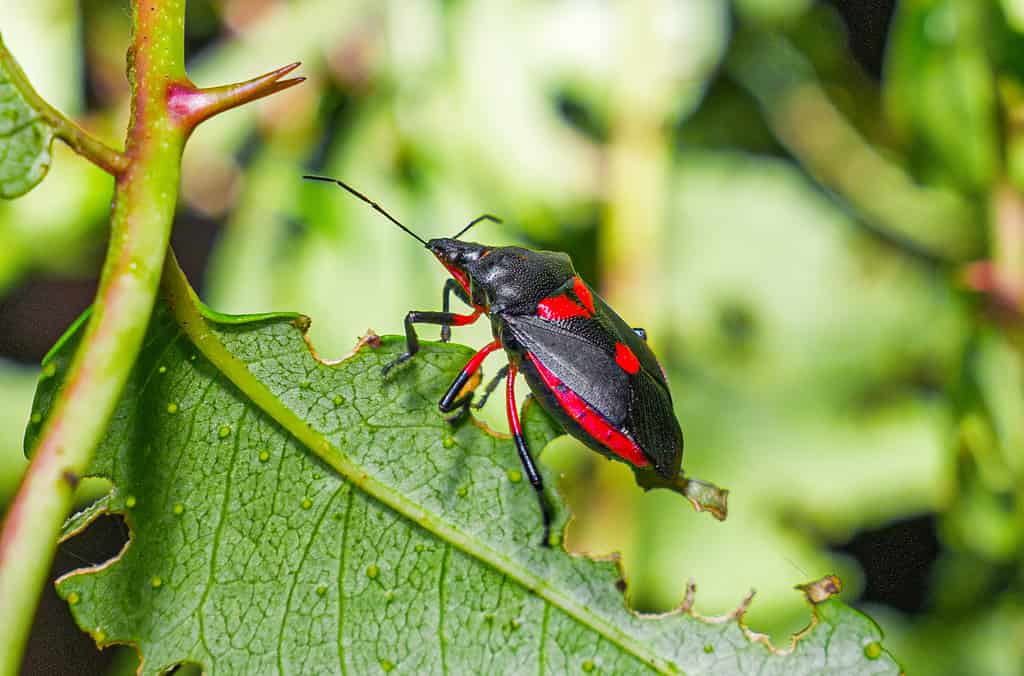
The Florida predator stink bug devours plant-damaging insects.
©Chase D'animulls/iStock via Getty Images
Adult male Florida predatory stink bugs are approximately 0.5 inches long. Females of the species are larger, measuring up to 0.7 inches in length.
Florida predatory stink bugs present no danger to humans. However, they can emit a mild defensive odor when disturbed. Far from being agricultural pests, they are valuable garden protectors that prey on plant-damaging insects, including caterpillars and beetles.
Broad-headed Bug
The broad-headed bug (Alydus eurinus), the most abundant species of its family in North America, is found in 43 states. An adult broad-headed bug is typically black or dark brown with a body covered in fine hairs, a notably wide head that matches the width of its thorax, and a hidden red-orange spot on the abdomen that becomes visible when it is in flight.
The average adult broad-headed bug measures between 0.39 and 0.55 inches long. The broad-headed bug is non-toxic and generally doesn’t pose a risk to human health. However, they are recognized as minor agricultural pests. Both adults and ant-like nymphs possess piercing-sucking mouthparts, which they use to draw sap from various legumes and wild plants. Large infestations can damage cultivated bean crops like edamame (soybeans).
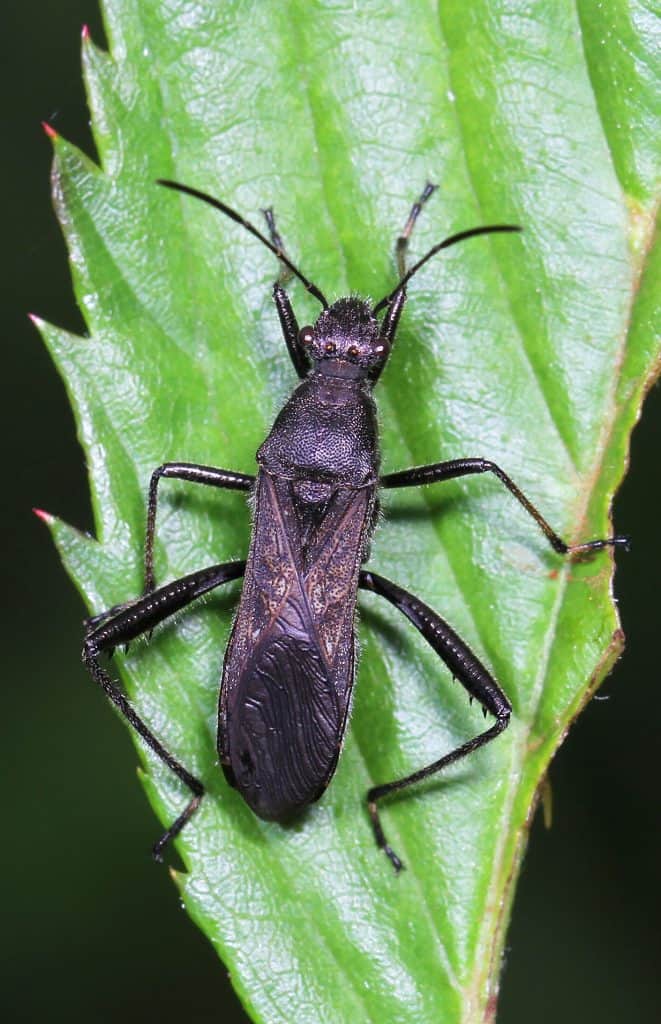
Broad-headed bugs can damage crops if their numbers are high enough.
Eastern Boxelder Bug
The Eastern Boxelder Bug (Boisea trivittata) is a species of true bug native to North America, widely distributed throughout Eastern Canada and the Eastern United States, though its range extends wherever its primary host, the boxelder tree (ash-leaved maple) is found.

The Eastern Boxelder bug is common across Eastern North America.
©Paul Reeves Photography/Shutterstock.com
Adult boxelder bugs are approximately 0.5 inches long, with flat, elongated bodies that are dark brown or black, accented by prominent red-orange veins and stripes along their thorax and wing margins.
While they often alarm homeowners by congregating in massive groups on sunlit surfaces or invading indoor spaces to overwinter, they are not harmful to humans; they are not known to transmit disease, and only bite defensively. Boxelder bugs primarily target the seeds, leaves, and twigs of female boxelder and maple trees without causing serious harm.
The White-margined Burrower Bug
The white-margined burrower bug (Sehirus cinctus) is a small, true bug native to North America, distributed broadly across the United States east of the Rocky Mountains. Adults are shiny black with a thin, light white border lining the margins of their thorax and abdomen. The average white-margined burrower bug is 0.15 to 0.27 inches long. The white-margined burrower bug does not pose a danger to humans or animals and is not considered a significant agricultural pest. Although they feed primarily on the seeds of mint and nettle plants, they rarely inflict lasting damage.
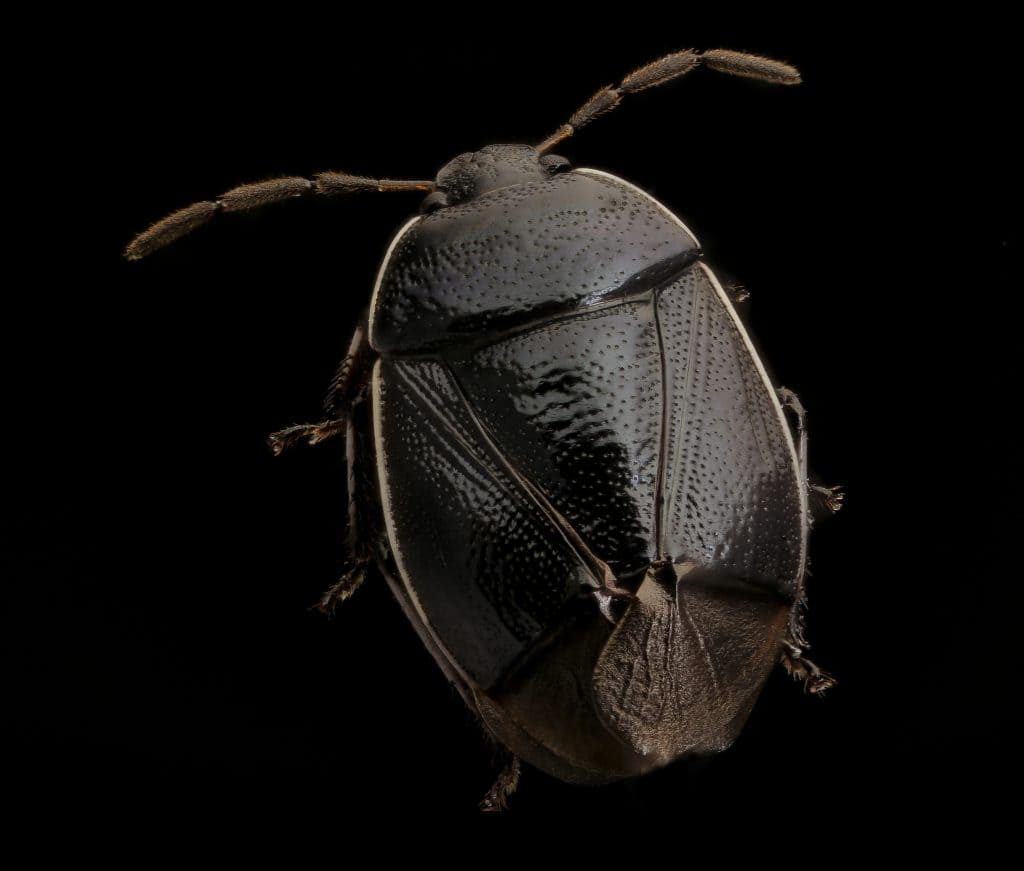
The white-margined burrower bug is found in the United States east of the Rocky Mountains, in Southern Canada, and in Mexico.
©USGS Bee Inventory and Monitoring Lab from Beltsville, Maryland, USA – Original / License
Masked Hunter
The masked hunter (Reduvius personatus) is native to Europe and Africa but has successfully expanded its distribution across the globe, becoming widely established in the Eastern and Central United States. As adults, these true bugs have a long, uniformly dark brown to glossy black body that ranges in size from 0.69 to 0.88 inches long.
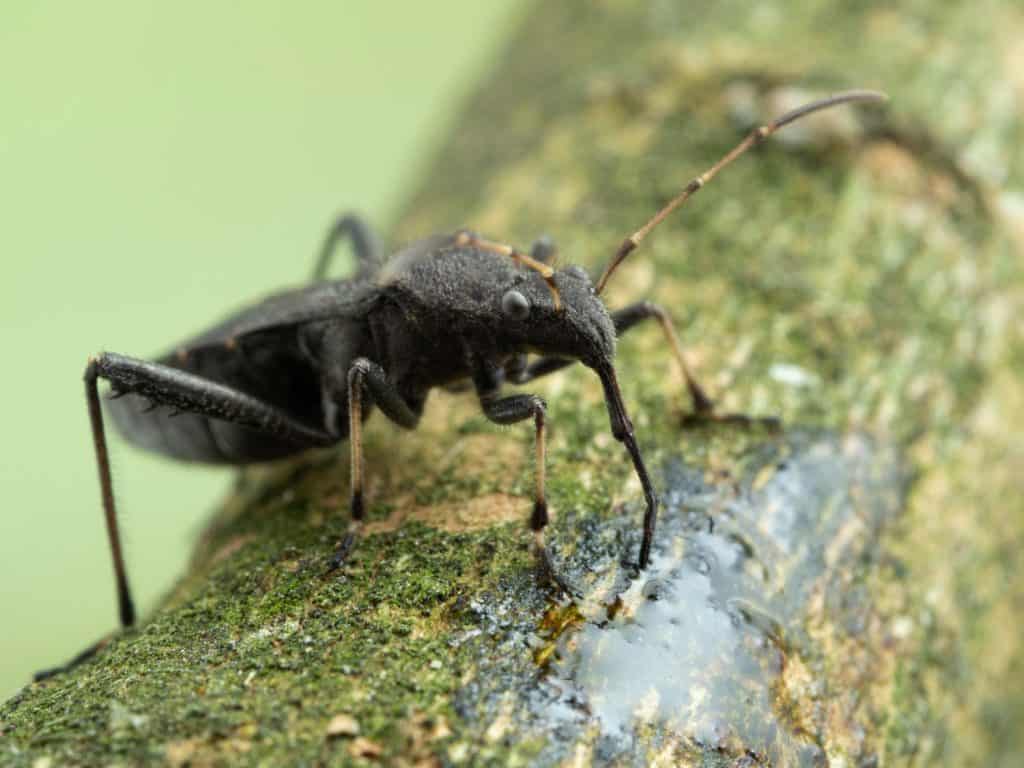
The masked hunter is now widely established in the Eastern and Central United States, parts of Canada, Australia, and India.
©Ernie Cooper/Shutterstock.com
The masked hunter does not present a severe danger to humans, nor is it considered an agricultural pest. In fact, it is considered beneficial because it preys on insect pests, including destructive indoor nuisances such as bed bugs, termites, and carpet beetles.
Although masked hunters do not transmit diseases or feed on human blood like their relatives, the kissing bugs, they can deliver an incredibly painful defensive bite with their short, needle-like beak if stepped on or handled carelessly.
Eastern Assassin Bug
The Eastern assassin bug (Apiomerus crassipes) is a predatory true bug widely distributed throughout Eastern North America. Adults are medium-sized, flattened insects measuring between 0.47 and 0.78 inches long. They feature a predominantly dark, blackish body covered in upright hairs. Eastern assassin bugs have striking orange or reddish markings along the margins of the abdomen.
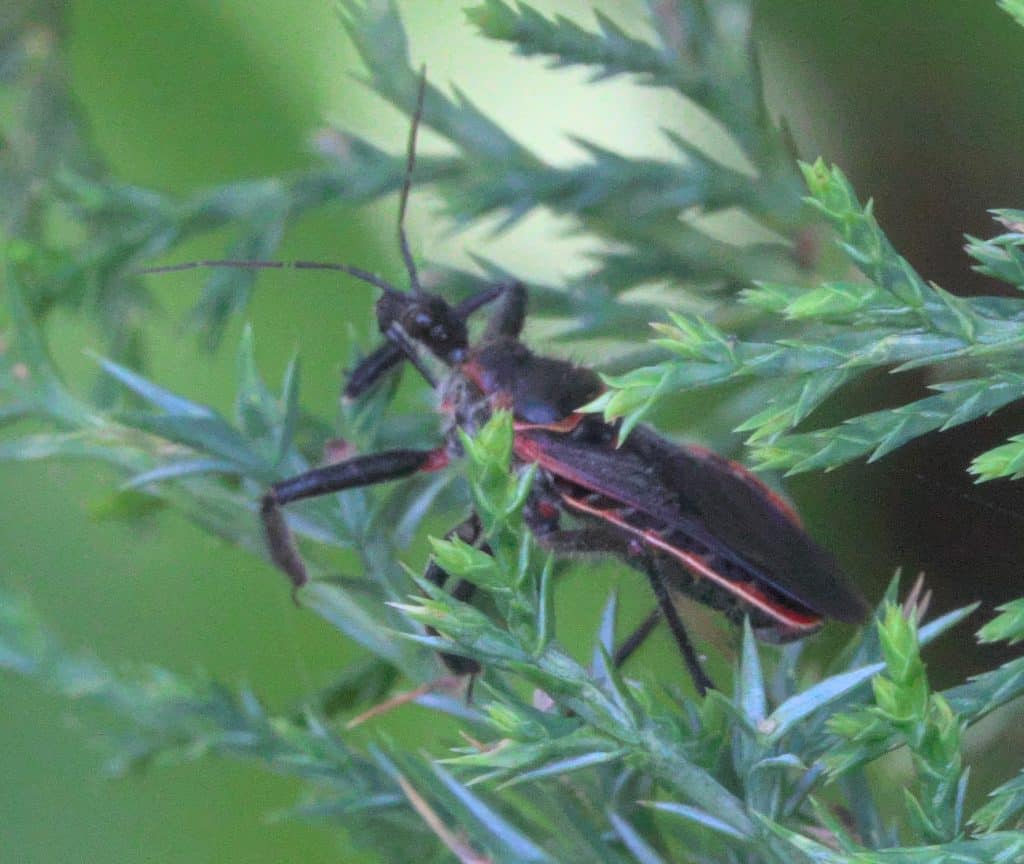
The Eastern assassin bug tends to prey on honeybees.
They do not present a danger to humans, nor are they considered agricultural pests. Although they can deliver a painful, bee-sting-like defensive bite if handled carelessly, their venom is not medically significant for humans. Eastern assassin bugs are generally viewed as beneficial to crops and gardens because they consume a wide variety of crop-damaging insects.