
Quick Take
- One creature on this list looks exactly like a bee, buzzes like a bee, and even visits flowers like a bee, yet it is actually a moth. Meet the bee-mimicking moth →
- Some of these bee look-alikes can sting you repeatedly without provocation, while others are completely harmless, yet most people can't tell them apart on sight. See who can sting repeatedly →
- One imposter has learned to change its actual flight behavior to mimic bees, going beyond just its appearance. See the flight behavior mimic →
- The insect most people confidently call a bee in their garden is often something else entirely, and the telltale sign is hiding in plain sight. Spot the garden imposters →
Have you ever seen an insect you thought was a bee but then realized it looked slightly different? Chances are, you may have encountered one of the many insects that look like bees but aren’t actually bees. While technically classified as bugs or flies, bee mimics often have the same color, shape, and even behavior as their buzzing cousins. However, upon closer inspection, you’ll be able to tell that these imposters aren’t bees at all. Explore this list of 9 bugs and flies that look like bees to learn more about these tiny copycats.
Flies That Look Like Bees
There are over 20,000 species of bees in the insect order Hymenoptera. They come in a wide range of sizes, with the smallest measuring less than 0.39 inches and the largest measuring up to 1.5 inches. Most common bees range from 0.4 to 0.6 inches. Bees tend to be hairy with a yellow and black color pattern, although they can also be solid colors. Their bodies are divided into three main parts: a head, a thorax, and an abdomen. They have six legs, two pairs of wings, and two antennae. The females have stingers.
Flies also come in a wide range of sizes. Tiny midges measure just 0.04 inches, while robber flies can reach up to 3 inches. Flies are characterized by their flexible heads, large compound eyes, and mouthparts designed for lapping and sucking. These insects belong to the order Diptera, meaning they have only two wings. Some fly species can be mistaken for bees due to their coloration, markings, and buzzing noise. Some of the bee species that flies mimic include bumblebees, honeybees, and wool carder bees. Take an in-depth look at some fly species that mimic the appearance of various bees.
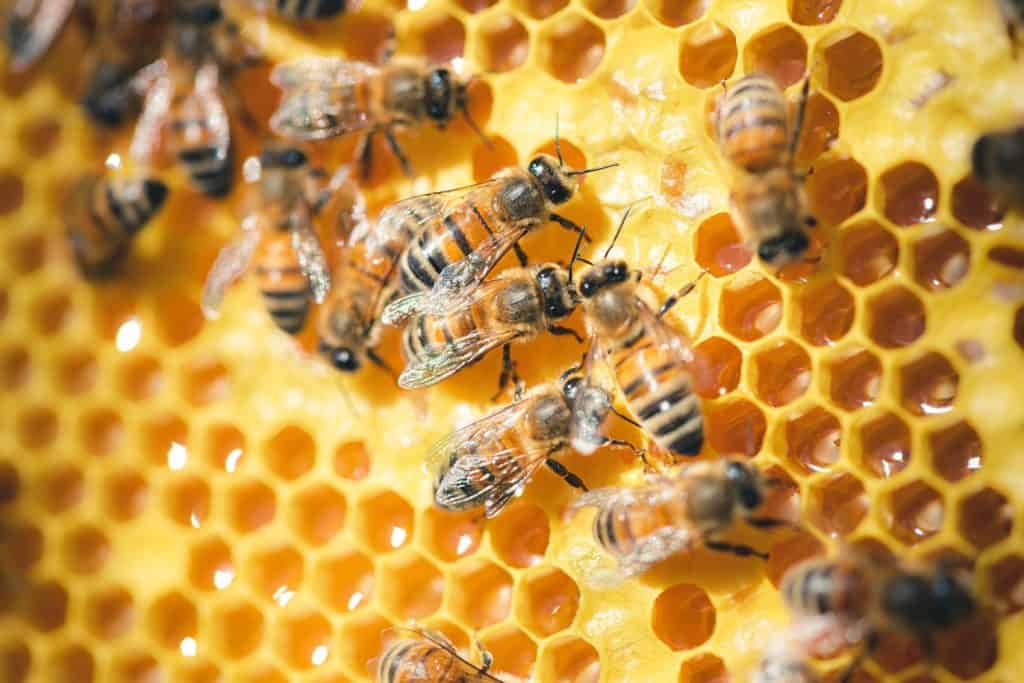
Some flies and other bugs mimic insects like these honey bees to avoid predators and steal food.
©Alexander Wallstrom/Shutterstock.com
1. Hoverflies (Syrphidae)
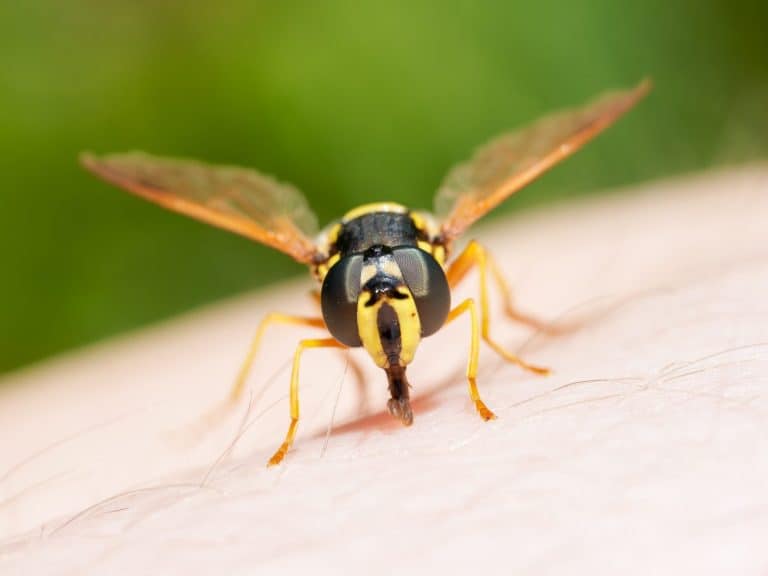
With yellow and black markings, hoverflies are one of the most convincing bee look-alikes. Their yellow bands are very similar to those of a honeybee. They even mimic the sound created by buzzing honeybees when they flap their wings. As their name suggests, they also hover over flowers and move quickly from one to another, which is something honeybees do, too. Hoverflies are similarly sized to bees, measuring from 0.125 to 1 inch.
However, they cannot sting, making them entirely harmless. Another subtle difference distinguishing them from bumblebees or honeybees is their antennae and the number of wings. Hoverflies have short antennae, while most bee species have long antennae. In addition, hoverflies have only one pair of wings, while bees have two pairs. Unlike typical bees, hoverflies have large heads with marbled black eyes.
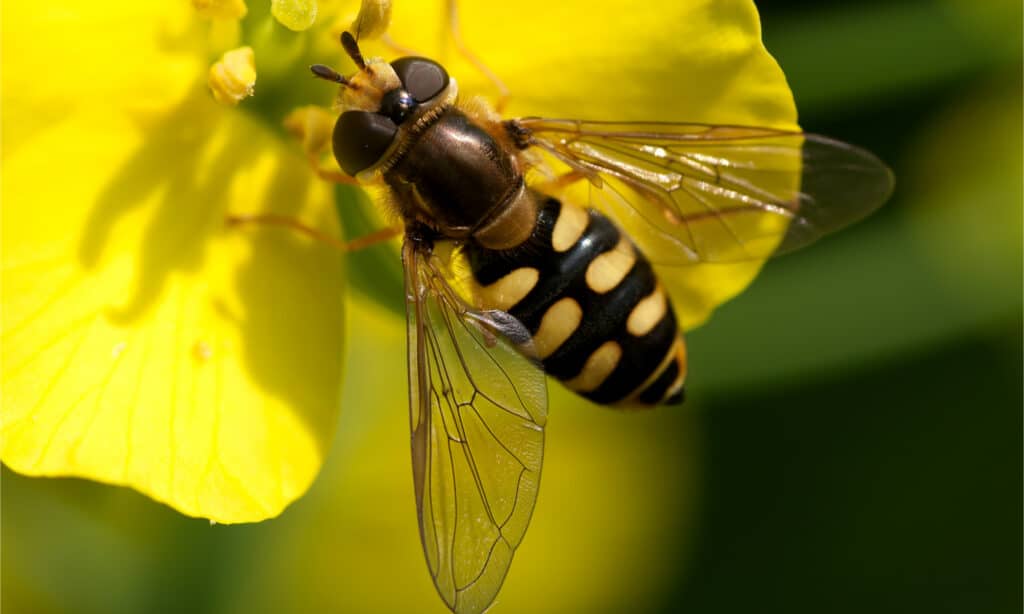
Hoverflies have large heads with marbled black eyes.
©Johan van Beilen/Shutterstock.com
2. Bee Flies (Bombyliidae)
Bee flies are small insects with stout bodies that look very similar in appearance to brown carder bumblebees or male hairy-footed flower bees. Like bees, they have hairy yellow, black, or brown bodies and transparent or patterned wings with dark stripes. They also have long proboscises, which they use to feed on pollen or nectar from flowers. Unlike bees, which tuck in their proboscises when not in use, bee flies keep theirs outstretched.
Bee flies don’t have stingers or the ability to make honey, and they hover in mid-air. Moreover, unlike bees with two pairs of wings, bee flies have only one pair of wings. Another giveaway is their wide waist, shorter antennae, and long, thin legs. They also don’t have mandibles for biting like bees. Bees flies and bees can sometimes overlap in size, with adults measuring about 0.25 and 0.75 inches.
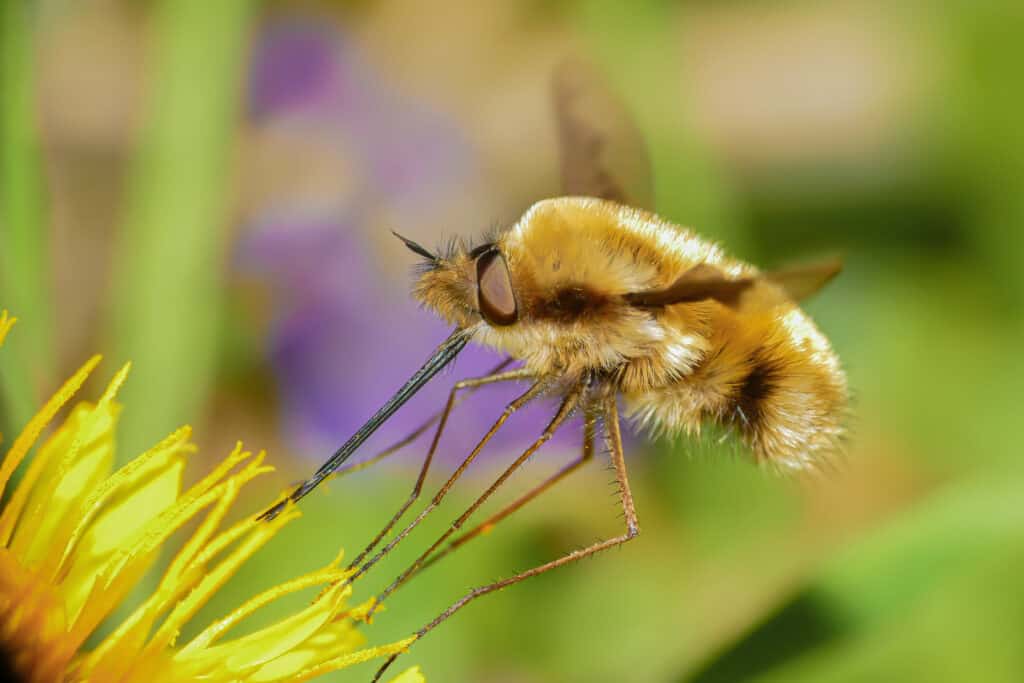
Bee flies have hairy yellow, black, or brown bodies and transparent or patterned wings with dark stripes.
©iStock.com/David Birkenfeld
3. Parasitic Flies (Tachinidae)
Parasitic flies are easily mistaken for bumblebees or wool carder bees due to their vivid yellow appearance when seen from the side. These insects are important pollinators. Parasitic flies are known for their unique ability to lay eggs on other insects, such as caterpillars and grasshoppers. Once the eggs hatch and larvae emerge, they feed on their host’s tissues.
Tachinidae differ from bees in a few ways, such as having bulb-like heads, short antennae, and a single pair of non-folding wings. While bees are typically hairy, most parasitic flies are more bristly-looking. They are smaller than bees and tend to be around the size of the average housefly at 0.125-0.5 inches long. Finally, these flies have no mandibles, and their waists are much wider than a bee’s.
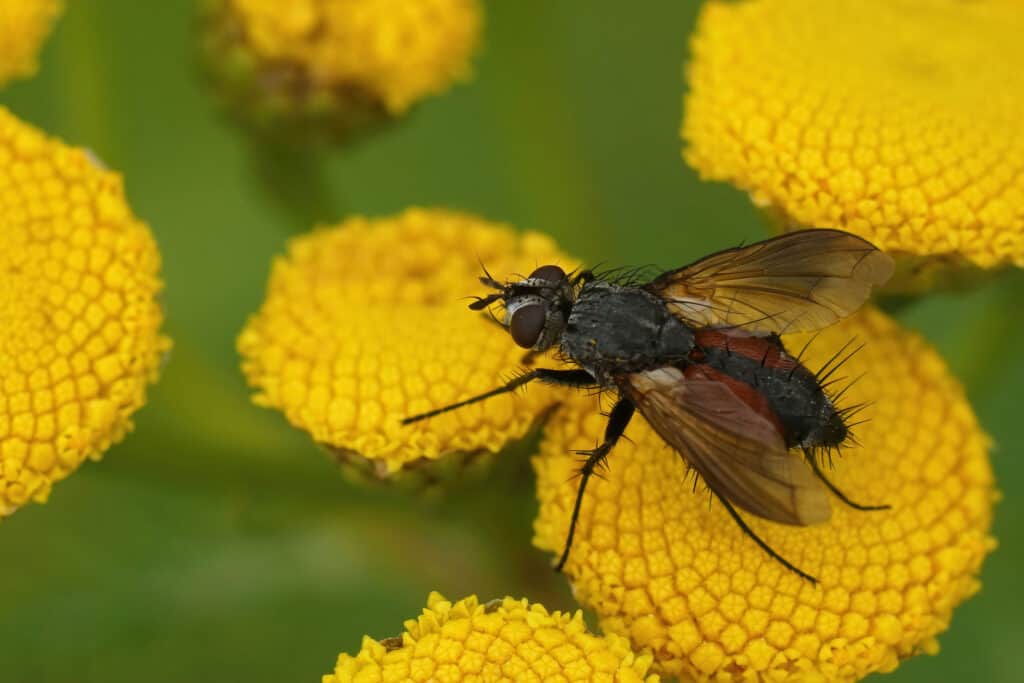
Parasitic flies are known for their unique ability to lay eggs on other insects.
©iStock.com/Wirestock
4. Bee Beetle (Trichius fasciatus)
Bee beetles, or Trichius fasciatus, have hairy, yellow-orange heads, white fuzz on their chests and abdomens, and a yellow and black color pattern that makes them resemble carder bees and small bumblebees. Like bees, they are found in gardens, meadows, and flowery areas, particularly around roses and thyme flowers.
Their notable difference from bees is that they have hard forewings that protect their flying wings, while bees have translucent wings. Their limbs are built primarily for walking and clinging to surfaces rather than collecting pollen. Size-wise, bee beetles are usually smaller than bees, measuring only 0.35–0.47 inches in length.
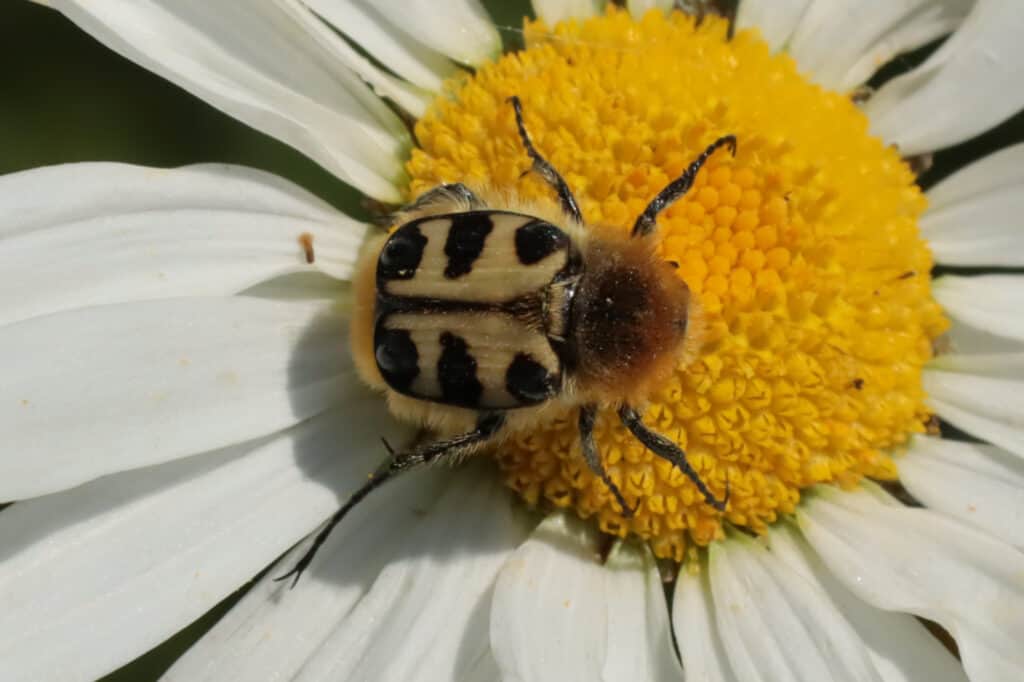
Bee beetles are found in gardens, meadows, and flowery areas, particularly near roses and thyme.
©iStock.com/DE1967
5. Wasps (Apocrita)
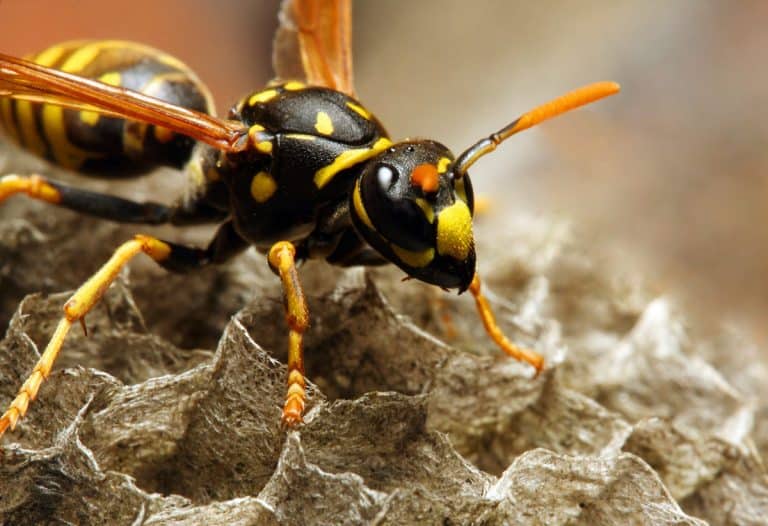
You may wonder how wasps come into the mix. Wasps are among the bee’s closest relatives, as they also belong to the order Hymenoptera. Similar to bees, wasps have two pairs of developed wings. They also have a narrow waist between the thorax and abdomen. Bees also have a narrow waist, but a wasp’s waist is even slimmer, giving the insect an overall more streamlined appearance.
Compared to bees, wasps are brightly colored with a broader range of color variations. Wasps lack the dense hair bees have, and their hairs aren’t branched. It’s easy to identify wasps by observing their behavior. To feed their larvae, wasps become scavengers and predators, hunting for other insects. They also feed on nectar. Wasps tend to be slightly larger, with most common species measuring from 0.5 to 0.75 inches.
Wasps tend to be larger than common bees, with slimmer waists.
©Rytis Bernotas/Shutterstock.com
6. Yellowjackets and Hornets (Vespula and Vespa)
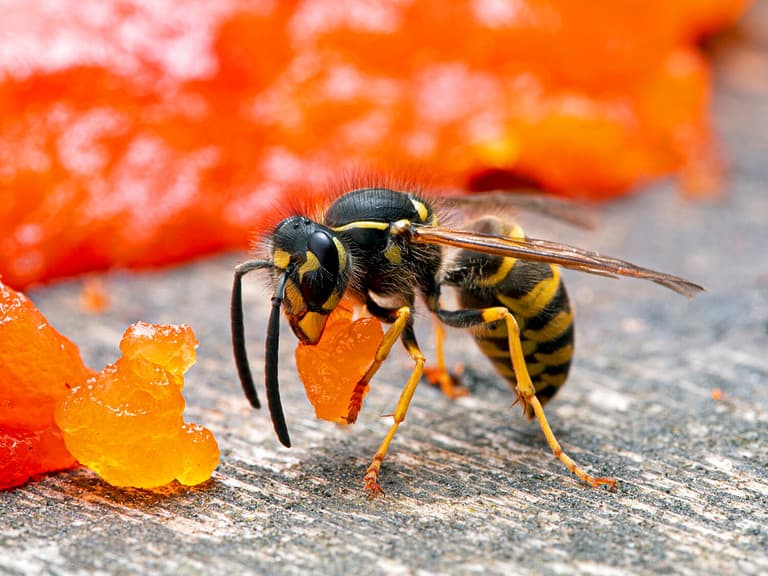
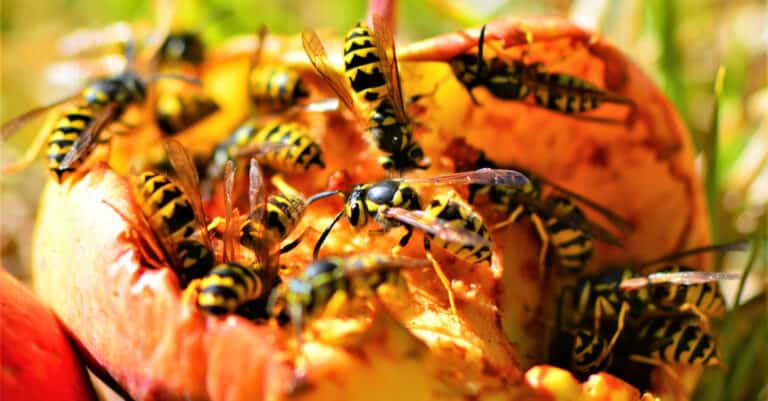
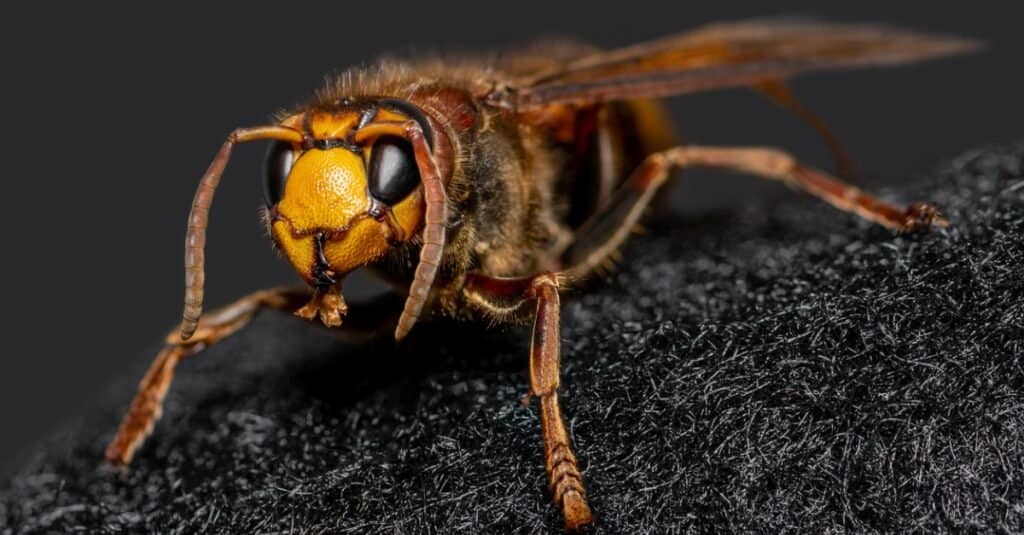
The striking resemblance between yellowjackets, hornets, and bees can be quite deceiving. Yellowjackets and hornets are both species of wasps with yellow and black stripes, similar to honey bees. However, a close-up observation will reveal some key differences. For one, yellowjackets and hornets lack hairy bodies like the honey bee and feature a more glossy texture.
Another notable difference between hornets and bees them is their size. Hornets are much larger than most common bee species, generally reaching 1-1.5 inches in length. However, yellowjackets are only slightly larger than bees at 0.5-0.75 inches. In addition to that, they have no pollen baskets. Also, in terms of behavior, yellowjackets and hornets are aggressive and can sting you multiple times without provocation. In contrast, honey bees are docile creatures and only sting when threatened. Unlike bees, yellowjackets and hornets not only depend on nectar but also prey on smaller insects.
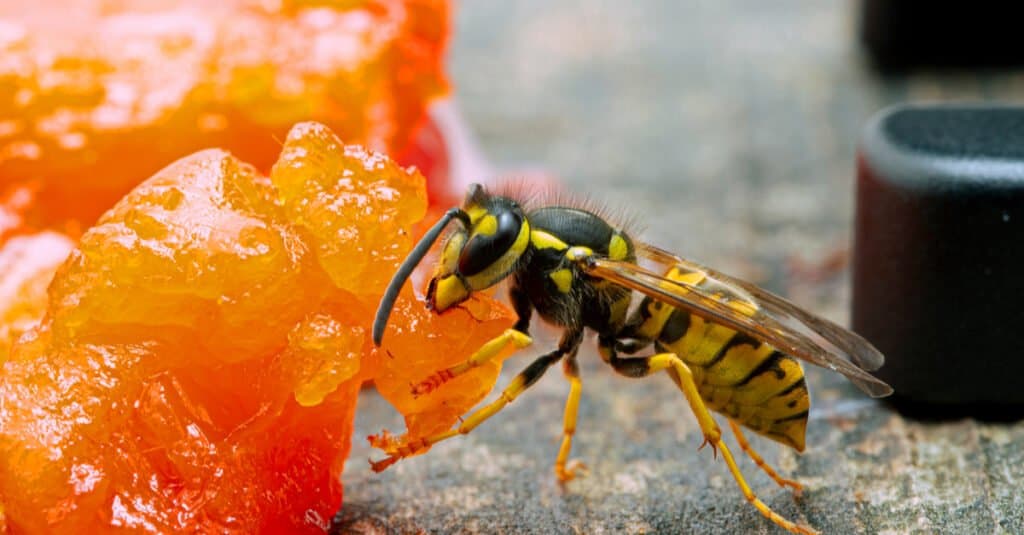
Yellowjackets have a yellow and black color pattern like bees.
©Ernie Cooper/Shutterstock.com
7. Cicada Killers (Sphecius)
If you see a large, solitary wasp flying around your yard, it’s likely a cicada killer. As their name suggests, they prey on cicadas, which they then use to provision their nests. Cicada killers are solitary wasps characterized by their glossy, long, and ovate black bodies with yellow bands.
The most glaring difference between cicada killers and bees is their size. Cicada killers are among the largest wasps in North America, ranging from 1.25 to 2 inches long. They also have brick-red eyes, reddish-orange legs, and one pair of light brown wings. Though females have a stinger, cicada killers are not aggressive toward humans, and females only sting if provoked. In contrast to wasps and honey bees, they do not have nest-guarding instincts.
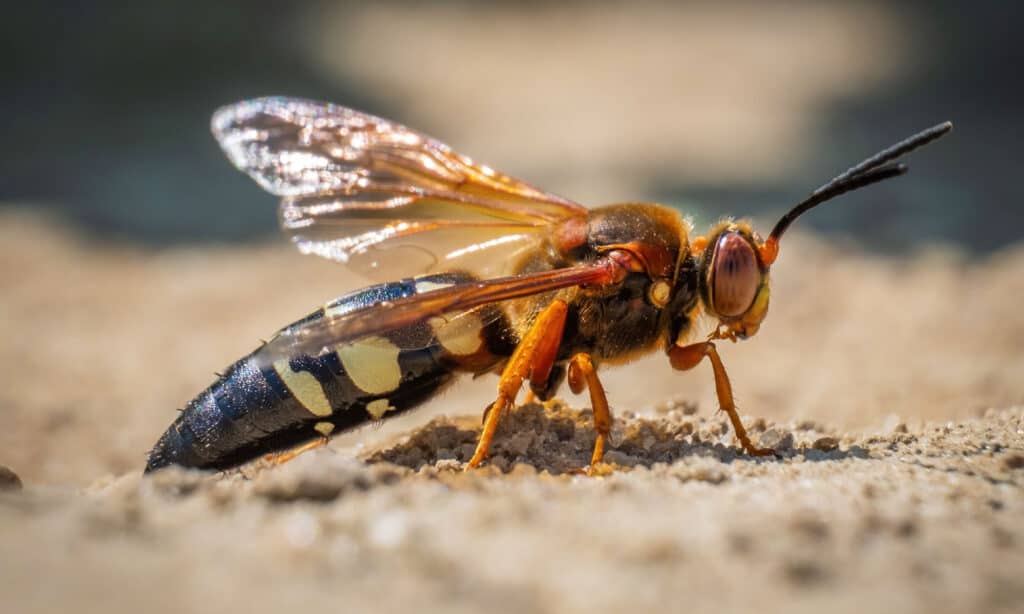
Cicada killers are solitary wasps characterized by long, glossy, ovate black bodies with yellow bands.
©samray/Shutterstock.com
8. Common Drone Flies (Eristalis tenax)
This bee mimic is often mistaken for a small honeybee, especially the males. They have fuzzy bodies and brown and yellow-orange markings. Another physical trait that makes it hard to tell a common drone fly from a honey bee is the dark brown coloring that both insects share. These flies have also changed their behavior to fly more like a bee by moving back and forth between flowers. Common drone flies are roughly the same size as worker honeybees at around 0.4 to 0.6 inches long.
However, these mimicry specialists have a single pair of wings, while honeybees have two. Another key difference is that male drone flies have larger compound eyes than honeybees. Drone flies have shorter antennae, they cannot sting, and they lack pollen baskets on their legs. Although these flies can mimic bee flight, they can also hover in one spot like other fly species.
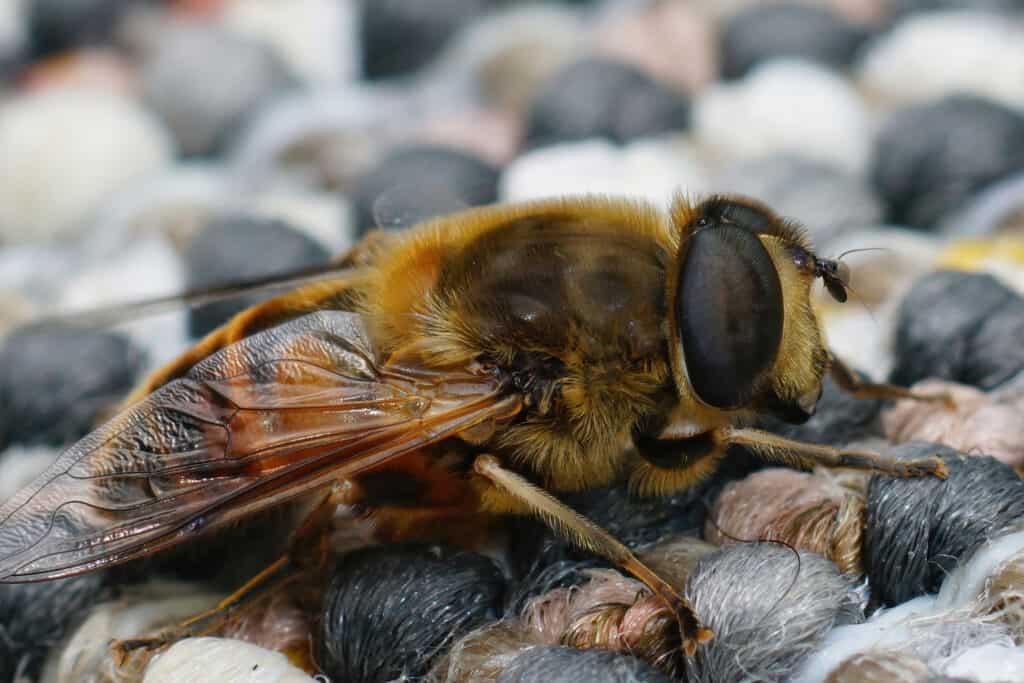
Common drone flies have even learned to change their flight behavior to mimic bees.
©iStock.com/Wirestock
9. Raspberry Crown Borers (Pennisetia marginata)
The raspberry crown borer may look like a bee or a yellowjacket, but it’s actually a type of moth with yellow and black stripes. Like bees, moths have bodies covered in dense hairs. Unlike most moths, the raspberry crown borer flies during the day like bees and wasps.
One difference between them is that the raspberry crown borers have feathered antennae despite their slender bee-like appearance. It is also easy to spot a raspberry crown borer since its wings rest at its side, whereas a bee’s wings lie flat against its body. This unique feature helps the moth protect itself from predators, making it look like a wasp or yellowjacket rather than a moth. They are also generally larger than bees, measuring 0.4–1 inch, with wingspans of 1-1.5 inches.
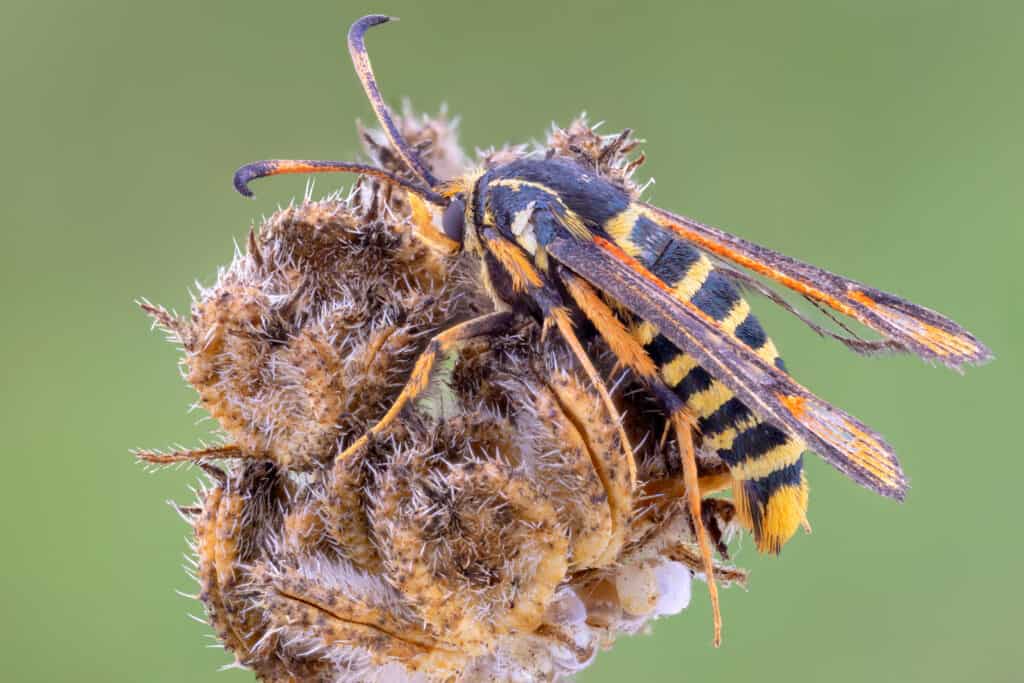
The raspberry crown borer is a type of moth with yellow and black stripes on its body.
©ozgur kerem bulur/Shutterstock.com
Can Flies Sting Humans?
While stinging bees and wasps tend to attract our focus, there are certain flies that can bite or sting. While they are typically not dangerous, they can certainly cause pain. Here are five stinging or biting flies to be aware of.
Horse Flies (Tabanidae)
Horse flies are not only intimidating for their size of 0.75 to 1.25 inches long, but they are aggressive and can inflict painful bites on humans. While they don’t usually carry diseases, their bites can cause allergic reactions in some people. This type of fly will repeatedly bite if it is able to draw and taste blood. Female varieties will even chase their targets. Some ways to repel these tiny beasts include using insect repellent and wearing light-colored clothing.
Sand Flies (Psychodidae)
Though sand flies are very small, measuring a quarter the size of a mosquito, their bites can produce blisters or small red welts that can itch or swell. It is possible for these creatures to carry parasitic diseases like leishmaniasis. This condition is usually contracted in places outside the U.S., but some cases have been reported in Oklahoma and Texas.
Deer Flies (Tabanidae)
Deer flies are a very aggressive fly species that delivers painful bites. Their mouths feature razor-like lips which can slice skin to feed on the blood. Some people have allergic reactions to the bites. The USDA warns that these flies are the chief bloodsuckers during summer months in the U.S. They are capable of carrying Tularemia (rabbit fever), which requires treatment with antibiotics.
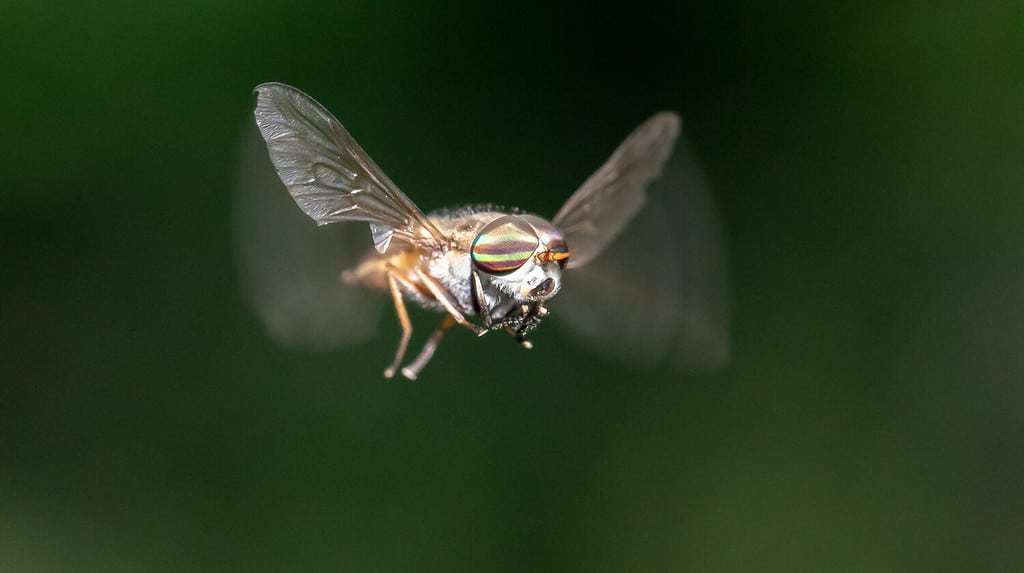
The aggressive deer fly is the number one blood-sucking fly in the U.S. during the summer months.
©Vinicius R. Souza/Shutterstock.com
Black Flies (Simuliidae)
Also referred to as buffalo gnats, these flies are common in the U.S. and slash the skin to feed on blood. Fortunately, they don’t usually transmit diseases. Their bites create a scab, and some people experience an itchy welt growing from it. If the latter occurs, the victim could develop “black fly fever,” characterized by nausea, headaches, fever, or swollen lymph nodes.
Biting Midges (Ceratopogonidae)
These flies are loosely referred to as gnats, but are also called “no-see-ums” due to their tiny size. A bite from one can result in a blister or red welt that itches. These flies do suck blood, and the bite delivers a painful sting. They can transmit Mansonella ozzardi, a parasite that could produce flu-like symptoms in the victim.