Quick Take
- One common household bug is so convincing as a tick imposter that even its nymph stage fools experts, and unlike ticks, it possesses a secret weapon they never have. See the winged imposter →
- The one body part that instantly exposes every single tick imposter, and you don't even need a magnifying glass. Check the telltale legs →
- Some of these lookalikes are just annoying. Others, however, are parasites that bite, embed, and feed just like ticks do. Meet the biting lookalike →
- There's a fiery red bug people panic over as a tick, yet no tick species on Earth actually looks anything like it. Discover the red imposters →
We all hate ticks, and just the idea of these little bloodsucking fiends is enough to make your skin crawl. But in the wild world of bugs, insects, and arachnids, there are a lot of imposters. There are numerous other bugs that look like ticks. Some of these lookalikes are harmless, while others are parasites like ticks. Identification is key to unmasking these bugs and telling them apart from the nine hundred tick species worldwide. Continue reading to learn how to identify bugs that look like ticks.
What is a Tick?
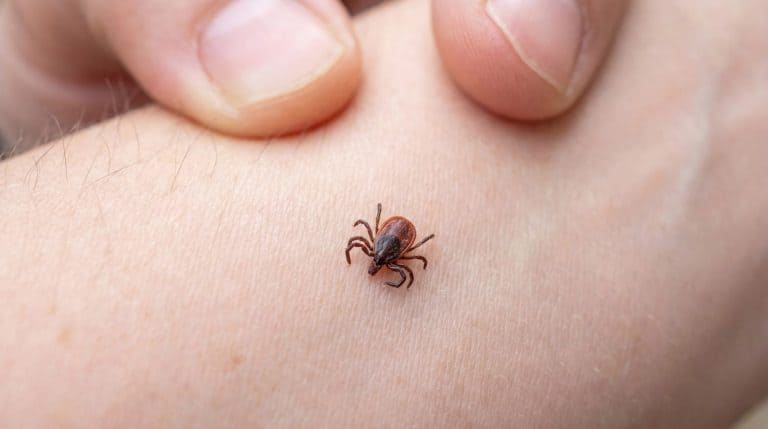
There are approximately 900 tick species worldwide, about 90 of which are found in the United States. Ticks are arachnids that are closely related to spiders. Like spiders, ticks have eight legs and flat, oval-shaped bodies. Their color is typically reddish-brown to dark brown, often with a distinct dark shield on their upper back.
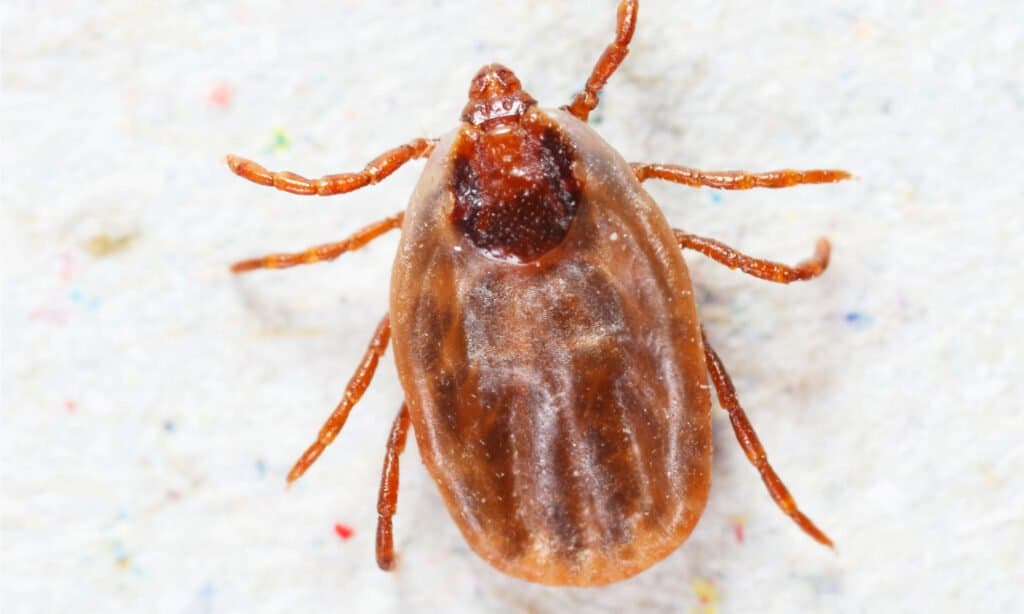
All 900 known species of ticks will always have eight legs, whereas insects and bugs only have six!
©7th Son Studio/Shutterstock.com
An unfed adult tick is usually about the size of a sesame seed or a small apple seed, while younger nymph ticks can be as tiny as a poppy seed.
However, their appearance shifts dramatically once they find a host, as their bodies swell significantly after feeding on their host’s blood.
Although mammals like deer, rodents, dogs, and humans are common targets, ticks are obligate blood-feeders that parasitize a wide range of vertebrates.
Rice Weevil
The rice weevil (Sitophilus oryzae) is a minute, highly destructive pest that infests stored agricultural grains. Adult rice weevils measure no more than 1/8 of an inch.

Rice weevils are about the same size as tick nymphs.
©Suntezza/Shutterstock.com
Unlike the tick’s oval-shaped body, the rice weevil has an elongated body and a long, downward-curving rostrum (snout). Rice weevils are typically deep reddish-brown to nearly black.
A key identifying feature of rice weevils is that they have fully functional wings underneath their hard shells and are strong flyers.
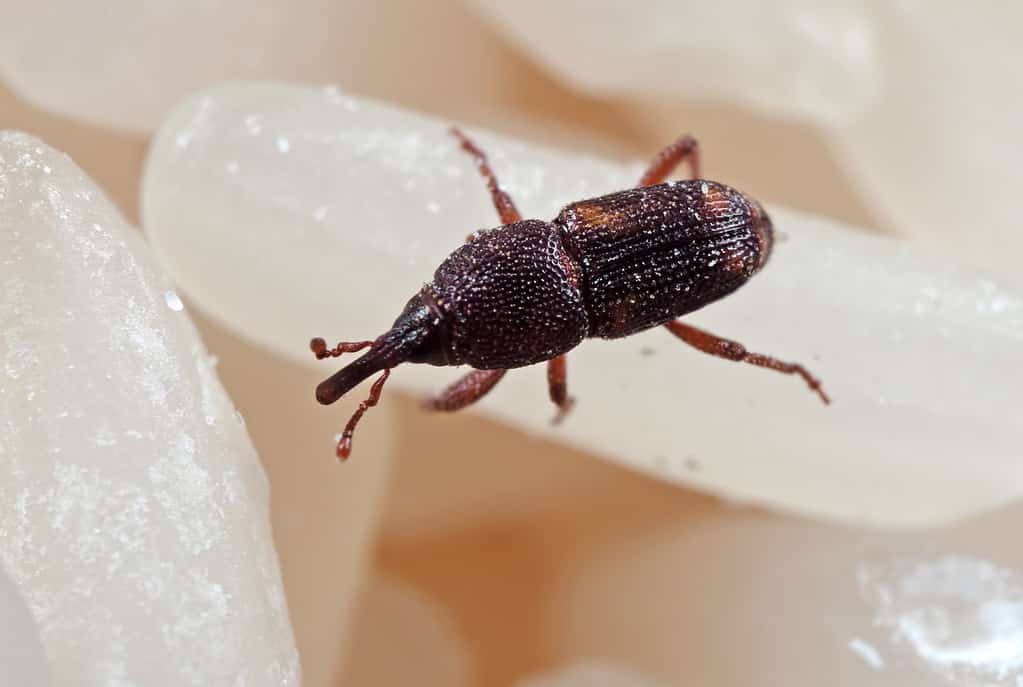
Rice weevils are longer and have a more pointed snout than ticks.
©Cherdchai Chaivimol/Shutterstock.com
American spider beetle
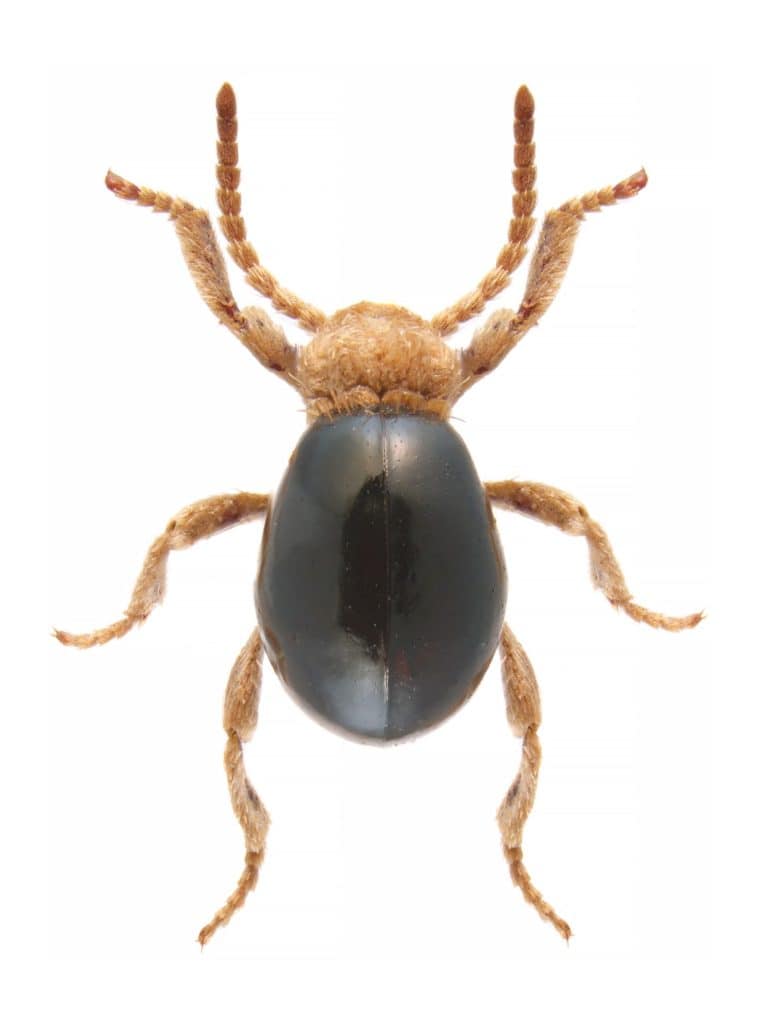
The American spider beetle (Mezium americanum) is frequently mistaken for a small spider or a tick due to its globular abdomen. However, the key difference is that the spider beetle is an insect with six legs, unlike ticks and spiders, which are arachnids with eight legs. The American spider beetle has a dark reddish-brown to black abdomen, while its head, thorax, legs, and antennae are heavily covered in yellow to cream-colored hairs, which can make its antennae appear to be legs.
©Tomasz Klejdysz/Shutterstock.com
While American spider beetles can be annoying household pests, they are not considered dangerous to humans. To tell a spider beetle from a species of tick, look closely to see if it is a true eight-legged arachnid or a six-legged beetle in disguise.
Mites
The clover mite (Bryobia praetiosa) and the red velvet mite (family Trombidiidae) are often confused with ticks. This is due to their bright red color. Both the clover mite and red velvet mite species are extremely small and are most often mistaken for seed ticks or nymphs.
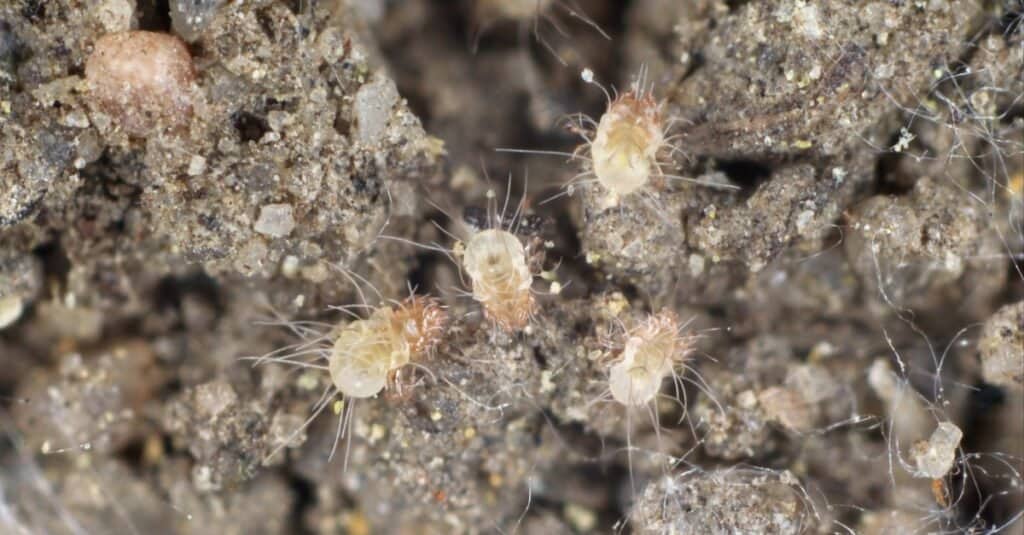
Mites are minuscule, often no larger than the head of a pin.
©Tomasz Klejdysz/Shutterstock.com
The clover mite (Bryobia praetiosa) and the red velvet mite (family Trombidiidae) are often confused with ticks. This is due to their bright red color. Both the clover mite and red velvet mite species are extremely small and are most often mistaken for seed ticks or nymphs.
Since the clover mite and the red velvet mite are both small enough to fit on the head of a pin, size is the first clue. Even the smallest tick species is visibly larger than these mites. However, even if both are compared side-by-side, the vibrant red coloring of both clover and red velvet mites is a dead giveaway. There are no known tick species in the world with that fiery red coloring.
Brown Marmorated Stink Bug
While the brown marmorated stink bug (Halyomorpha halys) is not dangerous to humans, it is highly invasive and is devastating to plants and crops, and it does emit a foul odor when frightened or crushed.
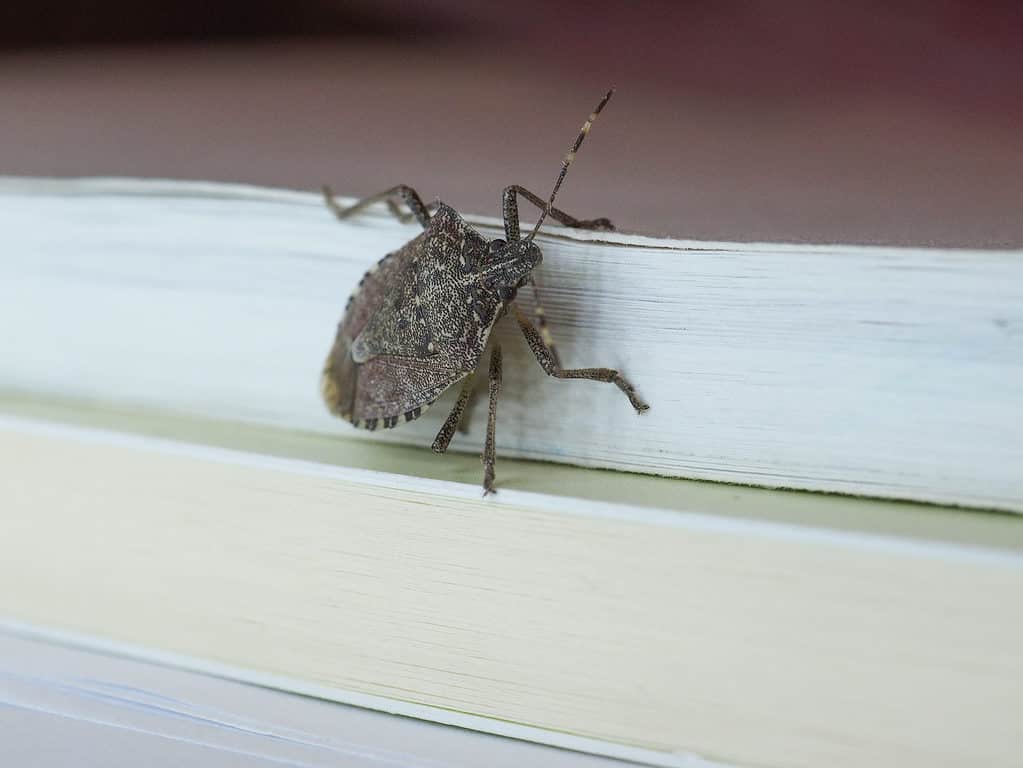
Originally native to East Asia, the brown marmorated stink bug was introduced to North America in the late 20th century and has since spread across much of the United States and Canada.
©Claudio Divizia/Shutterstock.com
During the winter months, stink bugs invade homes to survive the cold. In the same late spring and early summer months that ticks reach maturity, the marmorated stink bug is in its nymph stage. This is when they are commonly confused with ticks. A nymph stink bug has not yet developed the trademark shield-shaped body that identifies a stink bug.
The mottled brown bodies with reddish-orange markings that are common in many tick species are also present in this stink bug species. Combined with the missing shield shape of the nymph stage, the brown marmorated stink bug nymph is difficult to tell from a tick. Thankfully, the legs give this bug away! Ticks will always have eight legs, remember. The brown marmorated stink bug nymph also has wings, while ticks do not have wings at any stage of their life.
Varied Carpet Beetle
A small, destructive insect with worldwide distribution, the varied carpet beetle (Anthrenus verbasci) is a prevalent household pest throughout North America, Europe, and other temperate regions.
The adult beetle is exceptionally small, typically measuring no more than about 1/10 of an inch in length. It features a distinctively oval, convex body covered in fine scales that form a mottled, irregular pattern of white, yellowish-brown, and black patches across its back, though these scales can rub off over time to reveal a solid dark brown or black shell beneath.

Carpet beetles have similar coloring to many tick species, and their outer carapace can give the illusion of the tick’s round fused body.
©Tomasz Klejdysz/Shutterstock.com
Adult varied carpet beetles are harmless flyers that feed exclusively on outdoor flower pollen and nectar. However, their fuzzy, slow-moving larvae thrive indoors in dark, undisturbed areas, actively destroying organic materials such as wool, silk, feathers, and fur.
While their shape and coloring can make a carpet beetle appear to be a tick, once again, the legs are key: beetles have six legs, and ticks have eight.
Cat Flea
The cat flea (Ctenocephalides felis) is a parasite with worldwide distribution, and these fleas thrive in warm, humid climates throughout the United States.
Cat fleas are tiny, wingless insects that typically measure between 1/16 and 1/8 of an inch in length. Females of the species are notably larger than males, especially after a blood meal.
The cat flea has a reddish-brown to nearly black color and a flattened body covered in backward-facing bristles, which allows it to glide seamlessly through the fur of hosts like cats, dogs, and humans.

“I allowed this cat flea, Ctenocephalides felis to suck blood from my arm for about 5 minutes before I took this photo, the red colour in the abdomen is because of human blood.The image is a stack of 100 separate shots to give the most detail possible.”
©iStock.com/coopder1
Although cat fleas and ticks are both blood-feeding parasites, they belong to different biological classes and exhibit different behaviors. The cat flea is a six-legged insect that bites its host repeatedly. A tick is an eight-legged arachnid that embeds its mouthparts into its host to feed just once for several days before dropping off.
Head Louse
The human head louse (Pediculus humanus capitis) is an obligate ectoparasite with worldwide distribution where humans reside. Head lice cause millions of infestations annually in the United States alone.
These wingless, flat-bodied insects are small but fully visible to the naked eye, with adults typically measuring less than 1/10 of an inch in length. Head lice have six legs with claw-like toes (tarsi) for grasping human hair shafts close to the scalp.
Their coloration ranges from a translucent grayish-white to tan, though they are capable of adapting their body pigment to match the hair color of their host, often turning a dark brown or black on dark-haired individuals. Head lice are a distinct reddish-brown immediately after a blood meal.
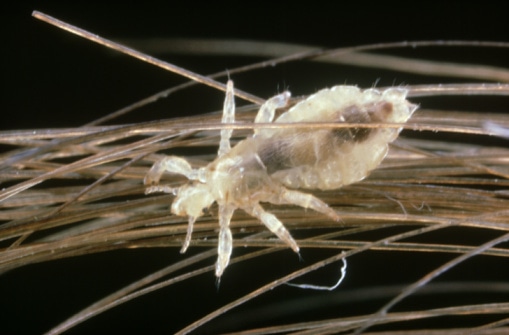
There is only one species of lice that feeds on the human scalp.
©© Oxford Scientific/The Image Bank via Getty Images
Once again, it’s the number of legs that can help differentiate these two parasites. Ticks have eight legs, while head lice only have six. Ticks can also be identified by their fused, round bodies and opaque coloring.
Bed Bug
The common bed bug (Cimex lectularius) is a parasitic insect with a global distribution, where it thrives in proximity to human populations throughout North America, Europe, and other temperate regions.
This wingless, nocturnal pest is small, with adults typically measuring about 3/16 to 1/4 of an inch in length, about the size of an apple seed.
The common bed bug has a flattened, oval-shaped body and a segmented abdomen with microscopic hairs that give it a banded look. Its natural coloration is a mahogany or reddish-brown, but its physical appearance changes drastically after feeding, when its body elongates, swells significantly, and shifts to a much deeper, darker red color.

Bed bugs are larger, more oval, and flatter than ticks overall.
©simon berenyi/Shutterstock.com
As before, one of the key differences between bed bugs and ticks is their number of legs: bed bugs have six legs and ticks have eight. Size is also a consideration. Adult bed bugs are typically slightly larger than unfed adult ticks, but they are much smaller than engorged ticks.