M
Species Profile

Madagascar Hissing Cockroach

Gromphadorhina portentosa

Hiss with purpose. Breathe to be heard.
Keith Muzzioli/Shutterstock.com

Madagascar Hissing Cockroach Distribution

Click a location to explore more animals from that region

Endemic Species
Loading map...

Found in 1 country

Types of Cockroach - Madagascar Hissing Cockroach

At a Glance

Wild Species
Also Known As Giant hissing cockroach, Hissing cockroach, Hissing roach, Madagascar hissing roach, Madagascar roach
Diet Scavenger
Activity Nocturnal+
Lifespan 2.5 years
Weight 0.012 lbs
Status Not Evaluated
Did You Know?

Adults are typically ~50-75 mm long (5-7.5 cm), making them among the largest commonly kept cockroaches.

Scientific Classification

A large, wingless cockroach endemic to Madagascar, famous for producing a loud hiss by forcefully expelling air through abdominal spiracles. Commonly kept as a pet and used in classrooms for insect biology and behavior.

Kingdom
Animalia
Phylum
Arthropoda
Class
Insecta
Order
Blattodea
Family
Blaberidae
Genus
Gromphadorhina
Species
Gromphadorhina portentosa

Distinguishing Features

  • Produces audible hissing via spiracles (used in disturbance displays and social interactions)
  • Large, robust body; generally wingless as an adult
  • Sexual dimorphism: males often have more pronounced pronotal ‘horn-like’ bumps
  • Detritivorous/scavenging diet typical of blaberid cockroaches

Physical Measurements

Males and females differ in size

Length
3 in (2 in – 3 in)
Weight
0 lbs (0 lbs – 0 lbs)
Top Speed
3 mph
running

Appearance

Primary Colors
Secondary Colors
Skin Type Hard, chitinous exoskeleton; smooth-to-slightly textured, often mildly glossy; wingless adult form.
Distinctive Features
  • Adult body length typically 50-75 mm (5-7.5 cm); robust, heavy-bodied cockroach.
  • Wingless species (no functional wings in either sex), adapted to forest-floor life in Madagascar.
  • Pronotum forms a large shield over the head; males often show raised horn-like tubercles.
  • Hissing produced by forcefully expelling air through abdominal spiracles (not by stridulation).
  • Hissing used in alarm/defense, male-male dominance interactions, and courtship contexts.
  • Long, filiform antennae; strong spiny legs for climbing bark, leaf litter, and rough surfaces.
  • Detritivore ecology: typically associated with leaf litter/rotting wood microhabitats rather than human homes.

Sexual Dimorphism

Males typically have prominent pronotal "horn" tubercles and a more robust, armored forebody, while females have a smoother pronotum and relatively broader abdomen. Males more often engage in dominance posturing and hissing contests.

  • Pronounced raised tubercles ("horns") on the pronotum; pronotum appears more sculpted.
  • More robust forebody and generally narrower abdomen compared with females.
  • More frequent dominance displays: elevated posture and hissing during male-male encounters.
  • Pronotum comparatively smooth with reduced or absent horn-like tubercles.
  • Abdomen typically broader/rounder, especially when gravid.
  • Less frequent dominance posturing; hissing more commonly in disturbance contexts.

Did You Know?

Adults are typically ~50-75 mm long (5-7.5 cm), making them among the largest commonly kept cockroaches.

The hiss is made by forcefully expelling air through abdominal spiracles (breathing openings)-not by rubbing body parts like crickets do.

They produce context-dependent hisses: a sharp alarm hiss, male-to-male dominance hisses, and courtship-related hissing.

Females retain the egg case (ootheca) internally and give birth to live nymphs (ovoviviparity).

Males can be identified by pronounced horn-like bumps/tubercles on the pronotum; females have a smoother pronotum.

They're detritivores in Madagascar's forest floor leaf litter-important recyclers of dead plant material.

In captivity, lifespan commonly ranges ~2-5 years (with temperature, diet, and colony conditions strongly affecting longevity).

Unique Adaptations

  • Spiracular sound production: specialized control of abdominal spiracles and airflow enables loud, repeatable hissing without wings or stridulatory files.
  • Heavily built, wingless body: a robust, domed exoskeleton helps them wedge into bark/leaf-litter crevices and resist compression and predation attempts.
  • Pronotum "horns" in males: enlarged pronotal bumps function as weapons/armor in pushing contests and as visual signals of maturity and competitive ability.
  • Water-loss management typical of large blaberid roaches: waxy cuticle and spiracle regulation help reduce desiccation in variable forest-floor humidity.
  • Live-bearing (ovoviviparity): retaining the ootheca internally buffers embryos from external drying and predation compared with exposed egg cases.

Interesting Behaviors

  • Spiracle-based alarm hissing: when startled, they expel air in a loud burst; the sound can deter predators and startle tank-mates into freezing or scattering.
  • Dominance contests (mostly males): males posture, shove, and ram using the pronotum "horns," often hissing repeatedly; winners typically secure better shelter spots and mating access.
  • Courtship signaling: males hiss while approaching females; antennal tapping and body positioning accompany the acoustic display.
  • Nocturnal activity pattern: usually hide in tight crevices by day (strong thigmotaxis-seeking contact with surfaces) and forage at night.
  • Aggregation: individuals often cluster under the same bark/cover object, benefiting from stable humidity and reduced predation risk.
  • Nymph-to-adult development: nymphs pass through multiple molts; freshly molted individuals are pale/soft before darkening and hardening.
  • Detritivore feeding: they rasp and chew decaying leaves, wood, and fruit; in mixed-species "hissing roach" colonies (Gromphadorhina/Elliptorhina/Princisia), diets and microhabitat use overlap but species can differ in body size and hiss character.

Cultural Significance

Gromphadorhina portentosa, the Madagascar hissing cockroach, is used in classrooms, zoos, and museums to teach breathing, communication, and behavior. Its hiss and being easy to handle make it a popular pet and a gateway to Madagascar, island evolution, and forest leaf litter conservation.

Myths & Legends

Name-origin lore (scientific naming): the species epithet portentosa is Latin for "portentous/remarkable," reflecting early collectors' impression of its large size and dramatic hiss-an enduring "natural history story" attached to the species' identity.

Classroom and keeper tradition: in modern educational settings, the hissing roach is often introduced as the insect that "speaks by breathing," a memorable narrative used to explain spiracles and insect respiration.

Madagascar association stories: in zoos and outreach programs, this species is frequently presented as an emblem of Madagascar's unique wildlife-an informal cultural association that mirrors how lemurs symbolize the island's endemism in popular storytelling.

Conservation Status

NE Not Evaluated

Has not yet been evaluated against the criteria.

Population Unknown

Life Cycle

Birth 40 nymphs
Lifespan 3 years

Lifespan

In the Wild
2–3 years
In Captivity
3–5 years

Reproduction

Mating System Polygynandry
Social Structure Aggregation Group
Breeding Pattern Transient
Fertilization Internal Fertilization
Birth Type Internal_fertilization

Behavior & Ecology

Social Aggregation (often kept as a captive colony) Group: 12
Activity Nocturnal, Crepuscular
Diet Scavenger Overripe banana (high-moisture, high-sugar fruit commonly preferred in captivity)

Temperament

Gregarious and shelter-seeking; individuals aggregate under cover rather than spacing out (Bell et al., 2007).
Generally docile toward humans; defensive response is hissing, not biting (Bell et al., 2007).
Adult males are the most aggressive: pushing/ramming and prolonged hissing during dominance contests (Nelson & Fraser, 1980).
Reproduction is ovoviviparous; broods commonly ~20-60 nymphs after ~60 days gestation (Bell et al., 2007).

Communication

Disturbance/defensive hiss: sudden hiss when handled or threatened; produced by both sexes Bell et al., 2007
Male-male aggression hiss: longer, repeated hisses during contests and dominance establishment Nelson & Fraser, 1980
Courtship/mating hiss: males hiss during interactions with females as part of mating behavior Nelson & Fraser, 1980
Chemical cues Cuticular hydrocarbons/pheromones) used for sex and conspecific recognition (Bell et al., 2007
Tactile antennation: antenna-to-antenna/body contact during recognition and escalation/de-escalation Bell et al., 2007
Physical displays: posturing, shoving, and ramming that signal dominance status, especially among males Nelson & Fraser, 1980
Shelter competition/spacing: dominance affects access to preferred hiding sites and proximity to females Nelson & Fraser, 1980

Habitat

Biomes:
Tropical Rainforest Tropical Dry Forest
Terrain:
Island Hilly Mountainous Valley Plains
Elevation: Up to 3280 ft 10 in

Ecological Role

Forest-floor decomposer/scavenger (detritus processor) in Madagascar ecosystems

Breakdown of leaf litter and fallen fruit, accelerating decomposition Nutrient mineralization and recycling (returns N, P, and carbon to soil via frass) Microbial/fungal dispersal through movement and feeding on decaying substrates Food-web support as prey for insectivorous vertebrates/invertebrates (links detrital resources to higher trophic levels)

Diet Details

Main Prey:
Insect and arthropod carrion Scavenged animal tissue Arthropod exuviae
Other Foods:
Leaf litter and decaying plant detritus Fallen overripe fruit Decaying wood and bark-associated organic matter Fungi Animal feces

Human Interaction

Domestication Status

Semi domesticated

Madagascar hissing cockroach (Gromphadorhina portentosa) is native to Madagascar but has been kept and bred in captivity for decades for education, display, and the pet trade. Captive stocks are often mixed with related hissing species. Females give live young (ovoviviparous), making colony care easy. Adults ~5–7.5 cm, live ~2–5 years.

Danger Level

Low
  • Allergic sensitization: cockroach allergens can trigger rhinitis/asthma in susceptible individuals; handling colonies can increase exposure to shed exuviae and fecal particulates (cockroach allergy literature is extensive; species-specific data for G. portentosa is less common than for pest roaches).
  • Minor mechanical injury: adults can grip with spiny legs; rare minor skin scratches; they do not sting and are not venomous.
  • Opportunistic contamination risk: like many insects, can carry environmental microbes on the cuticle; good hygiene (hand-washing, enclosure cleaning) reduces risk.
  • Invasive-species risk if released in suitable climates (primary concern is ecological/regulatory rather than direct harm to humans).

As a Pet

Suitable as Pet

Legality: Madagascar hissing cockroaches (Gromphadorhina portentosa) are often legal to own and sell, but some places ban or require permits because they can harm local plants and animals. Check current local rules first.

Care Level: Easy

Purchase Cost: $5 - $30
Lifetime Cost: $50 - $250

Economic Value

Uses:
Pet trade (display invertebrate) Education (classrooms, outreach, museums) Research organism (behavior/physiology demonstrations, respiration/hissing) Live feeder insects (limited use vs. softer-bodied feeders) Entertainment/novelty exhibitions
Products:
  • live specimens (adults and nymphs)
  • breeding colonies for classrooms and labs
  • educational kits/handling demonstrations

Relationships

Predators 5

Panther chameleon Furcifer pardalis
Oustalet's chameleon Furcifer oustaleti
Madagascar ground boa
Madagascar ground boa Acrantophis madagascariensis
Lesser hedgehog tenrec Echinops telfairi
Gray mouse lemur
Gray mouse lemur Microcebus murinus

Related Species 4

Wide-horned hissing cockroach Gromphadorhina oblongonota Shared Genus
Grandidier's hissing cockroach Gromphadorhina grandidieri Shared Genus
Halloween hissing cockroach Elliptorhina javanica Shared Family
Giant hissing cockroach
Giant hissing cockroach Princisia vanwaerebeki Shared Family

Ecological Equivalents 4

Animals that fill a similar ecological role in their ecosystem

Giant hissing cockroach
Giant hissing cockroach Princisia vanwaerebeki Overlaps strongly in niche as a large, wingless, terrestrial blaberid from Madagascar that is primarily detritivorous/omnivorous and uses spiracular hissing in social interactions. Often confused with or kept similarly in captivity due to comparable husbandry and behavior.
Halloween hissing cockroach Elliptorhina javanica Similar ecological role and life history among large blaberid cockroaches: ground-dwelling scavenger and fruit-feeder, ovoviviparous (nymphs born live), and capable of defensive and social hissing. Commonly occupies comparable microhabitats (leaf litter and rotting wood) and is used similarly in education and the pet trade.
Giant cave cockroach Blaberus giganteus Comparable functional niche (large-bodied detritivore/omnivore) and life-history strategy (slow development, relatively long-lived for a cockroach, ovoviviparity). Although not a hissing cockroach, it is ecologically analogous as a large scavenging blaberid occupying humid, sheltered microhabitats.
Giant burrowing cockroach Macropanesthia rhinoceros Analogous niche outside Madagascar: a very large, flightless, leaf-litter–feeding detritivorous cockroach with a long lifespan and strong reliance on sheltered terrestrial habitat. Convergent traits (large size and reduced or absent flight) align with similar predator-avoidance and resource-use strategies.

“The Madagascar hissing cockroach is one of the most recognizable cockroaches on the planet.”

Madagascar hissing cockroaches don’t just make great pets, they’re also one of the most fascinating species of cockroach in the world. Native to the island of Madagascar off the coast of Africa, there are around 20 known types of hissing cockroaches—though scientists think there may be more just waiting to be discovered.

You may hear the word ‘cockroach’ and think of the scurrying, filth spreading creatures that plague our basements and kitchens. But, Madagascar hissing cockroaches are unique in that they do not invade our homes, nor are they considered a pestilential species of roach. In fact, out of nearly 5,000 cockroach species around the world, less than 50 are known as pests.

4 Incredible Madagascar Hissing Cockroach Facts!

  • Female hissing roaches give birth to live young
  • Madagascar hissing cockroaches are also called hissers
  • Both males and females are very popular pets for bug enthusiasts
  • Male hissing cockroaches have ‘horns’ on their heads

Madagascar Hissing Cockroach Species, Types, and Scientific Name

The Madagascar hissing cockroach (Gromphadorhina portentosa) may come from the island of Madagascar, but today they can be found all over the world in private homes and zoos. They’re immensely popular as pets due to both their gentle natures and entertaining hissing sounds. There may be many species, but only portentosa has gained prominence in pop culture and among entomology enthusiasts.

Appearance: How to Identify Madagascar Hissing Cockroaches
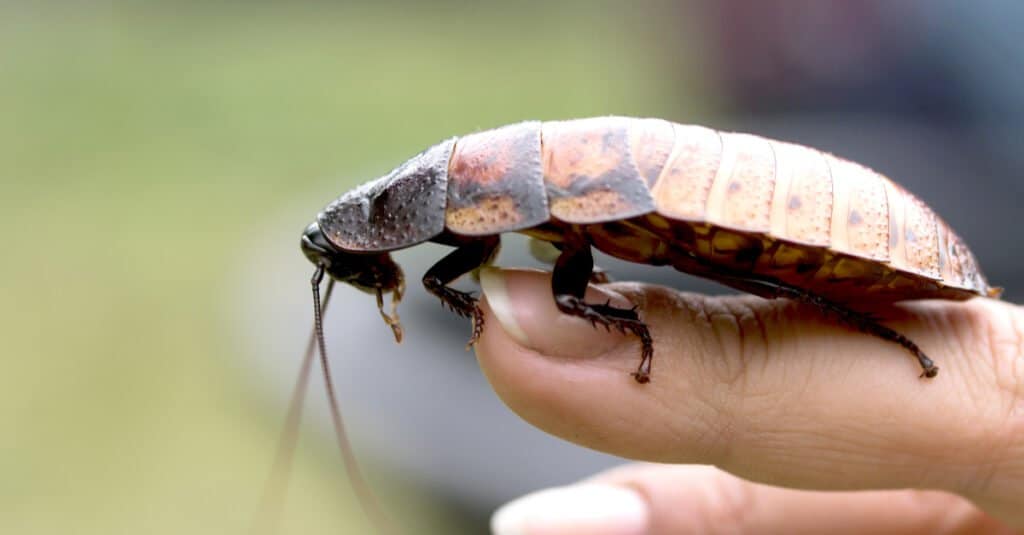
Hissing Cockroach As a Pet - Madagascar Hissing Cockroach

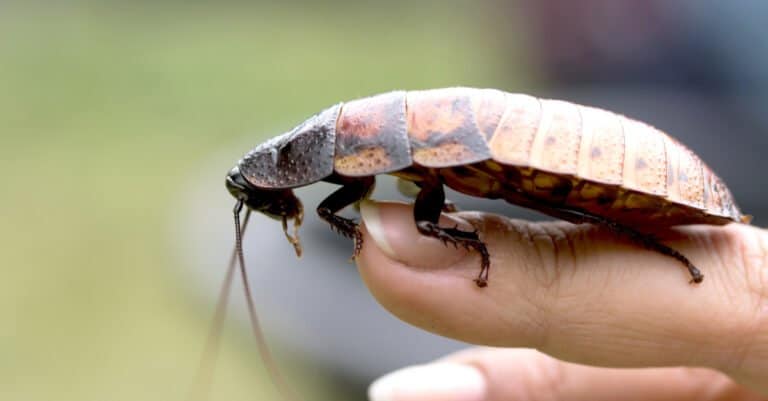
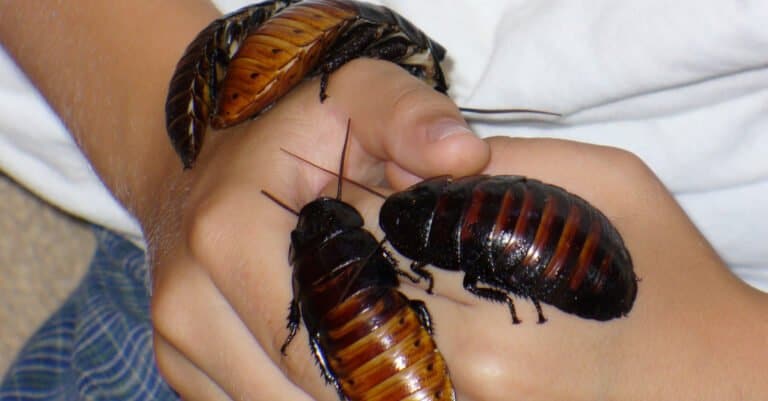
Madagascar hissing cockroaches are popular pets.

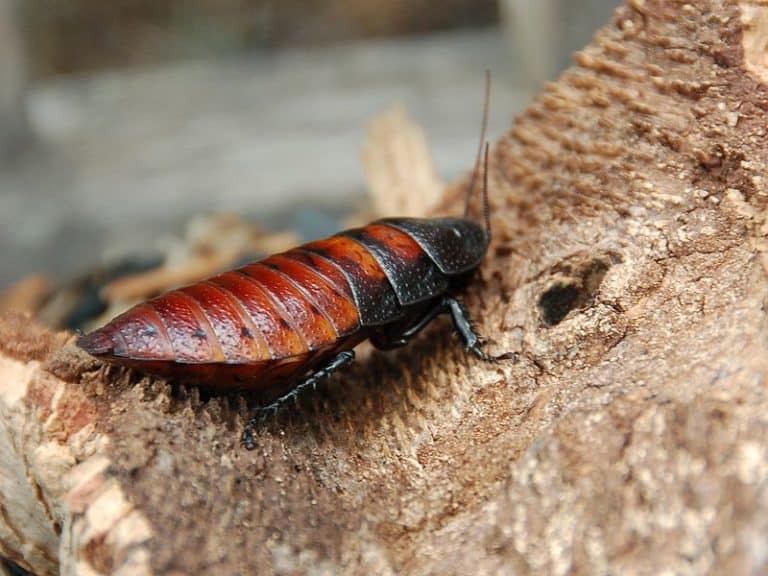
Most cockroaches have wings, even if they’re non-functional. Hissing cockroaches, however, are strictly ground-dwelling, and don’t even have vestigial wings. Instead, they have immense (relatively), oval-shaped bodies adapted for life on the ground.

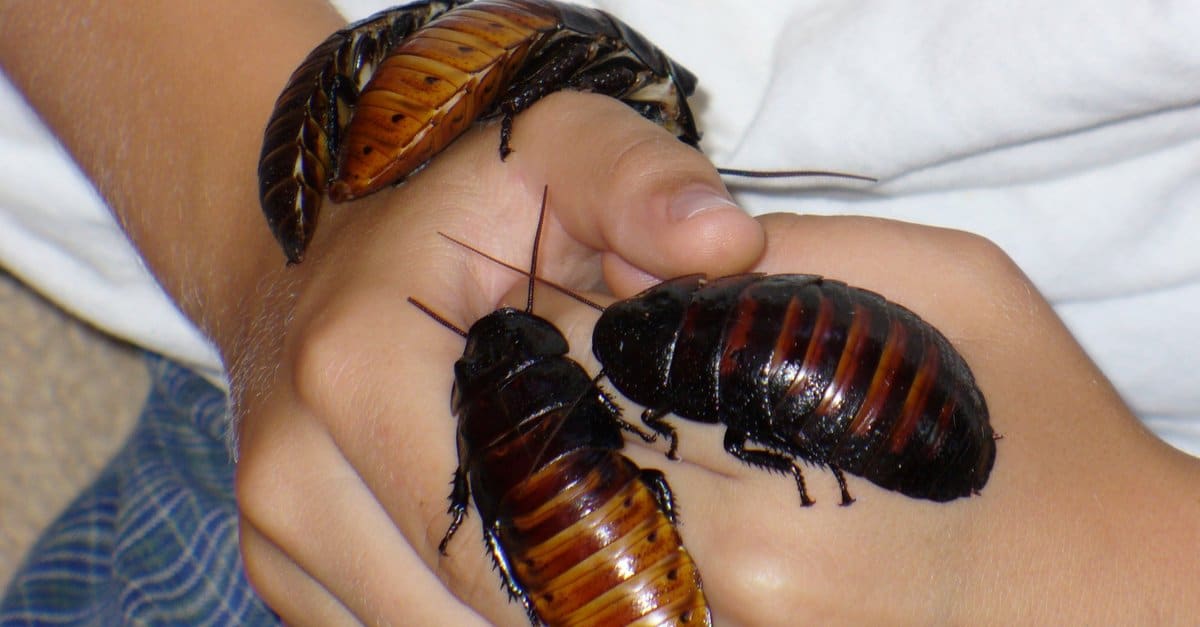
Madagascar hissing cockroaches are one inch wide and 2-3 inches long; they’re about the length of the palm of your hand. Their heads are the darkest part of their body; they’re so dark brown that they’re almost black. This black fades gradually to an amber-colored rear end. In the cockroach world, they’re considered very aesthetically pleasing. 

Males and females exhibit sexual dimorphism, meaning that males look different from females. Both have short antennae and six legs covered in short hairs, but only males have horns on their pronota (the hard shields that cover their heads). These horns are called pronotal humps; males use them to fight other males for territory and mating privileges.

Life Cycle: How to Identify Madagascar Hissing Cockroach Eggs
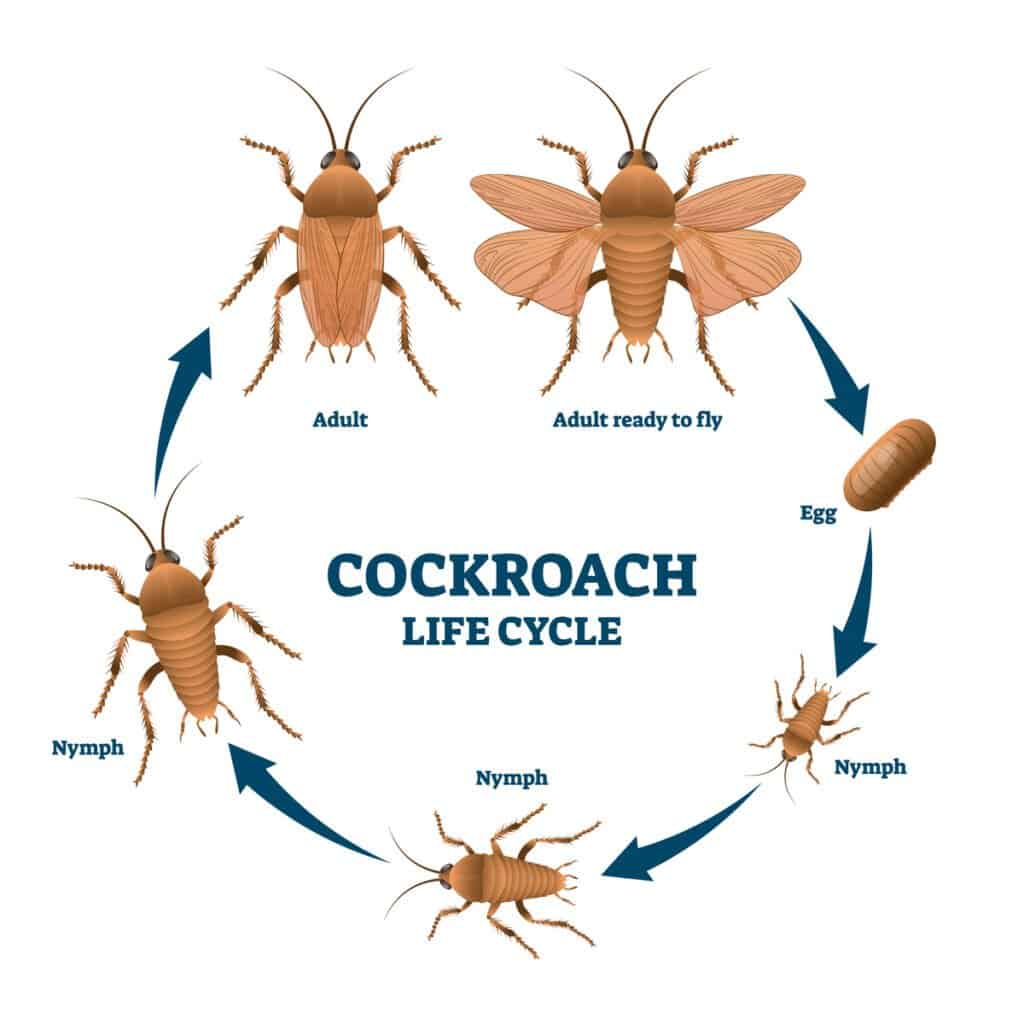
Baby Cockroach - Cockroach Lifecycle

Cockroaches follow a similar life cycle. Some species like Madagascar hissing cockroaches don’t fly.

Female hissing roaches give birth to live young, but that doesn’t mean that hissers don’t start out as eggs. Instead of laying the eggs, like a snake or a bird, the female hissing cockroach keeps the eggs inside her body during incubation. The eggs (up to 60 at a time) are further encased in an egg case called an ootheca within the female. The eggs hatch inside the female’s body, and she then births the live larvae. This process of reproduction is called ovoviviparity. 

Once the baby hissers are born, they’re known as nymphs. Though adults are dark, nymphs start out translucent white and darken with each molt. Molting happens when the nymph sheds its exoskeleton to grow larger. Young Madagascar hissing cockroaches molt six times before reaching adulthood. Once they become adults, they don’t molt anymore.

Unlike urban roaches, which tend to live in colonies, hissing roaches are largely solitary. This is particularly true of males, who are territorial and will defend their territory against other males. Their favorite places to live include dead logs and patches of rotting vegetation; males will defend these areas, as well as challenge other males for females.

Madagascar hissing cockroaches have three distinct types of hiss: one to signal danger, one to attract females, and one to challenge males. Females and nymphs only hiss to signal danger, while males make all three types of hiss. 

Unlike humans, who hiss with their mouths, hissers actually hiss with their bodies. But, unlike grasshoppers and crickets (who rub their body parts together to create sound), hissing cockroaches actually push air through tiny openings called spiracles. When the air passes through the spiracle, it produces the hissing sound for which hissing cockroaches are so famously known.

Habitat: Where to Find Madagascar Hissing Cockroach

In the wild, the only place to find a Madagascar hissing cockroach is on the island of Madagascar itself. But, if you’re looking for a captive hisser, you probably don’t have to go far. Hissing cockroaches are not only popularly kept as pets, they’re also often sold as feeder insects for exotic pets like lizards and toads.

Diet: What do Madagascar Hissing Cockroaches Eat?

All species of cockroach are omnivorous. Some are frugivores and eat mostly fruit, while others are detritivores and eat mostly detritus like dead leaves and waste. Madagascar hissing cockroaches fall more on the vegetarian side of omnivorous; their favorite foods are dead leaves and rotting wood. In the wild, they both live in, and snack on, the fallen detritus of the forest.

What Eats the Madagascar Hissing Cockroach?

Hissing cockroaches are one of the largest species of roach; they make a great meal for creatures that snack on insects. These include reptiles like lizards and snakes, amphibians like frogs and toads, small mammals like hedgehogs and shrews, and birds. Additionally, in many parts of the world, humans cook and eat cockroaches. Hissing roaches are a popular choice for human cuisine; they’re large and densely packed with nutrients and protein.

Madagascar Hissing Cockroach vs. Australian Rhinoceros Cockroach
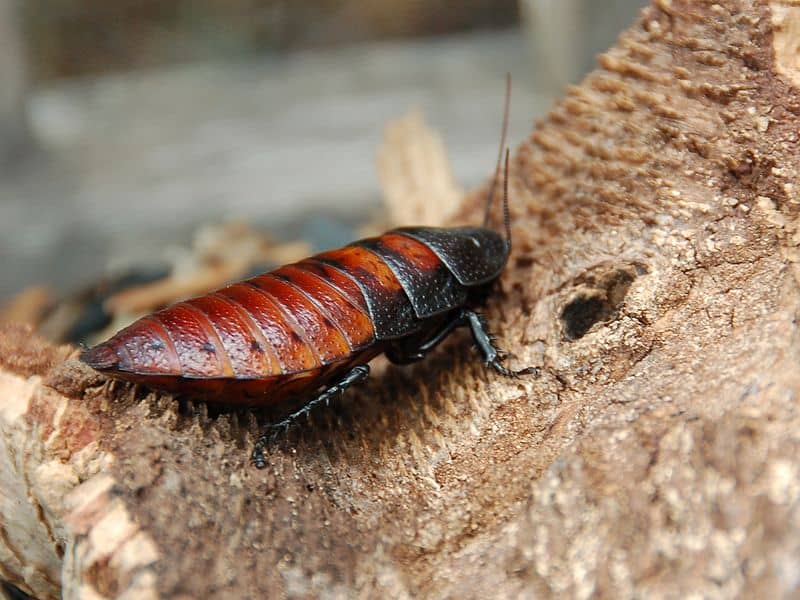
Madagascar hissing cockroaches are one of the largest species of roach around

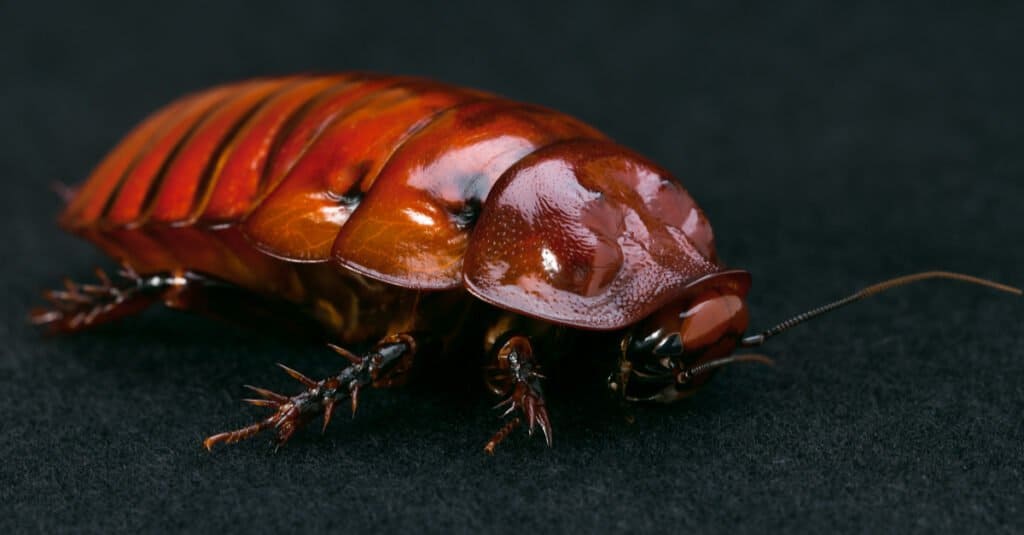
Hissing cockroaches aren’t the only breed of large roach. The heaviest cockroach in the world is actually the Australian rhinoceros cockroach (Macropanesthia rhinoceros), also known as the giant burrowing roach. Where Madagascar roaches are found only in Madagascar, the rhinoceros roach is endemic to Australia. 
Types of Cockroaches - Australian Burrowing

The Australian cockroach is another very large cockroach species that’s a similar size to Madagascar hissing cockroaches.

Hissers and burrowing roaches are roughly the same size, though the rhinoceros roach may grow a little longer. Rhinoceros roaches are a deep, mahogany brown color, while the hissing cockroach fades from almost black to amber. But perhaps the biggest difference between the two is the lifestyle. While hissers spend their time on the ground, eating dead leaves, rhinoceros roaches spend most of their time burrowing underground.

And, of course—only the Madagascar hissing cockroach hisses.

Madagascar Hissing Cockroach as a Pet

If all this talk of adorable hissing cockroaches has got you craving a cuddly new, exoskeleton-bearing pet, then read on. 

Hissing cockroaches can be widely purchased online and in exotic pet stores. If you plan on adding a hisser to your family, be sure to check out state guidelines first, some states require permits to own Madagascar hissing cockroaches.

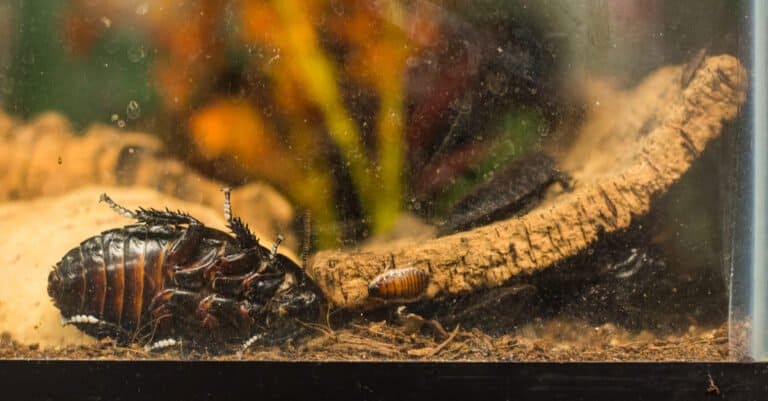
Once you’ve got your new hissing roach home, you’ll want to get it set up in an adequately sized tank filled with reptile bark, coconut fiber, or damp sphagnum moss. Make sure you put a lid on the tank though—hissing roaches are able climbers and can grip most surfaces, even glass.

Be sure to keep a clean source of water in the tank for your roach. The tank should also be warm—between 75-85 degrees. No need to provide any special lighting though, hissing cockroaches are nocturnal, and don’t like to come out in the daytime. Feed your hissing cockroach fresh vegetables, high-protein pet food, and fruit. And, be sure to remove any uneaten food and keep the tank clean.

View all 329 animals that start with M

Sources

  1. University of Kentucky Entomology Department / Accessed February 16, 2022
  2. Oklahoma State University Extension
Brandi Allred

About the Author

Brandi Allred

Brandi is a professional writer by day and a fiction writer by night. Her nonfiction work focuses on animals, nature, and conservation. She holds degrees in English and Anthropology, and spends her free time writing horror, scifi, and fantasy stories.

Thank you for reading! Have some feedback for us?