








M
Species Profile

Manchester Terrier

Canis lupus familiaris

Sleek. Smart. Born to Rat.
Ricantimages/Shutterstock.com

Manchester Terrier Distribution

Click a location to explore more animals from that region

Origin Location

This map shows the native origin of the Manchester Terrier. As a domesticated species, they are now found worldwide.

Loading map...

Found in 1 country

Size Comparison

Human 5'8"
Manchester Terrier 1 ft 3 in

Manchester Terrier stands at 22% of average human height.

Manchester Terrier close-up

At a Glance

Domesticated
Also Known As Manchester, Manchie, Manchies
Diet Omnivore
Activity Diurnal+
Lifespan 16 years
Weight 10 lbs
Status Not Evaluated
Did You Know?

The breed was developed around Manchester, England, and became famous for rat-catching (ratting).

Scientific Classification

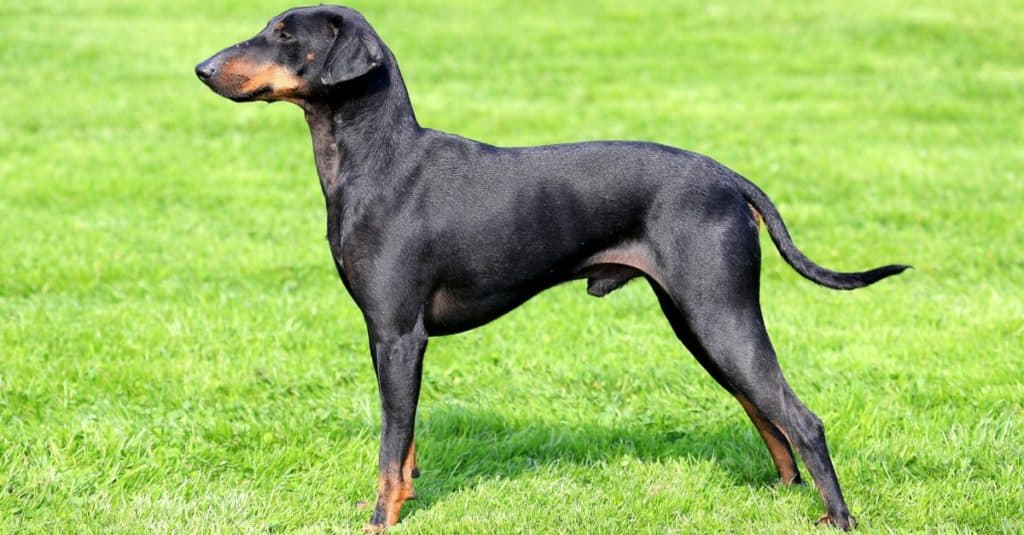
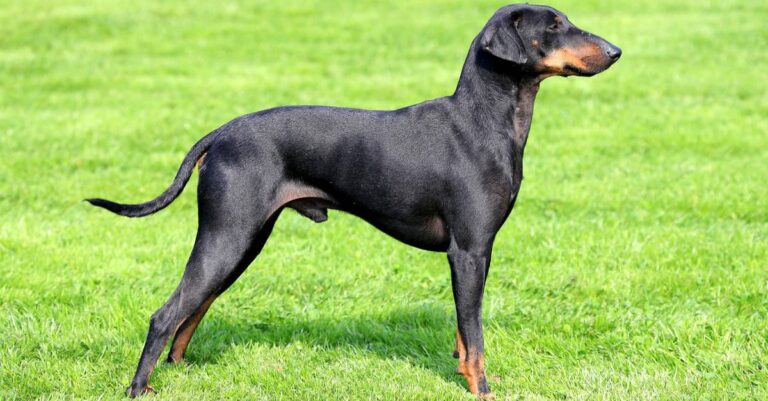
The Manchester Terrier is a sleek, black-and-tan terrier breed developed in England, historically used for ratting and small-game work; today it is primarily a companion and sport dog.

Kingdom
Animalia
Phylum
Chordata
Class
Mammalia
Order
Carnivora
Family
Canidae
Genus
Canis
Species
Canis lupus

Distinguishing Features

  • Distinct black-and-tan coat pattern (jet-black with rich tan markings)
  • Sleek, wedge-shaped head and compact, athletic build
  • Terrier temperament: alert, quick, and responsive; historically a ratter

Physical Measurements

Height
1 ft 3 in (1 ft 2 in – 1 ft 4 in)
Length
2 ft 2 in (1 ft 6 in – 2 ft 6 in)
Weight
15 lbs (11 lbs – 19 lbs)
Tail Length
8 in (7 in – 9 in)
Top Speed
25 mph
running

Appearance

Primary Colors
Secondary Colors
Tan
Skin Type Tight-fitting skin under a short, smooth, fine coat; low-odor, low-shedding but cold-sensitive.
Distinctive Features
  • Domestic dog breed (Canis lupus familiaris) selectively bred in Manchester, England for ratting and small-game work.
  • Sleek, athletic terrier silhouette: long neck, deep chest, pronounced tuck-up, and level topline.
  • Refined wedge-shaped head with tight lips; dark, almond-shaped eyes creating an alert expression.
  • Natural ears are small V-shaped drop ears; some lines historically cropped (where legal).
  • Short, close coat accentuates muscular definition; minimal feathering and no undercoat emphasis.
  • Compact, catlike feet and springy gait suited to speed, turning, and vermin pursuit.
  • Tail is moderately short and tapers, carried slightly up but not curled over back.
  • Distinguishes from the base species/wild canids: smaller size, fixed black-and-tan pattern, reduced coat thickness, and purpose-bred ratter build.
  • Health concerns seen in the breed: von Willebrand disease, hypothyroidism, patellar luxation, and some eye issues (e.g., lens problems).
  • Care requirements: regular aerobic exercise and training; short-coat grooming is easy, but provide warmth in cold weather and maintain dental/nail care.

Sexual Dimorphism

Males are typically slightly larger with a broader head and more pronounced musculature through neck and shoulders. Females tend to be finer-boned with a narrower head and lighter overall outline while keeping the same black-and-tan pattern.

  • Slightly heavier bone and more muscular forequarters.
  • Broader wedge head and thicker neck appearance.
  • Often a more robust chest and overall substance.
  • Finer bone and a more streamlined outline.
  • Narrower head and lighter neck/shoulder musculature.
  • Often slightly more delicate feet and overall frame.

Did You Know?

The breed was developed around Manchester, England, and became famous for rat-catching (ratting).

Manchester Terriers come in two varieties-Standard and Toy (Toy is sometimes treated as a separate variety/registry category).

Their signature look is a glossy black coat with sharply defined tan points on the face, chest, and legs.

Compared with many terriers, they're notably sleek and "houndy" in outline-built for speed and precision.

Historically, they were associated with urban pest control during Britain's industrial era.

They often excel in modern dog sports like agility, rally, obedience, and scent work due to their drive and quick learning.

Their short coat is low-shedding and easy to groom, but they're not built for cold weather without a jacket.

Unique Adaptations

  • Athletic, streamlined build: compared with the base species (gray wolf, Canis lupus), the Manchester Terrier is a human-directed, selectively bred form optimized for speed, agility, and close-quarters vermin control rather than endurance pack hunting.
  • Short, tight coat and defined pigmentation: selective breeding emphasizes a glossy black coat with crisp tan points; minimal coat bulk aids mobility in tight spaces but reduces insulation.
  • Compact, efficient gait: long legs relative to body size and a narrow frame support quick acceleration and sharp turns during pursuit.
  • Keen visual-and-scent targeting at close range: strong orientation to small, fast-moving targets aligns with the breed's historical job in urban environments.
  • Biddability shaped by domestication: as Canis lupus familiaris, the breed is adapted to interpret human cues and work alongside people, unlike wild wolves' primarily conspecific social focus.

Interesting Behaviors

  • High prey drive: many will intensely track squirrels/rodents, a direct carryover from their working ratter roots.
  • "Terrier stare" and rapid pounce: they frequently freeze, focus, then spring-classic small-game hunting behavior.
  • Shadowing their person: despite working ancestry, they commonly form close bonds and follow family members room to room.
  • Fast-learning, fast-bored: they pick up cues quickly but may invent their own activities without enough training and enrichment.
  • Alert watchdog behavior: they often announce new sights/sounds promptly, reflecting a vigilant, ready-to-act temperament.
  • Play style can be intense and chase-oriented; structured games (fetch, tug with rules, flirt pole) often suit them well.
  • Digging and "nesting" in blankets can appear, especially when understimulated or seeking warmth.

Cultural Significance

The Manchester Terrier (Canis lupus familiaris) grew in industrial-era Britain for rat hunting. Its black-and-tan look tied it to working-class life. Today it is mostly a pet and sport dog, prized for speed, focus, and being easy to train.

Myths & Legends

In 19th-century England, rat-catching contests (rat pits) became notorious public spectacles; black-and-tan terriers from the Manchester region were celebrated in stories and newspaper anecdotes for dispatching large numbers of rats at remarkable speed.

A common origin tale says Victorian dog breeders around Manchester turned an older black-and-tan terrier into the sleeker, faster Manchester Terrier (Canis lupus familiaris) by breeding, a story tied to the city's mills.

Traditional British dog lore often treated skilled ratters as lucky guardians of barns, stables, and shops; a dependable black-and-tan terrier was prized as a talisman against ruinous vermin infestations in crowded towns and warehouses.

Writers once called the Manchester Terrier (Canis lupus familiaris) the 'gentleman's ratter' — a small dog that stayed calm with people by day but became a tough pest hunter by night, raising its social status.

Conservation Status

NE Not Evaluated

Has not yet been evaluated against the criteria.

Population Stable

Life Cycle

Birth 3 pups
Lifespan 16 years

Lifespan

In the Wild
15–17 years
In Captivity
12–17 years

Reproduction

Mating System Polygynandry
Social Structure Managed Domestic
Breeding Pattern Serial
Fertilization Managed Selective
Birth Type Managed_selective

Reproduction is typically human-managed: breeders select specific male-female pairings, but stud dogs may sire litters with multiple females and females may be bred across seasons. Copulation and gestation occur via internal fertilization, with no enduring pair bond.

Behavior & Ecology

Social Pack Group: 3
Activity Diurnal, Crepuscular
Diet Omnivore Meat-forward meals (e.g., chicken or turkey) with moderate fat and added omega-3s (fish oil) for skin/coat.

Temperament

Breed-distinct: high prey drive and quick strike behavior from historic ratting and small-game work.
Alert, intelligent, and fast-learning; thrives on structured training and clear boundaries.
Typically loyal and people-oriented; may be reserved or wary with unfamiliar people without socialization.
Can be dog-selective; early positive exposure reduces reactivity and tension in crowded settings.
Across the breed, confidence ranges from bold to cautious; environment and handling shape outcomes.
Care: needs daily vigorous exercise, sprint/play opportunities, and puzzle/foraging games to prevent boredom.
Care: short coat offers little insulation; benefits from warmth in cold/wet weather and comfortable resting spots.
Health concerns seen in the breed: von Willebrand disease, patellar luxation, Legg-Calvé-Perthes, hypothyroidism; screen as advised.

Communication

sharp alert bark
short warning growl
whine/cry for attention or frustration
play grunts and snorts
intense stare, stalking posture, and sudden darts indicate prey interest and arousal.
ears, tail carriage, and body stiffness signal confidence, caution, or defensive uncertainty.
licking, leaning, and close following show affiliative bonding with preferred people.
scent investigation and marking are common outdoors; uses nose and tracking focus during play/work.
Trained sport or companion dogs may communicate more subtly; under-socialized dogs may escalate signals faster.

Habitat

Biomes:
Temperate Forest Temperate Grassland Mediterranean Boreal Forest (Taiga) Tundra Alpine Desert Hot Desert Cold Wetland Freshwater Marine +5
Terrain:
Plains Hilly Coastal Island
Elevation: Up to 16404 ft 3 in

Ecological Role

Domestic omnivorous mesopredator/pest-controller closely associated with humans; historically a specialized rodent hunter rather than a large-prey pack hunter like the base species (gray wolf).

rodent population control in human environments (historical primary role) deterrence of small pest species around homes/farms companion animal functions that indirectly support human well-being participation in sport/working activities (e.g., scent work) that channel predatory behaviors without wildlife impact

Diet Details

Main Prey:
Rodents Small lagomorphs Small mammals Small birds Invertebrates
Other Foods:
Grains and starches Vegetables and fiber sources Fruits Grasses Plant fibers

Human Interaction

Domestication Status

Domesticated

Canis lupus familiaris (domestic dog) came from the gray wolf through long human breeding for tameness, easy to train, and jobs like hunting, herding, pest control, and companionship. The Manchester Terrier, from around Manchester, England, is a small, sleek black-and-tan terrier bred for ratting and pest work; today it is a companion and sport dog with a strong prey drive.

Danger Level

Low
  • Bite risk exists like any dog, typically linked to fear, poor socialization, resource guarding, or rough handling; small-to-medium size reduces severity compared with large breeds.
  • High prey drive can lead to chasing/redirected nipping during arousal if not trained and managed.
  • Can be reserved with strangers; inadequate early socialization may increase reactivity.
  • Non-injury risks: tripping/leash pulling incidents and conflicts with small pets (cats/rodents) due to strong vermin instinct.

As a Pet

Suitable as Pet

Legality: Manchester Terrier (Canis lupus familiaris) is usually legal where pet dogs are allowed. Local rules (licenses, leashes, vaccines, spay or neuter), housing, import, quarantine, or landlord or HOA policies may still apply.

Care Level: Moderate

Purchase Cost: $100 - $2,500
Lifetime Cost: $14,000 - $28,000

Economic Value

Uses:
Companion animal industry Sport/competition dog services Breeding and showing Veterinary and preventive care market
Products:
  • puppy sales/adoption placements
  • stud services and pedigree breeding programs
  • training services (obedience/agility/scent work)
  • pet supplies (crates, leashes, enrichment toys suited to high prey drive)
  • routine veterinary services (vaccines, parasite control, dental care)

Relationships

Ecological Equivalents 6

Animals that fill a similar ecological role in their ecosystem

Domestic dog
Domestic dog Canis lupus familiaris In the Manchester Terrier context: compared to other domestic dogs and gray wolves, the Manchester Terrier is a small, sleek black-and-tan vermin hunter with a strong chase drive, alert agility, short coat, and high exercise needs. Ecologically it occupies a small-bodied, pursuit-based predator niche focusing on rodents and other vermin, and it is predisposed to health issues such as patellar luxation, Legg-Calvé-Perthes, hypothyroidism, and eye problems.
English Toy Terrier
English Toy Terrier Canis lupus familiaris Very similar historical function (ratting) and a nearly identical black-and-tan phenotype; generally smaller and more toy in type. Often considered a close cousin or related development of the old Black and Tan terrier types.
Miniature Pinscher
Miniature Pinscher Canis lupus familiaris Similar compact, sleek build and high, animated, watchful demeanor. Commonly kept as an alert companion with a strong chase/play drive, overlapping the modern niche of a small, active household dog.
Jack Russell Terrier
Jack Russell Terrier Canis lupus familiaris Shares the terrier vermin-control niche and an intense prey drive. Differs in coat and structure and in typical working style (often more earthwork-focused), but overlaps strongly in exercise and training demands.
Rat Terrier
Rat Terrier Canis lupus familiaris Another purpose-bred ratter with a similar small-game focus, agility, and strong chase instinct; has comparable needs for management of prey drive and provision of daily activity.
Domestic cat
Domestic cat Felis catus Occupies an overlapping human-associated rodent-control niche. Both have been commonly used historically to control rats and mice around homes, stables, and urban settings, though they employ different hunting strategies.

Manchester terriers are excellent, attentive dogs that come in two sizes: standard and toy. The Sherlock Holmeses of the canine world, they’re impressively observant and intelligent. But unlike the famous fictional detective, Manchester terriers are good with children and outwardly affectionate with their humans. Plus, shedding isn’t a massive issue with the breed, making them easy additions to any household.

Evolution And History

Active and adaptable, Manchester terriers are equally fit for game hunters living on country estates and city-dwellers with small apartments. Originally bred to be both good ratters for Manchester’s factories and companionable gentlemen’s hunting dogs, the breed came about by crossing black and tan terriers with whippets. Although it was named after the city of Manchester in 1860, it was still referred to as the black and tan terrier until the early 20th Century. A longtime member of the American Kennel Club, the Manchester terrier was first inducted in 1887.

It’s not uncommon to find a Manchester mix among groups of rescues, and they make excellent additions to myriad families — even families of one. Manchester terriers are loyal, devoted, and enjoy life.

The Two Different Types Of Manchester Terriers

There are two types of Manchester terriers: standard and toy. In the days of old, canine aficionados classified them as separate breeds. Today, canine enthusiasts see them as two different-sized options within the same breed.

Owning A Manchester Terrier: Three Pros And Cons

ProsCons
Easy Grooming
Manchester terriers are a “wash and go” breed with minimal shedding. Since their coats are short, they don’t require multiple weekly brushings. An occasional bath with a doggie shampoo is usually sufficient unless your pup is a mud hound.
Yap Alert
If you’re in search of a dog that isn’t yappy, Manchester terriers may not be for you. They’re exceptionally alert and will deploy warning barks in response to abnormal occurrences or sounds.
Very Adaptable
Manchester terriers aren’t particular about their living conditions. Of course, it should be clean and comfortable, but they’re equally at home in an apartment or a mansion.
Stimulation Needs
To remain happy and amenable, Manchester terriers need at least two brisk walks a day plus mental stimulation. A daily jaunt at the doggie park is also recommended. Humans without the time to fulfill these needs should probably look at a different breed.
Loyal and Smart
Since Manchester terriers are very loyal and smart, they make excellent companions. Whether you’re playing at the doggie park or cuddling on the couch, a Manchester terrier will just be happy to have you around.
Troublemakers
Remember the smart kid from high school who was always brewing up trouble? That’s the way of the Manchester terrier. If they get bored, they will find mischief — or conjure some up of their own making!
The lovely Manchester Terrier in a garden

Manchester Terriers are a breed with minimal shedding.

Size And Weight

As we’ve mentioned, Manchester terriers come in two sizes: toy and standard. However, the breed doesn’t exhibit height and weight “sexual dimorphism,” meaning the size range for both sexes is identical. Some sources may stipulate slight proportional differences between the ladies and gents, but the findings are negligible and inconsistent.

Standard Manchester Terrier Size And Weight

Standard-size Manchester terriers weigh between 12 and 22 pounds and stand between 15 and 16 inches at the shoulder. Puppies reach full size at 12 months.

Toy Manchester Terrier Size And Weight

Toy-size Manchester terriers weigh between six and 11 pounds and stand between 10 and 12 inches at the shoulder. Puppies are full-size after a year.

Common Health Issues
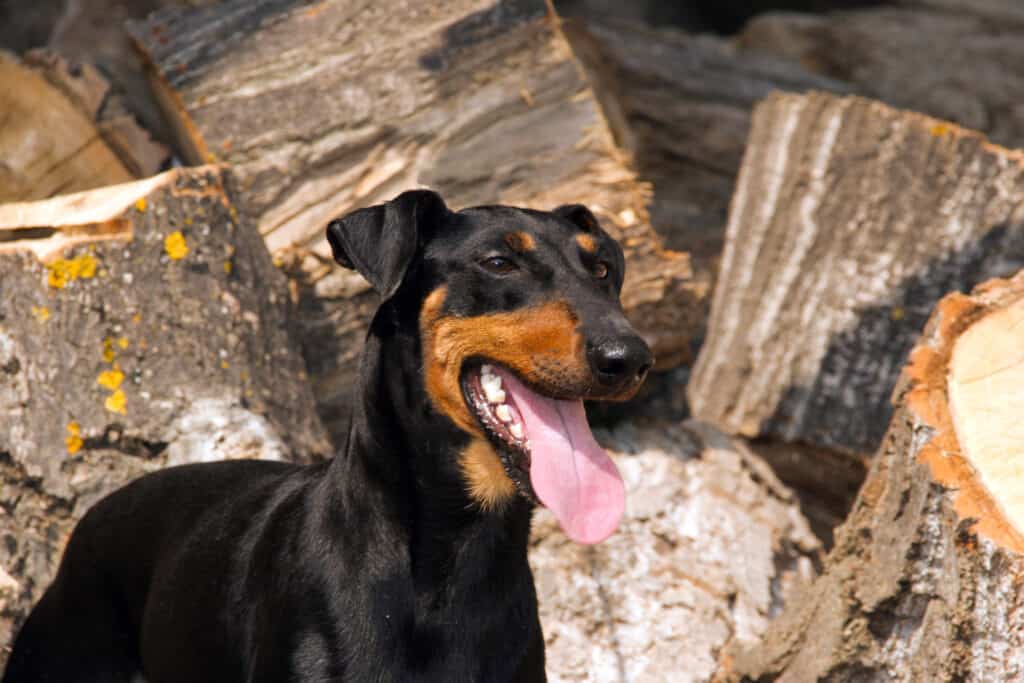
The breed’s most marked health issue is juvenile cardiomyopathy.

One of the most serious health issues in the breed is juvenile cardiomyopathy, though conditions like von Willebrand’s disease and patellar luxation are also concerns. In recent years, Manchester terrier breeders have been working diligently with vets to develop a genetic test for the condition.

Additionally, Manchesters have greyhound ancestry. As such, surgeons should be careful administering anesthesia. The breed also may suffer from poor eyesight and patellar luxation, aka “loose knees.” Thyroid problems may also present themselves.

The National Breed Club suggests the following tests for Manchester terriers:

  • Von Willebrand’s Disease DNA Test
  • Ophthalmologist Exam
  • Thyroid Evaluation

Manchester terrier rescues may be a mix. If so, different ailments may manifest. It’s always wise to take rescues to a vet ASAP for a complete blood workup. It’s worth the price to ensure your fur baby has all the meds and shots it needs.

Temperament And Behavior
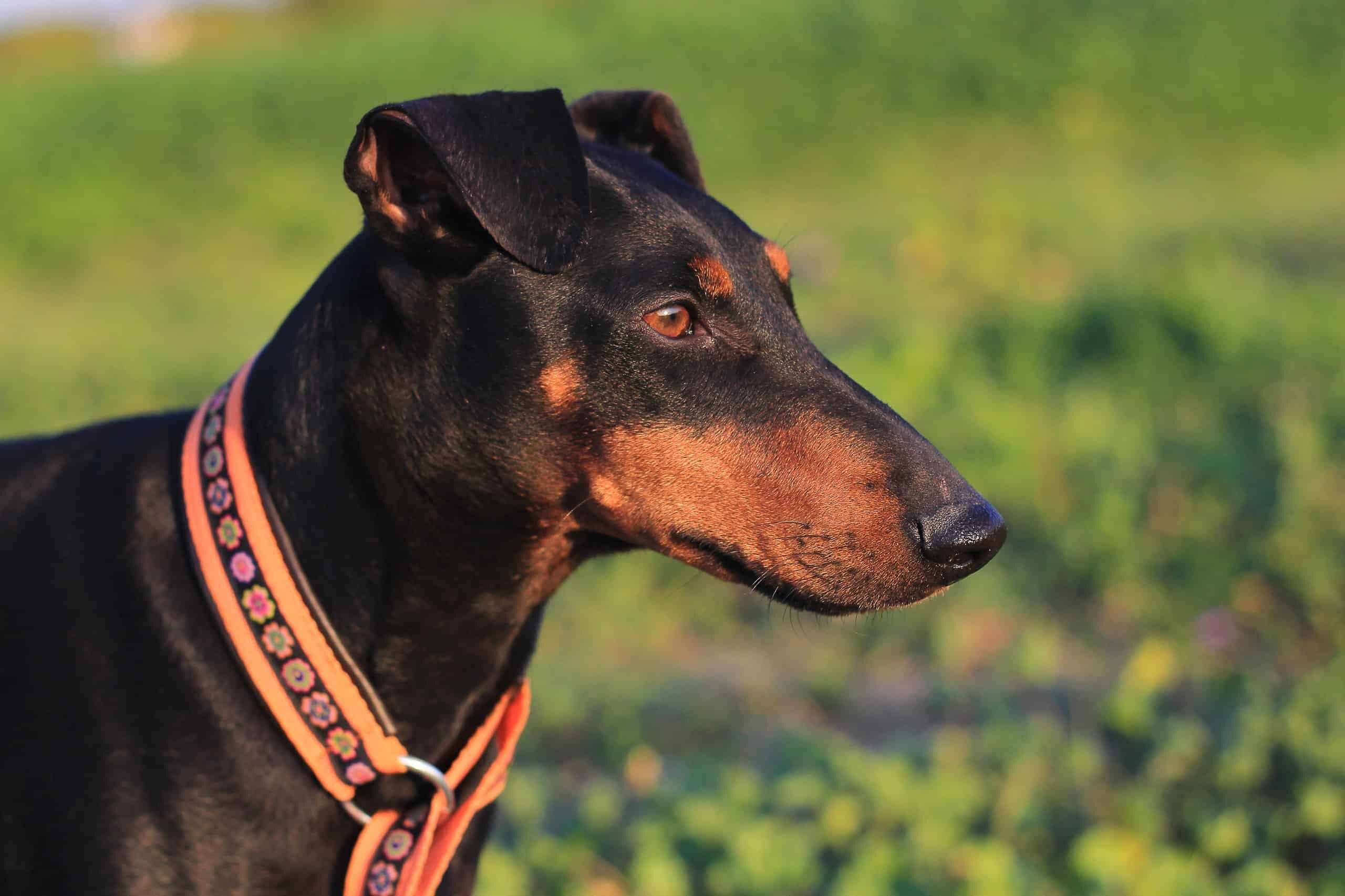
This terrier is a great breed for active families and individuals.

With their sleek, watchful, and athletic traits, Manchester terriers are a great personality fit for active families and individuals. However, people thinking about welcoming one into their homes should understand the breed is known for its “ratting” behavior. In other words, they like to hunt small animals! So if you don’t want a dog that chases and kills mice and vermin, Manchesters are probably not the pups for you. On the flip side, rural residents who’d love an in-house mouser may welcome the behavior.

Besides their athleticism and anti-vermin instincts, Manchester terriers have loads of other desirable traits. Not only are they brilliant, but they’re devoted to their masters, love to have fun, and are appropriately discerning. Unlike other terrier breeds with dour personalities, Manchesters are eager-to-please and happy-go-lucky. So long as you do your part to keep them active and happy, a better best friend you will not find.

It’s important to understand, though, that a genetic legacy mix in any dog may alter its behavior and traits. Plus, temperament and behavior traits aren’t a guarantee. Like humans, all dogs have unique personalities.

How To Take Care Of Manchester Terriers

People researching how to care for Manchester terriers, from puppy to old age, will be glad to discover that it’s a relatively healthy breed that requires little grooming maintenance.

The Best Dog Food For Manchester Terriers
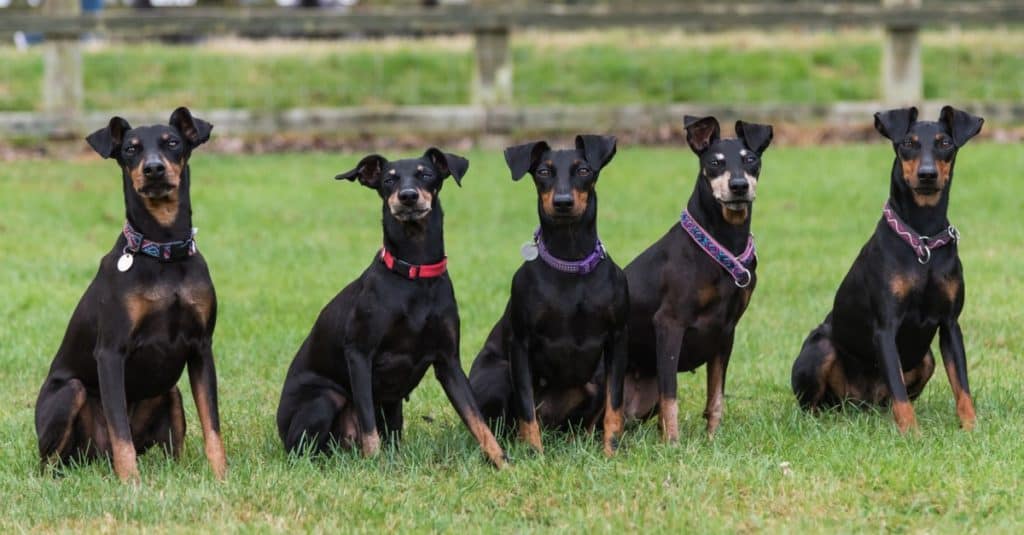
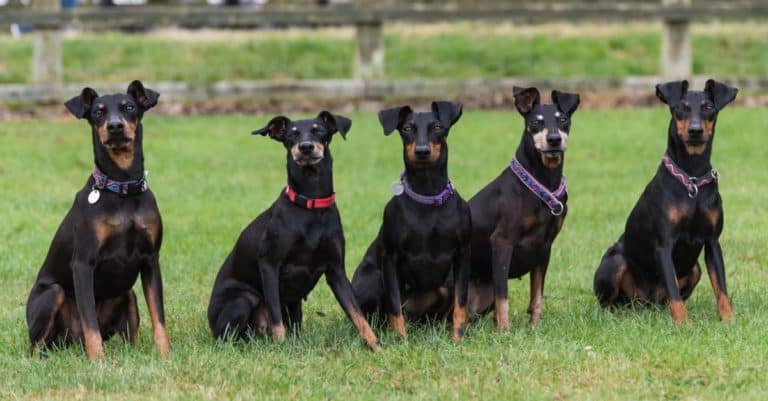
Five Manchester Terriers sitting in a row in a field

High-protein diets are best for this breed, both puppy and adult.

The ideal diet for Manchester terriers is dependent on activity level, age, health, and weight. Plus, one’s budget should also weigh heavily in the calculation.

Manchester terrier puppy food: The hearts of some Manchester terrier puppies may be slightly weaker. To help mitigate this potential health hiccup, vets recommend high-protein puppy diets. Quality meats should be the main ingredients, and the formula composed specifically for “growth,” “puppies,” or “all life stages.” For puppies of all breeds, foods with higher calcium content are a good idea, as it helps their bones grow strong, which can prevent problems down the road.

Manchester terrier adult dog food: Adult Manchester terriers do best with high-protein foods. Avoiding recipes with lots of filler is wise. It’s simply not as nutritious. However, because of their active tendencies, Manchester terriers do well with blends that incorporate protein, fats, and carbohydrates. As a general rule of thumb, make sure whatever food you buy is approved by the Association of American Feed Control Officials.

Something to consider is the breed’s propensity for juvenile cardiomyopathy. This makes it extra important to stay in touch with the vet about your dog’s health and nutrition. Get up-to-date on the link between canine heart failure and legumes, and aim for legume-free dog food.

Maintenance And Grooming

One of the reasons Manchester terriers make great companions is their minimal grooming needs. Beloved as a “wash and wear” dog, they only need occasional baths every couple of months. And while Manchesters do shed, it’s infrequent.

To keep your Manchester pup looking dapper, a weekly wipe down with a damp cloth followed by a quick brushing with a hound glove does the trick.

Training

What makes Manchester terriers so lovable can also make training them difficult. Their intelligence can morph into stubbornness, and their fun-loving personalities may interfere with training time. However, compared to other terrier breeds, Manchesters fall on the more manageable end of the scale.

Exercise
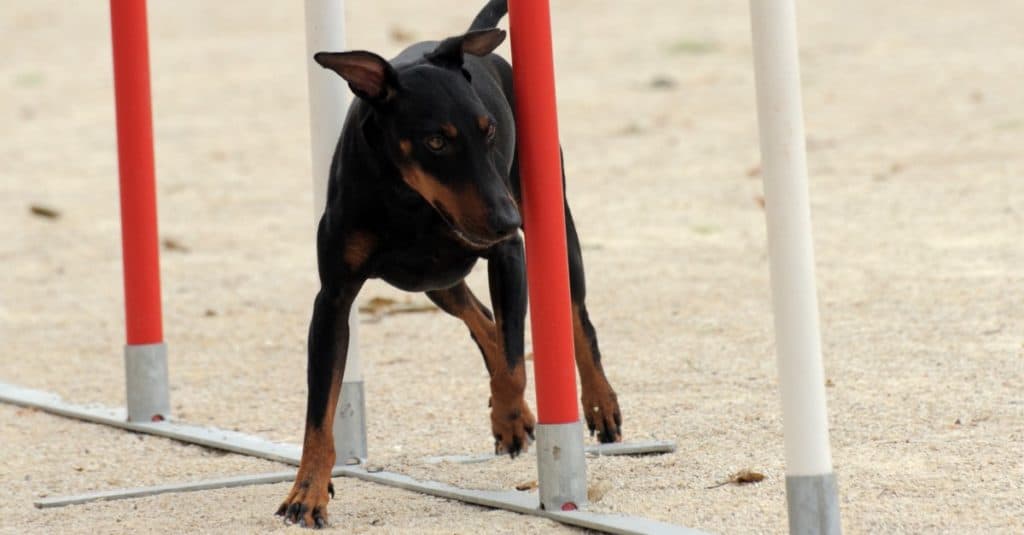
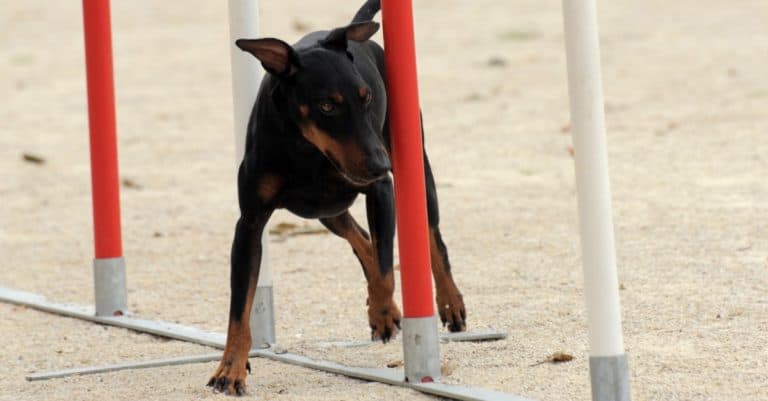
Manchester Terrier in a competition of agility

Manchester Terriers require at least two walks per day, but can be stubborn to train.

Keeping Manchester terriers happy and healthy requires at least two walks a day. If you have time to throw a ball around the backyard, that’s also great. However, terriers don’t need wide-open spaces. The smooth-haired athletes thrive in apartments and farmhouses alike.

Puppies

Besides screening for juvenile cardiomyopathy, a potentially fatal heart condition, Manchester terrier puppies don’t have specific care needs. However, they’re active and need more mental stimulation than many other breeds. Without it, you may come home one day to find your home ripped to shreds. To put it bluntly: if you don’t have the time and resources to commit a few hours a day to a Manchester terrier, you may want to consider another breed. Otherwise, your furniture may pay the price.

Early training is essential for Manchester terrier puppies. They can grow up to be overly aggressive when not socialized at a young age.
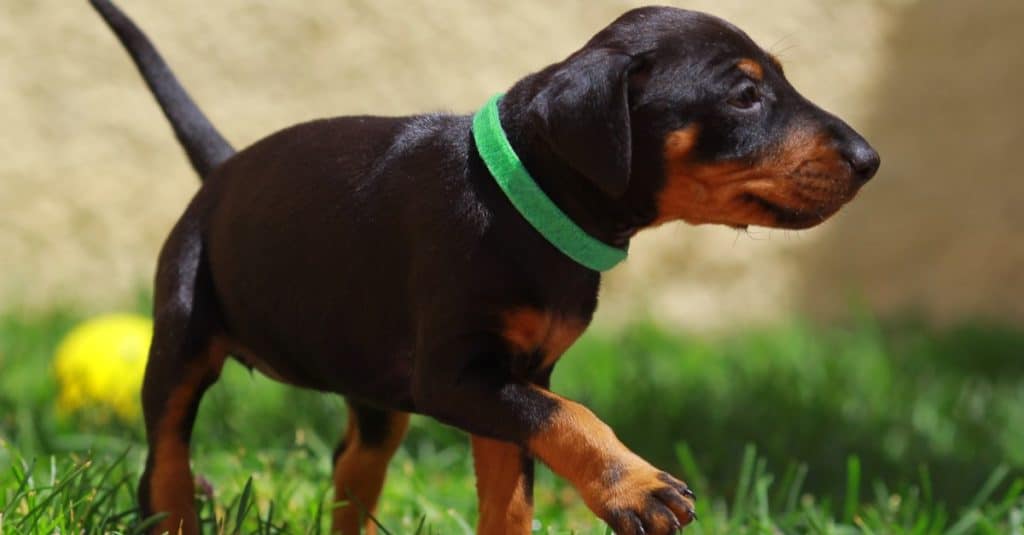
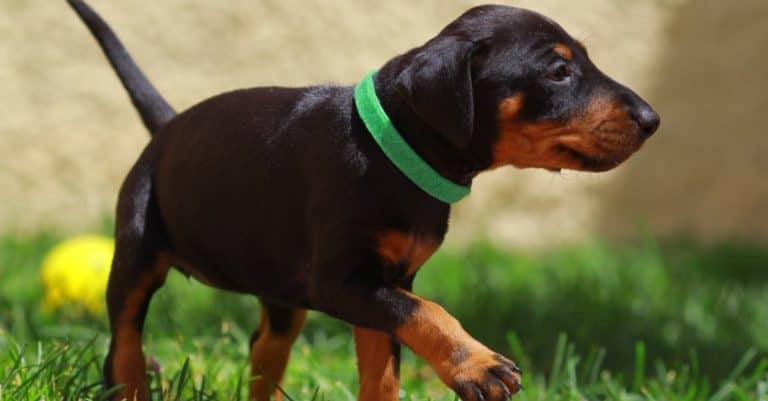
Manchester Terrier puppy

The puppies of this breed need more mental stimulation than many other breeds.

Manchester Terriers And Children

Are Manchester terriers good with children? It depends.

Puppies trained from an early age typically do well in family settings. Moreover, the breed’s athletic nature is a super fit for active clans. Plus, they’re fun-loving and playful — both inside and out — which is great for kids.

However, an untrained Manchester terrier may not be the best fit for families with babies, as they can be a bit stubborn and aggressive. At the very least, Manchesters should never be left alone with babies.

Dogs Similar To Manchester Terriers

Manchester terriers are most similar to rat terriers, bull terriers, and whippets.

  • Rat Terriers: Both rat terriers and Manchester terriers are superb vermin hunters with smooth-haired coats.
  • Bull Terriers: Like rat terriers and Manchester terriers, bull terriers are a smooth-haired breed. Behavior-wise, Manchesters and bulls also have a lot in common. Both are smart and fun-loving.
  • Whippets: The original Manchester terriers were conceived by crossing terriers with whippets. As such, the two breeds have similar looks and temperaments.

View all 329 animals that start with M

Sources

  1. American Kennel Club / Accessed April 3, 2021
  2. Your Pure Bred Puppy / Accessed April 3, 2021
  3. Vet Street / Accessed April 3, 2021

Melissa Bauernfeind

About the Author

Melissa Bauernfeind

Melissa Bauernfeind was born in NYC and got her degree in Journalism from Boston University. She lived in San Diego for 10 years and is now back in NYC. She loves adventure and traveling the world with her husband but always misses her favorite little man, "P", half Chihuahua/half Jack Russell, all trouble. She got dive-certified so she could dive with the Great White Sharks someday and is hoping to swim with the Orcas as well.
Connect:

Thank you for reading! Have some feedback for us?


Manchester Terrier FAQs (Frequently Asked Questions)

The price range for a purebred Manchester Terrier is between $600 and $1,000. Their food and treats run about $80 to $120 a month. Grooming costs are negligible for Manchester terriers because they have short coats.