
Quick Take
- The Atlantic manta ray was recognized as its own species in 2025.
- Manta rays are often confused with stingrays.
- Manta rays are considered threatened by human activity.
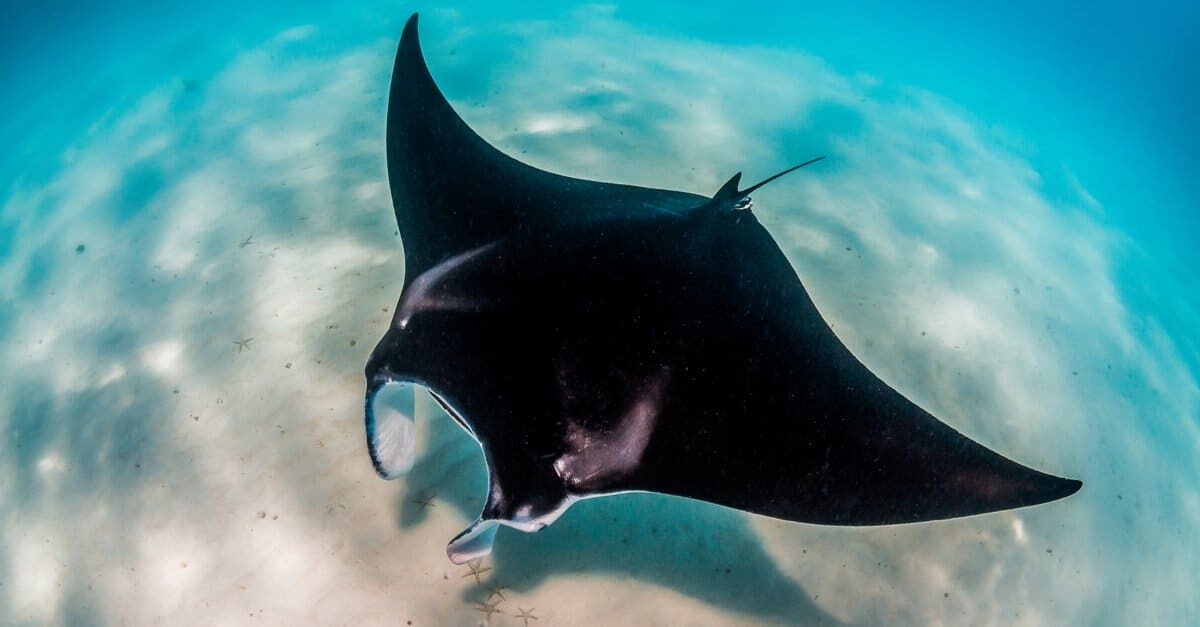
There are three species of manta rays belonging to the genus Mobula: the giant oceanic manta ray (Mobula birostris), the reef manta ray (M. alfredi), and the Atlantic manta ray (M. yarae). Manta rays have a cosmopolitan distribution, inhabiting tropical, subtropical, and warm temperate oceans worldwide, with significant populations around Ecuador, the Maldives, Indonesia, Mexico, and Mozambique. They are the largest rays among more than 600 species of cartilaginous fish, all characterized by flat bodies, pectoral fins fused to their heads, and gill slits on their undersides. Continue reading to discover just how large manta rays are and whether or not they present a danger to humans.
Manta Ray: Overview
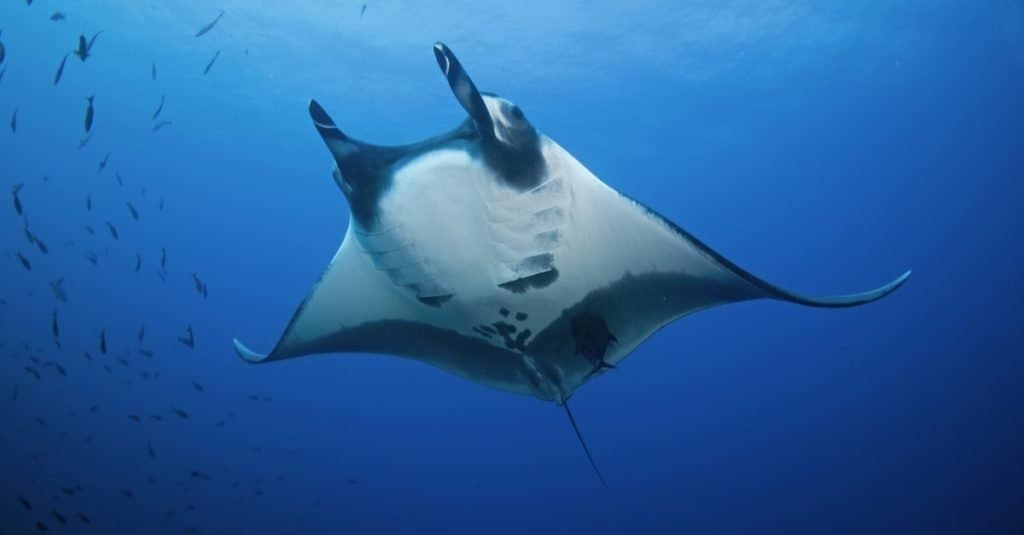
Female manta rays are typically larger than male manta rays.
©Martin Prochazkacz/Shutterstock.com
Manta rays are enormous fish with an average adult disc width measuring between 15 and 23 feet. The largest species, the giant oceanic manta ray, can have discs that are 29 feet wide, while the reef manta ray is more typically between 12 and 15 feet wide. Atlantic manta rays are slightly smaller, measuring between 9 and 12 feet across.
Manta rays typically weigh between 1,500 and 3,000 pounds, though some larger specimens have been reported to weigh up to 5,000 pounds. Female manta rays are generally larger than males because they need more space and energy to produce and carry large pups.
Manta rays are planktivores that consume vast quantities of microscopic zooplankton, including copepods, krill, and fish larvae, by filtering water through specialized gill rakers while swimming.
Manta rays are often found near coral reefs, where they engage in cleaning, social interaction, and access to abundant food. Reefs provide access to the small fish that remove parasites from the rays’ skin, improving their health. The nutrient-rich, calm waters around reefs also support high populations of plankton, on which manta rays feed.
Giant oceanic manta rays and Atlantic manta rays frequently undergo long-distance migrations, while reef manta rays are less likely to travel far.
Are Manta Rays Dangerous?
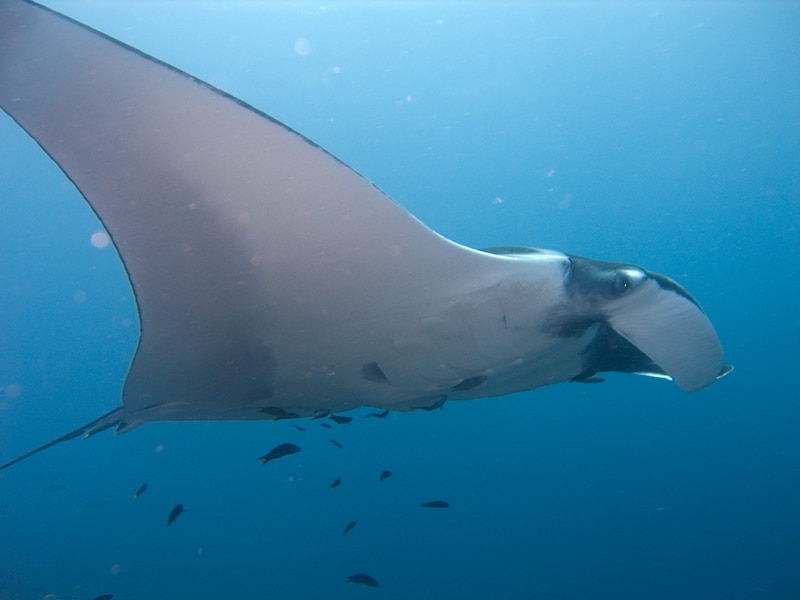
Manta rays do not pose a threat to humans.
©jon hanson / Creative Commons – Original
Because they are extremely large and are frequently confused with stingrays, manta rays may seem menacing. But manta rays are gentle, filter-feeding creatures that lack stingers, barbs, or teeth and do not pose a threat to humans. In fact, people often swim and snorkel with manta rays, particularly in hotspots like the Maldives and Isla de la Plata, Ecuador, where it is a popular bucket-list activity.
Some important precautions must be considered when swimming with these gentle giants to ensure everyone’s safety. When swimming with manta rays, it is important to respect their space for both safety and conservation. Key precautions include never touching them (to protect their slime coat), maintaining a respectful distance, avoiding swimming toward them, and moving calmly to avoid startling them or being struck by their fins.
Relationship Between Manta Rays and Humans
The International Union for the Conservation of Nature listed these deep-sea creatures as vulnerable. However, they are protected in international waters by the Convention on Migratory Species of Wild Animals. Besides predation by large sharks and whales, human activity has adversely affected the population of these sea creatures.
Manta rays are often entangled in fishing nets, which can lead to suffocation. Their inability to swim backward makes it difficult for them to escape once trapped, further threatening their survival. Manta rays are also hunted for their gill rakers, which are widely used in traditional Chinese medicine.