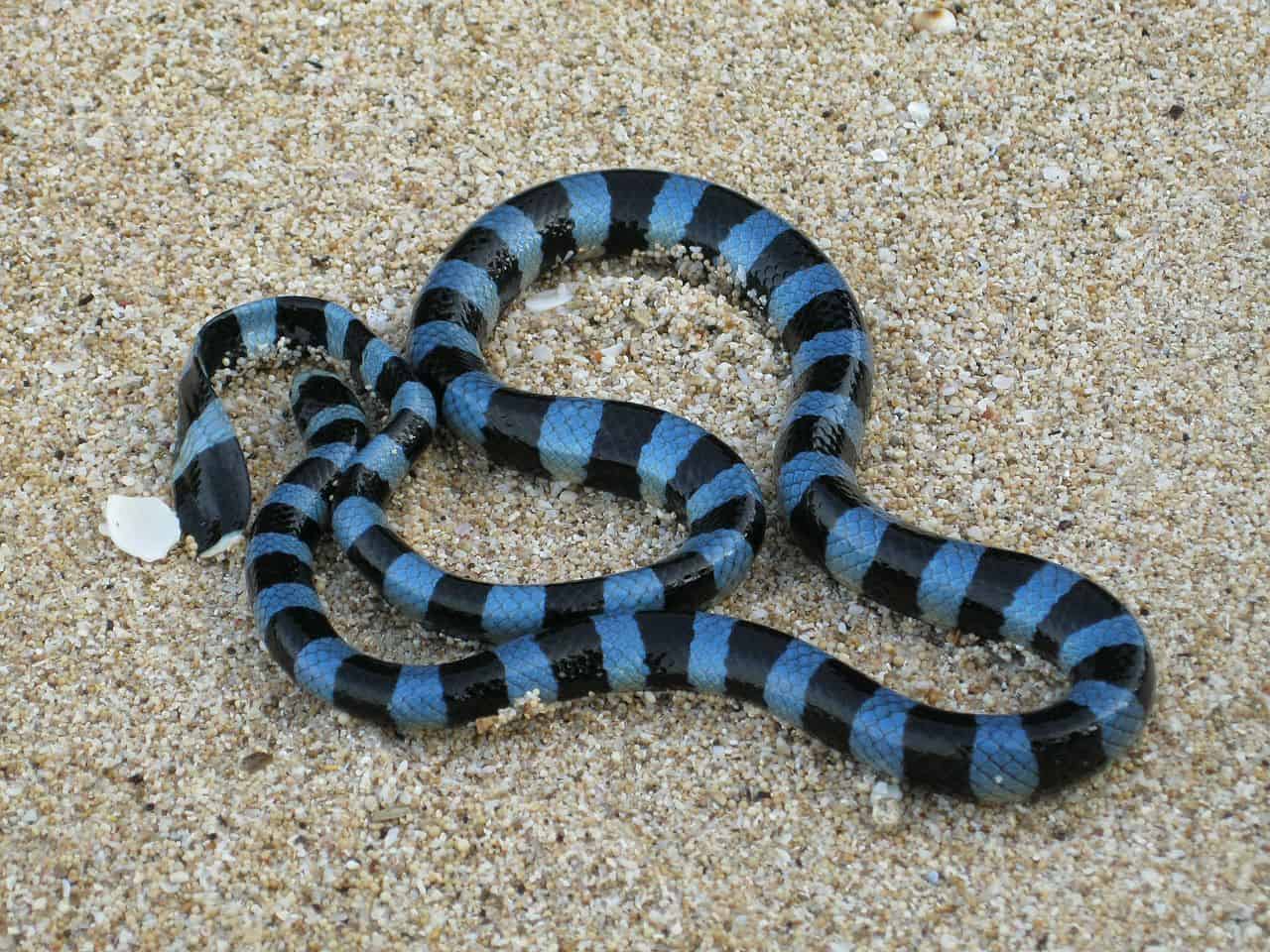

Sea snakes are spectacular and mysterious sea creatures. Throughout the world, 17 genera comprise 69 species of sea snakes. Most sea snakes are restricted to coastal areas of the Indian Ocean and the Western Pacific Ocean, though the yellow-bellied sea snake (Hydrophis platurus) is found throughout all tropical oceans except the Atlantic. Sea snakes have laterally compressed bodies and are often mistaken for eels. However, sea snakes are actually highly venomous snakes. Sea kraits and sea snakes have flattened, paddle-like tails to help them maneuver in water easily. Continue reading to discover some of the largest sea snakes in the world.
Sea Snakes: Overview
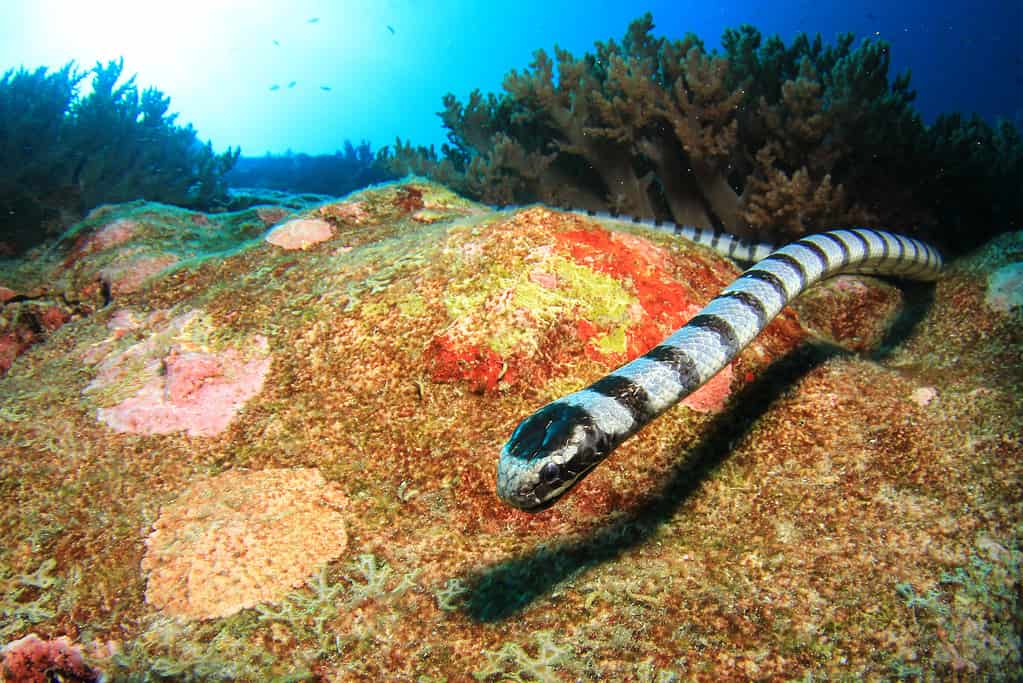
Banded Sea Snake or Krait swimming underwater, hunting on a coral reef.
©richcarey/ via Getty Images
Despite their marine adaptations, most sea snakes prefer to inhabit shallow waters near land, around islands, and in sheltered waters. Closely related to the Australian venomous terrestrial snakes in the family Elapidae, sea snakes are classified into two broad subfamilies. True sea snakes (subfamily Hydrophiinae) and the more primitive sea kraits (subfamily Laticudinae).
The majority of adult sea snake species grow to be between 4 feet and 5 feet in length. Their diet consists primarily of small fish, eels, and crustaceans. Some sea snakes possess the most potent venom of all snakes in the world. Though the majority of sea snake species have gentle dispositions, some aggressive sea snake species are capable of killing an adult human in less than 30 minutes.
Yellow-bellied sea snake
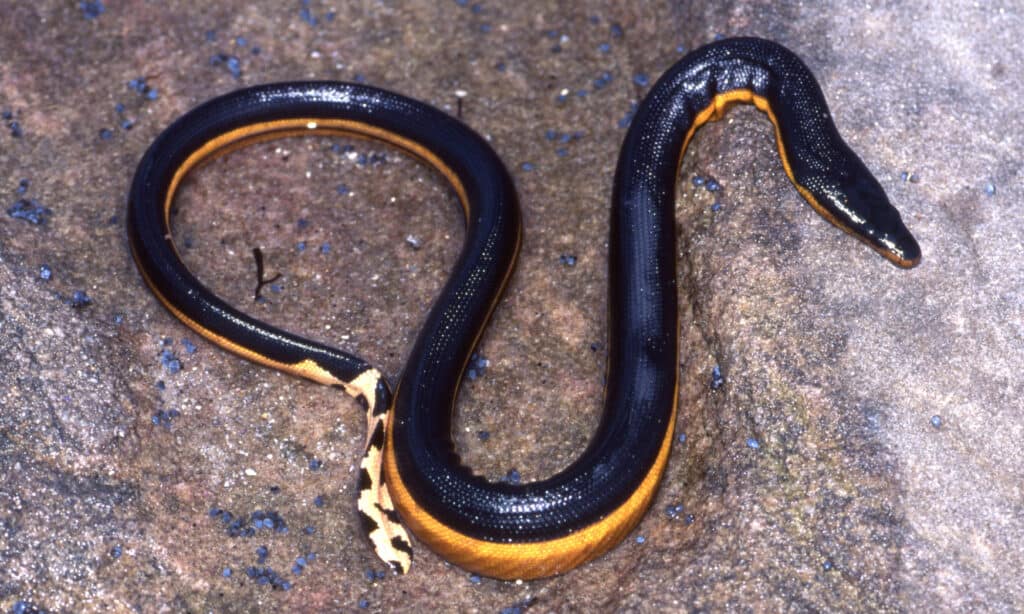
One of the most widely distributed snakes in the world is the yellow-bellied sea snake.
©Ken Griffiths/Shutterstock.com
The yellow-bellied sea snake (Hydrophis platurus) is one of the most widely distributed sea snakes in the world. Unlike other sea snakes, it is completely pelagic, found in all tropical ocean waters around the world except for the Atlantic Ocean. Hydrophis platurus is the most commonly seen sea snake species in the world. Measuring between 2.2 and 3.0 feet long, it is a large sea snake from the subfamily Hydrophinae. The yellow-bellied sea snake has a distinctive color pattern: a yellow underbelly and dark brown scales (hence the name, yellow-bellied), making it easily distinguishable from other sea snake species. This incredibly venomous sea snake has a unique ability to swim backward and hunt by floating on the surface of the water to attract pelagic fish.
Dubois’s Sea Snake
Another highly venomous species of sea snake, Dubois’ sea snake (Aipysurus duboisii), also called the reef shallows sea snake, is one of the most venomous sea snakes in the world, with the capacity to harm and kill humans with a single bite in under one hour. They are endemic to the coastal waters of Southeast Asia and Australia. Adults grow to between 2.6 and 4.8 feet long. This species is easily identified by its smooth dorsal scales, long fin-like tails, wide head, and series of dark brown crossbands. Living in depths of up to 262 feet, Dubois’ sea snakes feed on moray eels and numerous other fish species that live on the seafloor.
Yellow-lipped Sea Krait
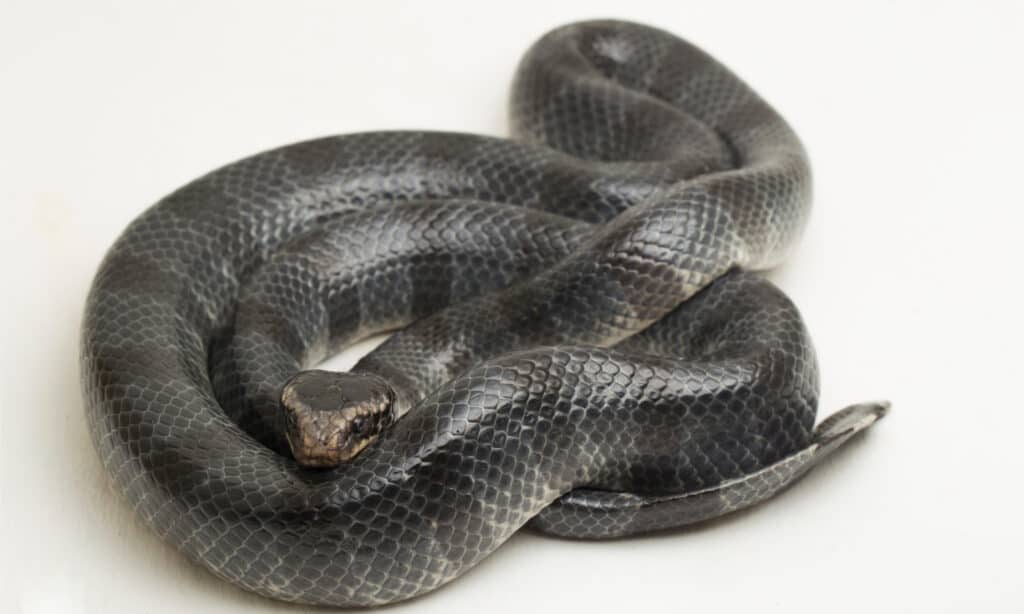
The yellow-lipped sea krait’s venom is very toxic.
©dwi putra stock/Shutterstock.com
Found in the tropical waters near the Indian Ocean and Western Pacific, the yellow-lipped sea krait (Laticauda colubrina) is a highly venomous sea snake from the Elapidae family. The yellow-lipped sea krait has a characteristic yellow snout (hence its name) and distinct black stripes with a paddle-shaped tail for swimming. On average, the body length of the yellow-lipped sea krait totals about 3 to 6 feet at maturity, one of the longest for a sea snake species. Females are significantly larger than males. Although they spend much of their time in the water, they can also return to land to digest, rest, and reproduce. They often encounter humans on land, but they’re not aggressive, and will only attack if provoked. The venom of Laticauda colubrina is highly toxic, which it uses to subdue its prey, which includes other eels and small fish.
Zweifel’s Beaked Sea Snake
The Zweifel’s beaked sea snake (Enhydrina zweifeli), also known as the Sepik beaked sea snake, is an uncommon species of sea snake. It has a gray to brown body, a rounded snout, a notch at the jaws, and light-colored transverse bands that taper along the body. It can grow up to nearly 5 feet in total length, making it one of the largest sea snakes in the world. Commonly found in the temperate waters of Papua New Guinea and the Australian Coast, the Zweifel’s beaked sea snake feeds on smaller fish but occasionally preys on large fish such as catfish. They’re highly venomous and aggressive, reportedly known to bite without provocation.
Beaked Sea Snake
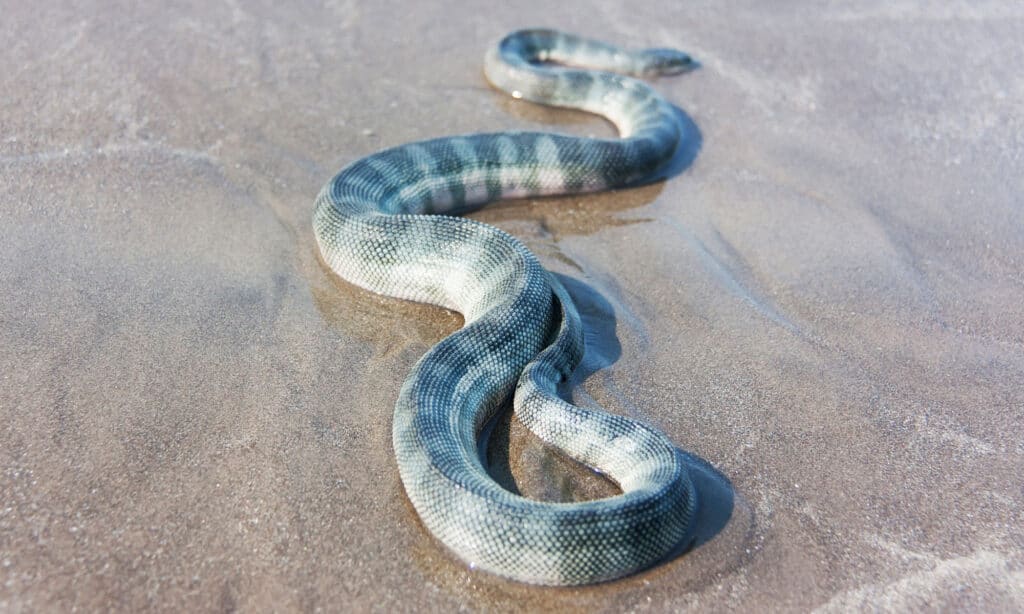
The beaked sea snake is considered one of the most venomous sea snakes in the world.
©iStock.com/Ekaterina Borisova
Enhydrina schistosa, the beaked sea snake or hook-nosed sea snake, is classified as one of the world’s deadliest sea snakes and the most venomous snake in the world. The snake is usually uniformly dark grey above; the sides and lower parts are whitish. An adult beaked sea snake grows up to an average length of 4 feet, while some larger specimens may be as long as 5 feet and 1 inch.
They are highly venomous and notably aggressive, responsible for more than 50% of all bites caused by sea snakes and up to 90% of deaths from sea snake bites each year. This deadly snake is found in the Arabian Sea, the Persian Gulf, and parts of Southeast Asia. The beaked sea snake can dive into deeper waters up to 328 feet and may remain submerged for up to a few hours while hunting for prey. Their primary source of food is fish.
Stokes’s Sea Snake
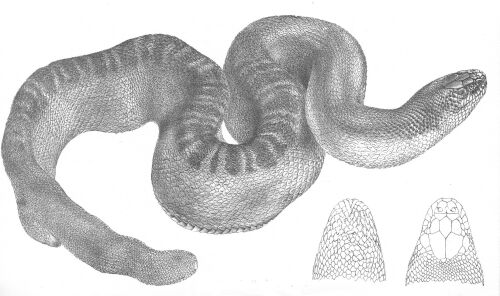
Stokes’s sea snake is one of the largest sea snakes in the world.
©Day & Haghe, Lithographers to the Queen / This work is in the public domain in its country of origin and other countries and areas where the copyright term is the author's life plus 70 years or fewer. – Original
Hydrophis stokesii, Stokes’s sea snake, is a large species of sea snake in the family Elapidae. Located in the tropical coastal areas in the Arabian Sea, the Taiwan Strait, and northern Australia, Stokes’s sea snake is one of the largest species of sea snake in the world. This species has a total length of up to 5 feet, though rare individuals may approach 6 feet. This species is one of the heaviest and bulkiest sea snakes in the world. They often vary in color, ranging from cream to grey to brown to black, with broad black dorsal crossbands. While some sea snakes have short fangs that may not penetrate a wetsuit, others, such as Stokes’s sea snake, have fangs long enough to do so.
Olive Sea Snake
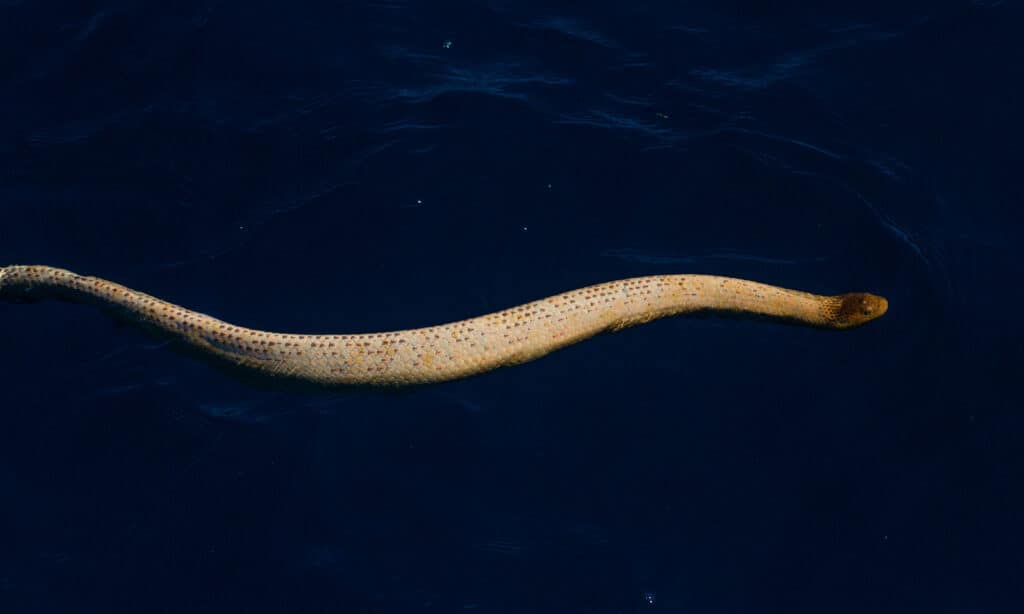
Olive sea snakes can grow up to 6.4 feet long.
©iStock.com/indianoceanimagery
The olive sea snake (Aipysurus laevis), has brownish and purple scales along the top of its body while its underside is white. It is a large venomous sea snake species measuring about 3.2 feet, with rare individuals growing to 6 feet 4 inches.
The olive sea snake typically hunts around coral reefs, using its special photoreceptor organs to remain completely hidden in the dark, safe from predators. Apart from its remarkable size, the sea snake species is highly venomous and hunts small crustaceans, fish, and benthic invertebrates, including prawns and crabs. Found in the shallow waters of the Indian Ocean, Western Pacific Ocean, and parts of Northern Australia, it spends its entire life cycle in the ocean.
Yellow Sea Snake
Hydrophis spiralis, the yellow sea snake, is the longest species of sea snake in the world, growing up to 10 feet long. This species is found in the Northern Indian Ocean, as well as around Southeast Asia and near New Caledonia in the Southwest Pacific Ocean. As its name suggests, the yellow sea snake’s color is yellowish or yellowish-green above, but the dorsal scales are edged with black. In the young Hydrophis spiralis, the head is black with a yellow horseshoe-shaped marking, but the head is usually completely yellow in the adult. Compared to most sea snakes, the venom of the yellow sea snake is less toxic. Yellow sea snakes primarily feed on eels. This species dwells on muddy, sandy ocean bottoms.
Fun Facts About Sea Snakes
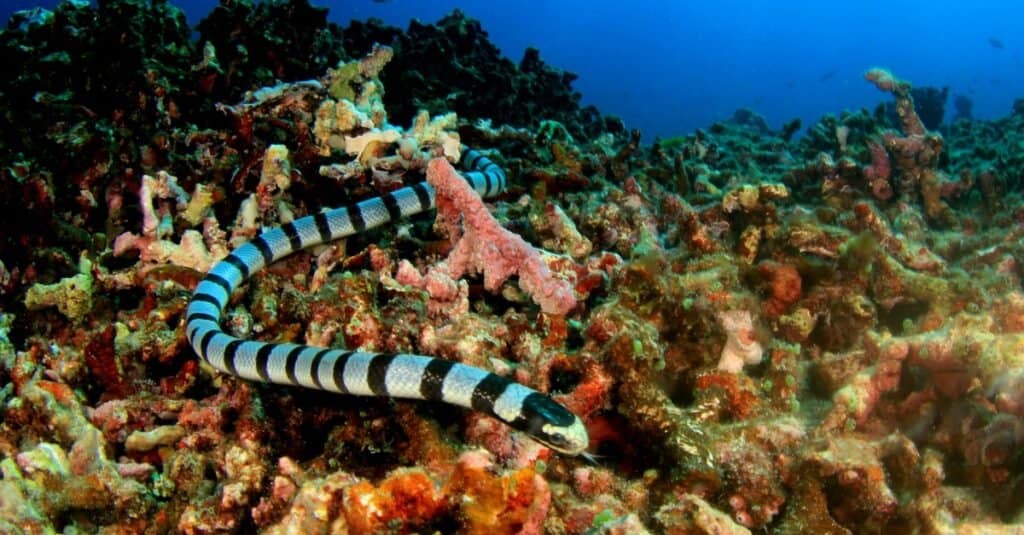
Sea snakes must come to the surface for air every two hours.
©Rich Carey/Shutterstock.com
- Although they evolved from terrestrial ancestors, the vast majority of sea snakes cannot move on land.
- Sea snakes can move both forward and backward in the water with equal speed and dive as deep as 328 feet.
- As water-dwelling air breathers, sea snakes must come up to the surface to breathe every two hours.
- Although highly venomous, sea snakes are not usually aggressive. Most species’ fangs are not long enough to penetrate a wetsuit.
- Most bites occur when fishermen are removing the sea snakes from nets or when the snake is stepped on in shallow water.