
Vine snakes refer to several genera of snakes in the family Colubridae. They include Oxybelis, a genus of New World vine snakes, Ahaetulla (Asian vine snakes), Imantodes (neotropical vine snakes), and Thelotornis (African vine snakes), with several species. Vine snakes appear in two colors: gray or brown species that inhabit the savannas or dry forests, and green species found primarily in rainforests. They have narrow heads and slender bodies with pointed snouts. Let’s discover the largest vine snake ever found!
What’s the Largest Vine Snake Ever Found?
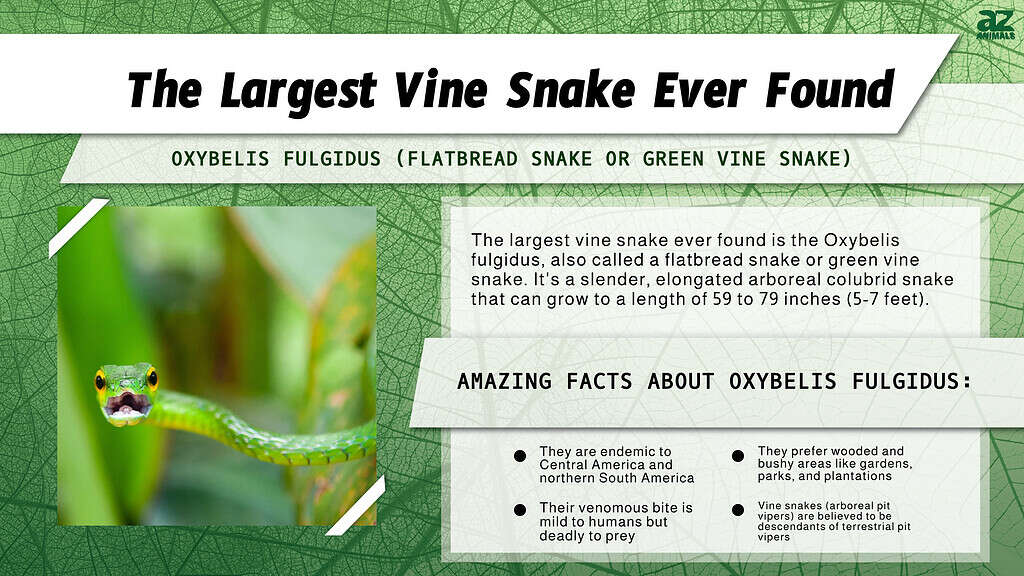
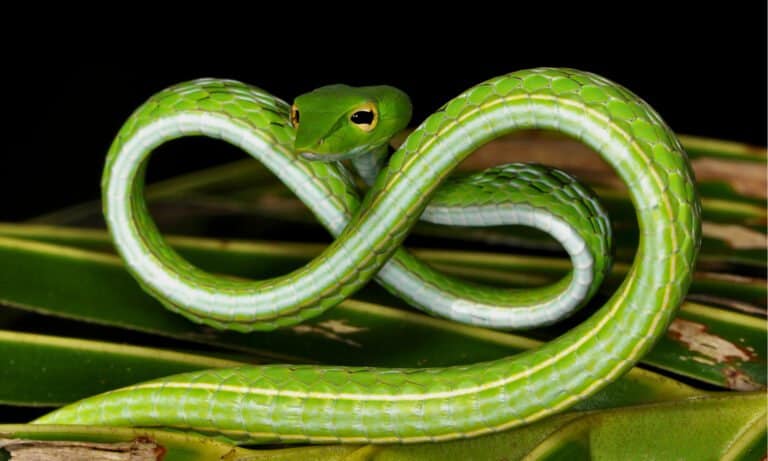
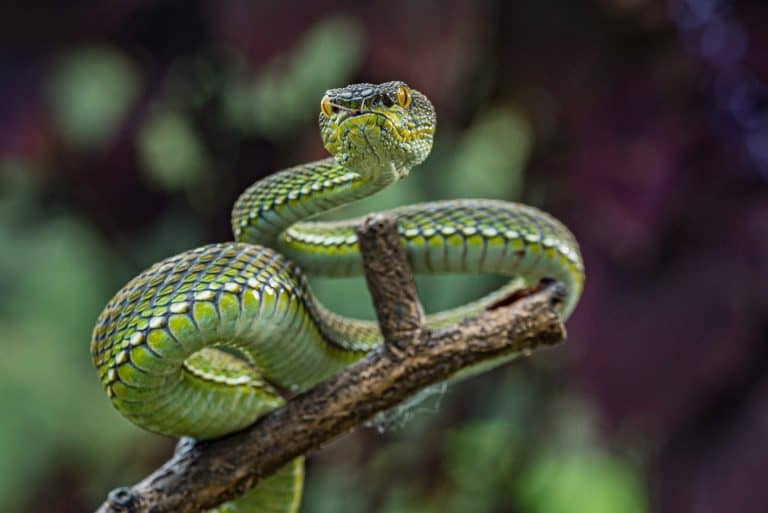
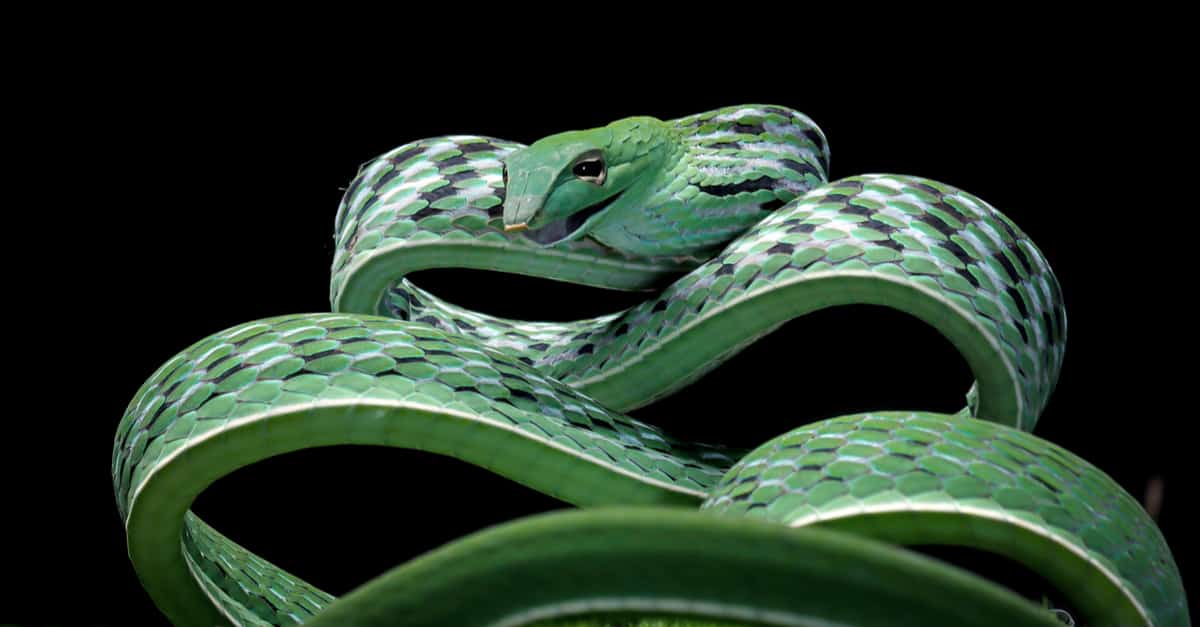
Oxybelis fulgidus is the largest vine snake. Also known as the flatbread snake or green vine snake, Oxybelis fulgidus is a slender, elongated arboreal colubrid snake. It’s commonly called cobra bicuda, cipo, bejuquilla verde, and bejuca lora in South America. This snake is often mistaken for the green-colored species in the genus Ahaetulla, which are also called “green vine snakes.”
Oxybelis fulgidus is roughly 0.79 inches thick and can grow up to a total length of 59 to 79 inches (5 to 7 feet), whereas Ahaetulla species can grow to be 2.5 to 5 feet long. Its tail is very long and appears delicate. Like other vine snakes, Oxybelis fulgidus’ head is pointed, and it has a large mouth that extends almost the whole length of the head. It keeps its long and green tongue outside the mouth. It’s believed that it uses its tongue to navigate through branches and brush.
Oxybelis fulgidus has a distinctive snout about three times as long as the eye diameter. It is yellowish-green ventrally on the upper lip and bright green dorsally, with a prominent yellowish-white stripe along both sides of the belly and tail. It has weakly keeled dorsal scales arranged in 17 rows at the midbody.
Evolution and Origins of a Vine Snake
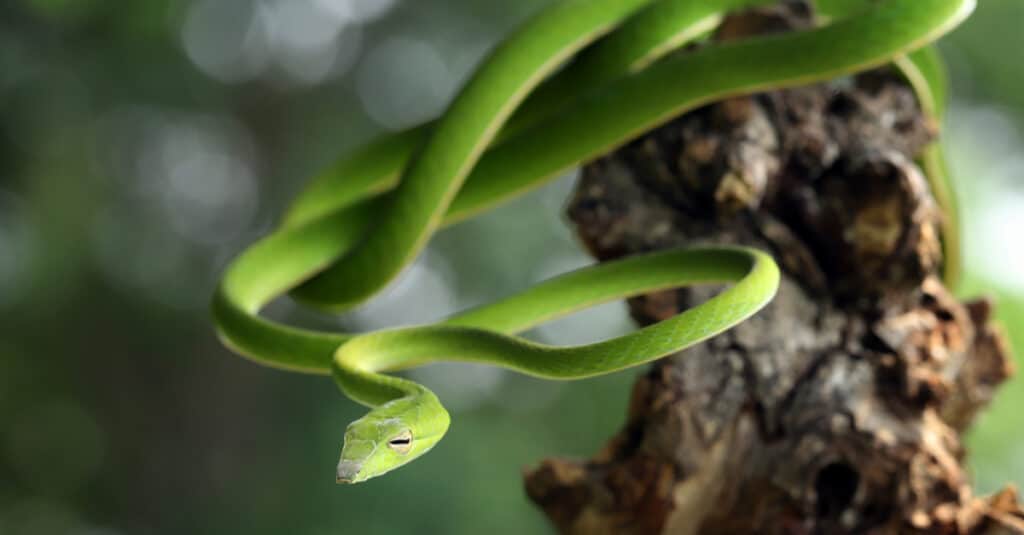
It is believed that vine snakes evolved from terrestrial snakes.
©Lauren Suryanata/Shutterstock.com
The evolution and origins of vine snakes are not well understood. However, it is believed that they evolved from terrestrial snakes and adapted to an arboreal lifestyle over time.
This adaptation allowed them to better hunt for prey in the trees and avoid predators on the ground. The exact timeline of their evolution is uncertain, as there is limited fossil evidence available. Further research is needed to gain a deeper understanding of the evolution and origins of vine snakes.
Where Can You Find the Flatbread Snake?
The flatbread snake (Oxybelis fulgidus) is native to Central America and northern South America. It’s diurnal and spends most of its life high in trees. These snakes prefer wooded and bushy areas, including gardens, parks, and plantations. The flatbread snake is widely distributed in its habitats and is not considered to be an endangered species.
Is the Flatbread Snake Dangerous to Humans?
The flatbread snake is mildly venomous. Its bite has little or no effect on humans but is fast-acting on small animals. Its bite typically induces numbness or tingling sensations. However, it may trigger severe allergic reactions, so caution should still be taken while near this snake.
Although their attacks are sporadic, one case of a bite from a flatbread snake in the Brazilian Amazon was reported in 2019. The patient was a 67-year-old man who manifested many symptoms, including tachycardia, erythema, dizziness, and bleeding in his left arm. He was treated with analgesics, and he responded well.
What Does the Flatbread Snake Eat?
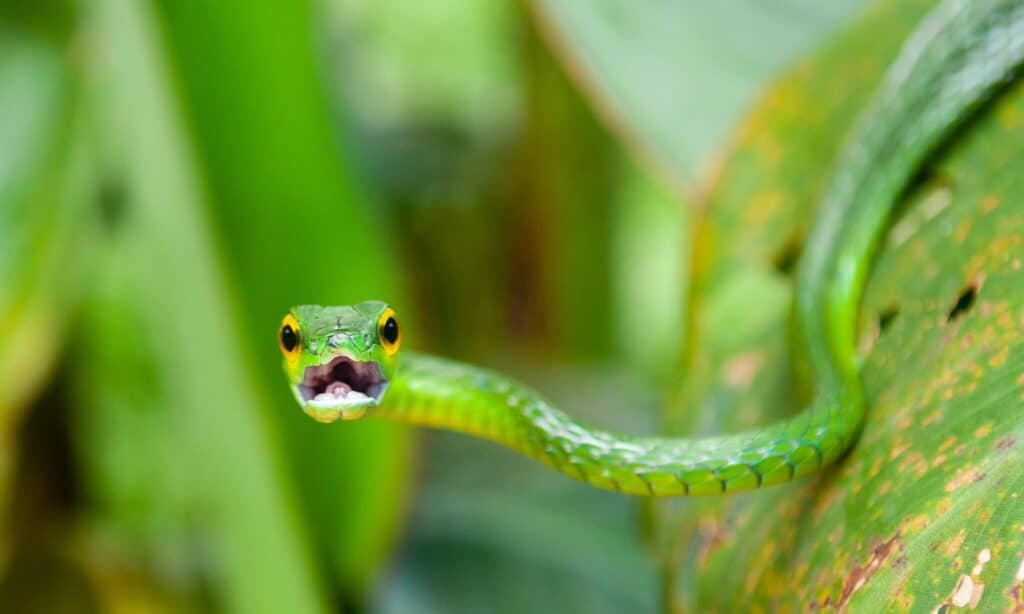
The flatbread snake eats frogs, small birds, lizards, and mice, among other animals.
©iStock.com/SL_Photography
Flatbread snakes have a varied diet that primarily consists of frogs, small birds, lizards, and mice, among other animals. They are solitary reptiles that hunt their prey in a “sit and wait” manner, hiding in thick branches. When it locates the prey, the flatbread snake follows it while smelling to ensure it’s the ideal prey.
If the flatbread snake is content with the prey, it bites into the head and lifts it eight to 15.5 inches off the ground. It does so to prevent the prey from using its physical strength to escape. The flatbread snake has two more prominent upper teeth at the back of its mouth, which transfer the toxic saliva into the prey to immobilize it. This vine snake then swallows the prey and finds somewhere to rest, usually at the highest point of a tree.
Can You Keep Flatbread Snakes as Pets?
Although interesting, vine snakes, such as the flatbread snake, can be challenging to keep as a pet due to their health needs. They are also exceptionally delicate to handle. However, they can make wonderful display animals. These snakes must be kept in high terrariums with a height of about 79 inches and a 65 to 172 square foot surface. Their behavior towards humans is neutral, but handlers are advised to wear a thick pair of gloves when attending to these vine snakes.
Flatbread snakes readily take mice or rats, unlike their Asian lookalikes, who are difficult to tame. Most of them adapt well and may even come closer to you, which is why they are often highly priced by reptile collectors. With good care, flatbread snakes may have an average life expectancy of up to 20 years.
What Are the Other Types of Vine Snakes?
Here are three other types of vine snakes:
1. Ahaetulla
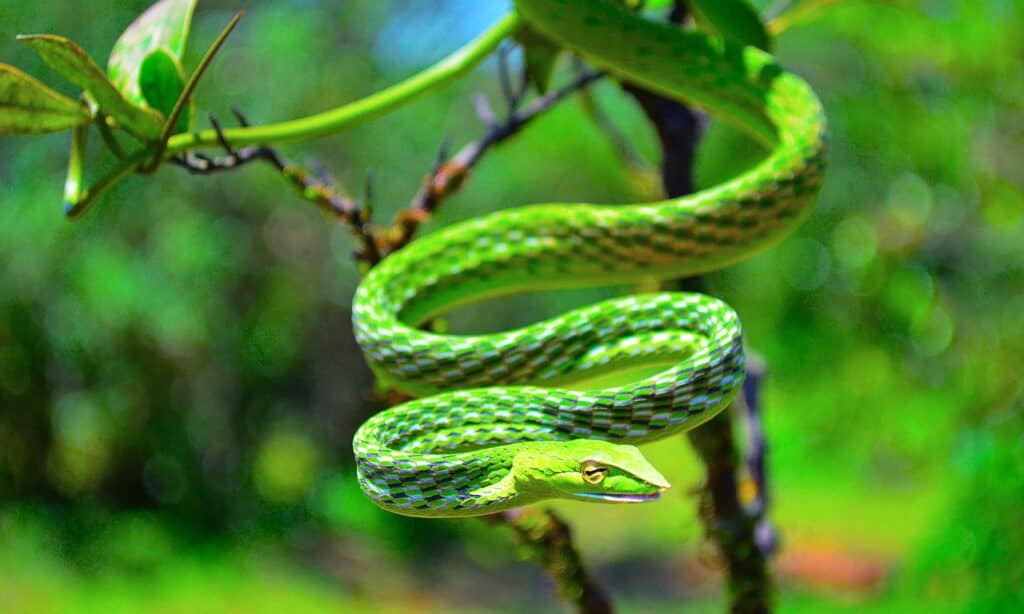
All Ahaetulla species are characterized by thin bodies of about 2.5 to 5 feet long.
©iStock.com/ePhotocorp
Commonly referred to as the Asian whip snake or Asian vine snake, Ahaetulla is an elegant and slender colubrid distributed throughout tropical Asia. The genus Ahaetulla is derived from the Sinhalese name ehetulla for Ahaetulla nasuta, which means “eye striker” or “eye plucker.” Like other vine snakes, Ahaetulla does not possess a sophisticated venom delivery system. Their large teeth are located in the back of the jaw, unlike those of cobras and vipers.
All Ahaetulla species are characterized by thin bodies of about 2.5 to 5 feet long. They have sharply triangular-shaped heads and extremely long tails. Their primary color is green, though they can vary quite a bit to browns, greys, oranges, and yellows. There are approximately 18 species of vine snakes in the genus Ahaetulla.
2. Imantodes
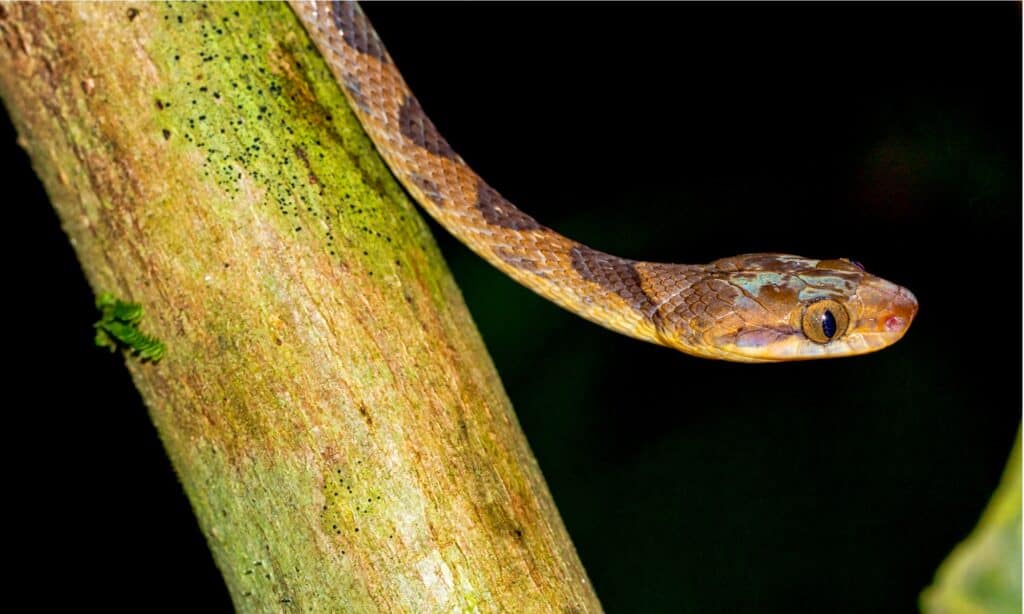
Imantodes are neotropical vine snakes found in Central America and throughout the coastal countries of western and northern South America.
©iStock.com/Alberto Carrera
Also known as blunt-headed tree snakes, Imantodes are neotropical vine snakes found in Central America and throughout the coastal countries of western and northern South America. These snakes have long, slim bodies, thin necks, and large heads. They inhabit primary and secondary-growth forests but can also be found in plantation areas.
These species are pale brown dorsally and white ventrally with dark-brown blotches. Their body length can exceed three feet. Their snout-to-vent length accounts for two feet of their total body length. Like the other vine snakes, Imantodes also have rear fangs.
3. Thelotornis
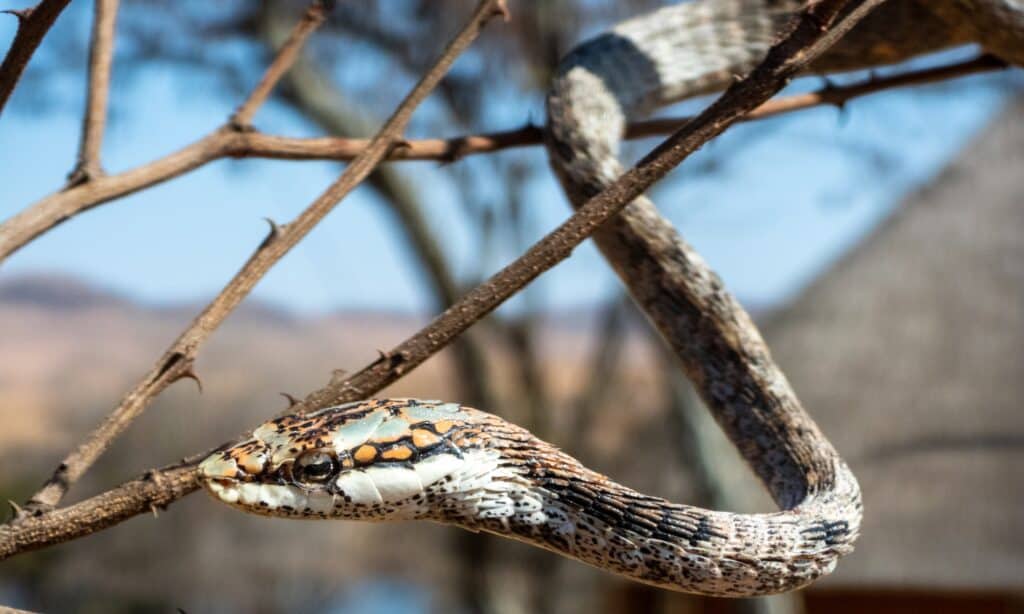
Twig snakes are rear-fanged venomous snakes native to Africa.
©iStock.com/Willem Van Zyl
Thelotornis are also known as twig snakes, vine snakes, or bird snakes. They are rear-fanged venomous snakes native to Africa. All species of the genus Thelotornis have slender and elongated bodies of about 48 inches, narrow heads, long tails, and pointed snouts. They are grayish-brown with faint light and dark markings. Of all the vine snakes, twig snakes are the most deadly.
So far, twig snakes have caused human deaths, including that of Robert Mertens, a famous herpetologist who was bitten by his beloved pet savannah vine snake (Thelotornis capensis). Their venom is hemotoxic, which affects the blood clotting mechanism, causing uncontrolled internal hemorrhaging and bleeding. However, they hardly bite unless mishandled.
Other Record-Breaking Snakes
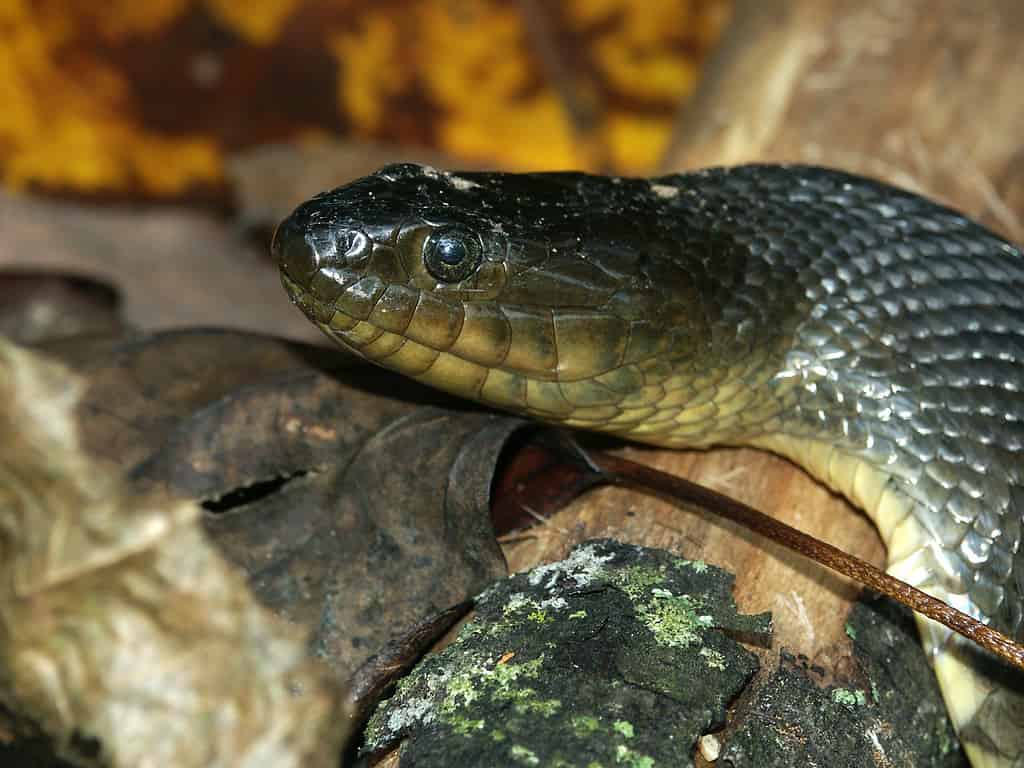
The green water snake is found only in the southeastern United States.
©Jason Patrick Ross/Shutterstock.com
Vine snakes are typically green, so in keeping with the theme of green snakes, you may want to check out the largest Mississippi green water snake. Green water snakes are among the most common snakes found in Mississippi, Alabama, Kentucky, and Louisiana. These semi-aquatic reptiles live in cypress swamps and the Mississippi lowlands and grow up to 45 inches or longer. This non-venomous snake has a thick, medium-sized body in a dark green color, mostly olive with numerous faint, olive-brown, or dark-brown patterns that alternate down its back and flanks.
Green water snakes are non-venomous and are not constrictors, so they ambush their prey quickly and eat them while they are still alive. They are semi-aquatic, so their diet consists of frogs, salamanders, toads, minnows, crayfish, small rodents, and other reptiles. The largest Mississippi green water snake ever recorded was over 45 inches long.