
Quick Take
- One snake on this list looks nearly identical to harmless species but carries a venomous bite that can send you to the hospital. Meet the dangerous lookalike →
- The Eastern kingsnake's banding pattern changes depending on where it lives, and that clue could be the key to telling it apart in the wild. See the banding patterns →
- Not all black snakes with white bellies behave the same way. One commonly spotted in suburban yards has a defensive habit that most people completely misread. Learn its defensive behavior →
- Some of these snakes span nearly the entire country through subspecies, so the one you spotted might not be what you think it is.
Identifying snakes isn’t always easy, especially when they have simple, muted colors. During the spring and summer, the likelihood of encountering a snake goes up, and knowing which ones are dangerous is important. There are over 4,100 species of snake across the world, and they come in an array of colors and patterns. Covering every black snake that had white on its belly is quite a task, so we narrowed our list today to snakes that can be found in the United States. Although most of these snakes are found in the Eastern U.S., a few of them have subspecies that can be found across most of the country. Continue reading to learn about these snakes, including their appearance, distribution, habitat, and whether or not they present a danger to humans.
Eastern Rat Snake
The Eastern rat snake (Pantherophis alleghaniensis) is one of the most common snakes in the Eastern United States. These snakes can vary in color depending on where they are found. Eastern rat snakes can be up to seven feet long and have a shiny black body with a white or cream belly. Their bellies are occasionally checkered in black and white.
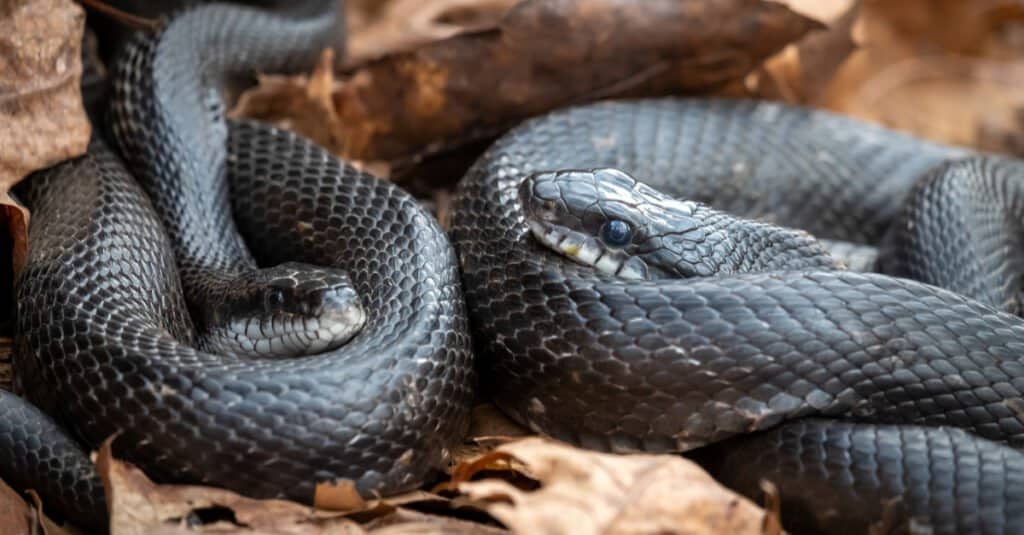
Depending on where it is found, an Eastern rat snake may be more gray than black.
©samray/Shutterstock.com
In other variations, these snakes can be striped and come in shades of gray, black, and even orange (in Florida).
The Eastern rat snake can be found from southern New England and the Great Lakes region south to Georgia and the Atlantic coastal plain.
Eastern rat snakes aren’t picky when it comes to habitat. They can be found in yards, suburbs, fields, and pine forests.
Eastern rat snakes do not pose a threat to human life.
Black Racer
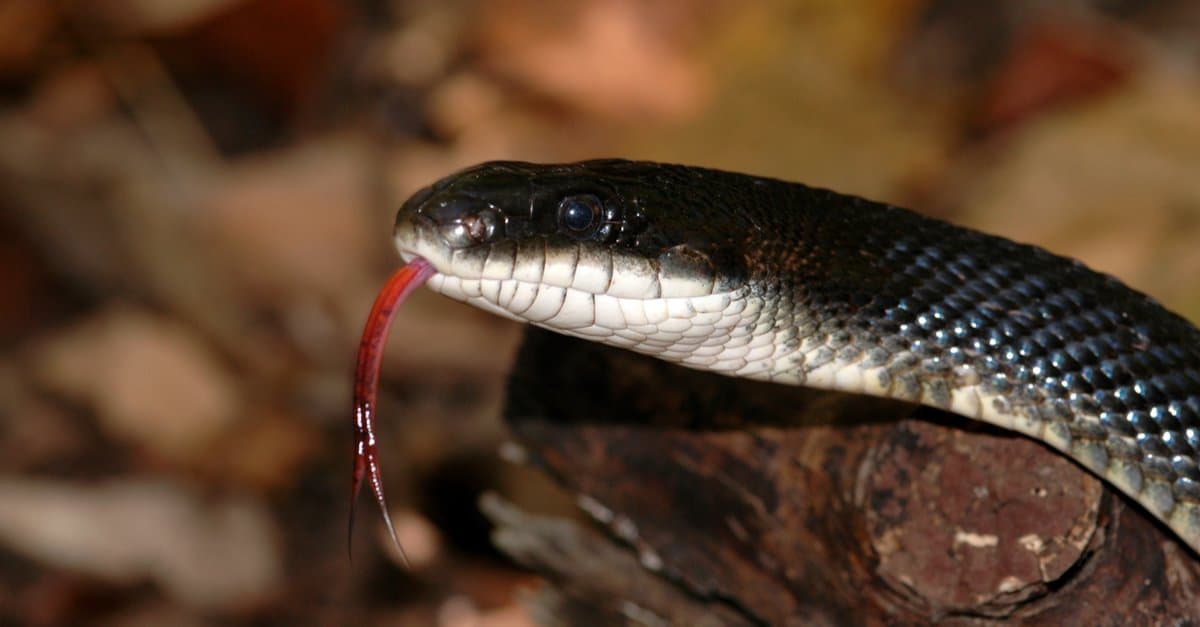
The black racer (Coluber constrictor) is another common snake in the Eastern U.S. with multiple recognized subspecies across its range. The Southern black racer is most likely to fit the description of a black body and white belly, however.
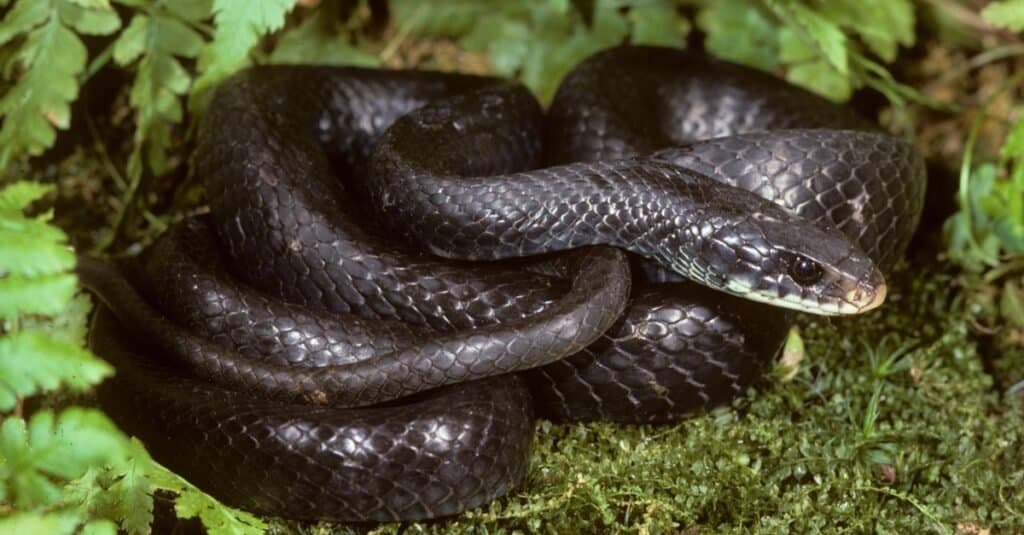
The black racer is another common snake with a black body. It often has a white chin and a lighter belly.
©Breck P. Kent/Shutterstock.com
Black racers can come in shades of gray or black and have throats that can be white or cream. Their bellies are usually a lighter shade than their backs and can vary from cream to various shades of yellow.
The black racer can be found across the entirety of the Eastern United States.
These snakes are generalists and can be found in forests, swamps, and even in the Florida Everglades. You are likely to encounter them slithering through yards or periscoping up in long grass.
Black racers are non-venomous and harmless to humans.
Eastern Kingsnake
The Eastern kingsnake (Lampropeltis getula) is less common than the black racer and rat snake but is widespread across much of the Eastern U.S. A related species, the California kingsnake (L. californiae), lives along the West Coast and comes in more colors than its East Coast relative. Within the Eastern kingsnake family are multiple variations, including the black kingsnake (L. nigra) and the speckled kingsnake (L. holbrooki).
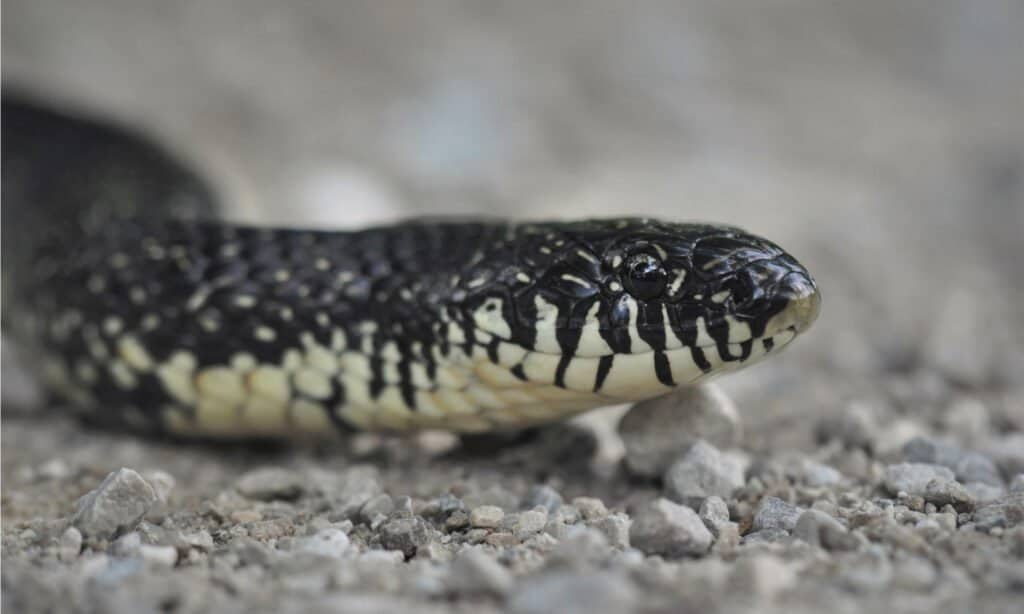
The Eastern kingsnake comes in many variations, most of which are black and white.
©Mike Wilhelm/Shutterstock.com
Eastern kingsnakes are thicker black snakes with white banding that reaches from their head to their tails. The width of the banding reflects their environment, with coastal populations having wider bands and mountainous populations having narrower ones. All Eastern kingsnakes are black and white with a white belly.
Eastern kingsnakes are widely distributed in the Eastern United States and and as far north as New Jersey.
Eastern kingsnakes can be found in forests, swamps, tidal regions, and more. They are almost always found near water, however, and spend much of their time hidden under objects.
Eastern kingsnakes are non-venomous snakes that kill their prey by constriction. They are not a danger to humans.
Cottonmouth
The cottonmouth (Agkistrodon piscivorus), also called a water moccasin, is one of the world’s few semiaquatic vipers and can be found across much of the Eastern United States. These snakes get their name from their white mouths, which they flash in defense when a predator gets too close.
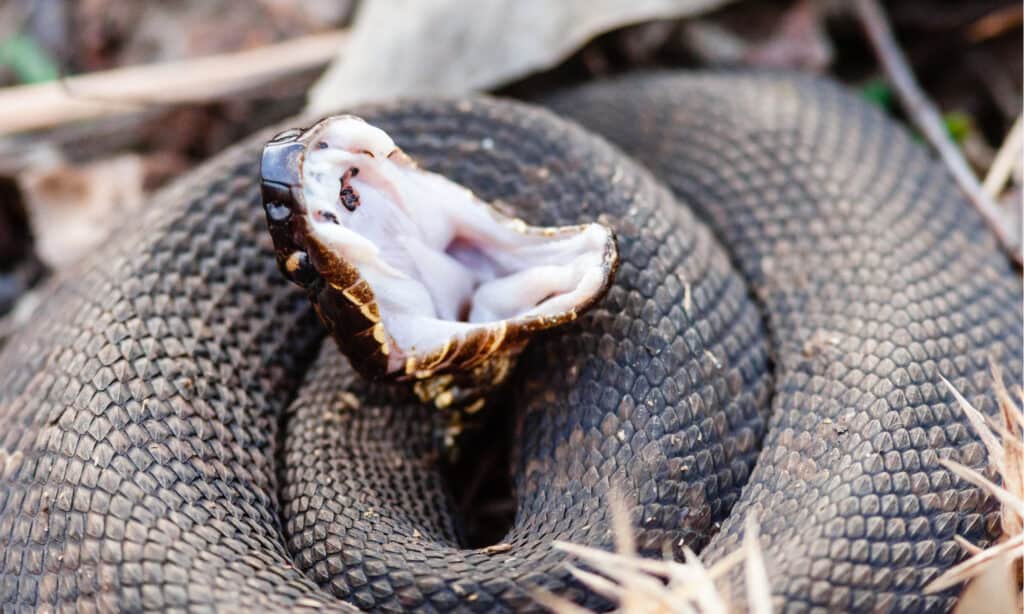
Cottonmouths are venomous snakes with black, gray, or brown bodies with lighter bellies.
©Marcum Havens/Shutterstock.com
The cottonmouth is a thick, broad snake that typically grows to about two to four feet in length. They come in shades of black, gray, and olive with crossbands that appear washed or absent altogether. Their scales are heavily keeled, and their eyes have a catlike slit. As pit vipers, these snakes have a distinct heat-sensing pit visible between their nose and eyes on either side.
Cottonmouths can be found in the Southeastern United States, ranging from southeastern Virginia south through Florida and west through southern Alabama.
The cottonmouth is an aquatic snake and is almost always found around water. They prefer swamps, marshes, floodplains, and wetlands of all types.
Cottonmouths are venomous pit vipers that can pose a danger to humans, though serious harm or death is rare with prompt medical treatment.