
Quick Take
- Albino and leucistic snakes both look white, though one simple trick tells them apart instantly. Spot the difference →
- Being pure white in the wild isn't just rare. It's a survival liability that shapes everything about how these snakes live. White snakes in the wild →
- One snake on this list dismembers its prey one piece at a time rather than swallowing it whole, and its white coloring turns out to be the least surprising thing about it. Meet the dismemberer →
- A snake discovered as recently as 2014 earned a name meaning "ghost," and its appearance makes that name hard to argue with. Discover the ghost snake →
Pure white is a rare color in the natural world, especially when it comes to snakes. All-white snakes in the wild are the result of rare genetic mutations, like albinism and leucism. Unfortunately, these brilliantly white snakes stand out and can be easily seen by predators. Yet, despite their rarity (or perhaps because of it), white snakes hold a strong allure for many people and are coveted in the pet world. However, some snakes naturally have white color patterns. Read on to learn the differences between albinism and leucism, and discover snake species with beautiful white color schemes.
Genetic Mutations in Snakes: Albino vs. Leucistic Snakes
Snakes are sometimes born without color due to rare genetic mutations. Most forms of albinism and leucism are due to recessive traits that are passed on to offspring. Although animals with albinism or leucism both have pale coloring, there are crucial differences between the two genetic conditions.
Albinism
Albinism is an autosomal recessive genetic trait. This means that the snake must inherit a copy of the mutated gene from each parent to be albino. Albino snakes are unable to produce melanin. Melanin is one of the pigments that create color in a snake’s body, so albino snakes are white or very pale.
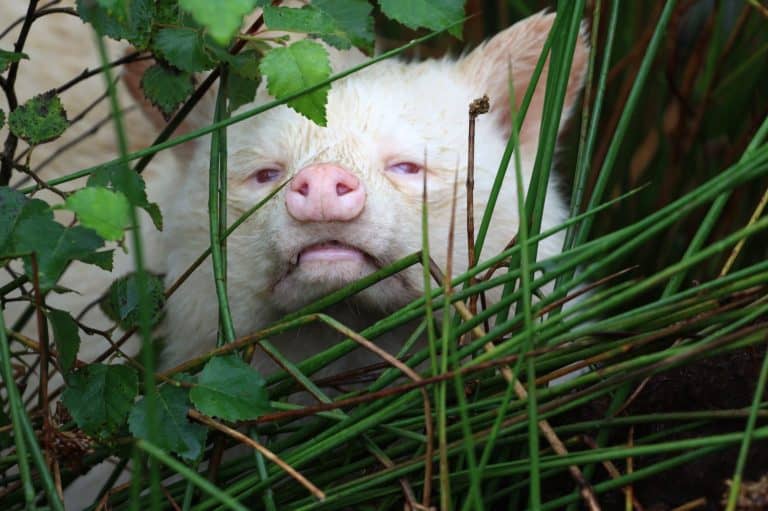
However, there are other pigments that create color, such as the red or orange shades of carotenoids. Since carotenoid pigments are not affected by albino mutations, albino snakes are white but also have pale pink or pale-yellow undertones. Albino snakes are easy to identify because they have red or pink eyes, as the lack of pigment means the blood vessels are visible.
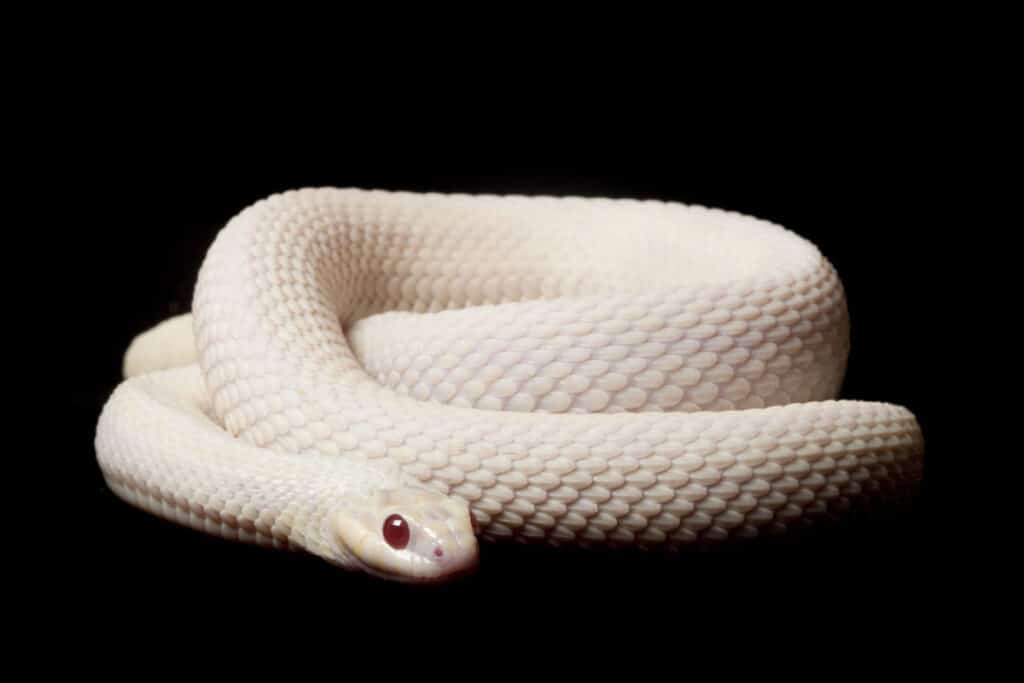
Albino snakes are completely white with red or pink eyes.
©fivespots/Shutterstock.com
Leucism
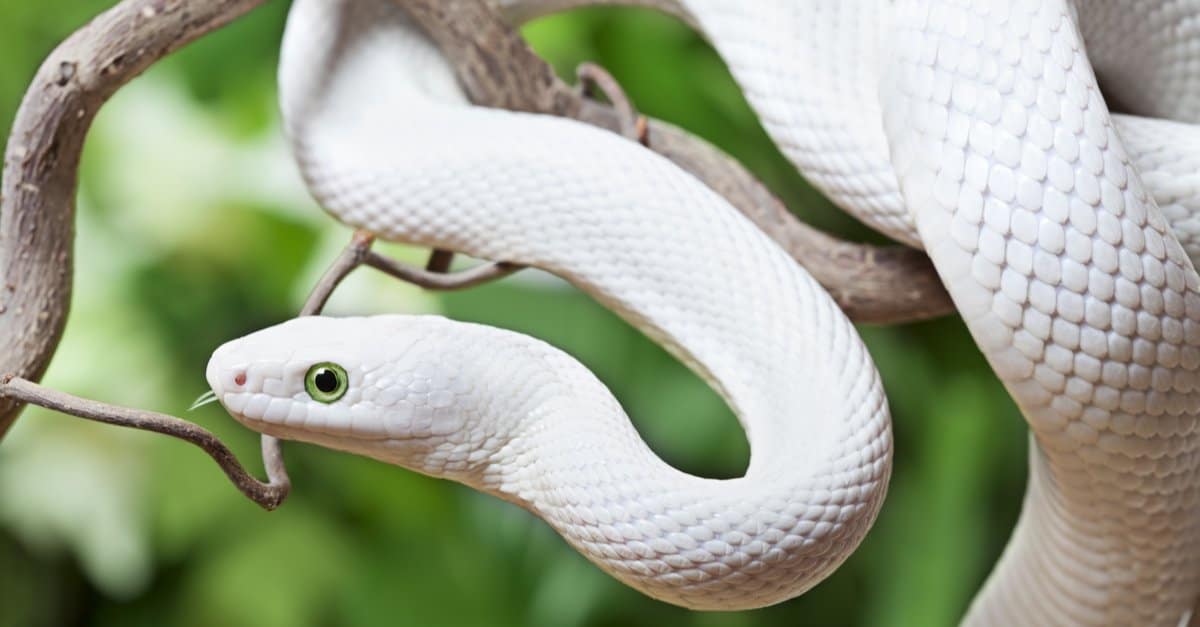
Leucism is also a recessive trait, meaning both parents must pass on a copy of the gene for it to be expressed in their offspring. The mutation affects the production of all types of pigmentation, including both melanin and carotenoids. However, these snakes have a much larger range of variability in their color patterns, as the amount of pigment affected by the mutation varies by the individual.
For example, a leucistic snake could be completely white, it could have white patches or spots, or it could have muted colors. One of the easiest ways to tell the difference between an albino snake and a leucistic snake is the eye color because the mutation does not affect the pigment cells in the eyes. If a snake has red or pink eyes, it is albino. If a snake has blue eyes or darker-colored eyes, it is leucistic.
White Snakes in the Pet World
Breeders all over the world have spent years breeding captive snakes of various species to have white colors and patterns. Today, there are many types of white-patterned and white-colored snakes that you can find as pets. For example, the blue-eyed lucy is a very popular leucistic color morph of the ball python, a snake native to parts of Africa. The pure white bodies of these snakes highlight their striking blue eyes like the perfect combination of sparkling snow and piercing ice.
The ivory ball python, on the other hand, is also white, but with a creamier, ivory tone. The pied ball python has very sharp and distinct blocks of white color, interspersed with the colors and patterns of a typical ball python. It almost looks like a white python that was strategically painted in a few places, or a colored python that accidentally fell into white paint.
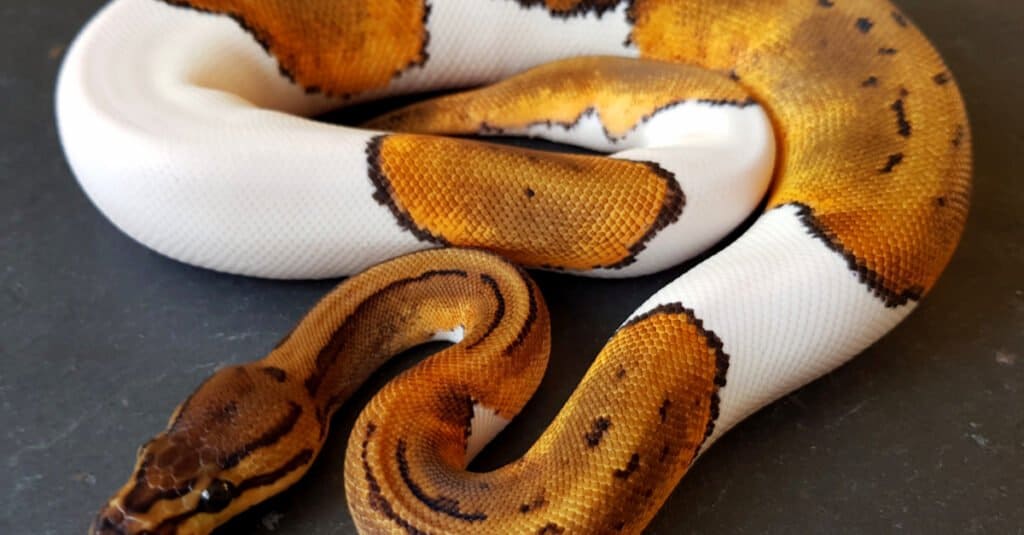
How much color a pied ball python has depends on its individual genetics.
©Deb Davis/Shutterstock.com
Snakes with White Color Patterns
Albino or leucistic snakes are rare in the wild, but there are many snakes that have white color patterns. Take a closer look at some common snakes with white coloring.
California Kingsnake (Lampropeltis californiae)
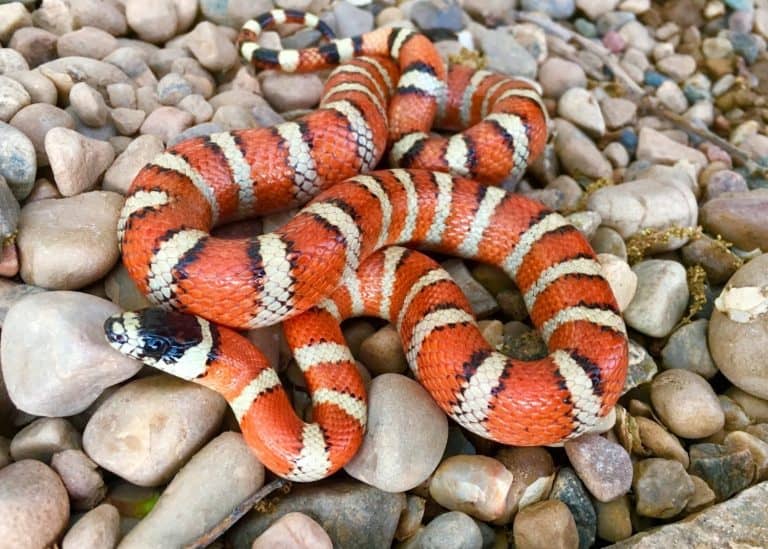
The California kingsnake is a subspecies of the nonvenomous common kingsnake. Its pattern is a sharp contrast of colored stripes, splotches, or rings. California kingsnakes can be either brown and red, or black and white. Typical black and white California kingsnakes have dark brown or black bodies, marked with distinct white or pale-yellow rings or bands. The width of these bands varies by individual. The snake’s head also has a black splotch on top with a distinct white “T” in the middle of it.
These snakes can be found in the wild of Northern Mexico and the western regions of the United States. They generally measure 2 to 4 feet in length, but some individuals may grow as large as 5 to 6 feet. As extremely popular pets, there are several color variants of California kingsnakes that have been selectively bred in captivity as well.
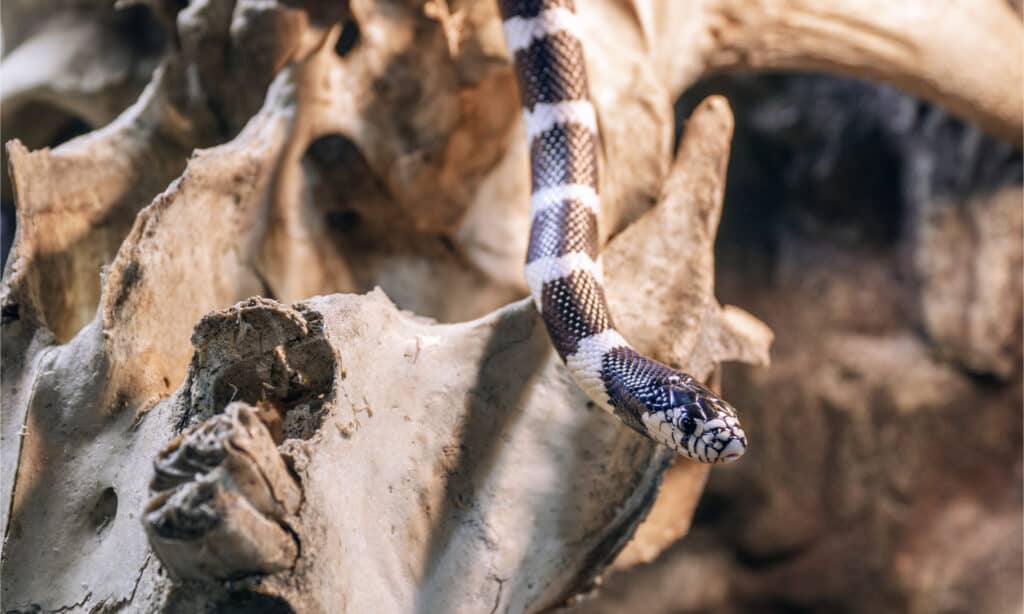
California kingsnakes have alternating dark and light bands.
©Ann May Snz/Shutterstock.com
Bandy-Bandy Snake (Vermicella annulata)
The bandy-bandy is endemic to Australia. These snakes have very smooth, glossy scales with black and white (or pale-yellow) banded patterns along the length of their bodies. The bandy-bandy snake typically measures around 2-2.5 feet in length with a round, slender body and small head. There are six species of bandy-bandy snakes that live in various habitats and regions across Australia. These snakes are venomous, but they are not typically aggressive and are rarely encountered by humans. Bandy-bandy snakes feed almost exclusively on blind snakes, though they occasionally eat skinks and lizards.
The bright, contrasting colors of bandy-bandy snakes do not blend in well with their environment. Instead, these snakes burrow beneath soil, rocks, and logs for protection, and typically only come out at night. When faced with a predator, the bandy-bandy snake has two primary methods of defense. The snake moves quickly and randomly, causing its stark black-and-white colors to “flicker” and create confusion, particularly in low lighting. This display is referred to as “flicker fusion.” This snake’s second defense is to coil its body into a “hoop” shape, making it appear much larger and hopefully more threatening to predators.
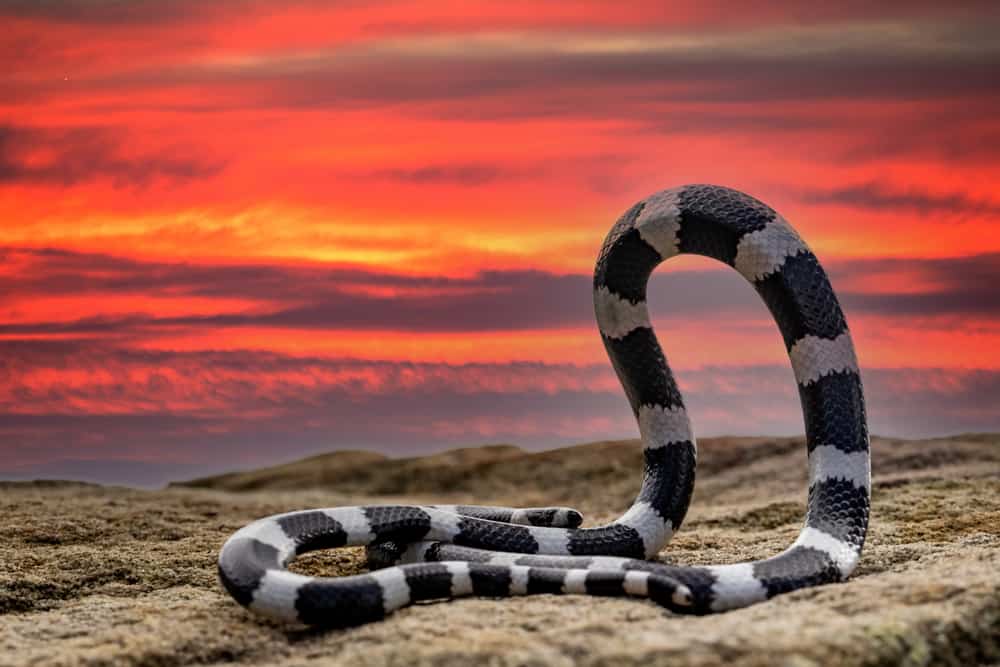
The bandy-bandy snake has unique defenses, including “flicker fusion” and curling its body into a hoop.
©Ken Griffiths/Shutterstock.com
Common or Eastern Kingsnake (Lampropeltis getula)
The common kingsnake, or eastern kingsnake, is a glossy, black, nonvenomous snake with thin, white, ring- or chain-like markings along the length of its body. Because of this, it is sometimes also called the “chain kingsnake.” These white bands vary in size depending on where the snake lives. Their bellies are also white or pale yellow with black “chains” or “zigzag” patterns.
On average, common kingsnakes grow between 3-4 feet long, but some may reach up to around 6 feet. These snakes range from southern New Jersey down to Florida and across the Southeast. They are very adaptable and live in a wide variety of habitats, including forests, grasslands, deserts, and wetlands, where they hunt and eat small mammals and snakes.
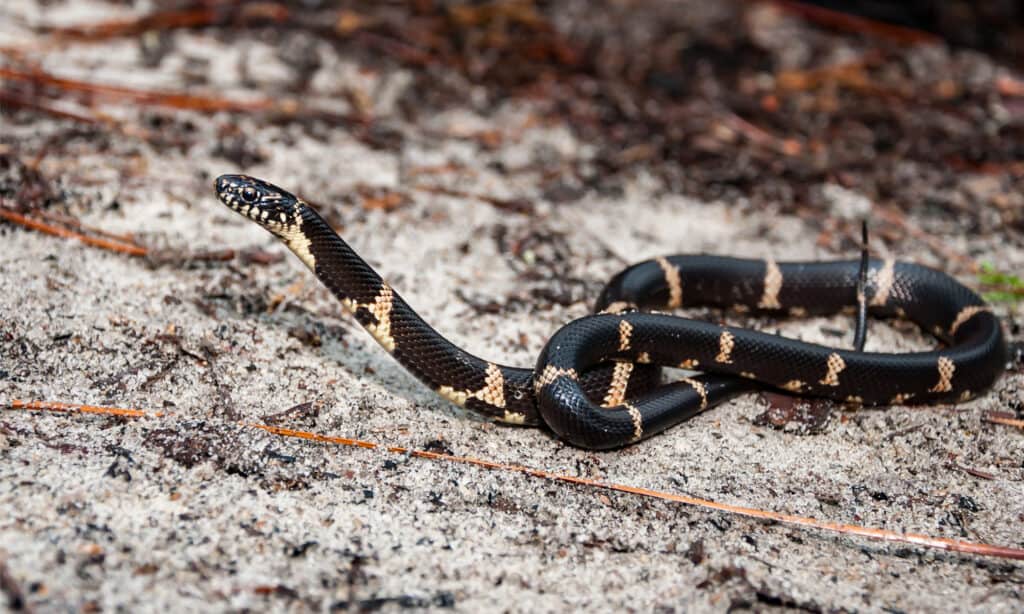
Common kingsnakes typically grow up to 4 feet long.
©iStock.com/JasonOndreicka
Long-Nosed Snake (Rhinocheilus lecontei)
The long-nosed snake has a white or cream-colored body with alternating red and black bands or blotches along its back. These crossbands are speckled with tiny white or cream dots, making the snake’s colors and patterns look somewhat pixelated. Sometimes these snakes are only black and white, with little to no red coloring.
Long-nosed snakes measure 2-2.5 feet in length, with distinctly elongated, upturned snouts. These snakes live in a few regions of Mexico, as well as the western United States. Long-nosed snakes prefer arid habitats like deserts and scrublands, where they hunt and eat lizards, rodents, and other small prey. These snakes are nonvenomous and rarely bite.
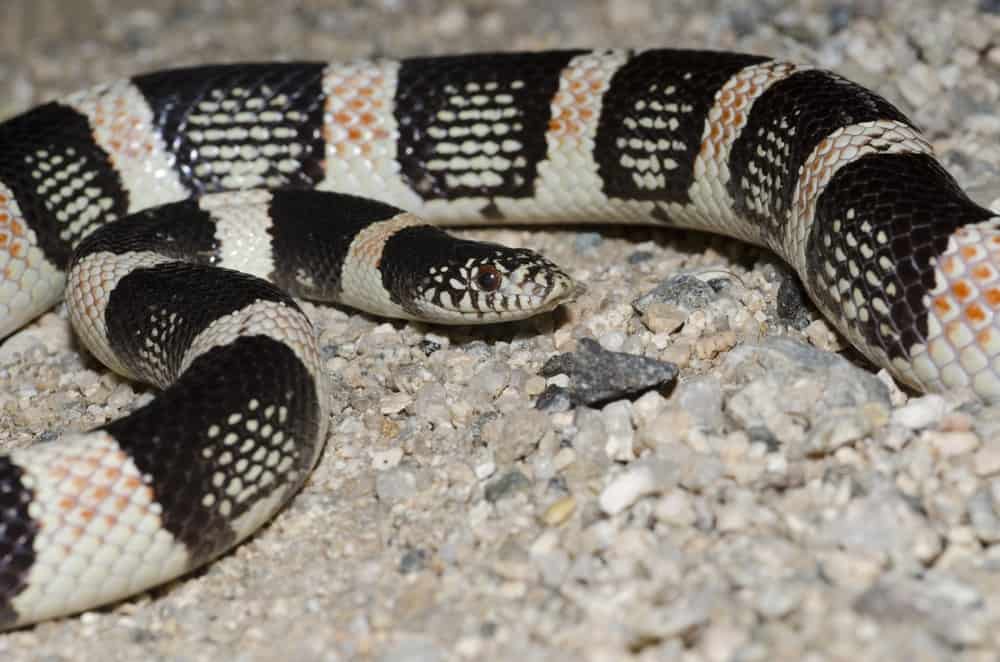
Long-nosed snakes do not usually bite. When threatened, they release a foul-smelling musk.
©Jason Mintzer/Shutterstock.com
Florida Pine Snake (Pituophis melanoleucus mugitus)
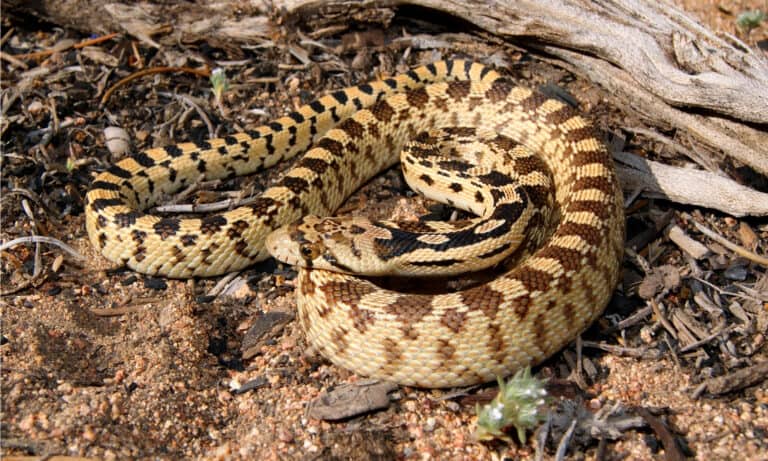
The Florida pine snake is a subspecies of the eastern pine snake. It is one of the largest snakes in the eastern U.S., with a heavy body measuring between 4 and 7 feet in length. This snake is white (and sometimes tan or rust-colored) with dark blotches. On occasion, a Florida pine snake may lack dark blotches, appearing almost entirely white or cream in color, possibly with a few dark speckles here and there. Florida pine snakes have small heads with pointed snouts.
The scales above the snake’s eyes are slightly ridged, making it look like the snake is “angry.” As its name indicates, the Florida Pine Snake is native to Florida, as well as Georgia, South Carolina, and Alabama. In Florida, these snakes are rare and considered a “threatened species,” so they are protected by state laws. They favor sandy, well-drained soil and open-canopy pine forests.
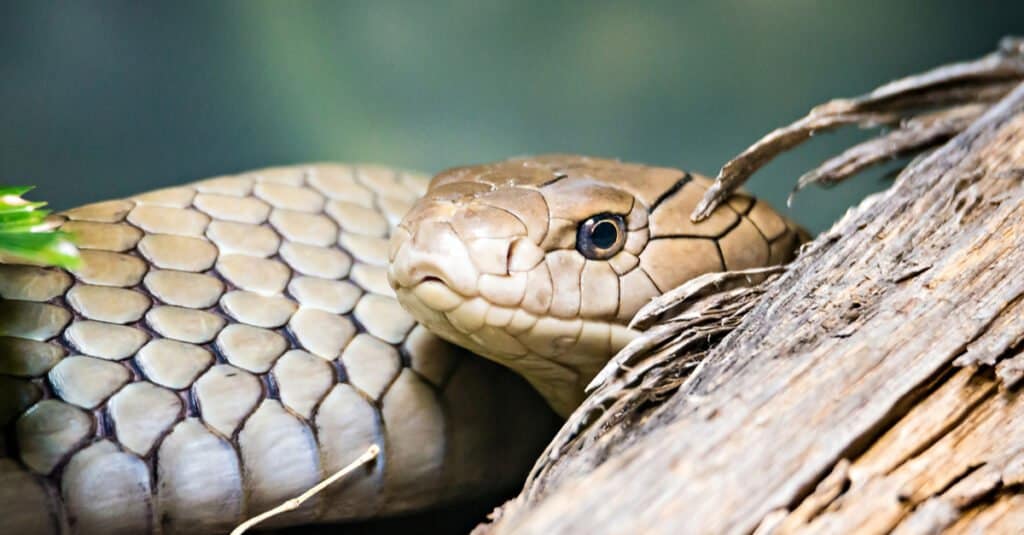
The Florida pine snake is among the largest snakes in the eastern U.S.
©digidreamgrafix/Shutterstock.com
Crab-Eating Water Snake or White-Bellied Mangrove Snake (Fordonia leucobalia)
The crab-eating water snake (or white-bellied mangrove snake) is an aquatic snake that can be a wide variety of colors and patterns. In southern Asia, for example, this snake is often grey or black with some dark blotches. However, in New Guinea and Australia, these snakes can be just about any color, from black-and-white piebald to yellow, orange, or red with black and white blotches.
Crab-eating water snakes only grow up to around 36 inches in length, but they are surprisingly strong, which helps them capture their preferred prey: crabs, shrimp, and mud lobsters. It is one of the few snakes that eats larger prey piece by piece, although smaller crabs may still be eaten whole. This snake uses its body to capture crabs and injects them with paralyzing venom. Once the crab has succumbed, the snake pulls off each leg and eats them one at a time.
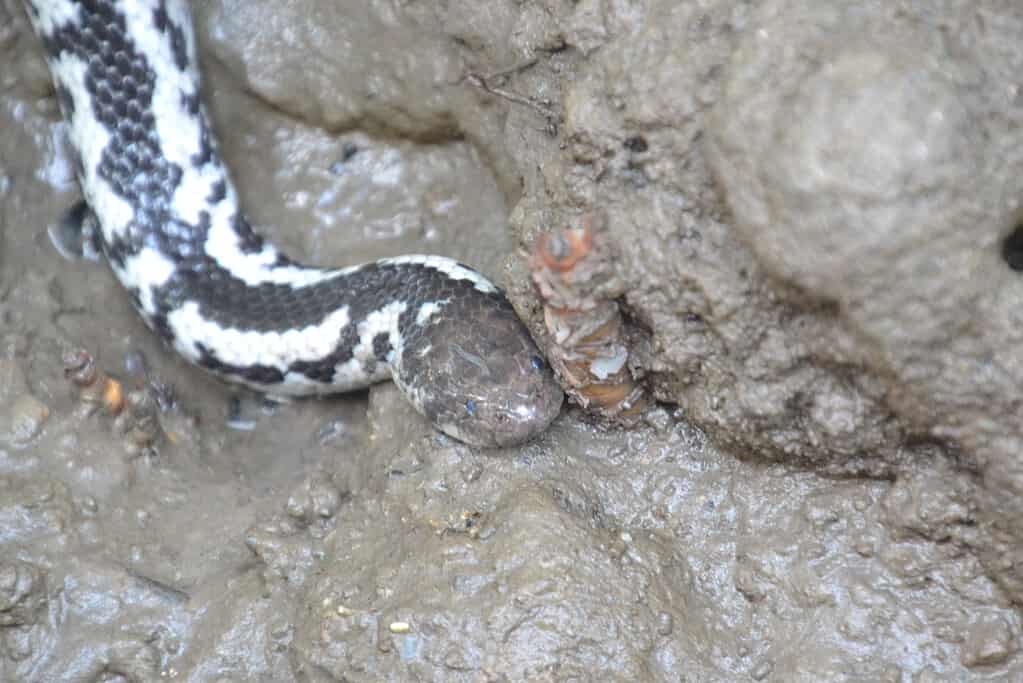
Crab-eating water snakes are surprisingly strong for their size.
©Robert Ham, CC BY-SA 4.0 <https://creativecommons.org/licenses/by-sa/4.0>, via Wikimedia Commons – Original / License
7. Ghost Snake (Madagascarophis lolo)
The ghost snake is a more recently discovered snake species, first seen in northern Madagascar’s Ankarana National Park in 2014. “Madagascarophis” applies to several snakes in Madagascar that have vertical pupils like those of a cat. “Lolo” (pronounced “luu luu”) is a Malagasy word that means “ghost.”
These ghost-like snakes are named for their elusive behavior, as well as their coloring. Ghost snakes are extremely pale with light gray and white patterns along the length of their bodies, making them look like ghostly apparitions drifting among rock formations rather than living snakes. These semi-arboreal, mildly venomous snakes grow to around 20 inches in length.
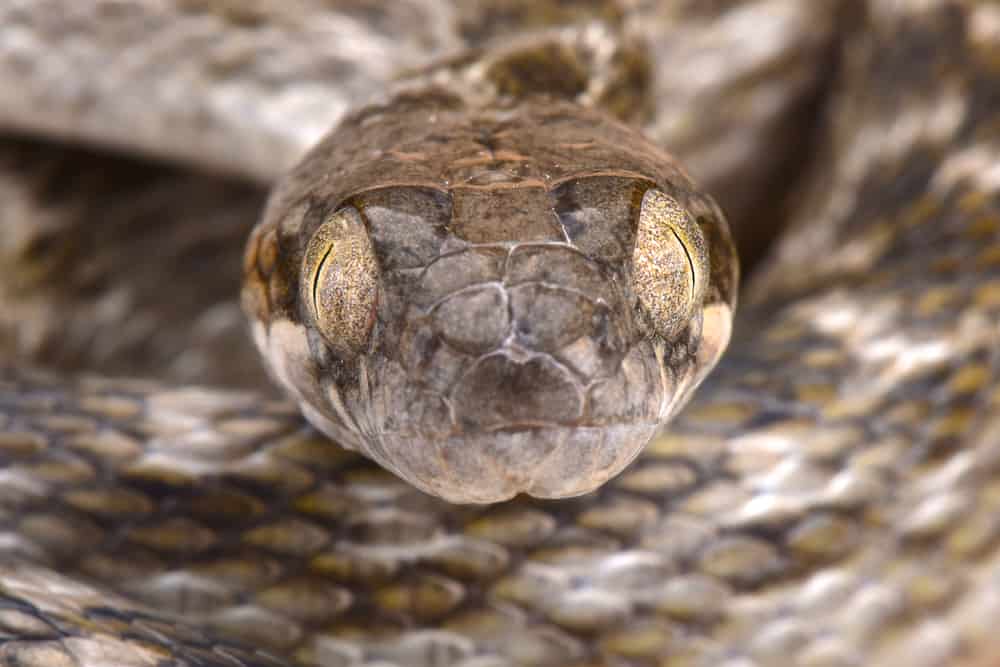
The ghost snake has vertical pupils like a cat.
©reptiles4all/Shutterstock.com