

P
Species Profile

Pine Snake

Pituophis melanoleucus

The bluffing burrower of the pines
Jay Ondreicka/Shutterstock.com

Pine Snake Distribution

Click a location to explore more animals from that region

Endemic Species
Loading map...
pine snake

At a Glance

Wild Species
Also Known As Pine snake
Diet Carnivore
Activity Diurnal+
Lifespan 15 years
Weight 2.5 lbs
Status Least Concern
Did You Know?

Adults are commonly 120-180 cm total length; record-sized individuals reach ~229 cm (Ernst & Ernst, 2003).

Scientific Classification

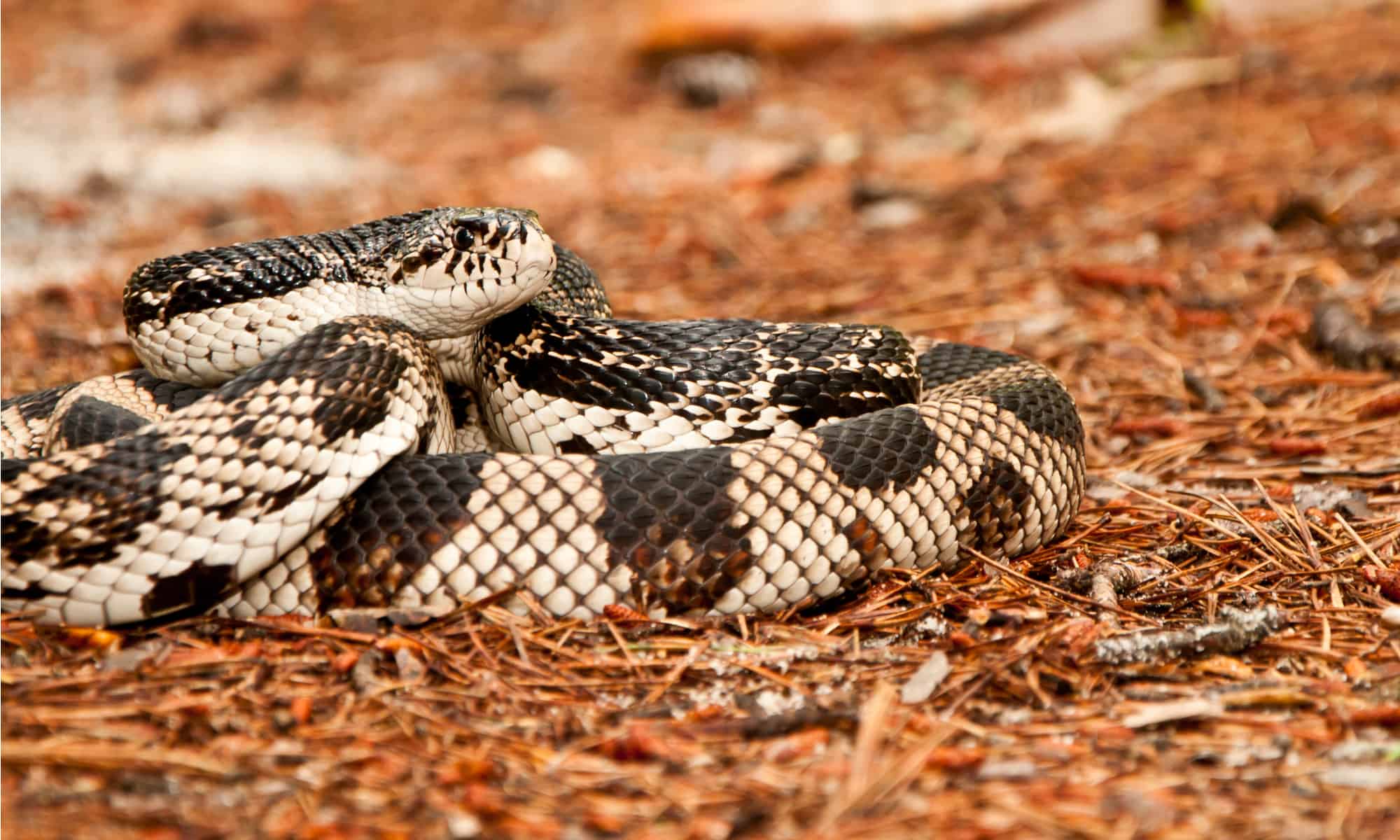
The Eastern Pine Snake is a large, nonvenomous North American colubrid known for powerful hissing, a reinforced rostral scale used for digging, and blotched patterning. It is strongly associated with sandy pine-oak habitats where it shelters in burrows and hunts rodents.

Kingdom
Animalia
Phylum
Chordata
Class
Reptilia
Order
Squamata
Family
Colubridae
Genus
Pituophis
Species
melanoleucus

Distinguishing Features

  • Large, heavy-bodied nonvenomous snake; often 120–180+ cm
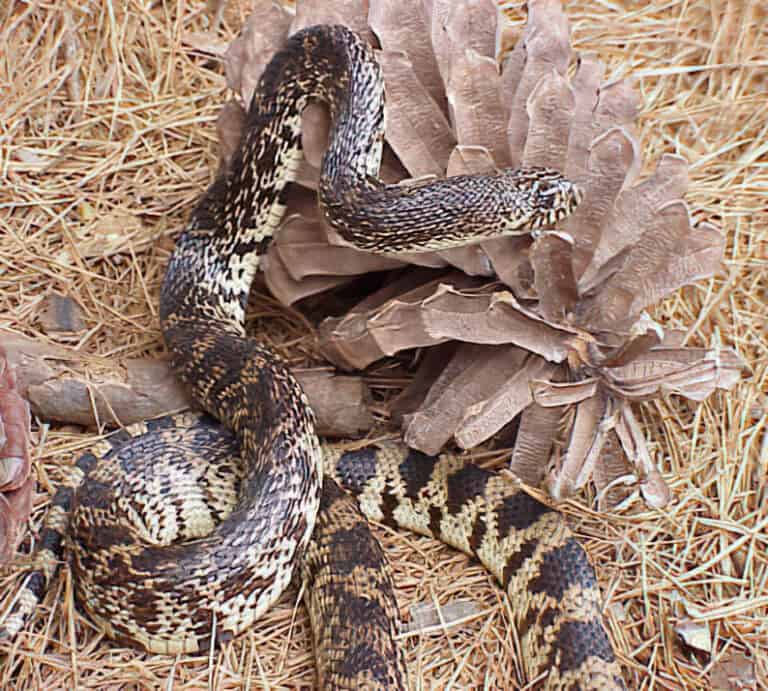
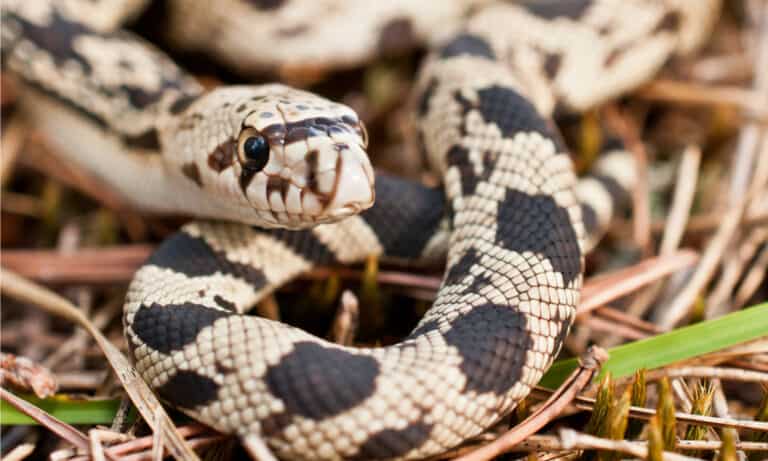
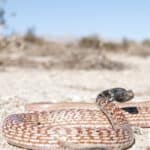
  • Blotched pattern (light background with dark dorsal blotches); coloration varies by region
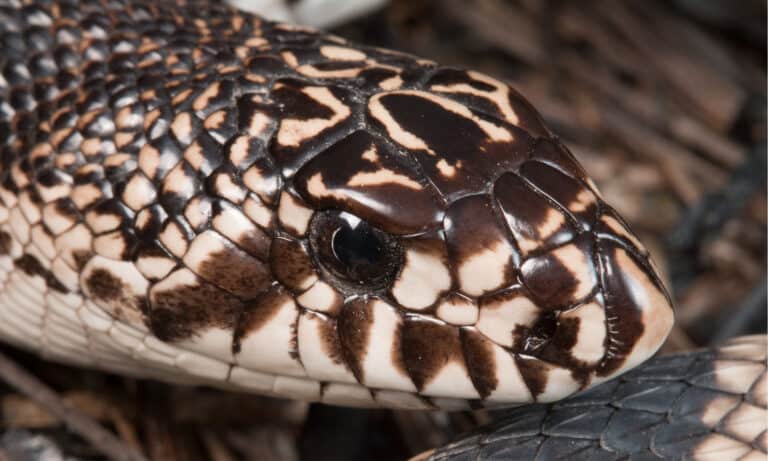
  • Distinct pointed/reinforced snout (rostral scale) adapted for burrowing
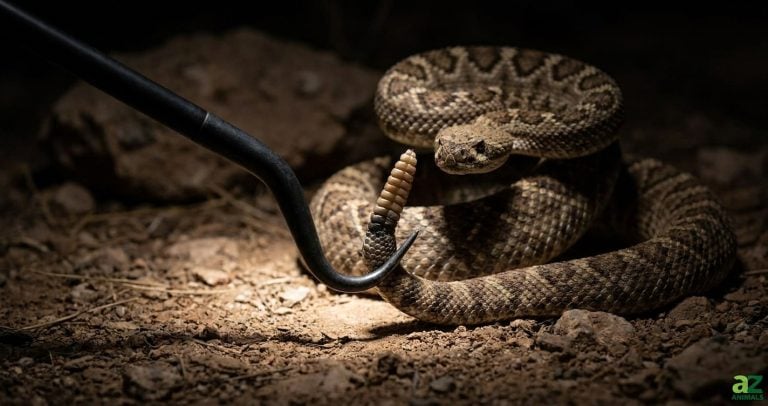
  • Loud hissing and defensive bluffing; may vibrate tail like a rattlesnake
  • Primarily a rodent predator; often associated with sandy soils and pine habitats

Physical Measurements

Length
4 ft 11 in (2 ft 11 in – 7 ft 7 in)
Weight
2 lbs (1 lbs – 6 lbs)
Tail Length
6 in (4 in – 12 in)
Top Speed
2 mph
slithering

Appearance

Primary Colors
Secondary Colors
Skin Type Dry, keratinized scales; dorsals strongly keeled, ventrals broad and smooth for traction.
Distinctive Features
  • Large, heavy-bodied colubrid; adults commonly ~90-180 cm total length; record ~229 cm (Ernst & Ernst, 2003).
  • Reinforced, enlarged rostral scale ("spade-like" snout) adapted for digging in sandy soils.
  • Dorsal scales strongly keeled, giving a rough texture and matte appearance.
  • Head relatively narrow with dark head/neck markings; pupils round (nonvenomous colubrid).
  • Tail relatively long and tapering; may vibrate tail during defensive displays (Ernst & Ernst, 2003).
  • Defensive display includes loud hissing and body flattening; coloration and blotches can resemble rattlesnakes, but species is nonvenomous (Ernst & Ernst, 2003).

Sexual Dimorphism

Sexual dimorphism is subtle. Males typically have longer tails and more subcaudal scales than females, while females often appear slightly stouter at comparable lengths (Ernst & Ernst, 2003).

  • Relatively longer tail beyond the vent.
  • Typically higher subcaudal scale counts than females.
  • Often slightly more elongated overall body form at equal total length.
  • Relatively shorter tail beyond the vent.
  • Typically lower subcaudal scale counts than males.
  • Often slightly heavier-bodied, especially when gravid.

Did You Know?

Adults are commonly 120-180 cm total length; record-sized individuals reach ~229 cm (Ernst & Ernst, 2003).

Its "pine-snake" lifestyle is literal: it strongly favors sandy pine-oak habitats and readily uses/extends mammal burrows for shelter and overwintering.

When threatened it can hiss extremely loudly-Pituophis species amplify sound with a modified glottis/epiglottis region (e.g., Ernst & Ernst, 2003).

It often performs a full bluff routine: inflating the body, flattening the head/neck, lunging, and vibrating the tail against dry leaves to mimic a rattlesnake.

It is an egg-layer; reported clutches are typically about 4-12 eggs, with larger clutches recorded in some populations (Ernst & Ernst, 2003).

In the genus Pituophis, close relatives include the Bullsnake and Gopher Snake; many share the same "digging snout + loud hiss" toolkit, but occupy different habitats across North America.

Unique Adaptations

  • Reinforced, enlarged rostral scale ("digging shield") that functions like a shovel tip for moving sand-key to its burrowing ecology in pine barrens and coastal plain sands.
  • Specialized sound production in Pituophis: anatomical modifications of the upper airway allow an unusually loud, sustained hiss compared with many other colubrids (Ernst & Ernst, 2003).
  • Pattern and posture deception: blotched coloration plus head/neck flattening and tail-vibration combine to deter predators by resembling sympatric rattlesnakes.
  • Powerful body and low-friction scales suited to moving through tunnels; thrives in subterranean microhabitats where surface temperatures and predators are reduced.

Interesting Behaviors

  • Burrow engineering: uses a reinforced snout to dig into loose sand and to enlarge existing rodent burrows for refuge and temperature control.
  • Rodent-focused foraging: actively searches along burrow systems, then subdues prey by constriction; helps reduce populations of mice, rats, and other small mammals.
  • Defensive display sequence: coils, inflates, raises the forebody, hisses explosively, strikes repeatedly (often with a closed mouth), and may smear musk.
  • Rattlesnake mimicry by behavior: rapid tail vibration in leaf litter can create a convincing "rattle-like" sound despite lacking a rattle.
  • Seasonal shelter fidelity: individuals commonly reuse favored burrows and overwinter sites, making intact sandy habitat patches especially important.

Cultural Significance

The Eastern Pine Snake (Pituophis melanoleucus) is large and often killed because people mistake it for rattlesnakes in coastal plain and pine barrens. It eats rodents, shows healthy sandy pine-oak habitat, and faces threats from habitat loss, roads, and lost burrows; globally Least Concern but of concern in some states.

Myths & Legends

"Rattlesnake pilot" tales in parts of the American South and Appalachians describe large nonvenomous snakes (often bullsnakes/pinesnakes) that supposedly travel with, lead, or "guard" rattlesnakes.

Frontier-era storytelling sometimes called Pituophis the "bullsnake" because its booming hiss was likened to a bull's bellow; the sound itself fed legends of an unusually aggressive snake.

Local pine-barrens lore in the eastern U.S. has long treated big, blotched 'pine snakes' as dangerous 'rattlers' due to their convincing bluff display-an identification tradition passed down in some rural communities.

Farm-country traditions in parts of the Southeast describe big 'gopher/pine' snakes as barnyard protectors that keep rats out of feed stores-an anecdotal, good-luck association tied to their rodent-eating habits.

Conservation Status

LC Least Concern

Widespread and abundant in the wild.

Population Decreasing

Protected Under

  • Not listed under the U.S. Endangered Species Act at the species level; legal protection is primarily through state wildlife regulations (varies by state), including restrictions on take/kill/collection for protected nongame reptiles in parts of the range.
  • Occurs in multiple protected landscapes (e.g., state lands, national forests, and conservation areas) where habitat management (especially prescribed fire and longleaf/shortleaf pine restoration) can benefit populations.

Life Cycle

Birth 10 hatchlings
Lifespan 15 years

Lifespan

In the Wild
10–20 years
In Captivity
15–25 years

Reproduction

Mating System Promiscuity
Social Structure Solitary
Breeding Pattern Seasonal
Fertilization Internal Fertilization
Birth Type Internal_fertilization

Solitary adults breed seasonally in spring (typically March-May); males trail female pheromones and may engage in male-male combat, and both sexes can mate multiple times. Females lay one clutch (~3-24 eggs) and provide no parental care.

Behavior & Ecology

Social None (solitary; temporary mating pair) Group: 1
Activity Diurnal, Crepuscular
Diet Carnivore Rodents (small- to medium-sized mammals, especially mice and rats)
Seasonal Hibernates 2 mi

Temperament

Secretive, fossorial-leaning ambush/active forager; shelters in mammal burrows in sandy pine-oak habitats.
Generally nonaggressive; when threatened, performs loud hissing, neck flattening, and repeated bluff strikes (Ernst & Ernst 2003).
Defensive display often includes tail vibration against leaf litter and cloacal musk release; may coil and elevate forebody.
Seasonality: most surface-active by day in spring/fall; may shift toward crepuscular activity during hot summer conditions (Ernst & Ernst 2003).
Adult size commonly 91-183 cm total length; recorded maximum 229 cm (Ernst & Ernst 2003).
Longevity: documented to exceed ~15 years in captivity; wild longevity poorly quantified in literature (Ernst & Ernst 2003).

Communication

Forceful, sustained hiss Air forced through glottis) used in threat displays; not true vocal calling (Ernst & Ernst 2003
Chemical communication via pheromone trails for mate-finding; tongue-flicking to vomeronasal organ.
Tactile signaling during courtship/mating: body alignment and contact; males may engage in ritualized combat/pressing.
Visual postures: head/neck flattening, forebody elevation, and open-mouth striking to deter predators.
Substrate-borne cues: tail vibration can create audible rustling in dry leaf litter, enhancing bluff display.

Habitat

Biomes:
Temperate Forest Temperate Grassland
Terrain:
Coastal Plains Hilly Sandy
Elevation: Up to 4921 ft 3 in

Ecological Role

Terrestrial mesopredator in pine-oak/sandy ecosystems; important controller of small-mammal populations via heavy predation on rodents and other small mammals.

Rodent population regulation (reducing impacts of small-mammal herbivory and crop/seed predation where habitats interface with managed lands) Trophic link transferring energy from small mammals to higher predators (e.g., raptors, mesocarnivores) Influences small-mammal burrow use and activity through persistent predation pressure in burrow networks (documented burrow-focused foraging behavior in species accounts)

Diet Details

Main Prey:
Rodents Rabbits Small mammals Ground-nesting birds and nestlings Bird eggs Small reptiles

Human Interaction

Domestication Status

Wild

The Eastern Pine Snake (Pituophis melanoleucus) is a wild, not-domesticated, nonvenomous snake. Human interactions are accidental: habitat loss from forestry, development, and changed fires in open, sandy pine and oak areas; people kill them because they mistake them for venomous snakes and fear loud hissing, puffing up, and tail shaking. Kept by hobbyists and bred in captivity, but not domesticated.

Danger Level

Low
  • Nonvenomous; no medically significant venom risk to humans
  • Defensive bites can cause puncture wounds and localized pain/swelling; infection risk if wounds are not cleaned
  • Powerful bluff display (very loud hissing, body inflation, tail vibration) can cause alarm and lead to unsafe human responses (e.g., attempted killing/handling)
  • Potential zoonotic risk typical of reptiles (e.g., Salmonella) if hygiene is poor after handling

As a Pet

Suitable as Pet

Legality: Eastern Pine Snake (Pituophis melanoleucus) is often legal to own in much of the U.S. if captive-bred, but laws vary by state. Wild collection is usually illegal; check local permits and rules.

Care Level: Experienced

Purchase Cost: $150 - $600
Lifetime Cost: $2,000 - $7,000

Economic Value

Uses:
Ecosystem service: rodent control (predation on small mammals in and near managed pine landscapes) Education/outreach (nature centers, interpretive programs, responsible private keeping) Pet trade (limited compared with some other pine and gopher snakes, but present via captive breeding) Conservation management relevance (indicator of intact sandy upland habitat; used in surveys/monitoring)
Products:
  • Live captive-bred animals for the pet/education market
  • Educational programming value (demonstration animals in permitted settings)

Relationships

Predators 9

Red-tailed Hawk Buteo jamaicensis
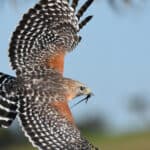
Red-shouldered Hawk
Red-shouldered Hawk Buteo lineatus
Great Horned Owl Bubo virginianus
Eastern Kingsnake Lampropeltis getula
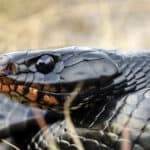
Eastern Indigo Snake
Eastern Indigo Snake Drymarchon couperi
Raccoon
Raccoon Procyon lotor
Virginia Opossum Didelphis virginiana
Red Fox
Red Fox Vulpes vulpes
Bobcat
Bobcat Lynx rufus

Related Species 10

Gopher Snake
Gopher Snake Pituophis catenifer Shared Genus
Mexican Pine Snake Pituophis deppei Shared Genus
Louisiana Pine Snake Pituophis ruthveni Shared Genus
Lined-necked Pine Snake Pituophis lineaticollis Shared Genus
Cape Gopher Snake Pituophis vertebralis Shared Genus
Eastern Kingsnake Lampropeltis getula getula Shared Family
Eastern Ratsnake
Eastern Ratsnake Pantherophis alleghaniensis Shared Family
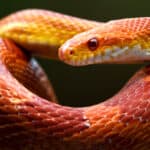
Corn Snake
Corn Snake Pantherophis guttatus Shared Family
Coachwhip
Coachwhip Masticophis flagellum Shared Family
Eastern Racer
Eastern Racer Coluber constrictor Shared Family

Ecological Equivalents 5

Animals that fill a similar ecological role in their ecosystem

Eastern Hognose Snake
Eastern Hognose Snake Heterodon platirhinos Overlaps strongly in sandy pine-oak and scrub habitats and uses digging/burrowing. Both exhibit prominent defensive displays (hissing/bluffing). Niche differs in diet (the hognose specializes on toads), but the shared preference for sandy soils, fossorial tendency, and reliance on burrows make it a close ecological analogue.
Southern Black Racer
Southern Black Racer Coluber constrictor priapus Both species inhabit pinewoods, sandhills, and habitat edges; both hunt and use ground cover and burrows to avoid heat and predators. The racer is more surface-active and relies on sight to locate prey, while the Eastern Pine Snake burrows more and waits to ambush prey.
Coachwhip
Coachwhip Masticophis flagellum Shares xeric, sandy uplands (including pine scrub and sandhills) and preys on small vertebrates; both use speed/cover selection and occupy open-canopy habitats. Coachwhip is more diurnal and wide-ranging; Eastern Pine Snake is more burrow-associated and rodent-focused.
Eastern Ratsnake Pantherophis alleghaniensis Overlaps geographically and trophically through predation on small mammals and birds (including nests). The Eastern ratsnake is more arboreal and climbs structures, whereas the Eastern Pine Snake is specialized for sandy-soil burrowing (with a reinforced rostral scale) and for hunting mammals in or near burrows.
Eastern Kingsnake Lampropeltis getula Uses similar upland/edge habitats and may occupy the same refugia (logs, stump holes, burrows). Both are large colubrids in the same communities. The kingsnake is an important snake-eating competitor/predator, while the Eastern Pine Snake is primarily a rodent-focused constrictor.
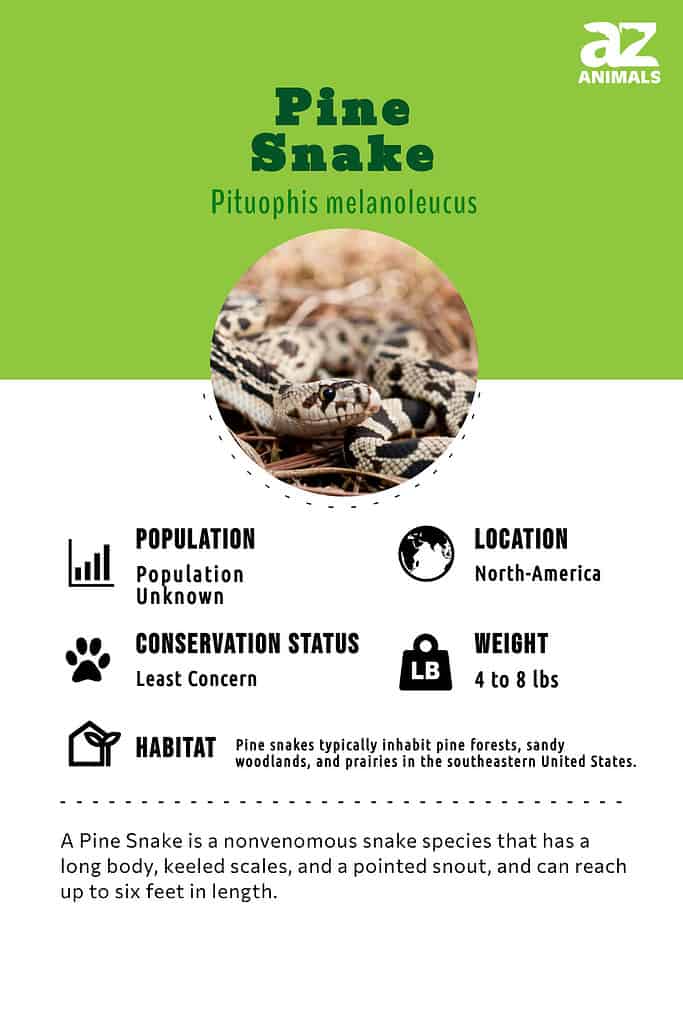
A Pine Snake is a nonvenomous snake species that has a long body, keeled scales, and a pointed snout, and can reach up to six feet in length.

The pine snake is native to the southeastern region of the United States.

It is a non-venomous constrictor that lives in prairies, pine forests, and other environments. The pine snake resembles a rattlesnake, but it is harmless to humans.

3 Amazing Facts About the Pine Snake
pine snake

The pine snake goes into a state of hibernation beneath the ground and possesses a snout that is specifically adapted for digging.

• It hibernates underground and has a snout designed for digging.
• If threatened, it shakes its tail to look like a rattlesnake.
• The Louisiana pine snake is the rarest snake in the United States.

Evolution and Origins

The Pine Snake, scientifically known as Pituophis melanoleucus, belongs to the Colubridae family of snakes and is native to North America.

The Pine Snake is believed to have evolved from a common ancestor with the Bull Snake, with both species sharing similar physical characteristics and behaviors. Fossils of ancestral Pituophis have been found dating back to the Miocene epoch, around 23 million years ago, indicating that the genus has existed for a considerable length of time.

The Pine Snake’s habitat includes pine forests, prairies, and coastal dunes, where it feeds on small mammals and reptiles.

Despite its wide range, the Pine Snake’s populations are threatened due to habitat loss and fragmentation, making conservation efforts crucial for its survival.

Different Types

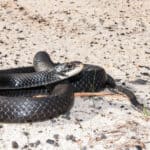
Four different types of pine snakes exist, namely the northern pine snake, black pine snake, Florida pine snake, and bull snake, with the northern pine snake featuring a black or dark brown marking on its back, and a white underbelly with black dots running along both sides.

Where to Find Pine Snakes
Black Pine Snake

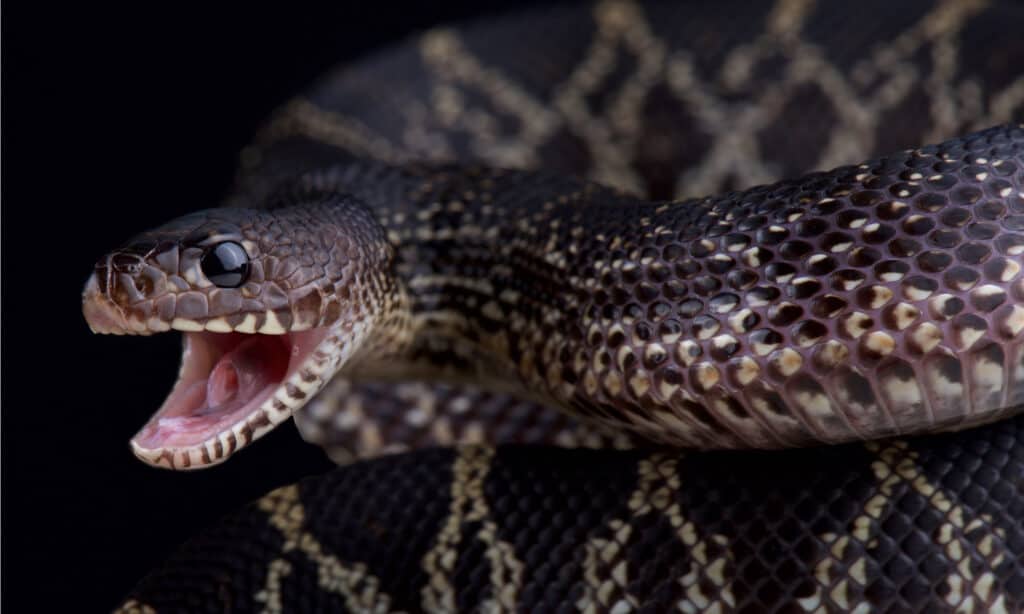
Black Pine SnakeThe snakes are indigenous to the southeastern pine forests and grasslands.

These snakes are native to the pine forests and prairies of the southeast. Throughout their range, they are found in a variety of habitats. They live in the coastal plains of southern states like North Carolina, South Carolina, and Georgia. They also live in the northern mountains of Virginia and Tennessee. There are pine snakes in the southern pine barrens of New Jersey, the grasslands of Alabama, and even in the southern region of Wisconsin, where they are called gopher snakes.

Where to see them in zoos
pine snake

Pituophis melanoleucus is the scientific name of this snake species which has several common names like chicken snake, bull snake, pilot snake, white gopher snake, and pilot snake.

Smithsonian National Zoo
Audubon Zoo
Memphis Zoo
Maryland Zoo
Utica Zoo

Scientific Name

Its scientific name is Pituophis melanoleucus. It has many popular names, including chicken snake, bull snake, pilot snake, white gopher snake, and pilot snake.

There are four subspecies of the pine snake:

• Northern pine snake
• Black pine snake
• Florida pine snake
Bullsnake

Population and Conservation Status
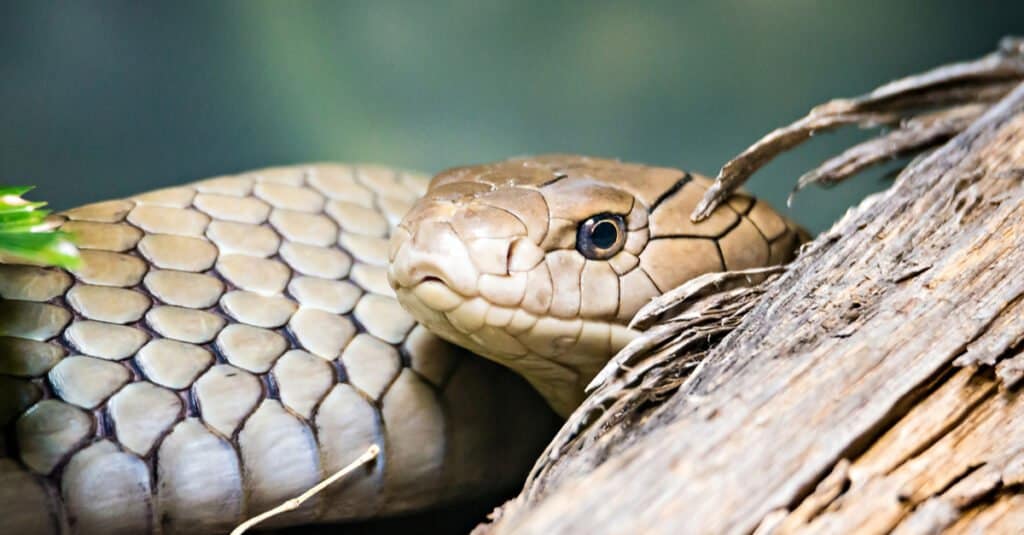
close up of a Florida pine snake

Pine snakes have a broad distribution, and they are considered of low conservation concern according to the IUCN Redlist.

Pine snakes are widespread in their range, and they are classed as “least concern” by the IUCN Redlist. Like all snakes, however, they have suffered population declines because of habitat loss and other factors.

They are listed as a species of special conservation concern in Georgia, and it is illegal to kill them under Georgia law. Their population is also considered threatened in Southern New Jersey. Conservationists believe they have been extirpated in Maryland and West Virginia, but wildlife biologists in Maryland say they still live in the Isle of Wight, a state Wildlife Management Area.

In 2020, the Audubon Zoo, Memphis Zoo, and U.S. Forest Service released 41 Louisiana pine snakes into the Kisatchie National Forest in Louisiana. The release of these juvenile snakes marked the end of a years-long process to raise them in captivity and reintroduce them to their former range. This subspecies of the northern pine snake is classed as endangered by the IUCN. It is considered the rarest snake in the U.S.

Appearance and Description

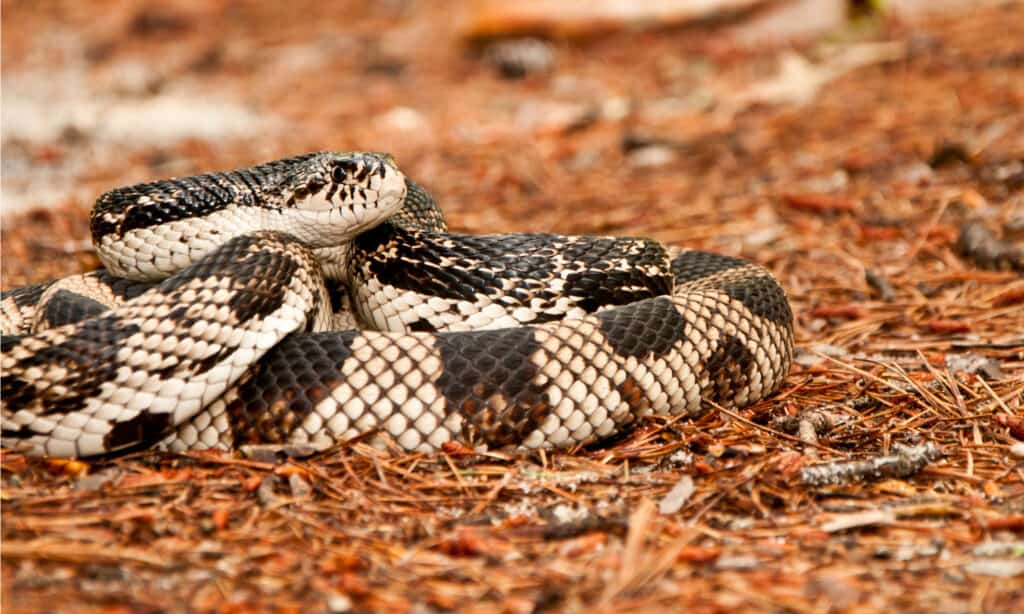
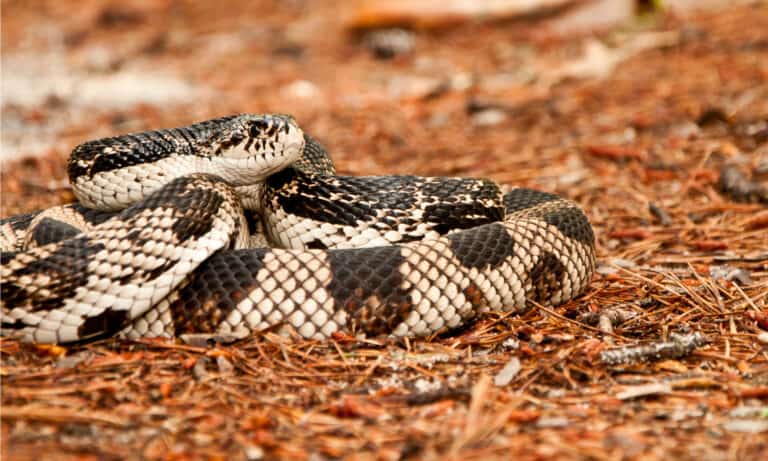
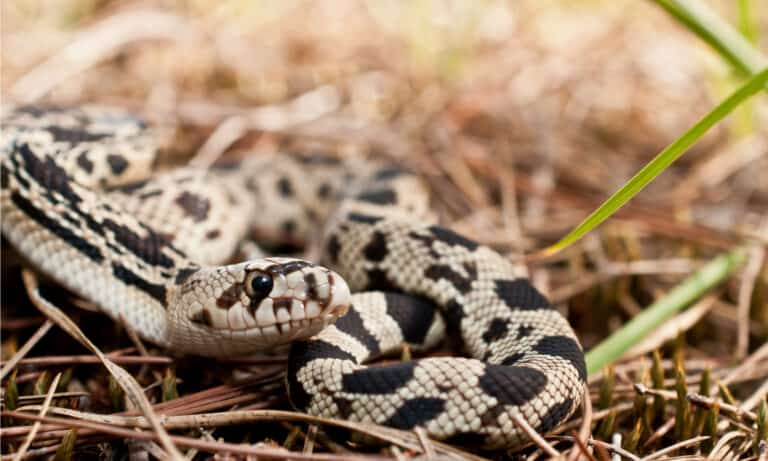
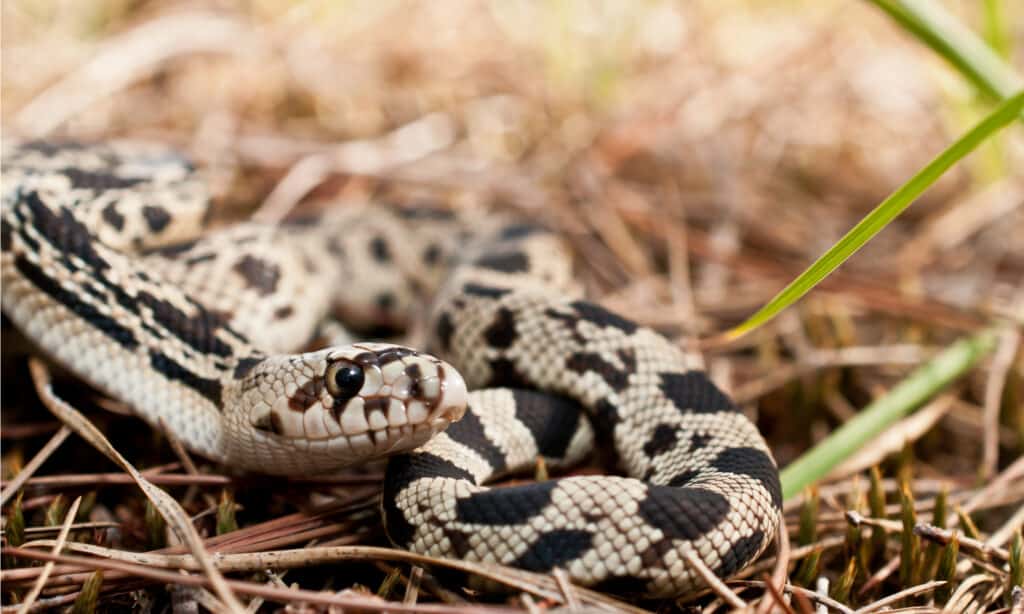
This is a large snake that reaches six feet in length and up to 9 pounds in weight. It has a large, stocky body with a distinct pattern on its scales. Typically, it has a light gray background with blotches of black, brown, and reddish-brown. These patches are usually darkest near the head and lighter near the tail. It has a white belly edged in dark spots.

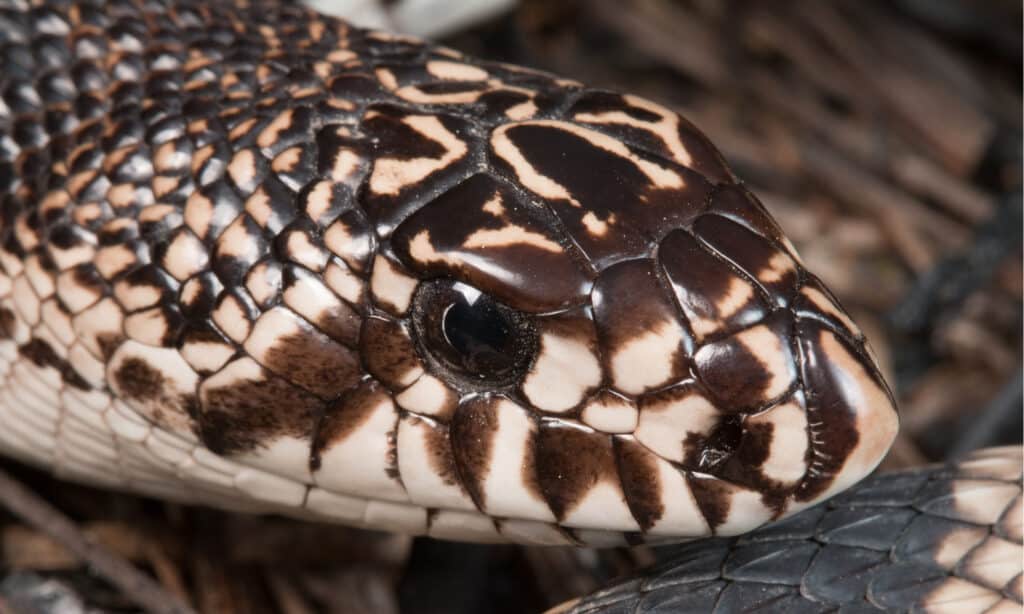
Unlike other members of the colubrid family, which have two prefrontal scales, it has four. It also has a pointed snout that helps it dig burrows to hibernate in during the winter.

Venom: How Dangerous Are They?

Despite their large size and intimidating defensive posturing, these snakes are not dangerous to humans. They are not venomous or poisonous. Their bite can be painful, but they will only bite if provoked.

Behavior and Humans

Pine snakes are skilled hunters. They are diurnal but will sometimes hunt at night. They are shy, reclusive animals who spend much of their time in their underground burrows.

They reproduce in the spring and summer. Females use their snouts to dig burrows, and they lay their eggs in these burrows. Most females return to the same burrow every year to lay their eggs. They lay from 12 to 20 eggs that incubate for about three months. Baby pine snakes are noteworthy for their size. They can be over a foot long at birth.

Human interaction

Although pine snakes are not venomous, they have adapted a technique that mimics the actions of the highly venomous rattlesnake. When a pine snake feels threatened, it will make a hissing sound while shaking its tail. This is an adaptation designed to make predators think it’s a rattlesnake. It may also bellow loudly to scare away the predator.

These snakes hibernate in the coldest part of the winter. They do this by using their snouts to dig underground burrows for shelter.

Pine snakes are non-venomous and harmless to humans. They may bite if they are threatened, but they have no venom.

View all 246 animals that start with P

Sources

  1. Coniferous Forest: Pine Snake
  2. Savannah River Ecology Laboratory: Pine Snake
  3. Maryland Zoo: Northern Pine Snake
Austin S.

About the Author

Austin S.

Growing up in rural New England on a small scale farm gave me a lifelong passion for animals. I love learning about new wild animal species, habitats, animal evolutions, dogs, cats, and more. I've always been surrounded by pets and believe the best dog and best cat products are important to keeping our animals happy and healthy. It's my mission to help you learn more about wild animals, and how to care for your pets better with carefully reviewed products.
Connect:

Thank you for reading! Have some feedback for us?


Pine Snake FAQs (Frequently Asked Questions)

No, they are not venomous. Their bite is painful, but it is not poisonous.