
Quick Take
- One of these spiders is an invasive species quietly spreading across the U.S., arriving faster than scientists expected. Joro's invasive spread →
- That zig-zag pattern woven into some spiders' webs is not merely decorative. Scientists debate a stranger purpose that most people have never considered. The stabilimentum mystery →
- Several of these spiders look alarming but are harmless, though one can actually cause a physical reaction in humans. Venom effects on humans →
- The females and males of these species can look so different they're mistaken for separate species entirely. Dramatic size dimorphism →
There are more than 54,000 described spider species globally, although scientists estimate the actual total could exceed 100,000. Arachnologists do not keep an exact count of species that are primarily black and yellow. However, these highly visible warning colors appear across several unrelated groups of spiders. Continue reading to learn about six black-and-yellow spiders and where to find them.
Golden Silk Orb-weaver Spider
The golden silk orb-weaver spider (Trichonephila clavipes) is found throughout the Americas in tropical and subtropical regions, ranging from South America through Central America, the West Indies, the Gulf States, and as far north as North Carolina.
Golden silk orb-weavers are known for their golden-colored thread, which they use to construct large, orb-shaped webs. These can span several feet in diameter and are extremely strong. Smaller spiders and insects may use them as a form of shelter.
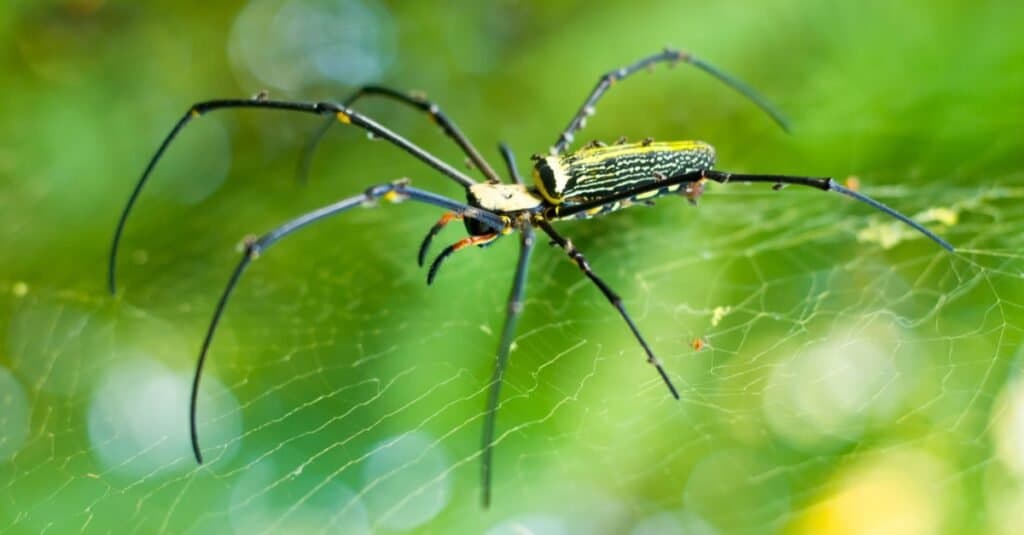
Golden orb-weaver spiders appear more menacing than they are.
©makuromi/Shutterstock.com
Golden silk orb-weavers exhibit sexual dimorphism, in which females are much larger and more colorful than males of the species.
Female golden silk orb-weavers have an average body length of 1.5 to 2 inches and a total leg span of 4 to 6 inches. Males have a body length of 0.25 inches and a shorter leg span.
Female golden silk orb-weavers are bright yellow-orange with black stripes on their legs and abdomen. Their underside is often black or brown. Male golden silk orb-weavers are not colorful and are typically muted earth tones in coloration.
Although golden silk orb-weavers may look scary, they aren’t dangerous to humans. These spiders feed on insects that they catch in their web.
Joro Spider
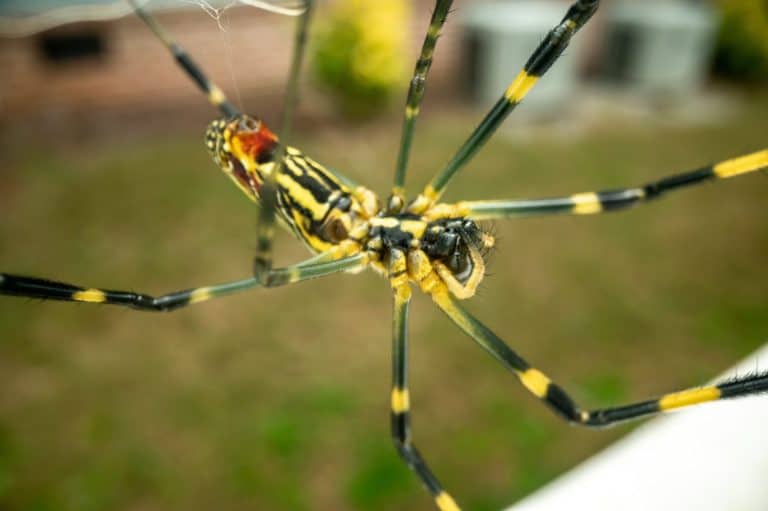
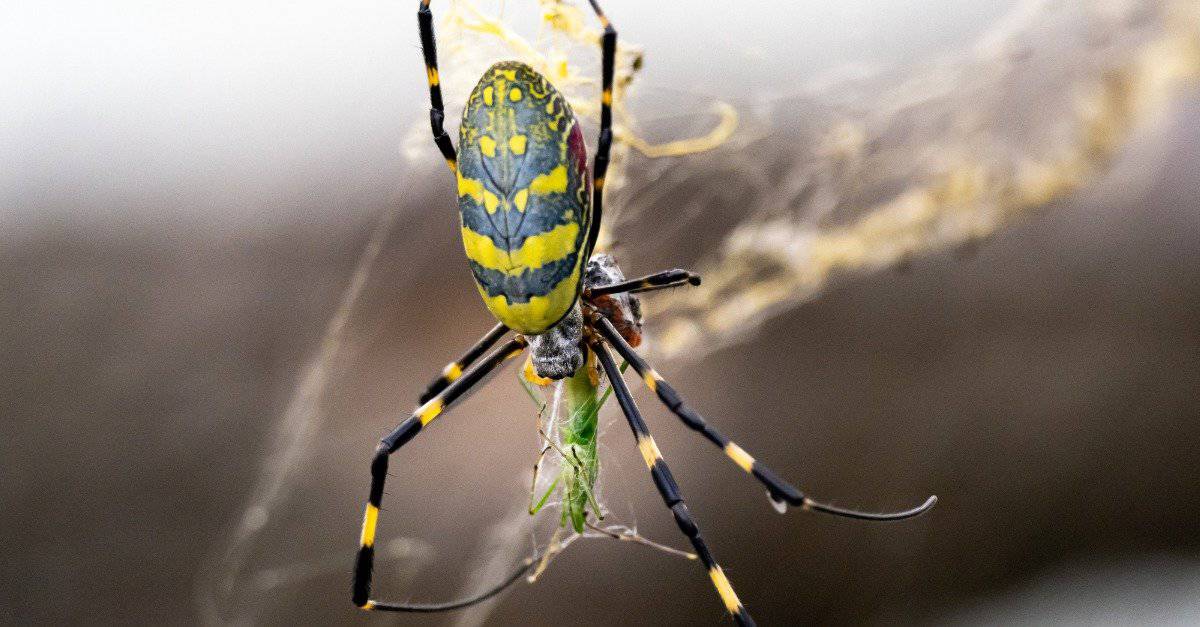
The Joro spider (Trichonephila clavata) is an orb-weaver that is native to East Asia. Since its accidental introduction to North America circa 2013, its range has rapidly expanded across the Southeastern United States, with established populations in Alabama, Georgia, North Carolina, South Carolina, and Tennessee.
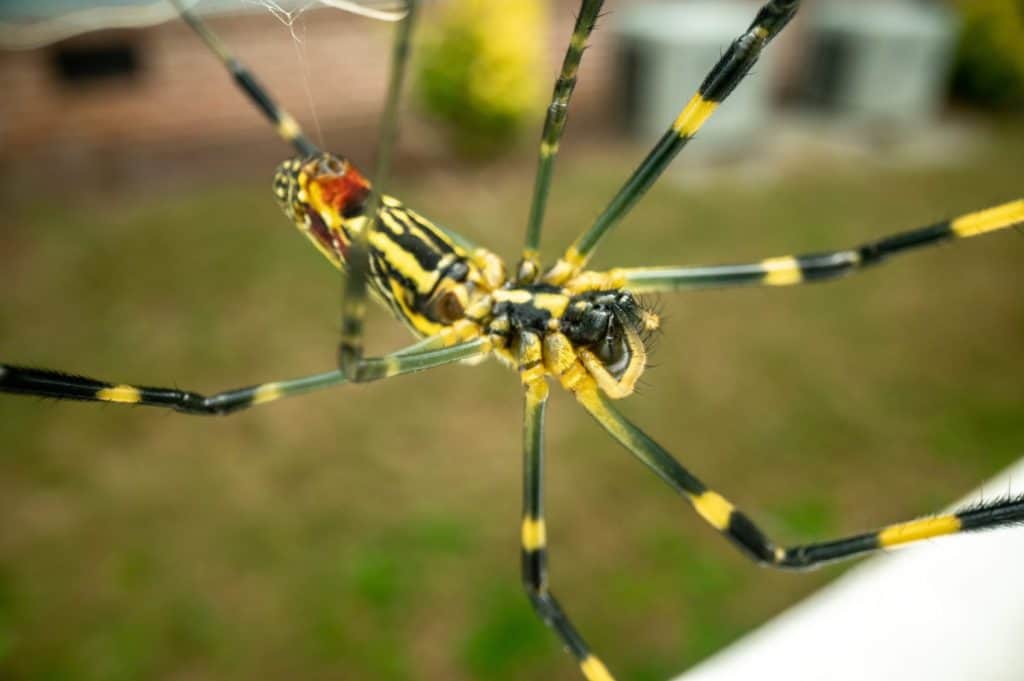
Joro spiders are considered an invasive species in North America.
©Kelly vanDellen/Shutterstock.com
Joro spiders exhibit significant sexual dimorphism. Females have a one-inch body and a leg span approaching 4 inches. Males are much smaller, with a body length of about 0.25 to 0.3 inches and a leg span of 1 to 1.5 inches.
The adult female is easily recognized by her vibrant coloration: a bright yellow abdomen with deep blue-black horizontal stripes, a splash of red near the rear, and long, spindly legs banded in black and neon yellow.
Black and Yellow Argiope Spider
The black and yellow argiope spider (Argiope aurantia) is an orb-weaver native to North America and Central America. This species exhibits dramatic sexual dimorphism in both color and size.
The female features a vibrant black abdomen patterned with bright yellow or orange symmetrical patches, a silver-white cephalothorax, and dark legs banded with yellow or red. Her body length measures 0.75 to 1.1 inches, while her full leg span stretches to between 2.5 and 3 inches.
The much smaller male has a brownish body measuring 0.2 to 0.35 inches in length and a proportional leg span that rarely exceeds one inch.
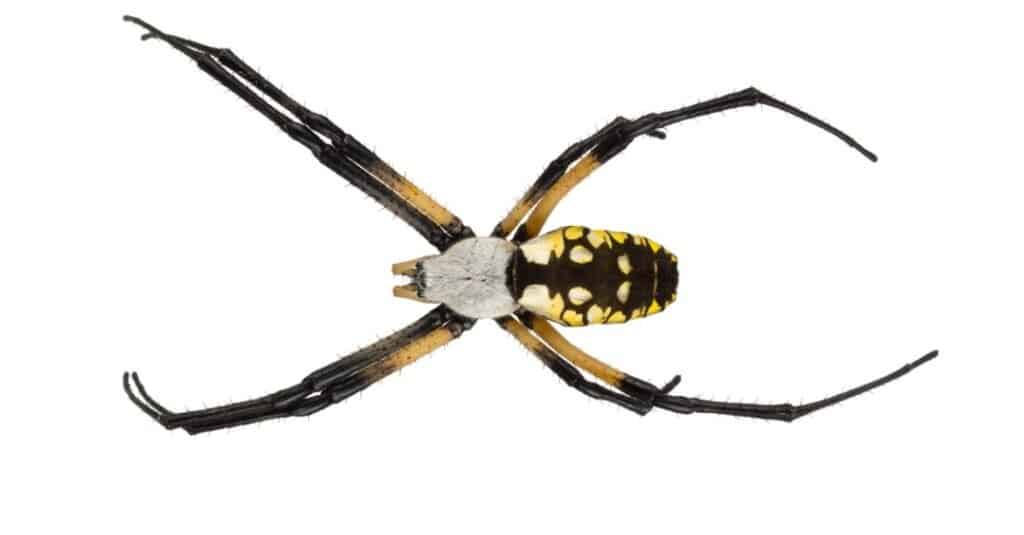
Another name for black and yellow Argiope spiders is the yellow garden spider.
©iStock.com/DianaLynne
The distinct zig-zag pattern found in the web of the black and yellow argiope is called a stabilimentum (plural: stabilimenta). While scientists still debate its exact evolutionary purpose, it is most widely thought to act as a highly visible warning that prevents large animals, like birds, from flying through and destroying the web. However, because this special silk strongly reflects ultraviolet (UV) light, it may actively lure prey to the web by mimicking the UV patterns of flowers, though this remains a contested hypothesis that is not supported by all research.
Like most spiders, the black and yellow argiope spider is not considered harmful to humans and helps reduce nuisance insect populations. The spider may bite if startled, but its venom is not considered medically significant to humans.
Banded Garden Spider
The banded garden spider (Argiope trifasciata) is an orb-weaver native to North and South America that has expanded its current distribution globally and is now found in Europe, Africa, Asia, and Australia.
Females are significantly larger than males, with a body length of 0.6 to 1.0 inches and a leg span reaching up to 2.5 inches, while males of the species measure 0.15 to 0.20 inches in body length with a leg span under 0.5 inches.
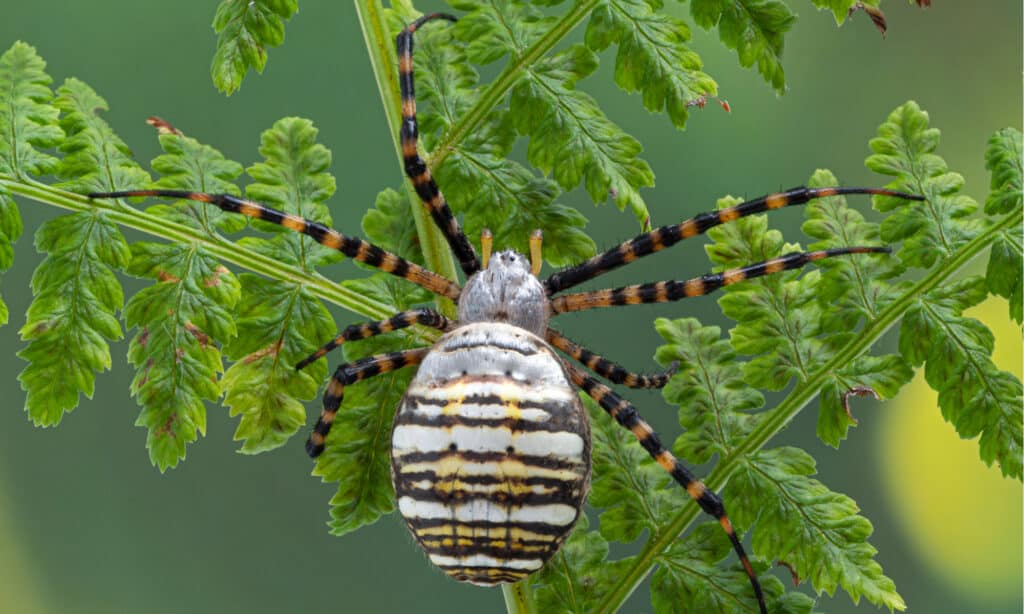
Banded garden spiders are not dangerous. Like almost all spiders, they are technically venomous, but their venom is designed to paralyze small insects and has little to no effect on humans.
©Ernie Cooper/Shutterstock.com
The banded garden spider is easily recognized by its striking black and yellow coloration. The female’s large, teardrop-shaped abdomen has alternating, parallel horizontal bands of bright yellow, white, and dark brown or black, while her legs have alternating bands of black and yellow. The much smaller males are drabber and less patterned, helping them blend into their surroundings.
Banded garden spiders spin two types of webs. The first type is a non-sticky web used as a platform for the spider to rest on or move across. The second type is a sticky web used to capture prey. The spider typically builds the sticky web in a spiral shape, starting at the center and moving outward, then waits patiently in the center for prey to become ensnared.
Spiny-back Orb-weaver Spider
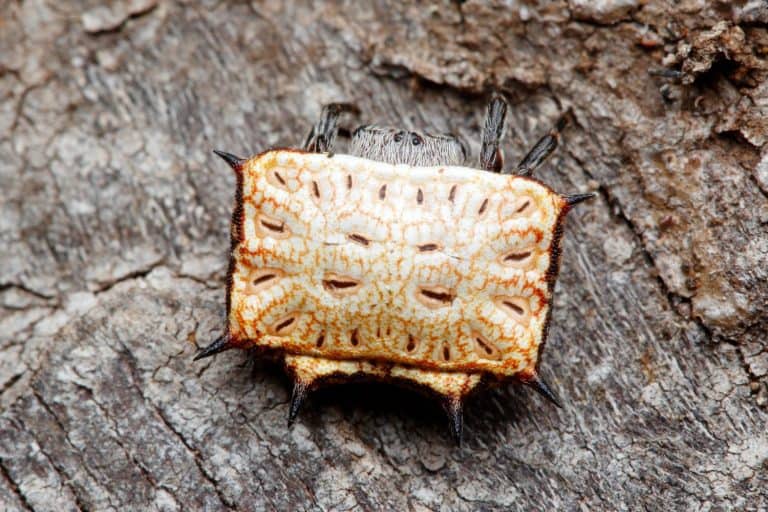
The spiny-back orb-weaver (Gasteracantha cancriformis) inhabits tropical areas worldwide. These spiders are recognized by their distinctive appearance, which includes spiky protrusions on their lemon-yellow abdomen.
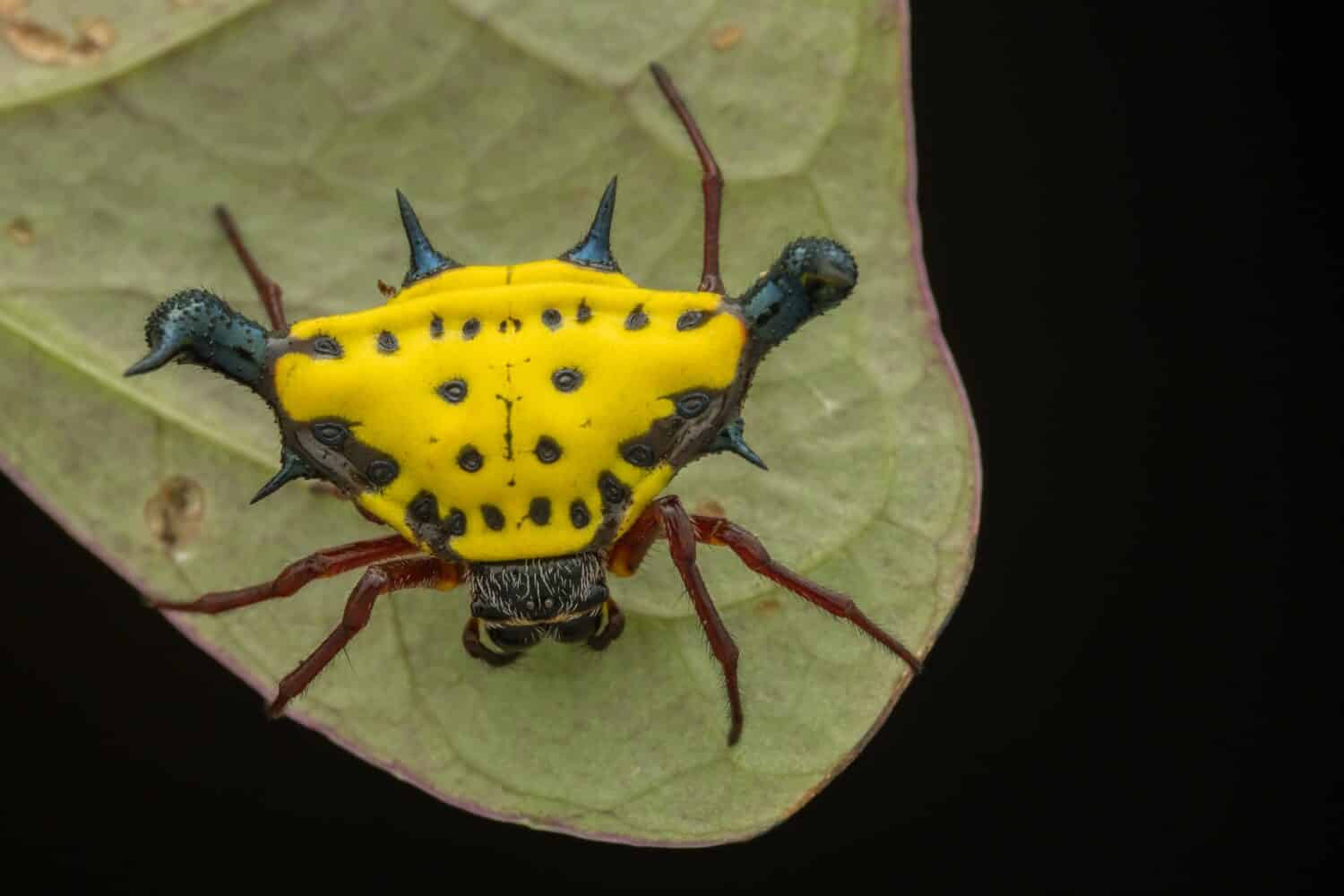
The Spiny-backed orb-weaver spider is considered a beneficial spider.
©Alen thien/Shutterstock.com
Spiny-backed orb-weaver spiders can be found in the understory of trees and plants. They are avid hunters and snare insects, including flies, mosquitoes, and butterflies, in their strong webs. These spiky abdominal protrusions also serve as a defense against predators.
Spiny-backed orbweaver females are significantly larger than the males. A mature female’s body measures between 0.3 and 0.5 inches long, with a leg span of 0.5 to 0.75 inches. Males of the species have an average body length of between 0.08 and 0.12 inches. Because males are slightly longer than they are wide and lack abdominal spines, their total leg span rarely exceeds 0.2 inches.
During mating season, the male spiny-backed orb-weaver approaches the female and drums on her web to signal his intentions. If the female is receptive, she allows the male to approach and mate. Afterward, the female lays eggs in a silk sac and guards them until the spiderlings hatch.
While the spiny-backed orb-weaver spider is not considered dangerous to humans, its venom can cause mild irritation and swelling at the bite site.
Arrowhead Spider
The arrowhead spider (Verrucosa arenata) is a small spider native to the United States. These spiders are recognized by their unique appearance, including a distinctive arrow-shaped abdomen.
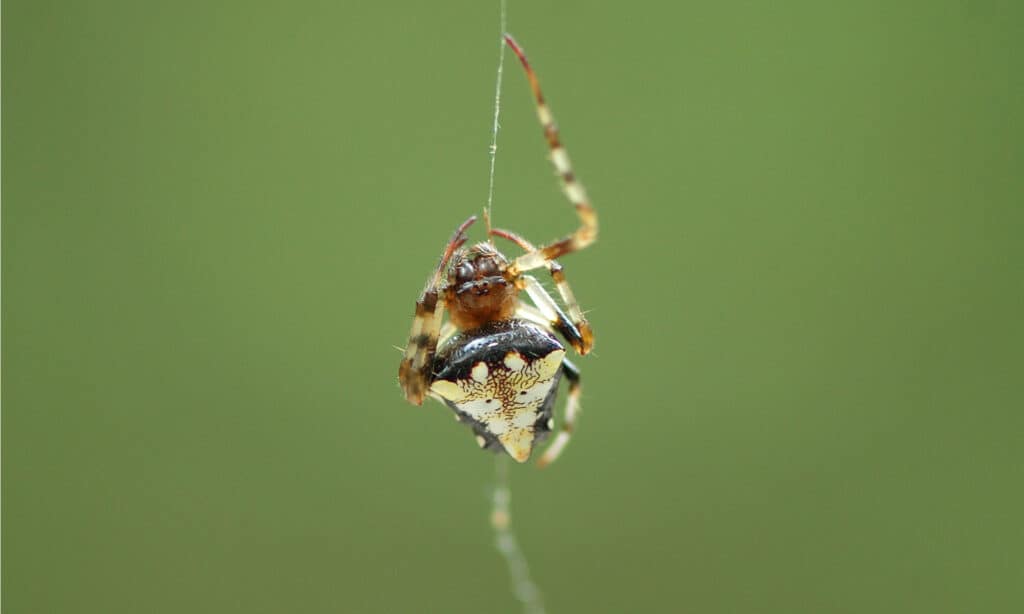
The arrow-shaped abdomen is one of the most distinguishing features of arrowhead spiders.
©Rusty Dodson/Shutterstock.com
Arrowhead spiders are strictly web-based hunters, relying entirely on their webs to catch prey rather than actively stalking or chasing it.
Female arrowhead spiders have a body length of between 0.25 and 0.5 inches and a one-inch leg span. Males of the species are about half the size of females, with a body length of 0.15 to 0.23 inches and a leg span of approximately one-half inch.
During mating season, the male approaches the female and engages in a courtship display. If the female is receptive, she allows the male to mate. The female then lays her eggs in a small silken cocoon, which she guards until the spiderlings hatch.
Arrowhead spiders are completely harmless to humans and play an important role in their ecosystems by controlling insect populations.