
The cliff swallow and the barn swallow are both members of the Hirundinidae family, which consists of the swallows, the saw-wings, and the martins. Both the cliff swallow and the barn swallow are social songbirds that are widespread around the world. They have a similar appearance, with pointed wings, dark plumage, and a white underbelly. However, there are still a few distinctive differences between them, so let’s take a look at them!
Comparing Cliff Swallow vs. Barn Swallow
| Cliff Swallow | Barn Swallow | |
|---|---|---|
| Size | Length: 5.00-6.00in Weight: 0.78-0.85 oz Wingspan: 11.00-11.80in | Length: 5.90-7.50in Weight: 0.60-0.70oz Wingspan: 11.40-13.30in |
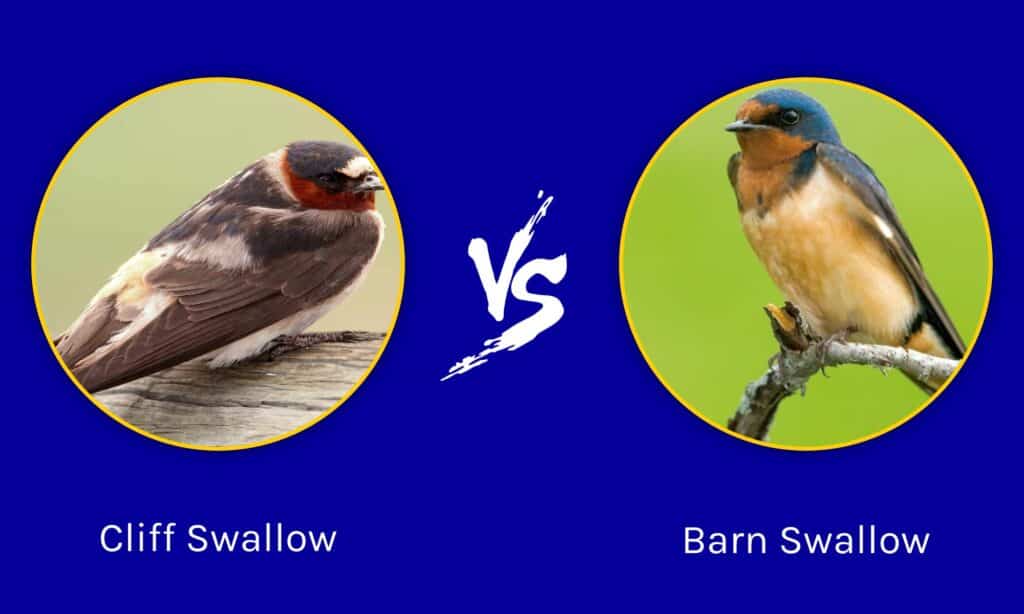
| Appearance | White forehead and belly, red cheeks, dark brown plumage, short black bills, and brown feet | Blue head with shades of black, beige, or white belly, gray to black feathers, forehead is orange or cinnamon hue |
| Diet | Primarily carnivorous; primary food is insects, and they sometimes feed on seeds, nuts, and grains | Carnivorous; insects make up about 99% of their diet |
| Lifespan | Up to 11 years | Average of 4 to 8 years |
Key Differences Between a Cliff Swallow and a Barn Swallow
There are a number of differences between the cliff swallow and the barn swallow, which include size and appearance. Let’s explore them in more detail below.
Cliff Swallow vs. Barn Swallow: Size
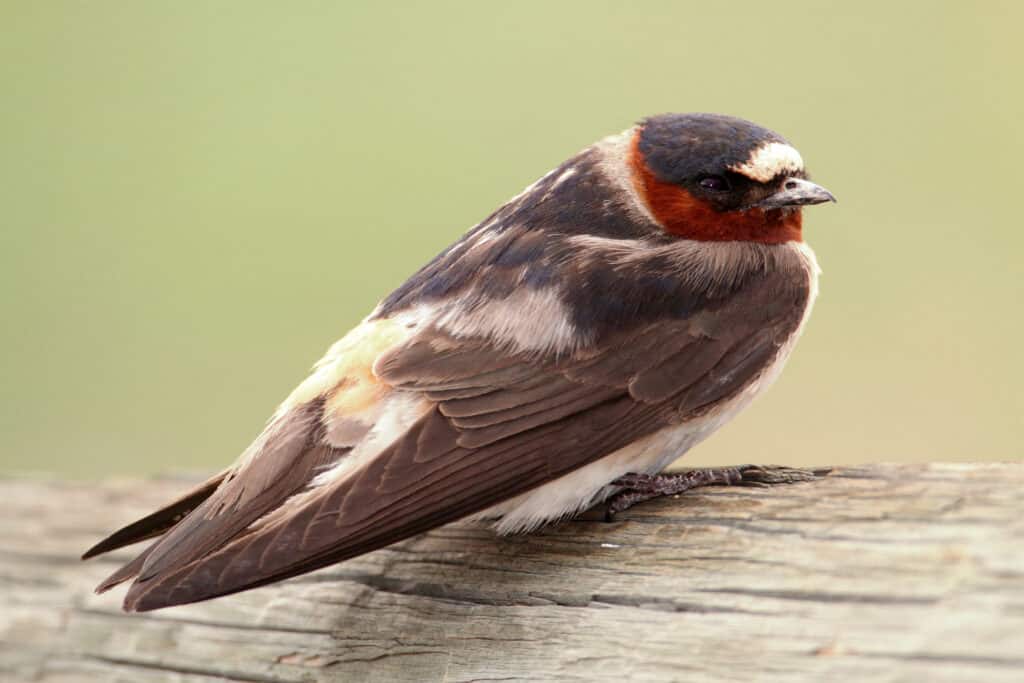
Cliff swallows measure about 5-6 inches in length.
©iStock.com/SteveByland
The cliff swallow and the barn swallow share quite a number of things in common, but size is not one of them. The cliff swallow measures about five to six inches in length, 0.78 to 0.85 ounces in weight, and has a wingspan measuring 11 to 11.8 inches. The barn swallow, on the other hand, has a length ranging from 5.9 to 7.5 inches, a weight ranging from 0.6 to 0.7 ounces, and a wingspan of 11.4 to 13.3 inches.
These figures show that the barn swallow is larger in terms of length and wingspan, while the cliff swallow is the heavier of the two.
Cliff Swallow vs. Barn Swallow: Appearance
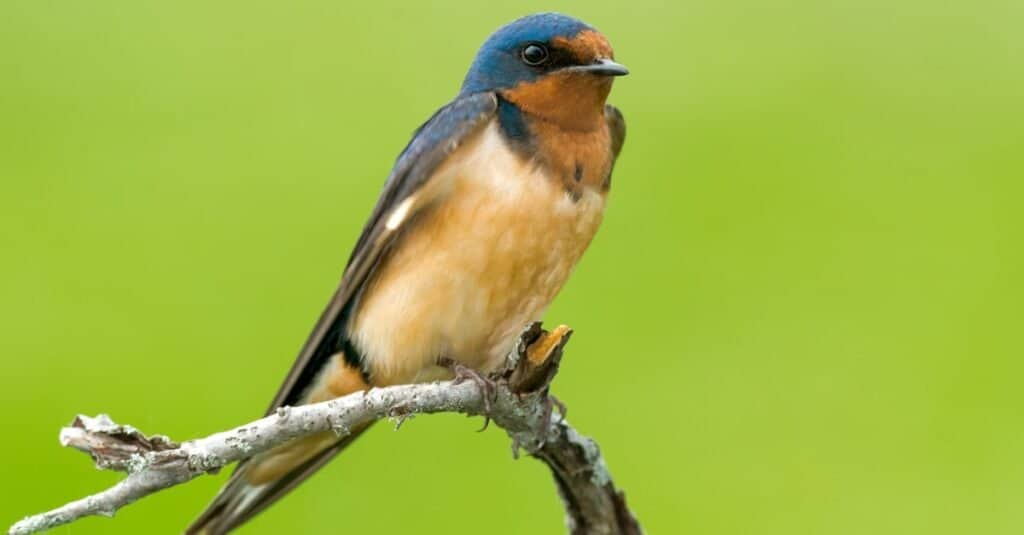
The barn swallow has a blue top with shades of black and a white/beige underbelly.
©Paul Reeves Photography/Shutterstock.com
Cliff swallows and barn swallows also have distinctive appearances. The cliff swallow has a cream/white forehead, red cheeks, dark brown plumage, black feet, and black bills. Also, male cliff swallows are generally more colorful than their female counterparts.
The barn swallow, however, has a blue top with shades of black and a white/beige underbelly. It also has gray/black feathers with an orange/cinnamon-colored forehead. Once you take note of these different physical qualities, telling the cliff swallow and the barn swallow apart should be a walk in the park.
Cliff Swallow vs. Barn Swallow: Diet
Cliff swallows mainly eat flying insects, and they are opportunistic predators, meaning they do not care what order or family these insects belong to. They may also sometimes ingest seeds, grains, and nuts, with grassy areas, lakes, and ponds being their main foraging areas. They may feed in groups of two to 1000 at times.
Barn swallows are primarily insectivores, and insects make up 99% of their diets. However, barn swallows do not typically feed on seeds, grains, and other plants. Much of their diet includes flying insects like grasshoppers, crickets, dragonflies, beetles, and moths. They are also opportunistic foragers and have been seen following farm equipment like plows and tractors to feed on insects disturbed by these machines.
Cliff Swallow vs. Barn Swallow: Location and Habitat

Barn swallows live in barns and other agricultural outbuildings, under bridges, and in open areas with water sources and shelter.
©Mirko Graul/Shutterstock.com
Cliff swallows and barn swallows also have different locations and habitats. Cliff swallows are typically found in North America and Central America, depending on whether it is breeding season or migration season. During breeding seasons, they are often found as far as Alaska down to the eastern and western coasts of the United States and northwards to Ontario and Quebec. The migration range includes the southeastern United States, as well as South and Central American countries like Cuba, Argentina, the Bahamas, and Paraguay. Habitats include canyons, hills, and cliff faces, and may extend to large buildings and grasslands with mud and water spots.
Barn swallows, on the other hand, have a breeding range that includes North America, Northern Europe, Northern Africa, the Middle East, Southern China, and Japan. During winter, they would migrate to South America, South Asia, and Indonesia. Habitats include barns and other agricultural outbuildings, under bridges, eaves of old houses, and open areas with water sources and shelter opportunities.
Cliff Swallow vs. Barn Swallow: Reproduction
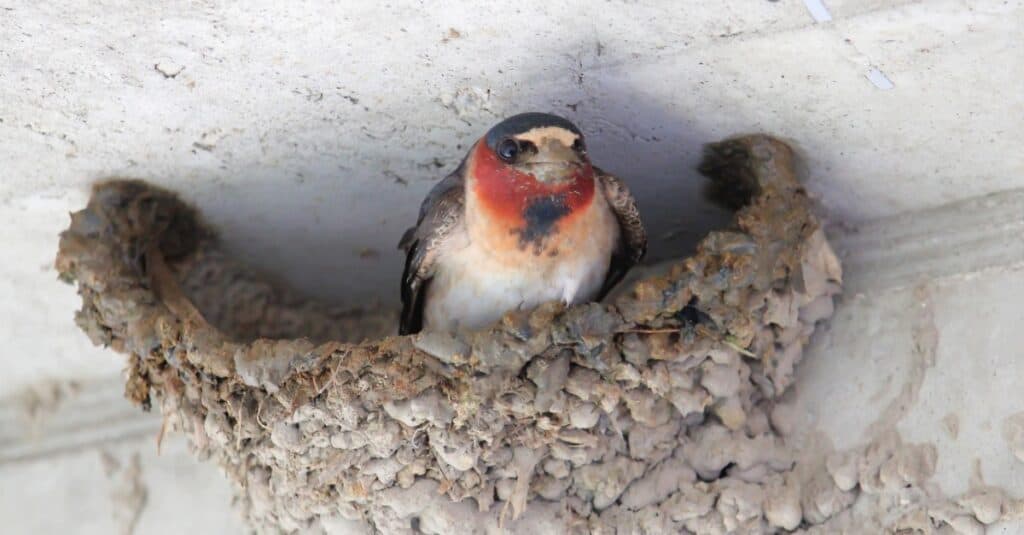
The cliff swallow is socially monogamous in that it chooses a mate for breeding nestlings.
©iStock.com/Kuhu
Cliff swallows and barn swallows have similar incubation and reproduction processes, with a few distinctions. They are socially monogamous in that they choose mates for breeding and raising nestlings. However, despite this monogamous arrangement, they would sometimes find other mating pairs because of their genetic predisposition to polygamy. Female cliff swallows lay an average of four eggs, and incubation lasts an average of 10 to 19 days. Males and females are equally involved in building mud-based nests for incubation.
Barn swallows are also socially monogamous, but male and female parents sometimes have another bird around during nesting and incubation. This extra pair helps with nesting and generally reduces the workload, and sometimes, it ends up mating with one of the parents, making the arrangement somewhat polyandrous or polygynous. We should also mention that during the courting stage, female barn swallows have been observed to prefer males with symmetrical wings and tails.
The females lay about four to five eggs, and incubation lasts for about 12 to 17 days with contributions from both parents.
Cliff Swallow vs. Barn Swallow: Lifespan
While cliff swallows can live up to 11 years in the wild, barn swallows typically live for an average of two to four years, although the oldest known barn swallow lived to be ten years old.