

Quick Take
- Tuataras survived the mass extinction that wiped out the dinosaurs, and their DNA holds a clue that scientists didn't expect to find.
- Tuataras have a third eye on top of their heads, and its purpose is stranger than you'd think.
- The temperature of a tuatara's nest decides something fundamental about its offspring, and the numbers behind this are remarkably precise.
- Tuataras can live longer than most humans, though their reproductive strategy makes that lifespan a double-edged sword.
Because it is not quite a lizard and not quite a dinosaur, New Zealand’s tuatara is one of the few unique animals left in the world. These reptiles may look like lizards, but they belong to their own separate class and are the only surviving members of their taxonomic order. Scientists are extremely interested in studying them because they can offer insight into how modern-day lizards and snakes evolved.

Tuatara Facts
- The name “tuatara” means “peaks on the back” in the Māori language.
- Tuataras have survived since the Triassic period, which was about 240 million years ago.
- They are the only surviving members of the order Rhynchocephalia.
- Tuataras have a third eye known as a “parietal eye” on the top of their heads.
- The lifespan of a tuatara is upwards of 60 years, and even up to 100 years in captivity.
Evolution
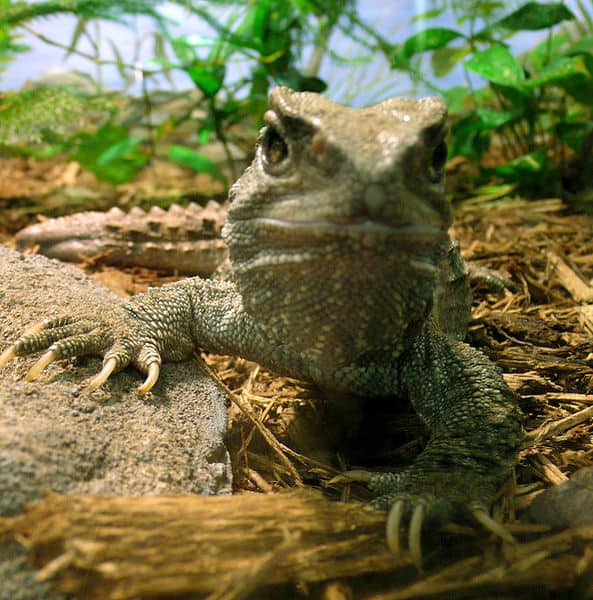
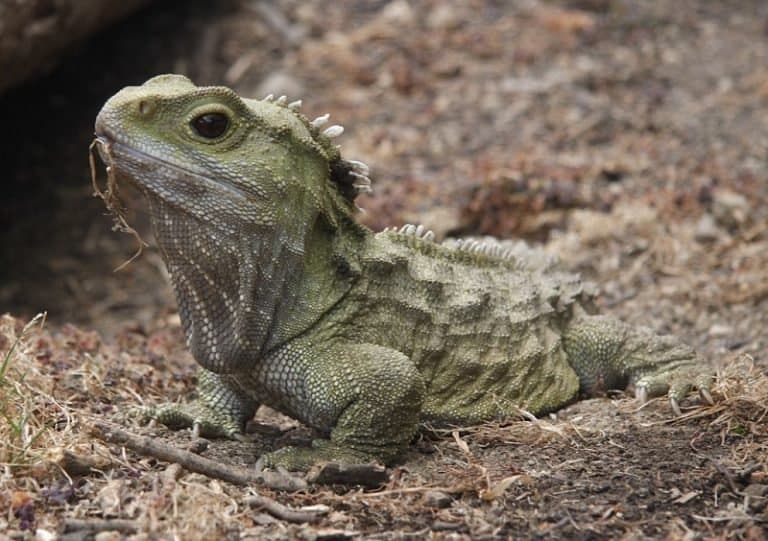
Tuataras are the only living species of an ancient order of reptiles.
©TimVickers – Public Domain
Tuataras first evolved within the order Rhynchocephalia around 238 to 240 million years ago, going on to flourish during the early Jurassic period. After this point, all members of the tuatara family tree practically vanish from the fossil record along with the dinosaurs, with the exception of the tuatara itself. Recent research into tuatara DNA reveals that modern-day specimens are almost genetically identical to fossils of Sphenodon punctatus dating back to 190 million years ago.
Classification and Scientific Name
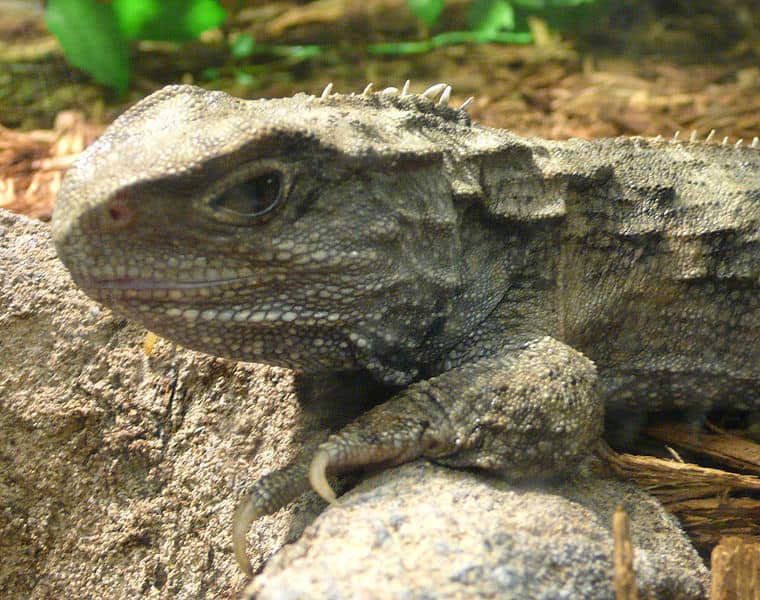
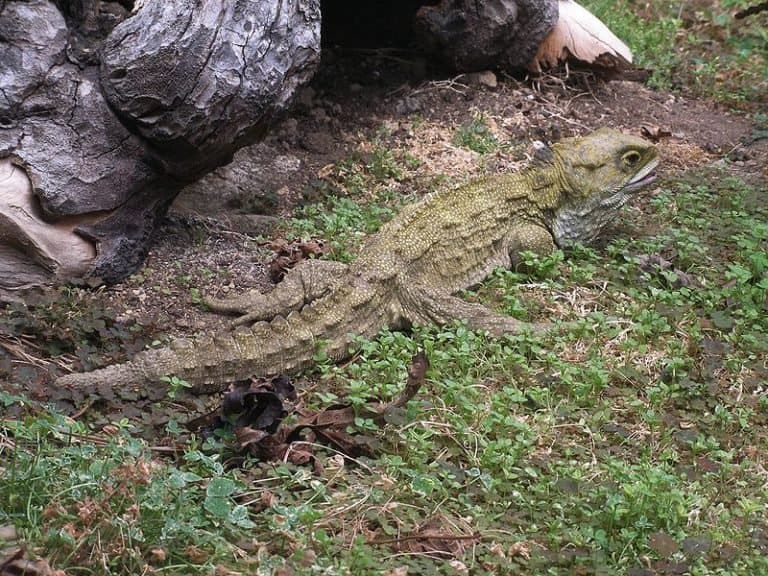
Tuatara’s common name comes from the Māori language.
©TimVickers – Public Domain
The tuatara’s scientific name is Sphenodon punctatus. “Sphenodon” originates from the Greek words “sphen,” meaning “wedge,” and “odon,” meaning “tooth.” “Punctatus” is a Latin word that means “spotted” or “having spots.”
In the Māori language, “tuatara” means “peaks on the back.” Māori are New Zealand’s indigenous Polynesian people. Tuataras hold great significance in the Māori culture and are depicted in various myths as living embodiments of gods and harbingers of great wisdom.
Appearance and Behavior
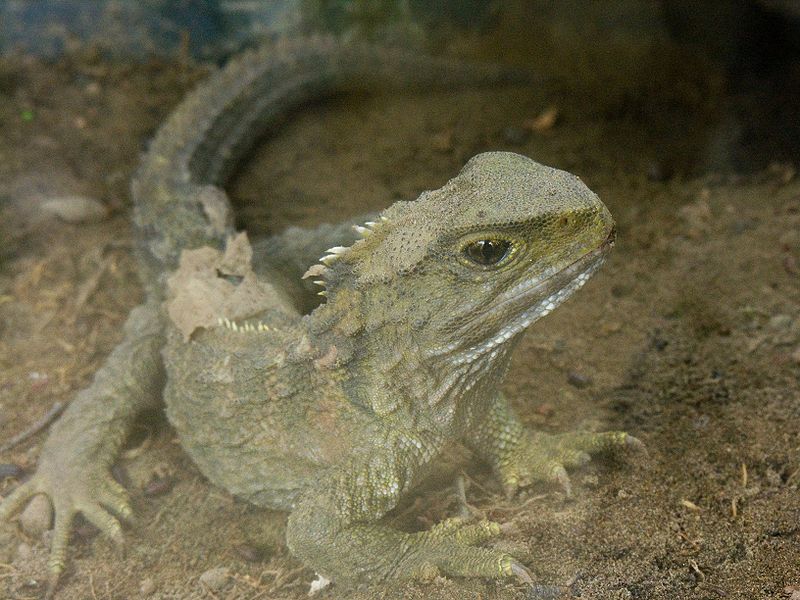
The tuatara is native to New Zealand, and it is the country’s largest reptile. Males can grow to about 61 cm (roughly two feet) in length, and adult females typically grow to be around 45 cm long. Both males and females weigh up to two pounds when fully grown, so despite the fact that they are labeled as the largest reptiles in New Zealand, they are not particularly large animals.
Tuataras are solitary animals that live in burrows, but they have been known to share their burrows with certain seabirds that they live in harmony with.
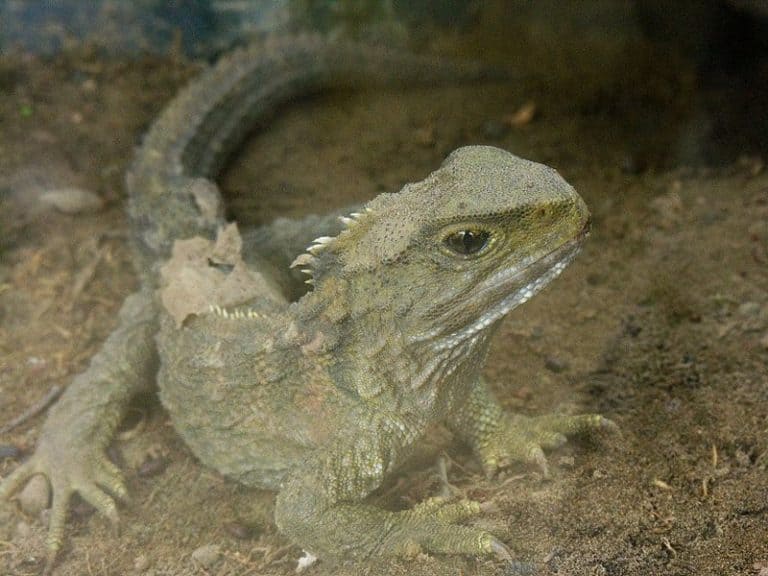
Both males and females have similar coloring. Most have skin that is a muted, olive green, or rusty brown color to help them blend into their surroundings. One interesting fact about tuatara coloring is that it can change with time. They molt one to two times per year, so their color can gradually shift as they age.
Male tuataras have a large, distinctive crest of spines along their backs and necks. These spines can be fanned out into a showy display to impress females during mating season, but they are also used to show dominance when they are fighting other males.
Habitat
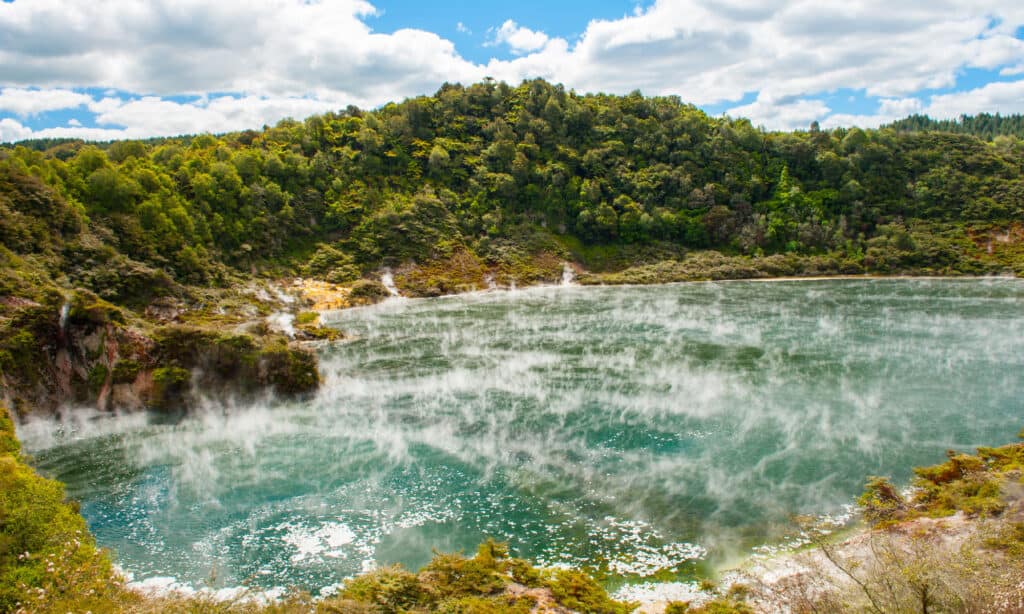
Tuataras are endemic to the islands of New Zealand.
©iStock.com/Fyletto
Tuataras can only be found in New Zealand. They currently only live on a few offshore islands and in limited regions of the mainland.
Diet
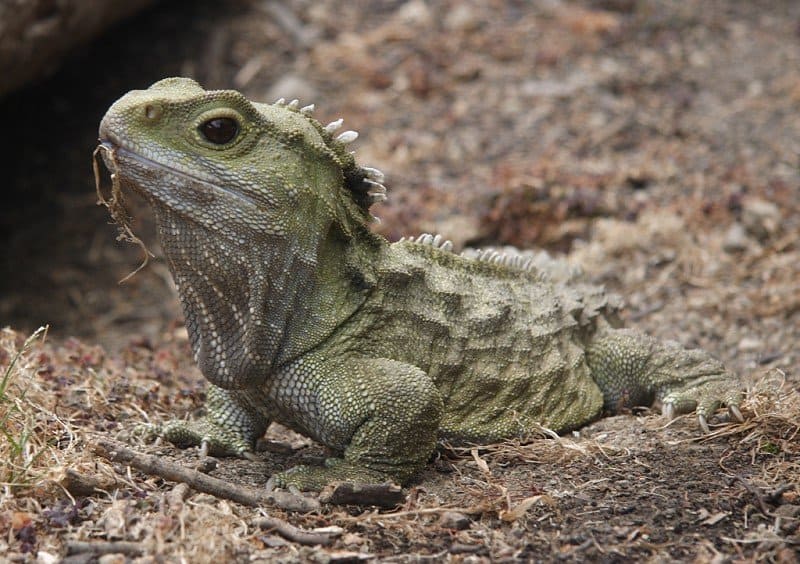
Tuataras primarily eat insects, though their diet consists of a few more unsavory menu items.
©Knutschie – Public Domain
Since tuataras are unique in the world of reptiles, many people ask, “What do tuataras eat?”
In this respect, tuataras are like many other lizards and reptiles of similar size. They primarily eat insects such as beetles, earthworms, crickets, and spiders. When these are unavailable, they have also been known to eat snails, frogs, bird eggs, skinks, and even their own young.
Predators and Threats
Tuataras fluctuate between being classified as an endangered species and being “at-risk” or “vulnerable,” which is a step below that. However, the IUCN recently updated it to be of least concern due to successful conservation efforts.
The most serious threats to wild tuataras are the mammalian predators introduced to the islands via human settlement. Dogs and rats have had the most serious impact on tuatara populations, but other animals such as ferrets and cats have affected their numbers as well.
Because these introduced predators decimated the wild tuatara populations in such a short span of time, the New Zealand government declared tuataras and their eggs to be fully protected in 1895. That protection is still in place today, and it is instrumental in preserving their dwindling numbers.
Reproduction, Babies, and Lifespan
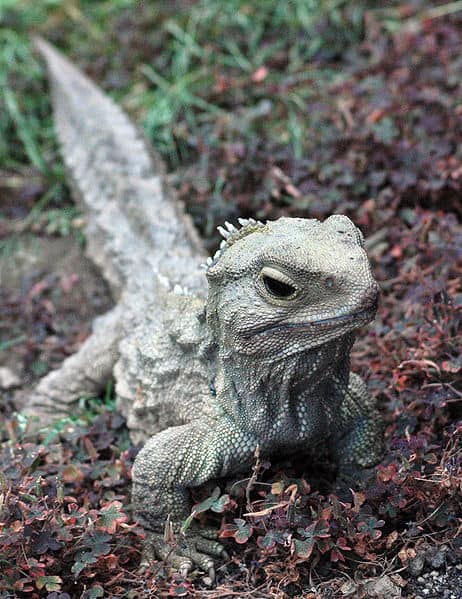
Tuataras can live incredibly long lives.
©KeresH / Creative Commons – Original
Tuataras are not like most reptiles in that they reproduce quite slowly. They have relatively long lifespans of 60 years or more in the wild, and they can live up to 100 years in captivity.
This long life means that they do not reach sexual maturity until they are between 10 and 20 years of age. In addition, they continue to grow until they are approximately 35 years old.
Mating occurs in midsummer and is largely dictated by the females. Males can breed every year, but females typically only breed every two to five years, with many sources citing approximately every four years. Males will darken their skin, spread their crests, and wait outside of a female’s burrow in an attempt to impress her. Male tuataras have no external reproductive organs, so they transmit sperm to females by rubbing their cloacae together. This is called a “cloacal kiss.”
Females can store this sperm for up to a year, and they use it to fertilize a clutch that can range in size from 5 eggs up to 18 eggs. These eggs incubate for well over a year, which is an exceptionally long incubation period for reptiles. Unfortunately, this long incubation means that tuatara eggs are easy meals for predators.
Tuatara mothers do not stay to protect the eggs or hatchlings, so survivors of the incubation period are particularly vulnerable and must immediately fend for themselves.
An interesting fact about tuatara babies is that the temperature of the incubation nest determines the gender of the hatchling. This is a phenomenon known as “temperature-dependent sex determination.” Researchers noted that eggs incubated at 70 degrees Fahrenheit have an equal chance of being male or female. Eggs that are incubated at 72 degrees Fahrenheit usually end up being about 80 percent male, and nests that are cooled to 68 degrees Fahrenheit are typically 80 percent female. If a nest is cooled to 64 degrees Fahrenheit, all of the hatchlings will be female.
Population
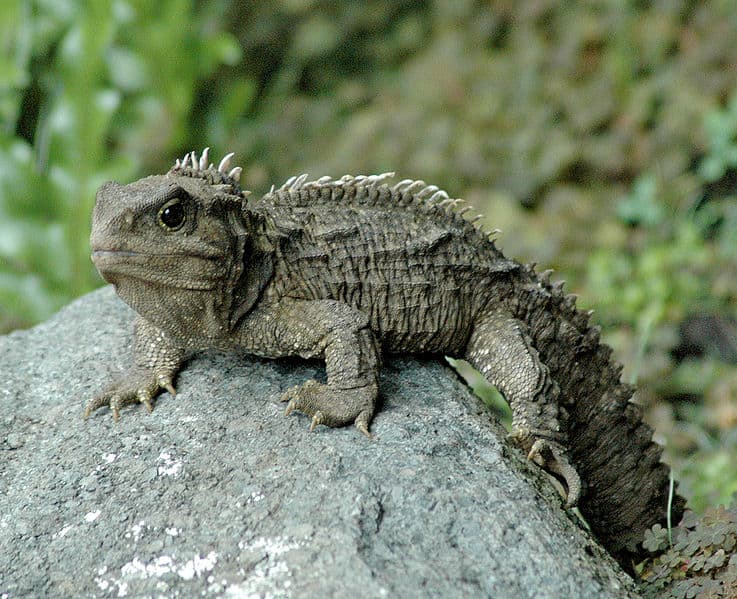
Tuataras have been classified as Least Concern on the IUCN Red List.
©KeresH / Creative Commons – Original
Currently, tuataras can only be found scattered across small pockets of mainland New Zealand and a handful of rodent-free outlying islands. It is estimated that only about 55,500 tuataras exist in the wild.
In addition to those found in the wild, there are some kept in special sanctuaries and raised in captivity as part of breeding programs to help boost population numbers.
Because of this, tuataras are often still thought of as an endangered species. However, the International Union for Conservation of Nature (IUCN) has it listed as least concern because the efforts to remove invasive species have had a strong effect on the well-being and future of the tuatara. However, this means the tuatara remains reliant on conservation management to survive.
Tuatara Pictures
View all of our Tuatara pictures in the gallery.

Knutschie - Public Domain
Sources
- David Burnie, Dorling Kindersley (2011) Animal, The Definitive Visual Guide To The World's Wildlife / Accessed November 3, 2009
- Tom Jackson, Lorenz Books (2007) The World Encyclopedia Of Animals / Accessed November 3, 2009
- David Burnie, Kingfisher (2011) The Kingfisher Animal Encyclopedia / Accessed November 3, 2009
- Richard Mackay, University of California Press (2009) The Atlas Of Endangered Species / Accessed November 3, 2009
- David Burnie, Dorling Kindersley (2008) Illustrated Encyclopedia Of Animals / Accessed November 3, 2009
- Dorling Kindersley (2006) Dorling Kindersley Encyclopedia Of Animals / Accessed November 3, 2009