
Quick Take
- Mule deer don't migrate the way scientists assumed, a difference that reshapes what conservation efforts need to prioritize. See study results →
- One collared deer's route crossed terrain that should have stopped it cold, yet somehow it pressed on regardless. Read about the 190-mile journey →
- Human borders are invisible to mule deer, and that's becoming a serious problem with no simple fix. Explore the jurisdiction problem →
The migration habits of many species have been the subject of scientific studies. One that makes the rounds on the internet is a GPS study of wolf movements in Minnesota, showing the lengths they travel and the efforts they make to avoid other wolf territories. But what about the animals that wolves prey upon, such as mule deer? The National Park Service recently published the results of a long-term study on mule deer migration.
The study, which began in 2013, involved fitting collars on over 50 female mule deer to track how far they traveled in and around Grand Teton National Park. Suffice it to say that the results were surprising. The mule deer subjects showed an incredible range of movement, spanning multiple land jurisdictions and two states. The mule deer didn’t show a preference for habitat type, either, as they moved through sand dunes, alpine meadows, and montane forests with ease. Let’s learn more about this landmark study, its results, and what it tells us about the migration patterns of a species that has experienced considerable decline in certain parts of North America.
Meet the Mule Deer
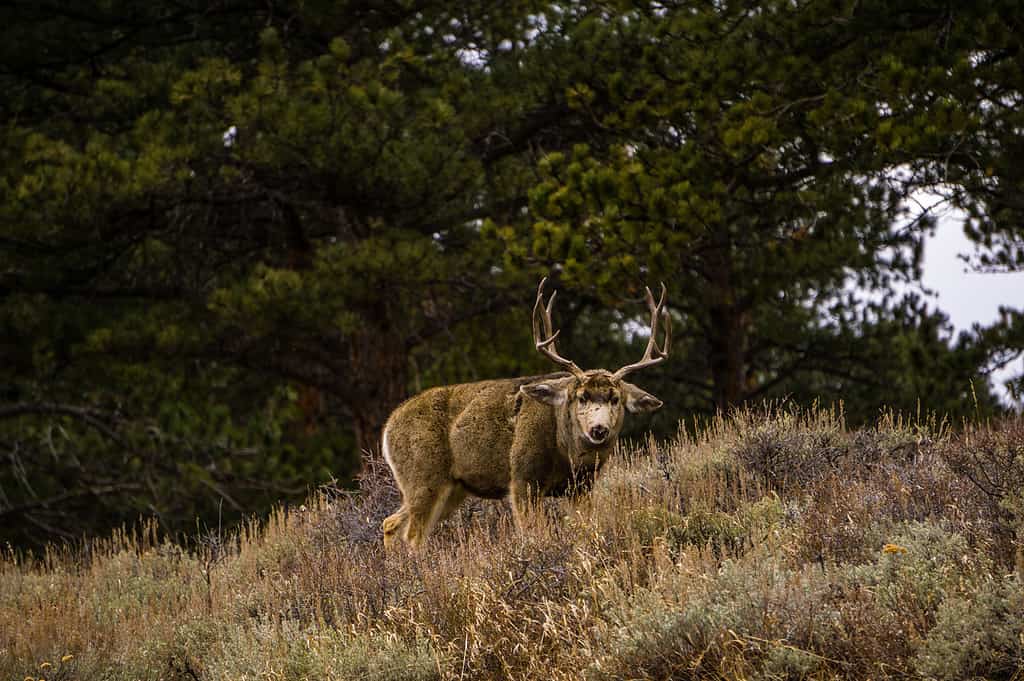
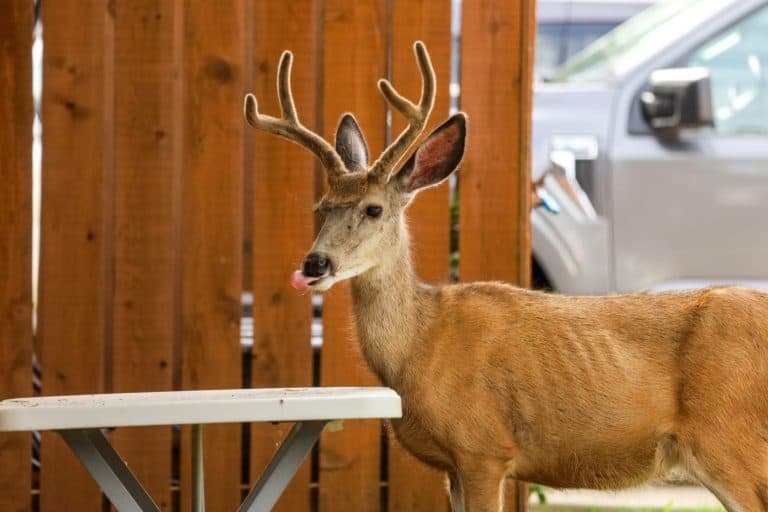
Mule deer are recognizable due to their dark facial markings and mule-like ears.
©iStock.com/Sparty1711
White-tailed deer often make the headlines, but mule deer are one of the most important species in the American West. They are easily identified by white tails with a black tip, dark facial markings, and mule-like ears. While white-tailed deer move more conventionally, mule deer are also identified by their unique leaping movement known as stotting (when all four hooves hit the ground simultaneously).
The voracious herbivorous diet of mule deer plays an integral role in ecosystems. But survival in the harsh habitats that comprise the Western United States requires variety, adaptation, and even improvisation. As such, mule deer tend to stay on the move, especially during certain seasons.
In search of nutrient-rich plants, many mule deer journey long distances from high-altitude snowpacks to areas with more food opportunities in lowland meadows and even sand dunes. These movements remain of great interest to scientists. The more scientists know about these movements, the better they can support a species that is experiencing decline in certain regions.
The Findings
Starting in 2013, biologists in Grand Teton National Park collared 54 adult female mule deer found on summer range in the park and parkway. To fill out the study, partners at Idaho Fish and Game collared a further 66 mule deer in Idaho winter ranges. The tracked Idaho mule deer included 38 found along the Teton River, 21 at Sand Creek Wildlife Management Area, and seven along the Teton Front.
Over the ensuing years, this allowed for the recording of 375 complete migration sequences involving eight population-level corridors. Those migration patterns showed an incredible range. During these patterns, collared mule deer traveled through at least three land jurisdictions for each corridor. Routes found on the eastern and western fronts of the Wind River Range crossed through at least seven jurisdictions. In total, the migration of mule deer subjects spanned multiple states.
The mule deer didn’t seem to be picky about the types of habitats they traversed, either. Following the path of green, nutrient-rich vegetation, the deer moved through a diverse range of habitat types, including sand dunes, sagebrush steppes, montane forests, and alpine meadows.
Distance and Elevation
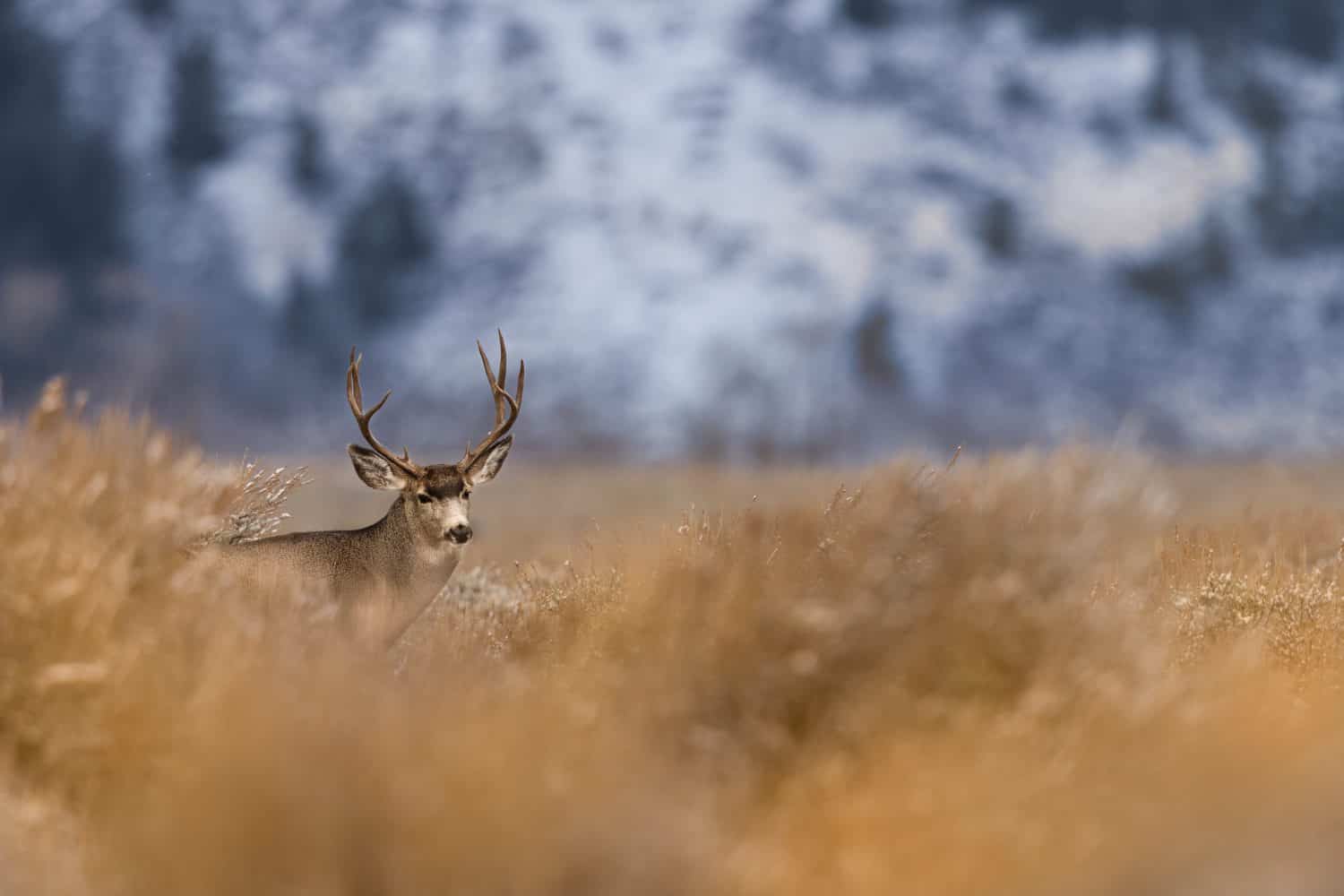
A mule deer reached an elevation of 11,496 feet during its migratory movements.
©Wirestock Creators/Shutterstock.com
In a constant search for viable food sources, mule deer migration patterns varied widely. The highest elevation recorded during the study was 11,496 feet, along a route through the Absaroka Range. Several other tracked mule deer crossed elevations between 10,500 and 11,300 feet.
The range of migratory distances was surprising, too. While some routes, such as those in the Jackson and Teton River areas, only took mule deer herds around 10 miles, others ranged far longer. One mule deer traveled 190 miles between the summer range near Spalding Bay in Grand Teton, ending up at wintering grounds near Rock Springs and the Interstate 80 corridor.
The map of these migratory routes also highlights the unique way mule deer migrate. They aren’t like birds that winter in one place and summer in another on a fixed schedule. Instead, mule deer use staging grounds where they rest and recuperate before beginning their spring migration. This allows them the energy required to travel long distances. This strategy also keeps them moving in sync with the blooming of vegetation.
Border Obstacles
While scientists know about the migratory patterns of mule deer, this long-running study provides critical insight into the factors that affect mule deer movement. Despite being less populated than, for example, the Northeast, the American West features an increasing amount of human development. In the process, habitats become fragmented, fences go up, and highway traffic slices through once-open pastures.
As the study found, no mule deer migration corridor can avoid land management jurisdictions. Each one crosses a minimum of three distinct jurisdictions. This creates a growing number of opportunities for mule deer to be negatively affected by human activity.
This long-running study provides the documentation necessary for taking appropriate conservation action. It shows that human borders don’t apply to animals, especially ones like mule deer that must travel long distances for food sources. Research like this can provide the first steps toward connecting parks, private landowners, wildlife departments, and highway authorities. Such collaborations will be necessary to preserve the historic migratory corridors mule deer rely on to survive.