
Quick Take
- This octopus walks on two arms, and scientists debated about whether that even counts as walking. See the bipedal behavior →
- It carries a shell it's not using yet, and that deliberate choice has sparked a heated debate about animal intelligence. Explore the tool use debate →
- Hermit crabs do something similar, but scientists say there is a crucial difference. See how they differ →
- When threatened, this octopus uses a clever camouflage trick. See its threat response →
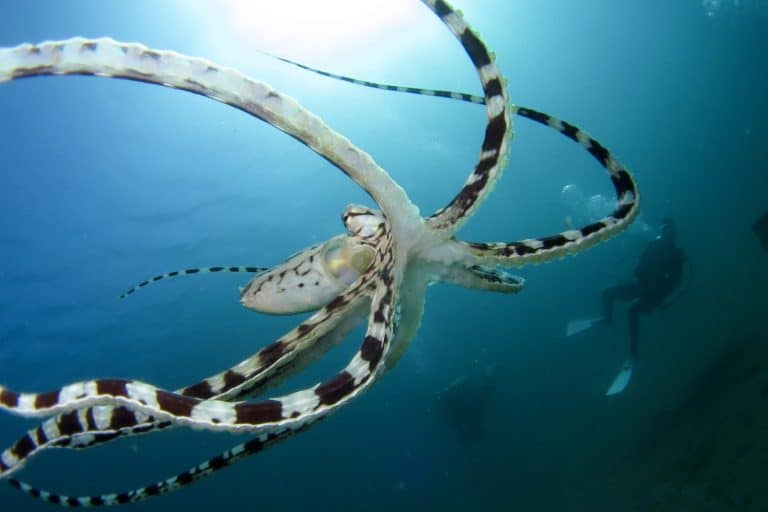
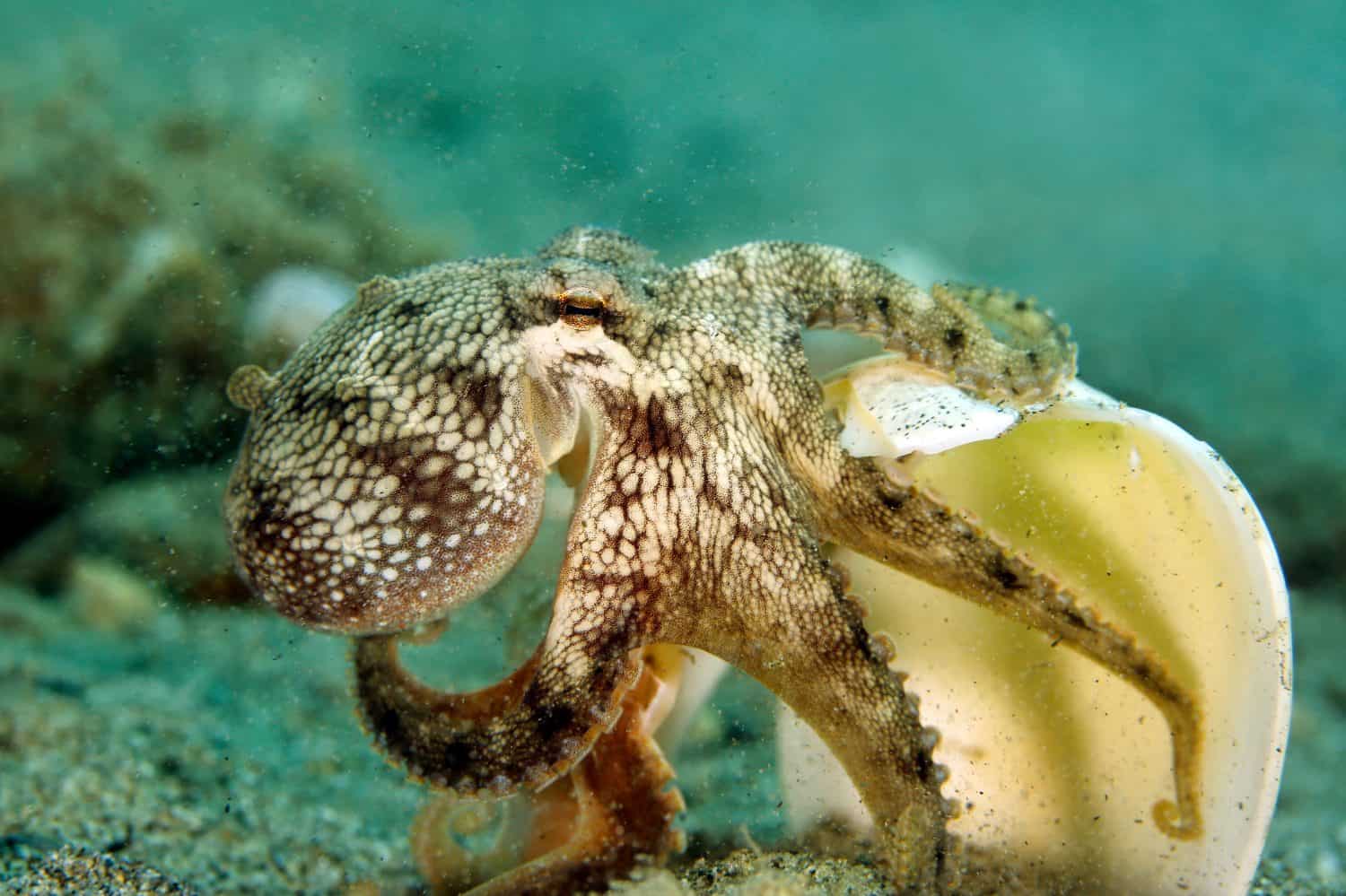
Octopuses are masters of disguise. They can change the color and texture of their skin to camouflage perfectly into their environment. Some, like the mimic octopus, can even change shape to look like a completely different creature. One species, the veined octopus, uses discarded coconut halves and clam shells as a clever disguise. Using six of its arms to carry its portable home, the octopus rises on two arms and walks across the sandy ocean floor. If you spot a large clam shell on the sea bottom and peek inside to see a creature with arms and suckers, you’re likely looking at the veined octopus.
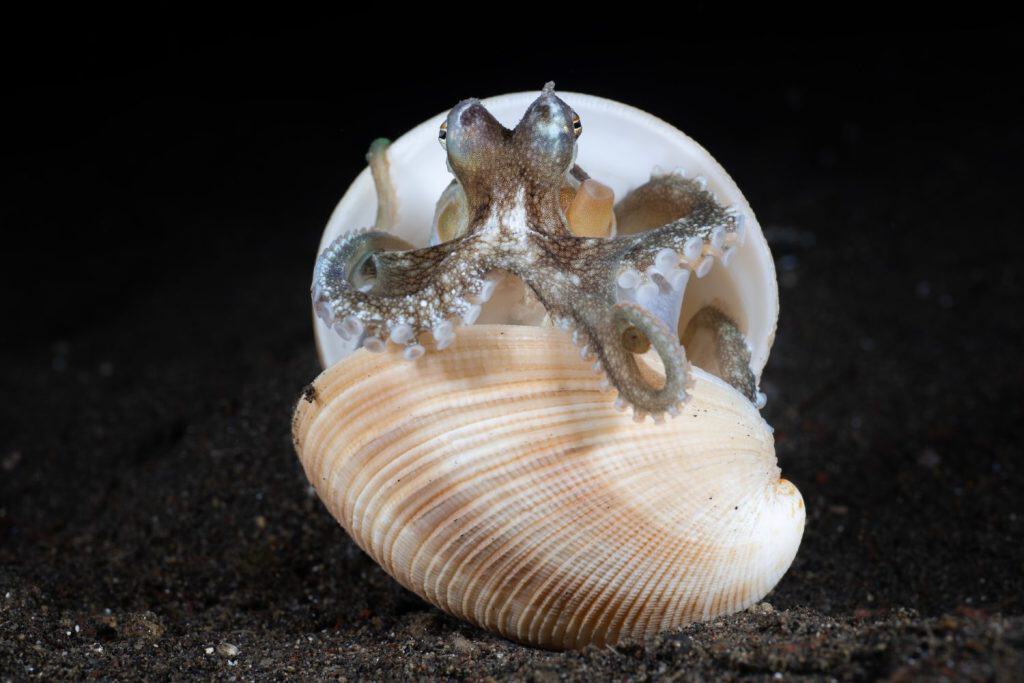
The veined octopus uses a clever disguise of clam shells to protect itself from predators.
©DiveIvanov/Shutterstock.com
Meet the Veined Octopus
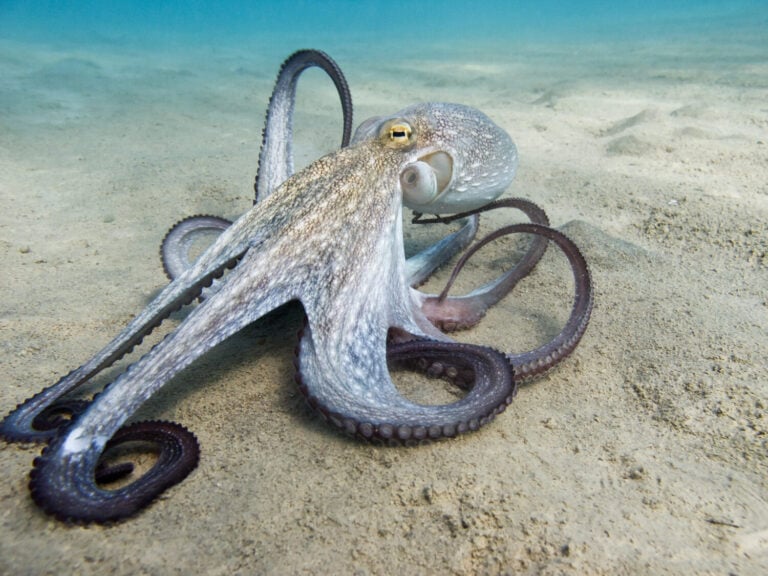
The veined octopus (Amphioctopus marginatus) is named for the dark veins that branch along its mantle and arms. It has a white pattern under each eye and white-blue suckers. It’s also commonly called the coconut octopus for its habit of using coconut shells as protection. This cephalopod mollusk is a true octopus and a member of the octopus family, Octopodidae.
Where Does the Veined Octopus Live?
The veined octopus lives in the tropical waters of the western Pacific Ocean and the Indian Ocean. It prefers sandy or muddy environments where shells are plentiful.
How Does the Veined Octopus Hunt?
It’s most active at dusk and dawn when it forages for food. It hunts by probing its arms into holes in the ocean floor to catch small fish and shrimp. This small to medium-sized octopus has a mantle length of about 2 to 4 inches. It can reach 12 inches total, including its arms.
Yes, This Octopus Really Does Walk on Two Arms
In addition to its clever camouflage, this octopus has another unusual behavior. It walks on two alternating arms while it uses its other six arms to carry its protective shell. Also known as “stilt walking,” scientists observed veined octopuses using this rolling gait. The behavior is described in a paper published in 2005.
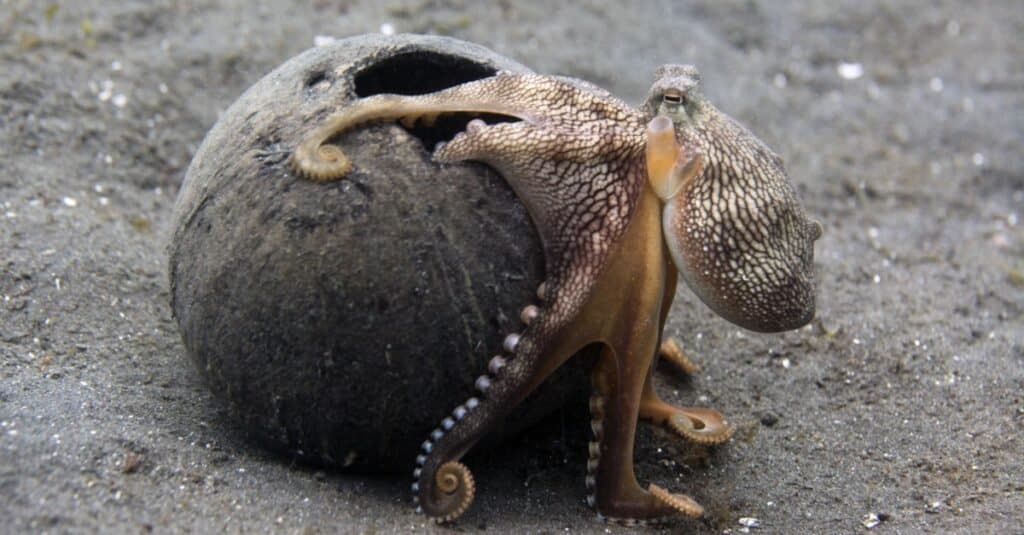
Also known as the coconut octopus, the veined octopus sometimes uses coconut shells as shelter.
©Agarianna76/Shutterstock.com
The scientists filmed veined octopuses underwater. They observed that their walking motion on two arms was different from the usual crawling, in which they use their suckers to push and pull themselves along. Researchers concluded that this gait qualified as bipedal walking because each arm touched the ocean floor for at least half of the stride.
A Portable Suit of Armor
The veined octopus burrows into the sand or mud to hide from predators. But it also uses another unusual strategy to disguise itself. Because this soft-bodied cephalopod lives on exposed seafloors, where there aren’t many places to shelter, it’s found a clever form of protection. The veined octopus picks up discarded coconut or clam shells and uses them as protective armor to shield itself from hungry predators.
How the Veined Octopus Uses Its Shell
The octopuses hold onto their shells even when hunting for food. When they feel threatened, they tighten the two halves of the bivalve shells together, enclosing themselves within a strong shield of armor.
When they use coconut shells for protection, the octopuses have been seen rolling into tight balls within their shells, before closing the two halves together, fitting perfectly inside. They have even been spotted walking along the ocean floor while inside the coconut halves, appearing to be a coconut with legs.
Does the Veined Octopus Use Tools?
In the journal Science, researchers describe their observations of veined octopuses off the coasts of Northern Sulawesi and Bali in Indonesia. Researchers observed the octopuses walking on two arms and carrying the shells underneath their body with their other arms.
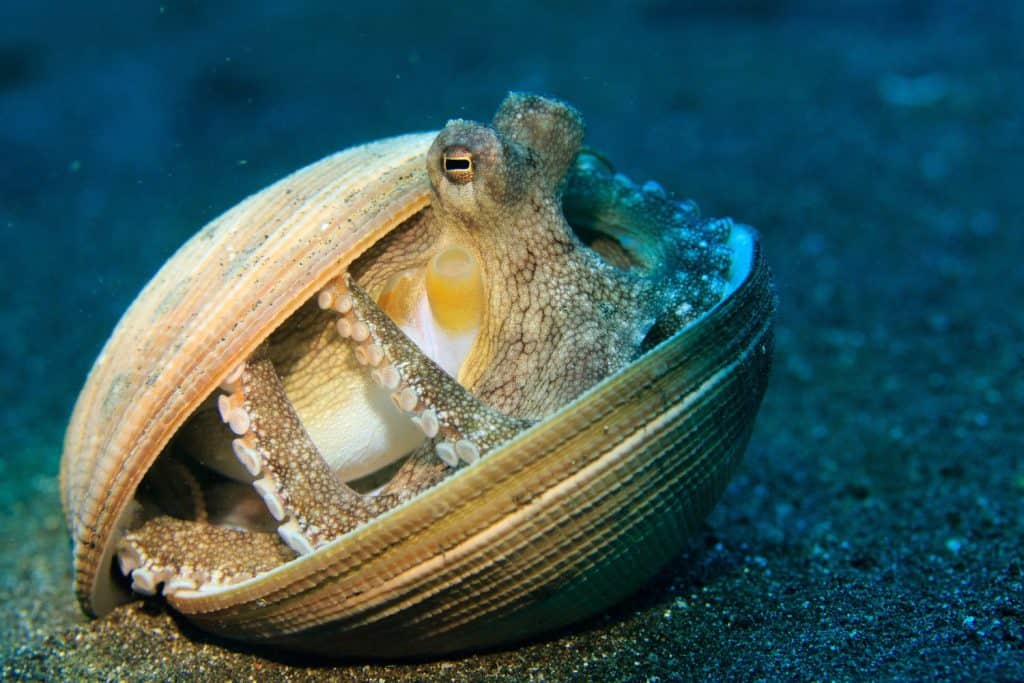
Veined octopuses can climb into their shells and close them up when a predator approaches.
©SergeUWPhoto/Shutterstock.com
Scientists determined that because the octopuses were not using the shells to disguise themselves as they carried them, this indicated that the octopuses planned to use the shells at a later time, signifying tool use. Further, the octopuses arranged two halves of clam shells with their concave surfaces together, making them easier to carry.
How Shell Use in the Veined Octopus Differs from Hermit Crabs
When researchers first presented their findings, some scientists disagreed that the octopuses’ behavior constituted “tool use.” Their argument was that hermit crabs live in discarded shells that they find on the ocean floor, which is not the same as an animal using a tool. However, the researchers believe that, unlike hermit crabs that comfortably wear a shell all the time, the octopus chooses to carry its shell, even though it’s cumbersome, with a plan to keep it for later use.