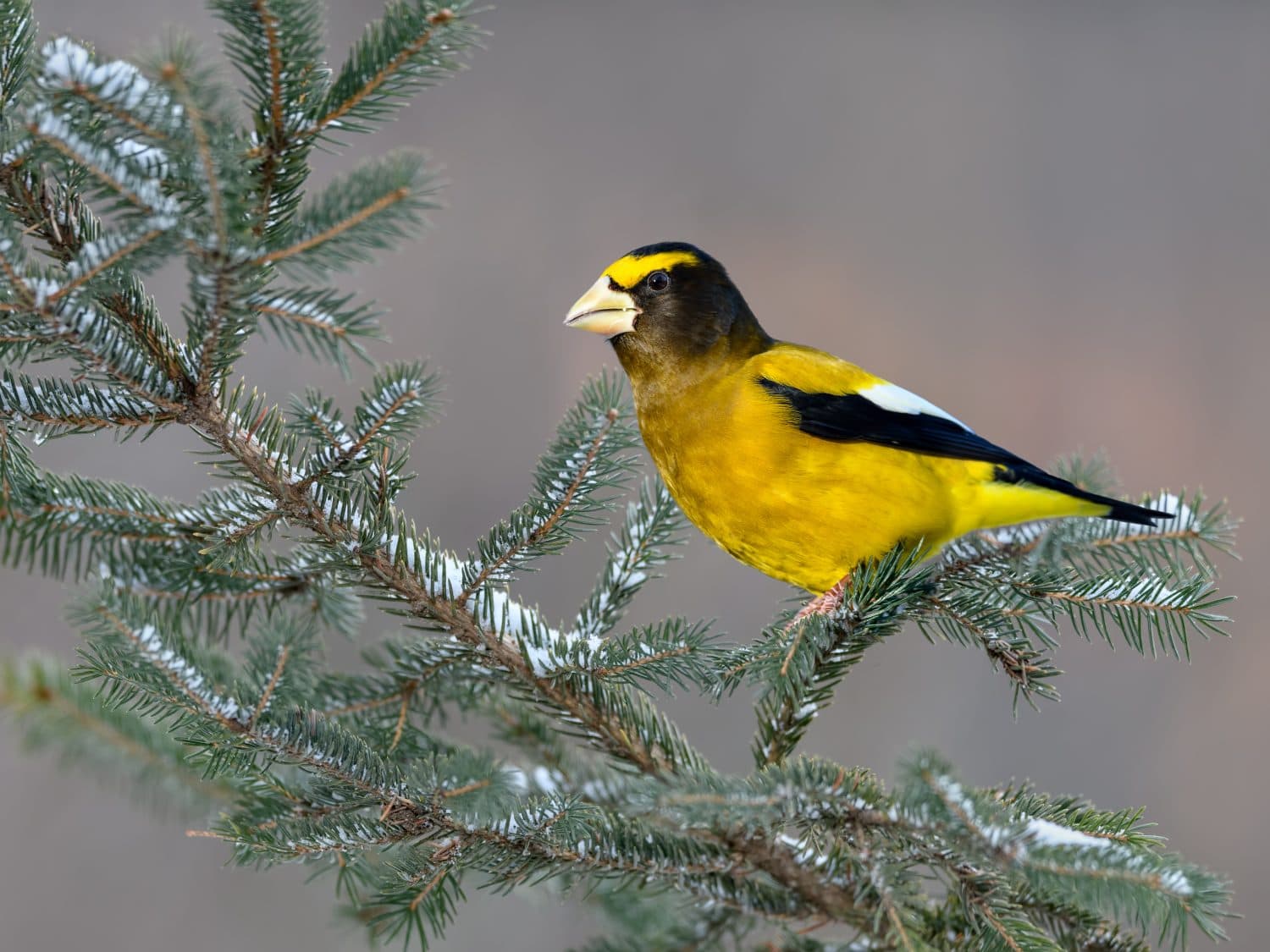

This stocky finch with a thick bill was once a common sight across the U.S. and Canada. Many backyard bird lovers enjoyed seeing these brightly colored, gregarious finches flock to their feeders each winter. Unfortunately, like many North American birds, evening grosbeaks have suffered sharp declines in populations over the last 50 years. Fewer are being spotted at backyard bird However, this brightly colored finch is making a comeback in the Northeast. Scientists are studying why evening grosbeaks are thriving in some regions, even as their overall numbers continue to decline.
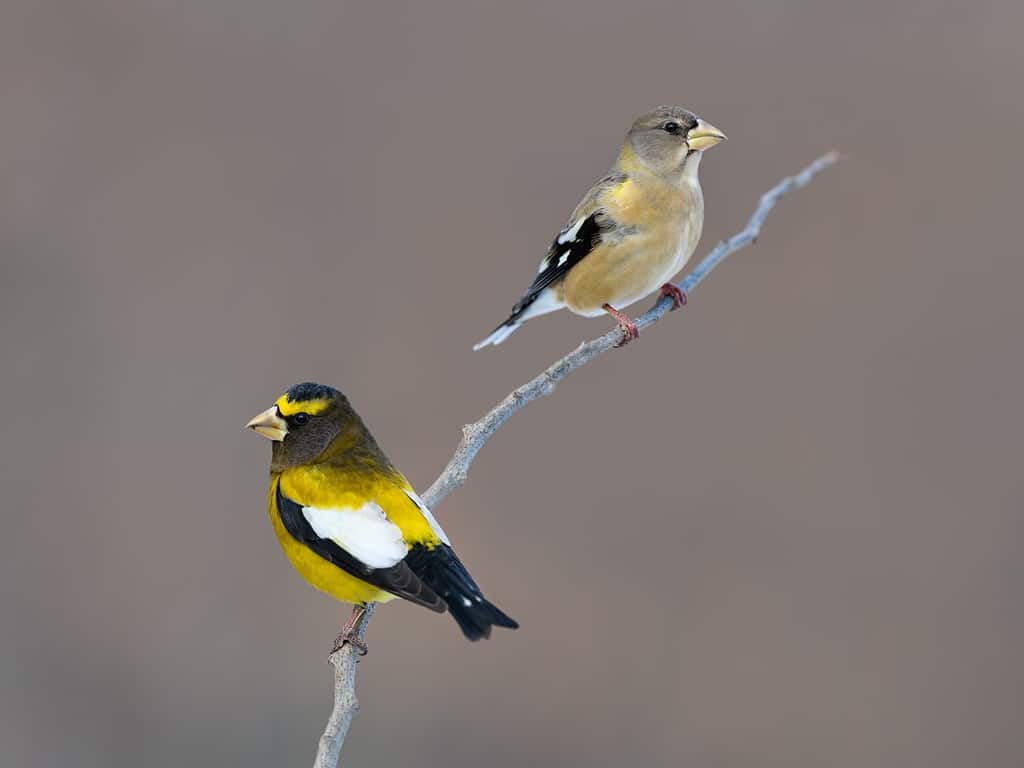
Evening grosbeaks have experienced a significant decline in population since 1970.
©FotoRequest/Shutterstock.com
About Evening Grosbeaks
Evening grosbeaks (Coccothraustes vespertinus) are heavyset finches native to North America. They breed in coniferous forests and were once frequent visitors to backyard feeders across the U.S. during the winter. They travel together in large, noisy flocks. The males are more colorful than the females with their bright yellow bellies and backs. The females are brownish-gray with darker heads.
Before the 1900s, evening grosbeaks were rarely seen east of the Great Lakes. Scientists believe their eastward spread began after box elders were planted across the country and backyard feeders became more common. Their population peaked from 1950 to 1990 in the Northeast. At the same time, there was a large outbreak of spruce budworms in the northern U.S. and Canada, which provided the birds with abundant food.
The Overall Decline of Evening Grosbeaks Across North America
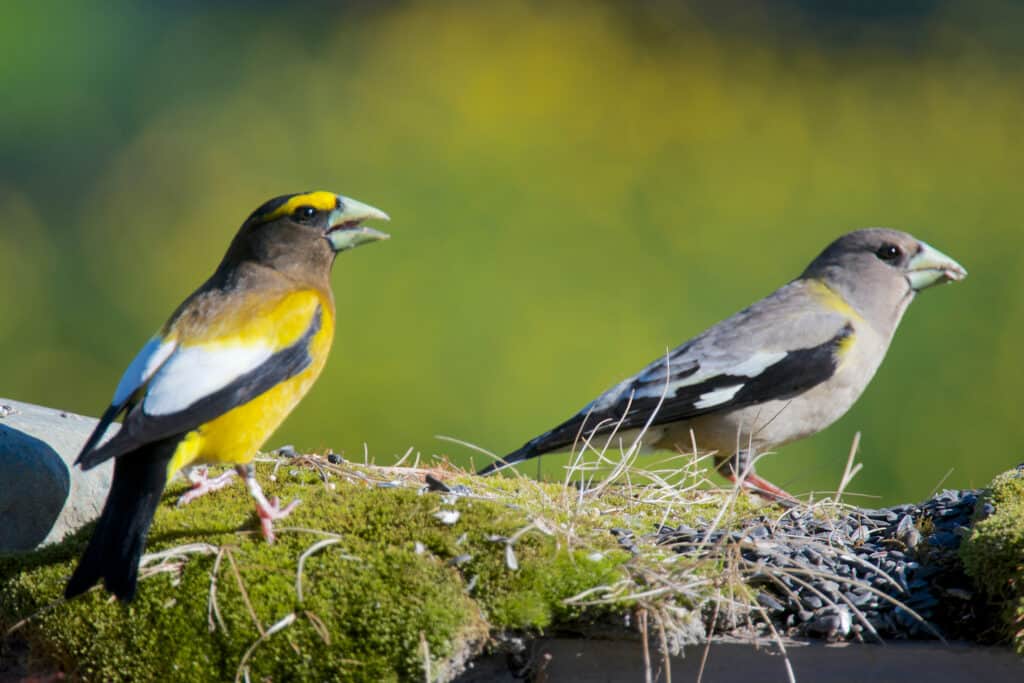
Male evening grosbeaks are more brightly colored than the females.
©Danita Delimont/Shutterstock.com
A 2019 study revealed stunning losses of bird populations across North America. According to the study, since 1970, the U.S. and Canada have lost 2.9 billion birds. Many of the missing birds were ones commonly seen in backyards across the country. In fact, 90% of the losses come from just 12 families of birds, including finches, blackbirds, and sparrows.
The evening grosbeak is one of the bird species hit hardest by population losses. Named a “tipping point” species, the study showed that 9 in 10 evening grosbeaks were lost since 1970.
Scientists are still trying to understand the cause of the decline, but it was likely due to a combination of reasons, including climate change, habitat loss, and pesticides. Another factor could be that evening grosbeaks are highly susceptible to dying by flying into windows. Biologist Stephanie Egger at the U.S. Geological Survey Bird Banding Laboratory said in a report that grosbeaks, “seem to be susceptible to window kills, because they’re social and they flock at feeders.” And finally, grosbeaks are prone to contracting feeder-related diseases, such as conjunctivitis.
An Upswing in Evening Grosbeak Populations in Some Parts of the U.S.
Despite the losses overall, there are some parts of the country where evening grosbeaks are experiencing an upswing. Anecdotally, backyard bird enthusiasts in the Southeast have reported seeing flocks of evening grosbeaks arriving at their feeders in the last few years. According to the Vermont Center for Ecostudies, scientists have been tagging an increasing number of evening grosbeaks in Vermont. The Road to Recovery conservation project, which began in 2019 in response to the study on bird losses, has been reporting an uptick in numbers in Maine, Minnesota, and Pennsylvania.
Why Is the Northeast Seeing Evening Grosbeaks Return in Higher Numbers?
Experts have hypothesized that the upswing could be tied to the cyclical spruce budworm outbreak in the north. Spruce budworms are a favorite food of evening grosbeaks, and the birds could be arriving where the budworm population is up. A nationwide team of researchers has joined the Evening Grosbeak Working Group to get to the bottom of learning the reasons for the decline and how to reverse the trend. Part of that involves understanding what factors are contributing to the increased population of evening grosbeaks in the Northeast.

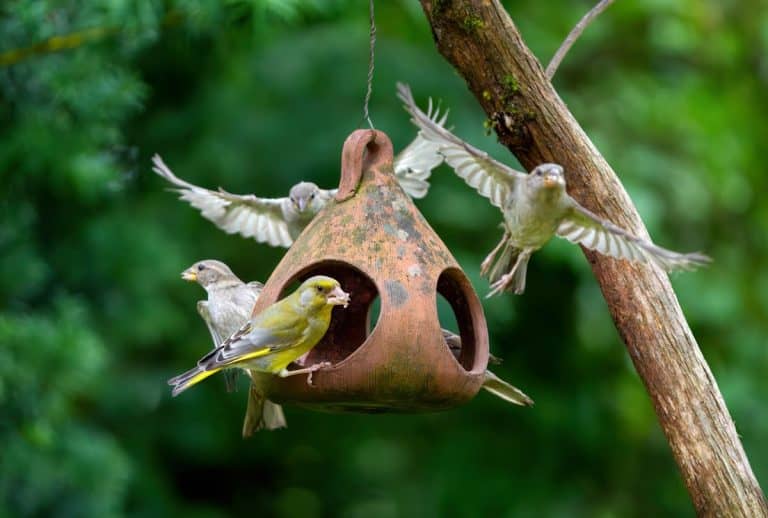
To attract evening grosbeaks to your yard, offer sunflower seeds in platform feeders.
©Valleyboi63/Shutterstock.com
Tracking Evening Grosbeaks
The Evening Grosbeak Working Group is conducting a tracking study on the bird’s winter range. By catching and banding the birds at feeders in the Northeast, the team can use satellite and radio transmitters to follow the banded grosbeaks throughout the year.
The team planned to begin in the Northeast and then spread their efforts to the Midwest and the West. Scientists have banded birds in Maine, Minnesota, New York, Pennsylvania, and Utah. Recently, they added Michigan to the list.
According to the Vermont Center for Ecostudies, a major challenge for evening grosbeak conservation is the lack of general understanding about the species’ ecology and behavior, making it difficult to identify and reverse population declines. By tracking the birds’ movements, scientists hope to gain insights that will aid conservation efforts.