
Quick Take
- Binturong, known as the bearcat, is a civet, not a bear or a cat, native to Southeast Asia.
- They are solitary, arboreal omnivores with a long prehensile tail used like a fifth limb.
- Fully grown binturongs reach 24–38 inches in length and weigh 22–31 pounds, with females up to 20% heavier.
Is it a cat? Is it a bear? Actually, it’s neither. There is an animal roaming Southeast Asia that seems almost too unique to be real, but it is—and a video captured it walking around a truck, flicking its tail in a way that resembles both a cat and a bear. The animal is so cute (and a little odd!).
When Instagram user @beyond_the_wildlife recently shared a video of an unusual animal hanging out near a truck, viewers saw a creature that looked like a cross between a feline and a ferocious bear. In reality, the video features a binturong—a truly fascinating animal that poses no danger to humans.
An Instagram user shared an unusual video of a binturong interacting with a truck.
©Tinuske, CC BY-SA 3.0, via Wikimedia Commons – Original / License
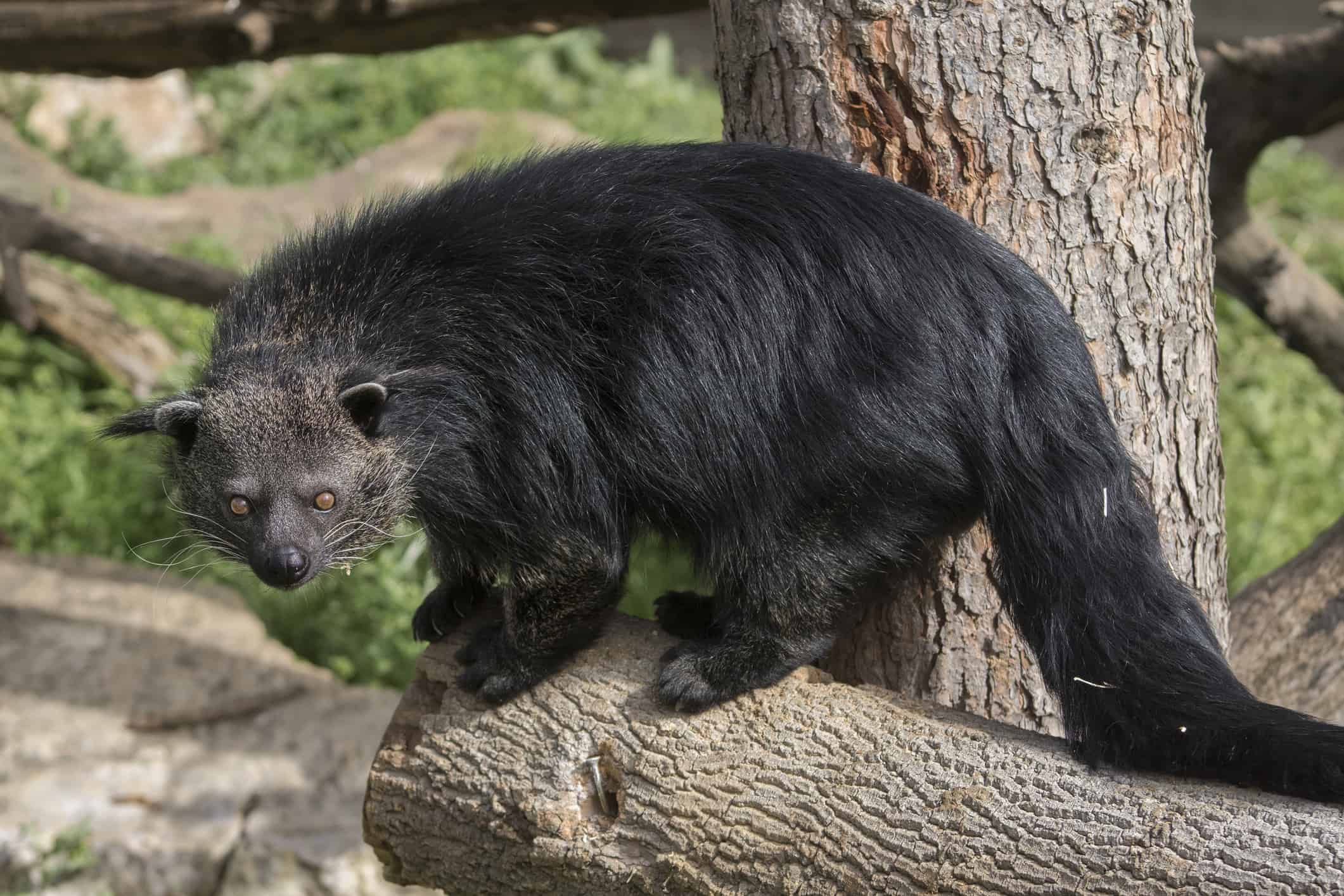
“The binturong, often known as the bearcat, is a striking and unusual mammal native to the forests of Southeast Asia,” the caption reads. “Despite its name, it is neither a bear nor a cat. It is a member of the civet family. With its shaggy black fur and long prehensile tail that functions almost like a fifth limb, the binturong stands out with a face that looks part cat and part bear.”
The video shows two clips of the binturong. In one, the large animal stands on its hind legs to look over the bed of a truck. It closely resembles a bear as it looks over the top of the truck, seemingly searching for food. It would definitely be scary to come across one of these while running errands! In the other video, the binturong walks on all fours with its tail pointing up and flicking behind it. From this angle, the binturong looks exactly like a cat. It’s such an unusual creature!
What Are Binturongs?
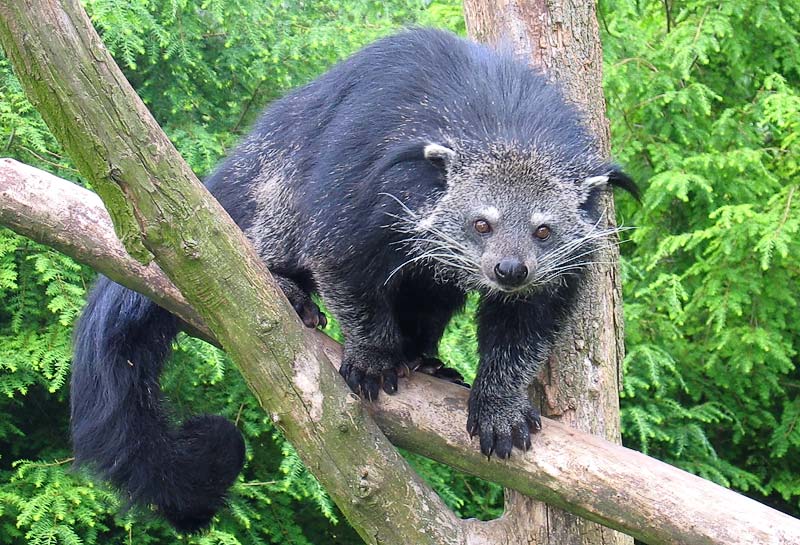
Binturongs spend most of their time in trees.
©TassiloRau, CC BY-SA 3.0, via Wikimedia Commons – Original / License
Binturong (Arctictis binturong) is also known as the Asian bearcat. This mammal was previously found in many areas in Southeast Asia, including China, India, Malaysia, Indonesia, the Philippines, and Borneo, although its dwindling population makes it hard to find in the wild. Another reason you might not often see a binturong? It prefers being alone. As a solitary animal, it spends most of its time climbing trees, swimming, and keeping to itself.
They typically live in dense forests, finding cover both in the trees and on the ground. Its conservation status is currently listed as Vulnerable by the IUCN Red List, with a decreasing population that is approaching the Endangered status; the exact total population is unknown but believed to be in significant decline. Experts attribute the decline of this unique animal to habitat loss, deforestation, hunting, and capture.
How Big Is a Binturong?
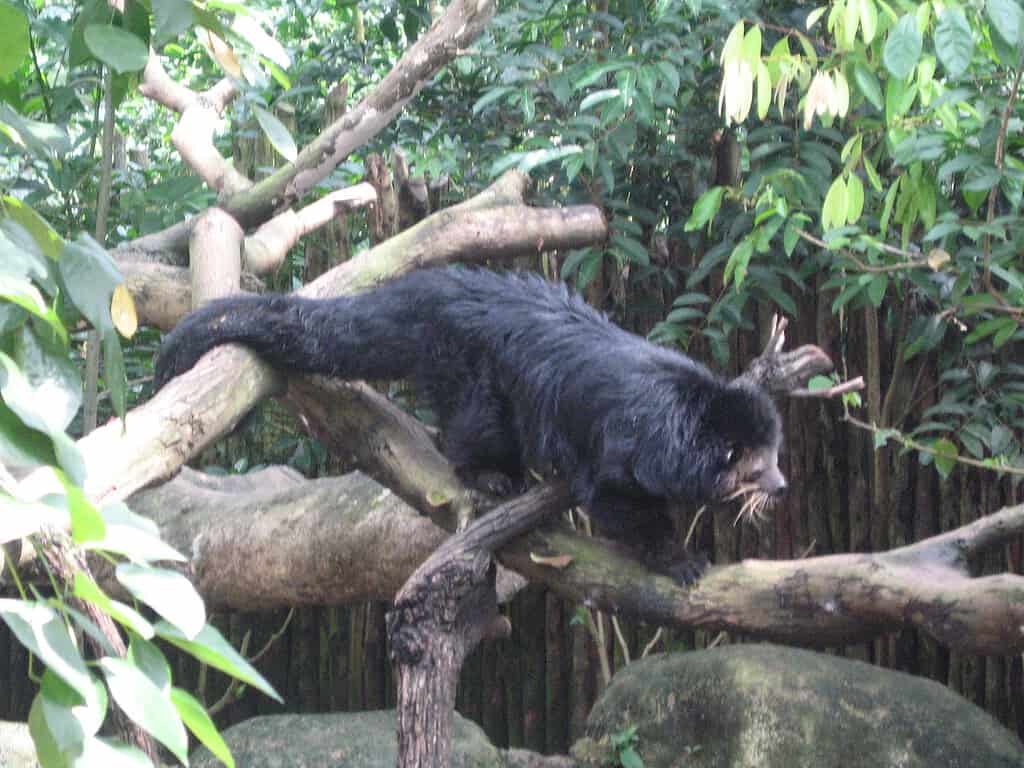
Binturongs can grow between 24 and 38 inches long.
©Terence Ong., CC BY-SA 3.0, via Wikimedia Commons – Original / License
A fully grown binturong weighs between 22 and 31 pounds and is 24 to 38 inches long. Females can be up to 20 percent bigger and heavier than males. It’s not as big as bears, the biggest of which can stand up to 10 feet tall on its hind legs, but it’s bigger than house cats, the biggest of which is about 16 inches tall.
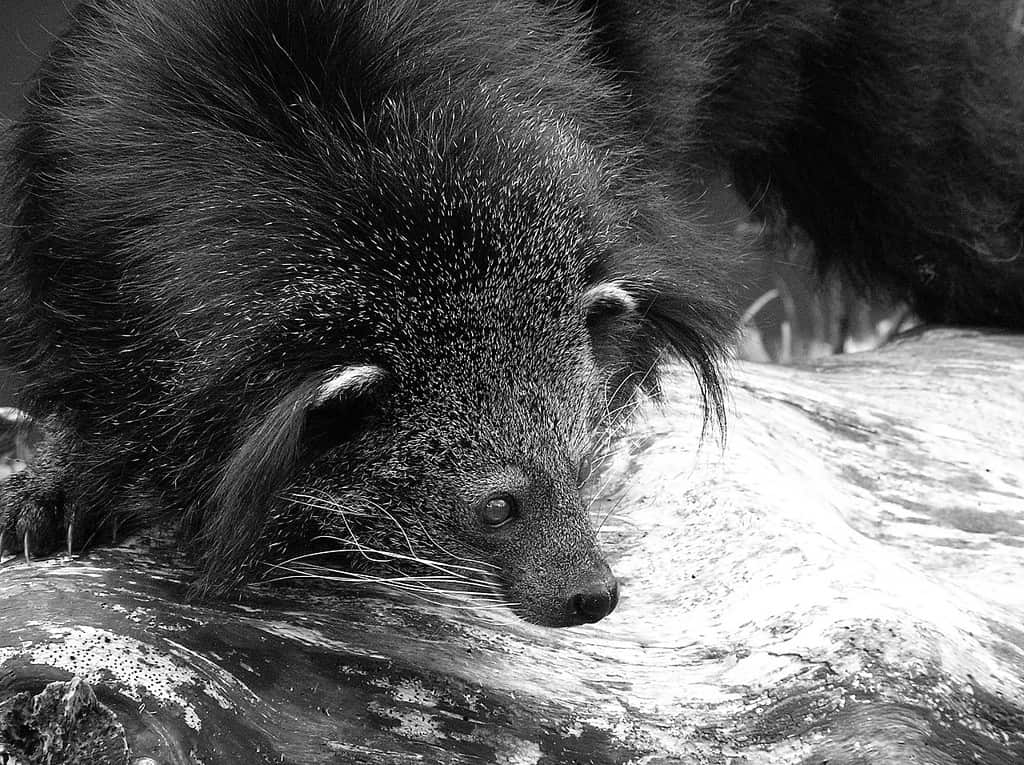
This cute creature may look cuddly, but it is actually covered in coarse, shaggy fur that can be brown, grey, or black. On its face, the binturong has long white whiskers, making it look even more like a cat. Binturongs also have prehensile tails, which means they act like another limb and can assist with climbing, gripping, and providing stability.
Binturongs Have an Unusual Smell

Smell popcorn? A binturong might be near.
©Millie Bond – Copyright A-Z Animals
One of the coolest facts about binturongs? They smell like popcorn (yes, really!). A 2016 study in The Science of Nature found that the same compound that is used to create the buttery popcorn smell is expelled in the urine of a binturong. The chemical 2-acetyl-1-pyrroline (2-AP) is responsible for this scent, which is why the smell of movie theatre popcorn can be detected near a binturong’s home.
Are They Dangerous?
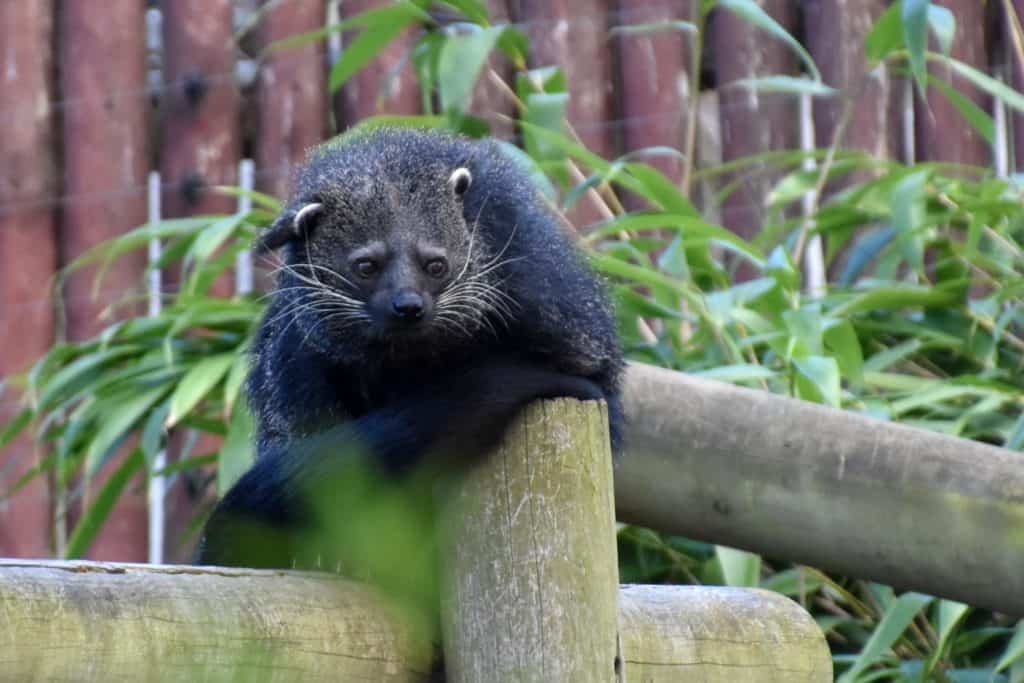
Binturong are passive and not dangerous to humans.
©Millie Bond – Copyright A-Z Animals
Although they are big and look bear-like, binturongs are not dangerous. Research has shown that these animals are passive toward people. They aren’t even dangerous to most other living creatures, as the binturong is an omnivore that mostly eats fruit and insects. However, they also eat birds and rodents.
Even though they are docile, it’s a good idea to leave them alone if you ever do see them in the wild. These cool creatures have been affected by the pet and zoo trade, as they are so unique, which contributes to their decline. Of course, their primary threats are habitat loss and hunting for traditional medicine and meat, but the exotic pet trade also puts additional pressure on their survival.