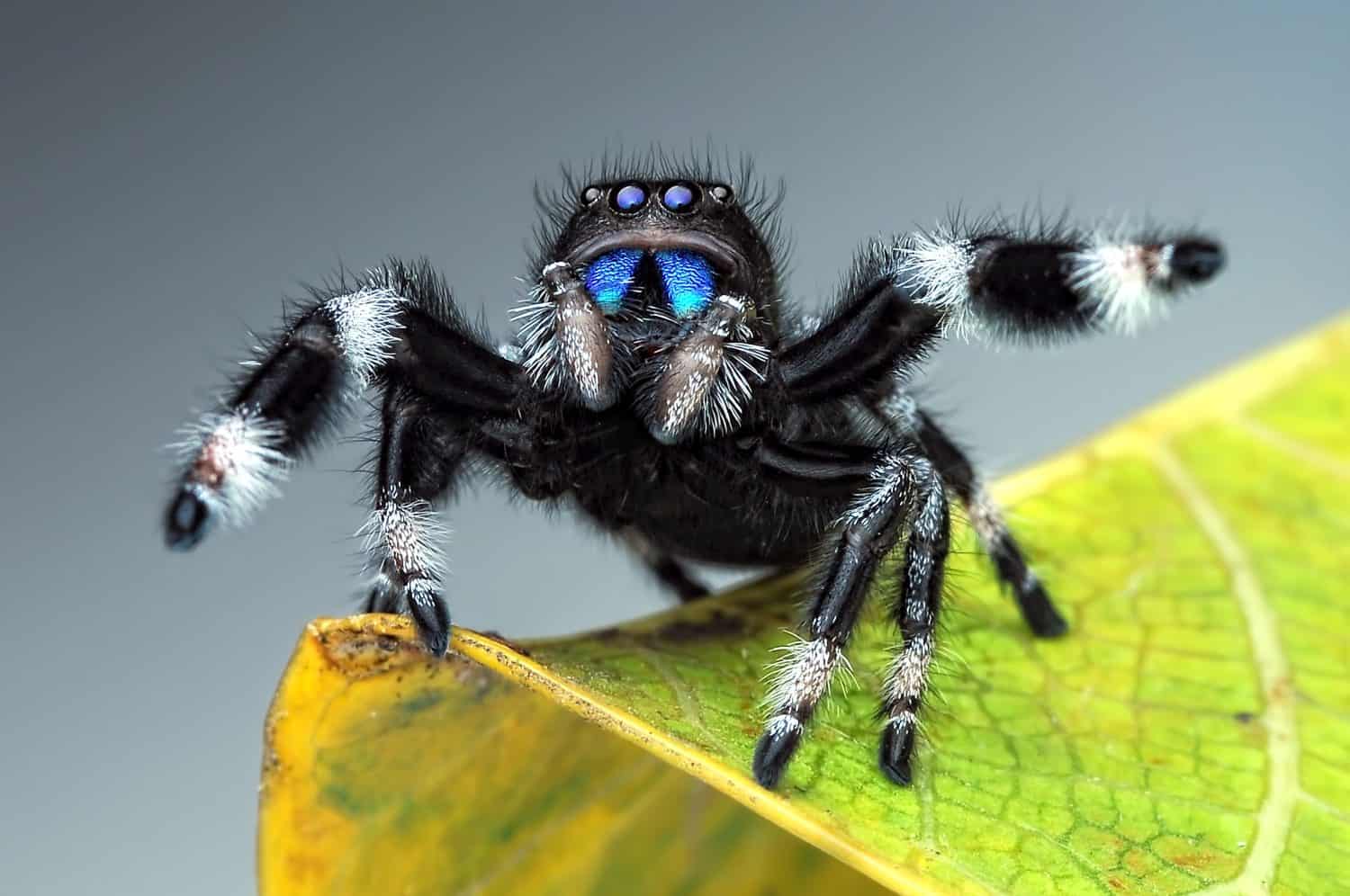

Have you ever seen a spider skitter under a cabinet in your kitchen, then spotted a similar one later in the day? While many of us, especially those afraid of spiders, would like to believe that a spider can’t recognize us, a new study published in eLife suggests that it might be able to—at least if it’s a regal jumping spider (Phidippus regis). Researchers from the University of Neuchâtel’s Institute of Biology and Taipei Medical University’s Graduate Institute of Mind, Brain and Consciousness found that jumping spiders can recognize and remember other spiders they’ve met before. Previously, this was an ability that researchers only believed animals with larger brains could pull off.
The study of spider intelligence is growing rapidly. With each new similar study, we learn more about these tiny yet complex creatures that inhabit nearly every single part of our planet (Antarctica notwithstanding).
What are Jumping Spiders?
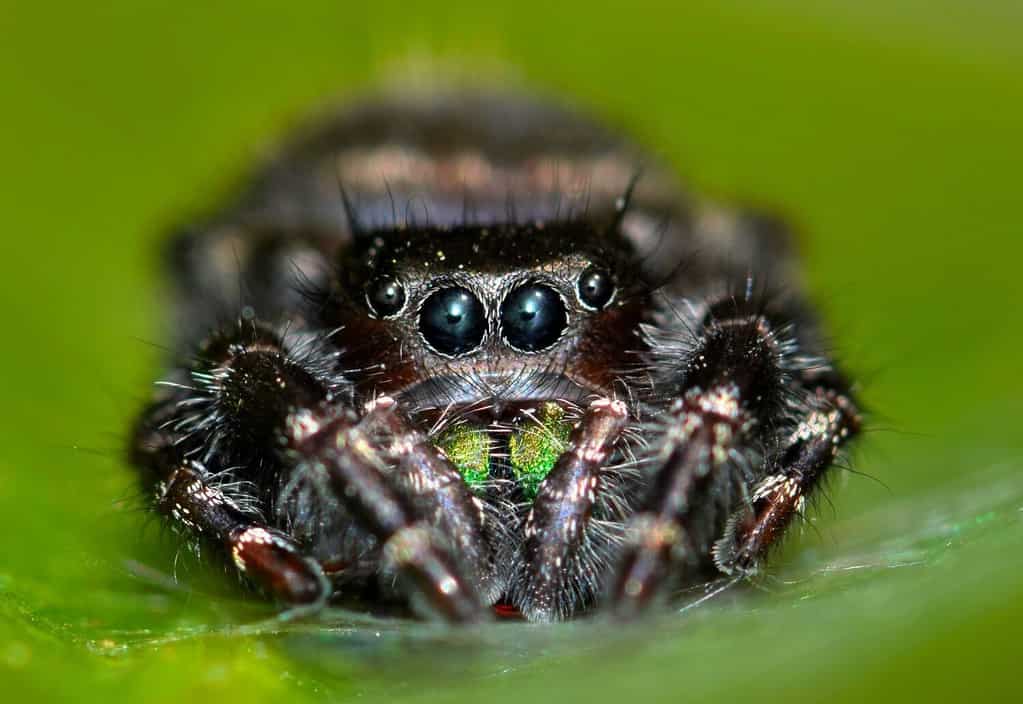
There has been a recent uptick in the trend of keeping jumping spiders as pets, thanks in part to TikTok videos portraying the spiders as curious, cute, and friendly.
©Brett Hondow/Shutterstock.com
Jumping spiders, part of the family Salticidae, comprise over 6,000 different species, making this the largest family of spiders worldwide. Some examples of jumping spider species include the bold jumping spider (Phidippus audax), the zebra jumping spider (Salticus scenicus), and the peppered jumping spider (Pelegrina galathea).
These spiders are known for their incredible jumping abilities (hence the name). They are able to propel themselves anywhere from 10 to 50 times the length of their bodies. Their jumping ability is useful for both escaping predators and hunting prey. They can easily pounce on insects such as fruit flies, crickets, mealworms, and roaches. Usually, these spiders hunt during the day.
Jumping spiders are also known for their excellent vision. Not all spiders are able to see in color, and many spiders, such as tarantulas, actually have notoriously poor vision and must rely on other senses. Jumping spiders, on the other hand, have four pairs of eyes, including a large set that gives them the doe-eyed, face-like appearance many people love. They can distinguish between colors, as well as see ultraviolet (UV) light. Finally, these spiders are known for being intelligent, fairly docile (not quick to bite), and curious. People who own jumping spiders as pets note that they engage with humans more than other spiders.
How Researchers Tested Spider Memory
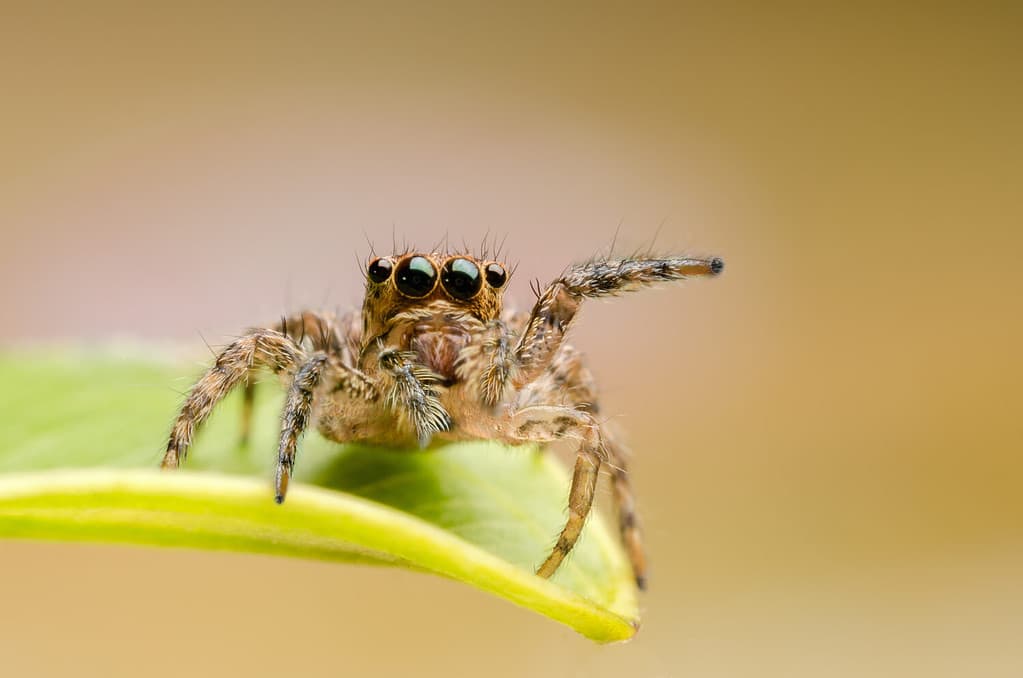
A jumping spider’s brain is only around the size of a poppyseed, making its memory even more impressive!
©common human/Shutterstock.com
In the wild, jumping spiders are typically solitary and do not usually live with or near other spiders. They are relatively solitary by nature, only coming together during mating times. Even in captivity, those keeping jumping spiders as pets should not keep multiple spiders in the same enclosure, since they could fight or even kill each other. Because of this, it’s unlikely that a jumping spider would come across another jumping spider frequently in natural settings.
Still, researchers wondered whether the regal jumping spider could recognize other spiders. In the study’s pre-print, published in September 2025, the researchers set out to determine whether spiders could remember another spider based solely on memory, rather than chemical cues.
Study Setup
To evaluate the jumping spiders’ memory, the researchers set up what they called a habituation-dishabituation paradigm for 36 jumping spiders. Habituation refers to becoming accustomed to something, while dishabituation describes renewed interest when something new is introduced. Each spider was placed in a clear container. There were two spiders per container, separated by a wall. The spiders could see each other but could not physically interact. Researchers believed the spiders might habituate (or get used to each other) and display dishabituation (greater interest) when a new spider was swapped into its place.
The Procedure
The first experiment on habituation used 20 jumping spiders. To begin, spiders were given 10-15 minutes to acclimate to the cube they were placed in. The research team allowed this time to ensure that any discomfort with the study setting would not affect the results.
The jumping spiders then spent seven minutes in visual contact with another spider. At first, the spiders showed immense interest in each other. They even walked closer to the separating wall to inspect each other in more depth. The pair was then separated for three minutes before being reintroduced. Upon the reintroduction, however, the spiders stayed greater distances away from one another. To researchers, this suggested the spiders recognized their counterparts. More importantly, the spiders were no longer as interested in the other individual.
The researchers also found that the effect of habituation persisted over time: even after several hours, the spiders could recognize individuals they had already met. By the third session of introductions, the spiders no longer showed more interest in new spiders than in those they had already met. But was this because the spiders were habituated, or because they were tired?
The Second Experiment
To determine this, researchers conducted a second experiment to distinguish between long-term habituation and simple fatigue. For this experiment, researchers added 16 new spiders to the original group of 20. If the spiders did not approach the new individuals, the researchers believed it would indicate fatigue. However, the study authors reported that the spiders were more interested in the newcomers, even describing the level of interest as unprecedented.
The Importance of Recognition Between Jumping Spiders
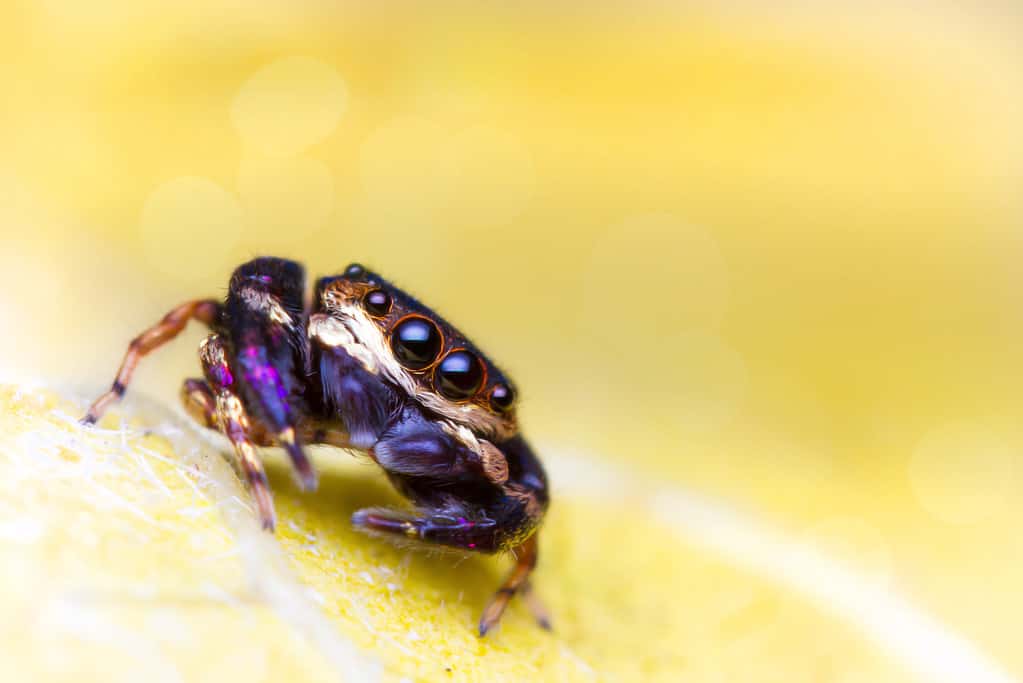
One hypothesis for why jumping spiders need to recognize each other is to find a mate.
©Hyde Peranitti/Shutterstock.com
In their paper, the two researchers wonder why jumping spiders might have the ability to recognize other spiders. They present and explore several theories. The first is that jumping spiders might want to remember other spiders when searching for a potential mate. However, this explanation is quickly discounted. As the researchers explain, jumping spiders can usually tell males and females apart based on color and facial hair patterns. Because spiders can identify specific colors and patterns, they wouldn’t need to recognize individuals.
Another hypothesis is that jumping spiders may need to recognize potential enemies in their territory. Ultimately, the spiders’ tiny brains do not mean they are simple creatures, and it will be interesting to see what future research reveals about spider intelligence. But then they discuss the dear enemy effect. This posits that, even in territorial creatures, a spider might be less aggressive to a neighboring spider it sees frequently and more aggressive towards new spiders in the area.
While there are no concrete answers here, the jumping spiders’ ability to recognize other individual spiders highlights how spiders can have flexible learning and long-term memory. Ultimately, the spiders’ tiny brains do not mean they are simple creatures, and it will be interesting to see what future research reveals about spider intelligence.