
Quick Take
- The very feature that made Schomburgk's deer one of the most spectacular animals in Asia quietly sealed its fate long before the last one died. See how antlers sealed their fate →
- While early accounts often labeled the deer as 'common,' this reputation was misleading. That mistaken perception may have helped mask the species' decline until it was too late. Read the misread that doomed them →
- The last of its kind didn't die in the wild. Its final moments unfolded in a place no one would expect, at the hands of someone with no reason to be there. Trace the species' final chance →
- The final extinction wasn't caused by a natural disaster or slow ecological collapse. It ended with one decision, on one night, by one person. Discover that one fatal decision →
Sporting some of the most elaborate antlers ever seen, Schomburgk’s deer seemed almost mythical even when it was alive. It once roamed the swampy floodplains of central Thailand. Then, it vanished forever in one of the strangest extinction stories on record.
Unlike many species, the final Schomburgk’s deer did not die quietly in the wild. It did not succumb to old age, disease, or even a hunter’s bullet. Instead, the last known member of the species — a tame stag living on the grounds of a Thai temple — was beaten, stabbed, and stoned to death by a heavily intoxicated visitor in 1938. It was a bizarre and tragic end for one of the most spectacular deer ever known. Its enormous, crown-like antlers once towered above the wetlands of central Thailand before habitat loss and hunting pushed it to extinction.
The Fatal Flaw of a Magnificent Crown
Western science first described the species (Rucervus schomburgki) in 1863, naming it after Sir Robert Schomburgk, the British consul in Bangkok. While early accounts often labeled the deer as ‘common,’ this reputation was misleading. Few scientists actually saw the animals in the wild. Instead, the species’ apparent abundance was inferred from the large number of its spectacular antlers found in local markets.
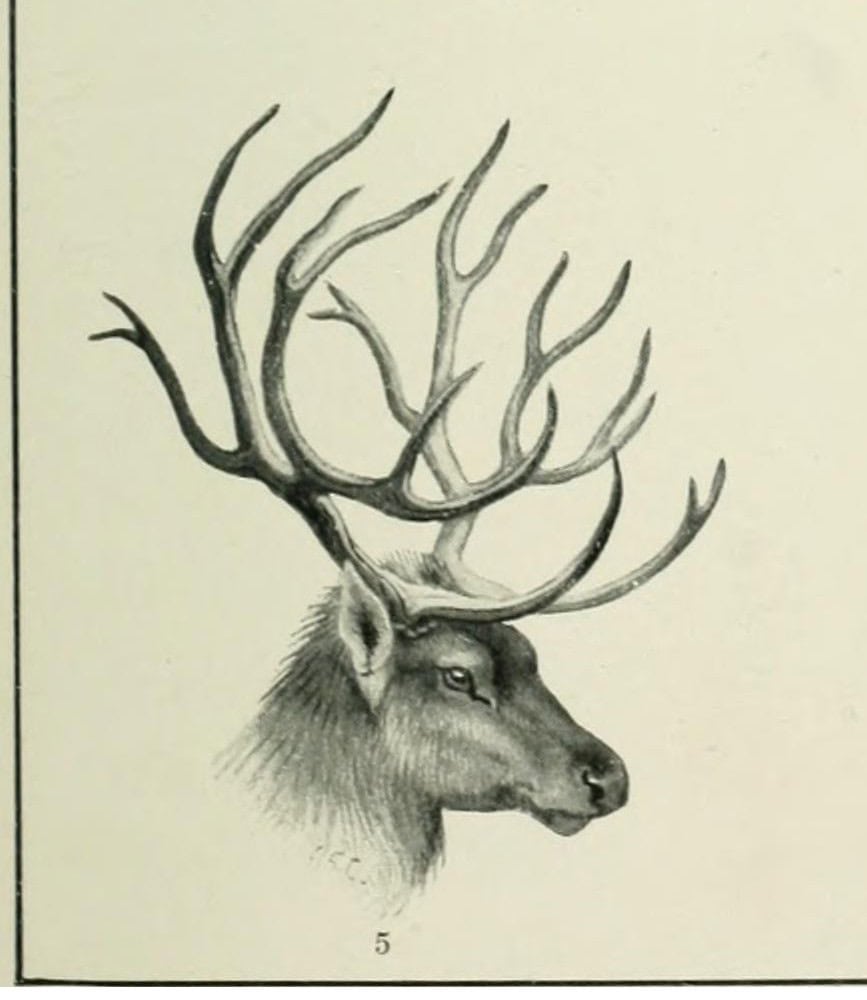
Male Schomburgk’s deer could have up to 33 points or tines on a single rack.
©Caspar Whitney, 1905 / Internet Archive Book Images / No restrictions / Wikimedia Commons – Original / License
Those antlers were impossible to ignore. Adult males carried enormous, basket-like crowns with a complex branching pattern that often produced 16 to 20 points — and occasionally far more. Their antlers spread so widely that the species was ill-suited for dense forests. Instead, Schomburgk’s deer lived in open wetlands, grassy floodplains, and river valleys throughout Thailand’s Chao Phraya River basin.
Ironically, the very habitat that helped the deer thrive ultimately doomed it.
During the late 19th and early 20th centuries, Thailand’s booming rice export industry transformed vast stretches of wetland into commercial rice fields. Marshes and grasslands were drained, fragmented, and converted into agricultural land. As the deer’s habitat disappeared, the animals became increasingly concentrated in isolated patches of remaining floodplain.
Seasonal flooding made things even worse. During the rainy season, rising waters forced herds to gather on small islands of higher ground. Hunters quickly realized these trapped groups of deer were easy targets. At the same time, expanding railways opened up previously remote areas. As demand for antlers increased, hunting pressure intensified until the species could no longer survive.
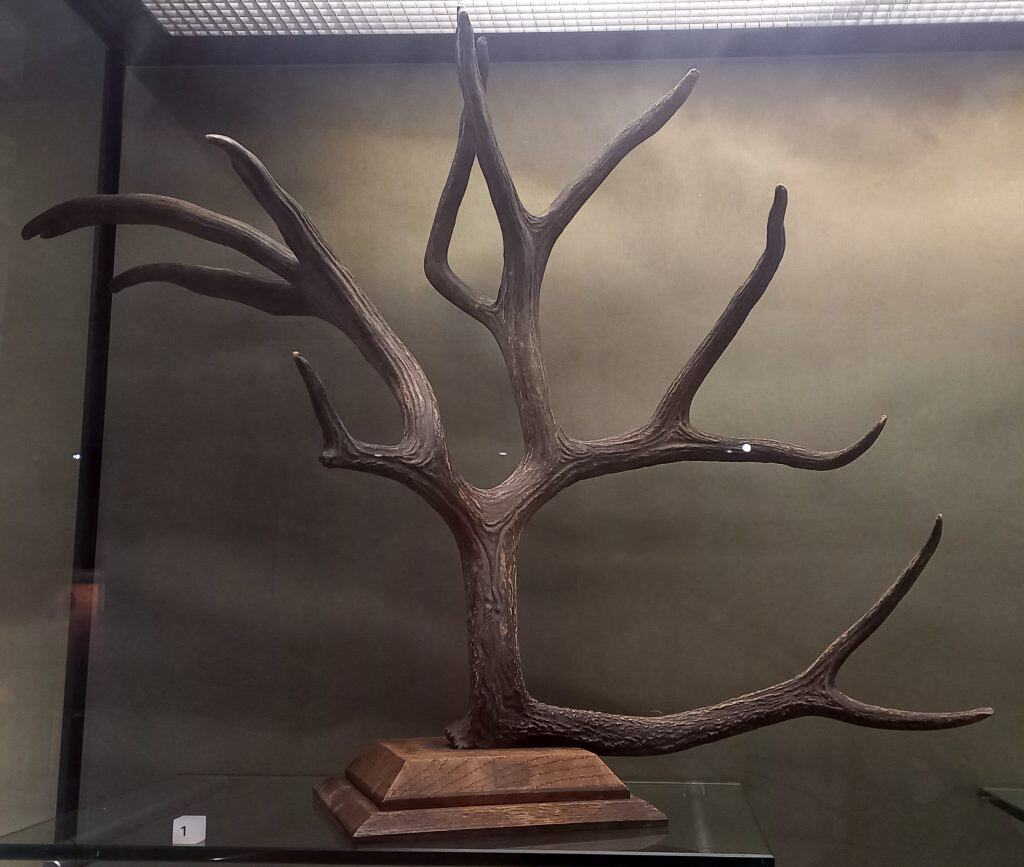
Despite its prominence in Thai culture, Schomburgk’s deer received virtually no scientific study before it went extinct.
©FunkMonk / CC BY-SA 4.0 / Wikimedia Commons – Original / License
A Swift and Tragic End
The deer’s decline was swift. By 1932, the last recorded wild Schomburgk’s deer had been shot by a Thai police officer. The species vanished from the wild, leaving behind only a handful of captive animals — none of which proved capable of saving the species.
Although European zoos had historically kept several Schomburgk’s deer, they never managed to establish a breeding population. Eventually, only a single known survivor remained: a tame male living peacefully on the grounds of a temple in Thailand’s Samut Sakhon Province.
Then came the species’ final tragedy. In 1938, a heavily intoxicated visitor entered the temple grounds and attacked the deer, reportedly stabbing, beating, and stoning it to death. With the loss of that lone captive stag, Schomburgk’s deer disappeared from the earth forever, though some believe a hidden population may have survived into the early 1990s.
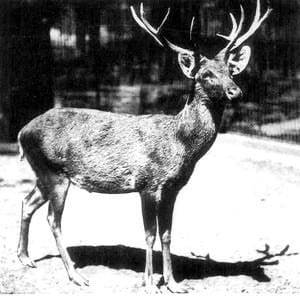
This image is the only historical photograph of a living Schomburgk’s deer, captured in 1911 at the Berlin Zoo.
©Lothar Schlawe / Public domain / Wikimedia Commons – Original / License
This extinction was not the result of a natural disaster or an ancient catastrophe; it unfolded within living memory through habitat destruction, overhunting, and a senseless act of violence.
Today, Schomburgk’s deer survives only in museum specimens, scattered antlers, and a handful of historical photographs. Its story serves as a stark reminder that extinction is not always dramatic or inevitable. Sometimes, it arrives one rice field at a time — and ends with a single drunken decision.