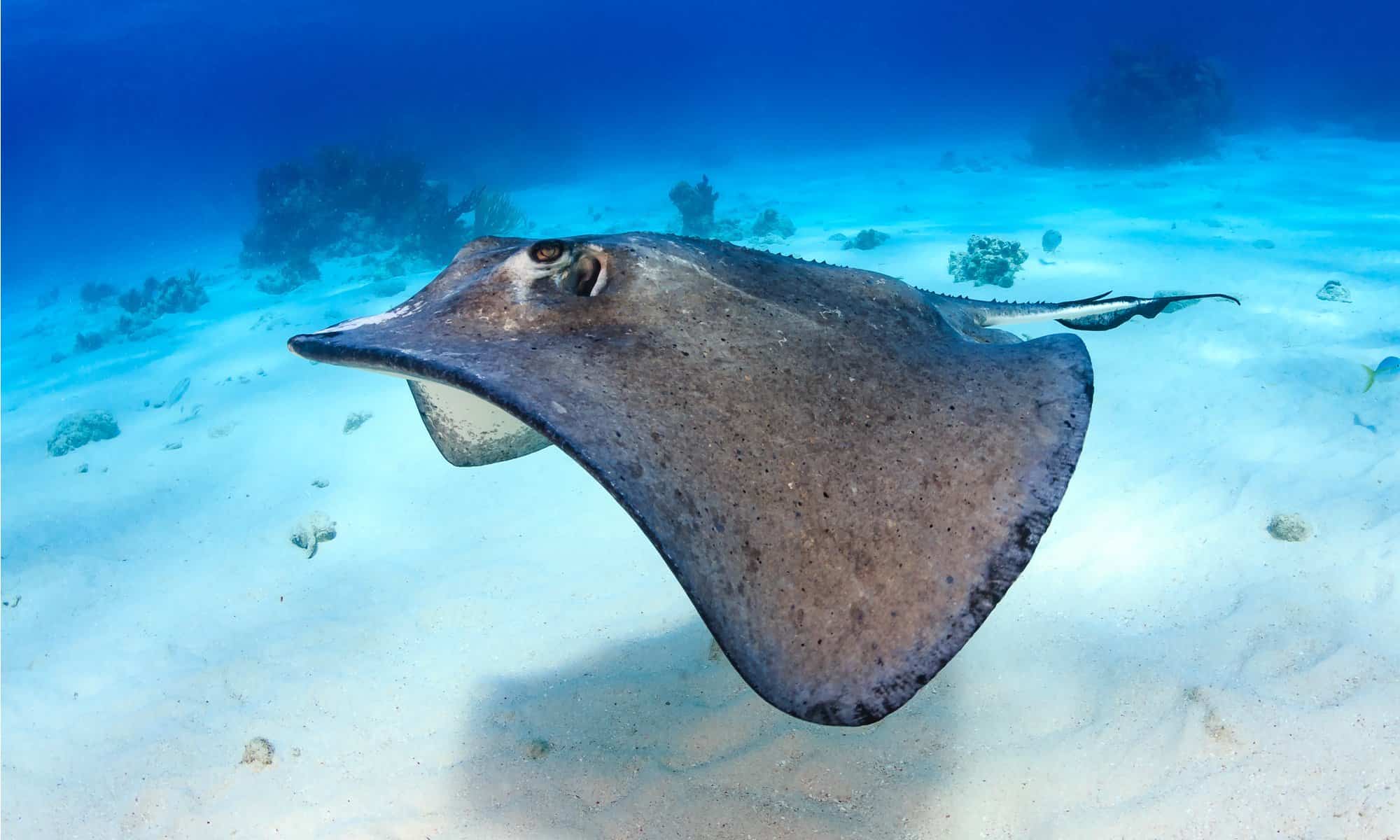

Manta rays and stingrays are some of the most graceful animals in the ocean, as they glide through the water in search of prey. These animals are both cartilaginous fish and have a very similar appearance, with their flattened bodies and broad pectoral fins, which can make it difficult to tell them apart. Luckily, there are actually a few distinctive differences that distinguish one from the other.
Comparing Manta Rays vs. Stingrays
| Manta Rays | Stingrays | |
|---|---|---|
| Species | 3 species | Approximately 220 species |
| Distribution | Tropical and subtropical waters around the world, in open oceans and near coastal reefs | Females release pheromones to attract males, and males form a “courtship train” |
| Size | Up to 23 feet wide | Average 3 to 6 feet wide |
| Mouth | Front of body | Underside of body |
| Teeth | Tiny, peg-like | Flattened, used for crushing prey |
| Tail | Does not have a barb | Has a venomous barb |
| Diet | Zooplankton | Mainly crustaceans and small fish |
| Mating Behavior | Females release pheromones to attract males and males form a “courtship train” | Males bite females before mating with them |
| Gestation Period | 12 to 13 months | 3 to 11 months, depending on the species |
| Intelligence | Show evidence of being self-aware | Have not shown evidence of being self-aware |
| Litter Size | Usually one pup | Usually 2 to 10 pups |
| Lifespan | 40 to 50 years | 15 to 25 years |
The Key Differences Between a Manta Ray and a Stingray
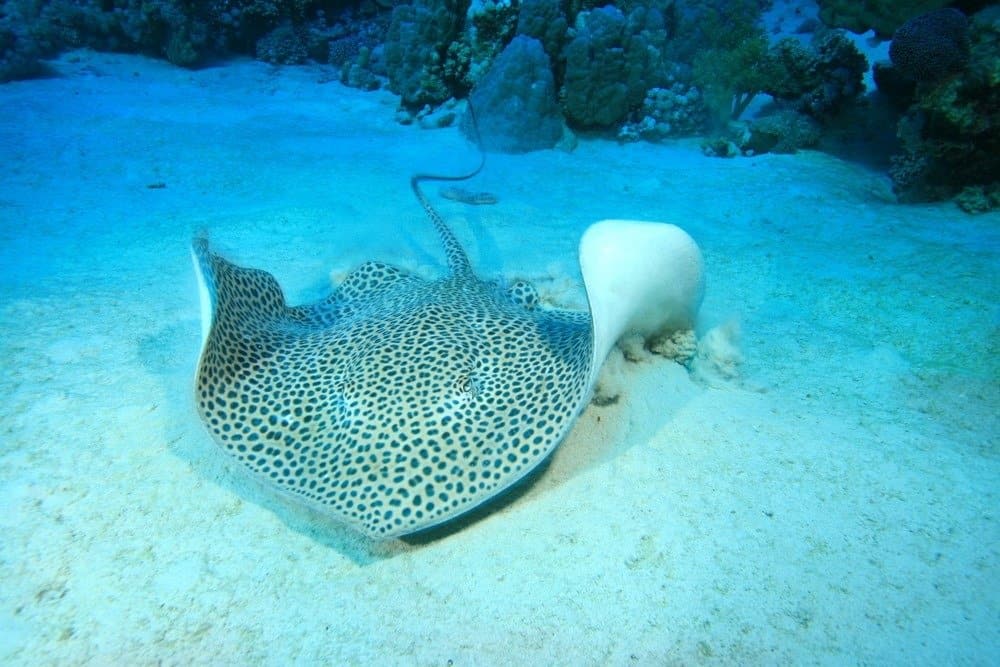
There are approximately 220 species of stingrays in the world.
©Rich Carey/Shutterstock.com
There are many differences between manta rays and stingrays, including what they eat, how they eat, and how they mate. Let’s take a closer look at these differences below.
Distribution
Manta rays live in tropical and subtropical waters all around the world and also occasionally venture into temperate waters. The Atlantic manta ray and the reef manta ray both inhabit waters close to coral reefs and the coasts. The Atlantic manta ray has the smallest distribution of the three species of manta rays, inhabiting only the western region of the Atlantic Ocean. However, the giant manta ray prefers the open ocean and is rarely found in coastal regions.
Stingrays also inhabit tropical and subtropical waters. Some species can be found in the open ocean, but many prefer the coastal regions. However, there’s also a group of stingrays known as freshwater stingrays that inhabit bodies of freshwater. There are estimated to be more than 35 species of freshwater stingrays, and they live in lakes and rivers across South America.
Size
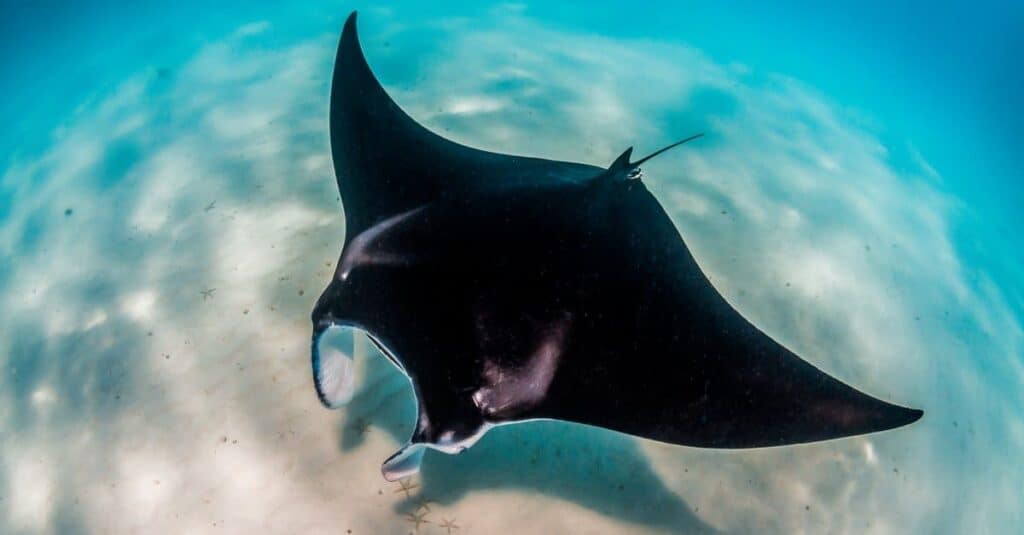
Manta rays can grow up to 23 feet wide.
©Aaronejbull87/Shutterstock.com
The next difference between manta rays and stingrays is the most obvious one — their size. Manta rays are much bigger animals than stingrays. The largest species is the giant manta ray, which has a disc width of up to 23 feet and a length of up to 30 feet. Meanwhile, stingrays have an average width of three to six feet, depending on the species. Some can be much smaller than this, such as the bluespotted ribbontail ray, which has a disc width of only 12 to 14 inches.
Tail
One of the biggest differences between these two animals is their tail. Stingrays have a long tail with a sharp, barbed spine on the end, which contains venom. The venom isn’t always deadly to humans, but it can be if it is injected into a vital organ. However, despite possessing venom, stingrays aren’t naturally dangerous to humans, but they will use their tails in self-defense if they are threatened.
Although manta rays also have a long, whip-like tail, they do not have a venomous barb on the end of it. As a result, manta rays are completely harmless to humans.
Mouth
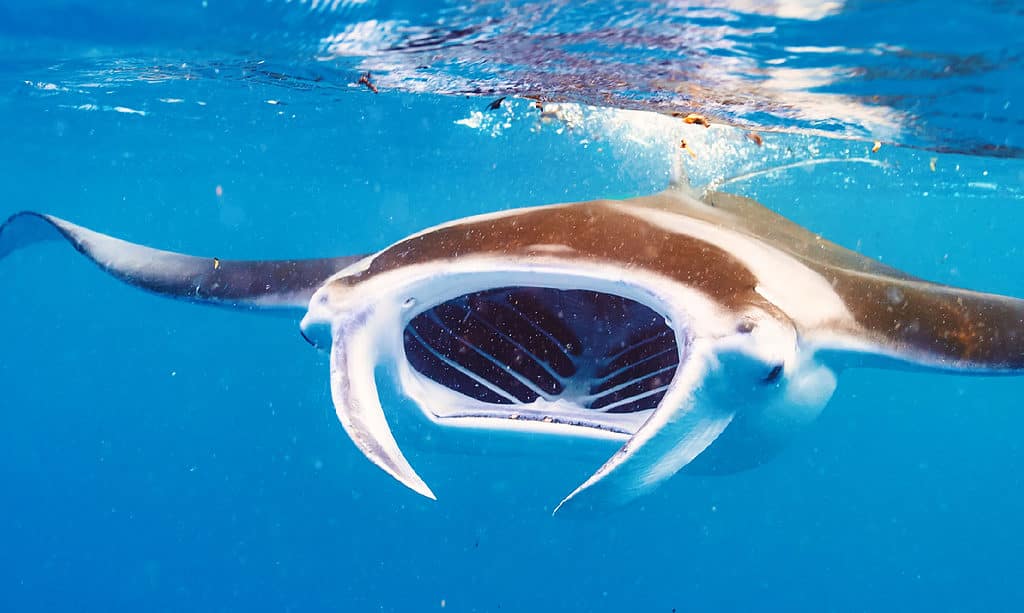
Another distinguishable difference between manta rays and stingrays is the location of their mouth. Manta rays have a mouth that is positioned at the front of their body, whereas stingrays have a mouth that is located on the underside of their body. The different locations aid them with their feeding behavior, which we’ll explain next.
Diet

The mouth of a stingray is located on the underside of its body, allowing it to capture prey from the ocean floor.
©BlackFarm/Shutterstock.com
As we’ve just mentioned, the mouth of a manta ray is located on the front of its body. This is because manta rays are filter feeders and eat zooplankton. Manta rays have hundreds of tiny teeth, but they don’t use them for catching or eating their prey. Instead, as filter feeders, they swim into the clouds of zooplankton with their mouths open to take in mouthfuls of the tiny organisms. They then filter the water out of their mouth before swallowing the food.
Stingrays are not filter feeders; they are ambush predators. They eat a variety of crustaceans, such as crabs, lobsters, and clams. They also eat small fish and other small organisms, such as worms. Most of the food that stingrays eat is located on the ocean floor, which is why their mouth is located on the underside of their body, as it allows them to more easily pick up prey. Their jaws are also uniquely adapted to their diet, as their upper jaw protrudes slightly so they can search for prey amongst the rocks and sand. Also, unlike manta rays, stingrays use their teeth when they are eating. Stingrays have strong, flattened teeth, which they use for crushing the shells of their prey.
Mating Behavior
Female manta rays release pheromones to attract males.
©haveseen/Shutterstock.com
Manta rays and stingrays also have very different mating behavior. During breeding season, male stingrays approach the females and bite them on their back and on their pectoral fins. Often, the female will struggle in an attempt to get away from the male before he can mate with her.
Manta rays have a much more romantic mating ritual, which begins with the female releasing pheromones. These pheromones are chemicals which signal to males that she is ready to mate. The males are attracted to the female by these signals and form what is known as a “courtship train” behind her. The courtship train involves several males lining up behind a single female manta ray. The female then swims in a series of elaborate patterns, involving twists, turns, and swimming at speed, during which the males follow her moves. Once the female has chosen a male (possibly the one that she deems to have followed her moves the best), she slows down and swims to the surface to wait for him.
Gestation Period
Both manta rays and stingrays are ovoviviparous, meaning that their young develop and hatch from eggs inside the female’s body before being born alive. Manta rays typically have a gestation period of 12 to 13 months and usually give birth to only one pup, although they may sometimes have twins. They don’t reproduce every year, though, with pups being born only every two to five years.
The gestation period of a stingray differs depending on the species. Some species, such as the longtail stingray, have a gestation period of approximately 11 months. However, others have a gestation period of as little as three months. Most stingrays give birth to between two and ten pups and usually reproduce every year.
Intelligence
Although fish aren’t widely regarded for their intelligence, manta rays are one of only a handful of animals that have shown evidence of being self-aware using the mirror test. The mirror test is used to assess an animal’s ability to recognize itself, and studies have shown that manta rays displayed different behavior when in front of a mirror, indicating that they are self-aware. Other animals that have shown similar behavior with the mirror test include bottlenose dolphins, elephants, and some primates — such as chimpanzees and orangutans.
Stingrays are also considered to be intelligent animals, as they have exhibited the ability to move objects to find food. However, they have not shown any indication that they are self-aware.