A new discovery in Maine has drawn attention from scientists, veterinarians, and residents alike: the Asian longhorned tick. This tiny arachnid, originally from East Asia, has been gradually spreading across the United States. Its arrival in Maine marks the farthest northeast appearance yet and raises important questions about its potential impact. Farmers, pet owners, and outdoor enthusiasts all have reasons to pay attention.
No One’s Favorite Species

There are over 900 species of ticks. This is Dermacentor variabilis, a tick often found on dogs.
Ticks are small, parasitic arachnids that survive by feeding on the blood of mammals, birds, and reptiles. They have eight legs like spiders and an outer shell that protects their bodies. Ticks go through four life stages: egg, larva, nymph, and adult. They have to drink blood at each stage to develop and reproduce. They live in grassy, wooded, or humid environments and latch onto potential hosts as they pass by. They can be quite small and difficult to notice, but are easier to see as they get massively engorged with the blood of their hosts.
Of the more than 900 species of ticks, only a few dozen regularly bite people, but these are of great concern because they can spread Lyme disease, Rocky Mountain spotted fever, and ehrlichiosis. Left untreated, these diseases can cause serious symptoms like nerve problems, organ damage, and damage to blood vessels.
Meet the Asian Longhorned Tick
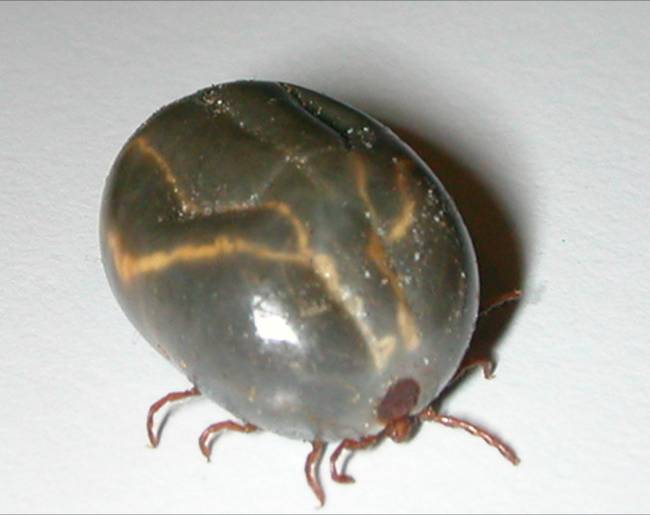
An Asian longhorned tick is fully engorged with blood.
©Wikimedia Commons
The Asian longhorned tick (Haemaphysalis longicornis) is a small, light-brown parasite that often goes unnoticed until it attaches to a host. It is especially dangerous to livestock, spreading diseases like Theileria orientalis in Asia that can cause severe anemia and death in cattle. It has also transmitted serious human illnesses there, including severe fever with thrombocytopenia syndrome (SFTS), a potentially fatal disease. While it has not yet been shown to spread diseases in the United States, its history in Asia makes it a major concern.
Another worrisome aspect of this tick is that, if no males are around, a female can still reproduce without a mate. Laying 1,000 to 2,000 eggs at a time, just one tick can create a large infestation by itself. This kind of reproduction makes the tick especially difficult to control.
How Far Has It Spread?

Starting in New Jersey, Asian longhorned ticks have reached Maine.
©travelview/Shutterstock.com
First identified in New Jersey in 2017, the Asian longhorned tick likely arrived years earlier, possibly around 2010, by hitching rides on people, pets, or livestock. Since then, it has spread quickly and is now documented in more than twenty states, from the Northeast through the Midwest and Southeast, with reports as far west as Oklahoma. In 2025, Iowa and Maine became the latest states to confirm the tick in their borders. Experts warn that its potential range could cover much of North America, since this species is highly adaptable and capable of thriving in many different climates and habitats.
Why It Matters in Maine

Cattle are especially vulnerable to tick-borne disease.
©Radowitz/Shutterstock.com
The Maine detection matters for two big reasons. First, it’s the northernmost sighting of the Asian longhorned tick in the U.S., which shows it can handle colder climates better than anyone expected. Second, it’s a real threat to livestock. Heavy infestations can weaken animals from blood loss, reduce their productivity, and even cause death. On top of that, this tick can carry Theileria orientalis, a parasite that hits cattle with anemia, jaundice, and lower milk production.
Maine may be famous for potatoes, blueberries, and maple syrup, but livestock is still a big part of the picture—especially dairy cows, as well as beef cattle, sheep, and goats. Most of these farms are small and family-run, which means even a moderate outbreak of theileriosis or a heavy tick load could have a serious impact on people’s livelihoods.
Risks for People and Pets

Pets can become anemic due to blood loss if they are infested with large numbers of ticks.
©andriano_cz/iStock via Getty Images
The Asian longhorned tick can definitely affect dogs and cats, but the level of threat is different from that for livestock. Pets can be bitten and develop irritation, anemia, or weakness if they pick up a heavy load of ticks. In countries where the tick has been established longer, like Japan and Korea, it has been linked to the spread of certain pathogens in dogs, including Babesia (a parasite that infects red blood cells). In the U.S., though, no major outbreaks in pets have been tied to this tick so far.
The main worry for cats and dogs here is the sheer number of ticks that could attach at once. Since females can reproduce without males, infestations can grow fast, and pets left untreated or without tick prevention could end up with dozens—or even hundreds—of ticks feeding on them. That amount of blood loss alone can make animals sick, even without a disease being transmitted. So, while it’s not the top threat compared to livestock right now, it’s still something pet owners should watch closely.
What Are States Doing About This Problem?

Clearing brush is one of the preventative measures authorities and homeowners can take to slow the spread of ticks.
©photoschmidt/Shutterstock.com
States where the Asian longhorned tick has been found are focusing first on identification and education. Agriculture departments and universities are running surveillance programs, collecting ticks from livestock, wildlife, and the environment to track their spread. Extension services are teaching farmers, veterinarians, and the public how to recognize the tick, report sightings, and regularly check animals. Researchers are also testing ticks for pathogens like Theileria orientalis to get a clearer picture of the risks in each area.
On the control side, the goal isn’t extermination—once a tick is established across states, eradicating it is nearly impossible. Instead, states are working to limit damage. That includes treating livestock and pets with approved tick preventives, managing habitats by clearing brush and mowing pastures, and increasing testing of animals for signs of illness. In Maine, where the tick was recently confirmed by the University of Maine’s Tick Lab, officials are treating it as an isolated case but plan to expand monitoring and farm outreach. The strategy is to catch new cases quickly and prevent the tick from gaining a foothold in the state.
How to Protect Yourself and Your Animals

Tick repellent can help protect you from bites while you’re outdoors.
©encierro/Shutterstock.com
Because Asian longhorned ticks can appear in a wide range of environments, protecting yourself starts with daily habits. Performing a full-body tick check after spending time outdoors is one of the most effective steps you can take. Wearing long sleeves and pants limits exposed skin, while light-colored fabrics make it easier to spot ticks before they attach. For extra protection, treat clothing and gear with 0.5 percent permethrin and apply an EPA-approved repellent to bare skin. Around the home, simple yard care goes a long way—keeping grass trimmed, clearing brush, and laying mulch or gravel between wooded areas and lawns all help reduce the spaces where ticks thrive.
Pets need protection too, since they can bring ticks into the house or suffer infestations themselves. Monthly preventives are strongly recommended for dogs and cats, and owners should check their pets carefully after each outing, especially around the ears, neck, and belly, where ticks like to hide. Livestock require a broader approach, and veterinarians can recommend strategies such as topical treatments, pasture rotation, and other targeted controls. Whether for pets, people, or livestock, prompt removal matters: any tick found should be grasped close to the skin with fine-tipped tweezers, pulled straight out, and the bite area cleaned. Saving the tick for identification and monitoring for symptoms afterward are important final steps in staying safe.
Conclusion
The arrival of the Asian longhorned tick in Maine has big implications for the state. This invasive species, with its rapid reproduction and potential to harm livestock, will require heightened surveillance, prevention, and preparedness. Farmers, pet owners, and residents all have roles to play in limiting the range of this rapidly multiplying parasite and preventing it from spreading serious diseases.