Matriphagy is a type of animal behavior where the young eat their own mother. It is the ultimate display of maternal martyrdom and takes motherly love to the highest level. You can see it in action in this extraordinary YouTube clip where a mother centipede is eaten by her babies. Read on to find out more about this startling behavior.
Centipede Matriphagy
The centipede in the clip is a Scolopendra gigantea, which is the largest centipede in the world. They are also known as the Peruvian giant yellow-legged centipede or the Amazonian giant centipede. They are found in South America and the extreme south of the Caribbean. Despite their huge size (they can grow to 12 inches in length) and their ability to deliver a venomous bite, they are also kept as pets. Instances of matriphagy have been observed in captivity, but it is not known if this is typical behavior for Scolopendra gigantea in the wild.
Pros and Cons of Matriphagy
The obvious downside for the mother in this scenario is that she dies. However, nature is not about preserving the individual; it is about the survival of a species. So, while the mother has lost out, she has given the best possible start to her offspring. This strategy is even more advantageous than if the mother were to remain alive to help her offspring find food. One could argue that the species loses out in terms of numbers, since the mother could have produced more offspring if she had survived. For this species, however, it is better to have fewer offspring with a higher chance of survival than more offspring with little chance of reaching adulthood. Put simply, there is a net benefit for the mother’s genes.
The main benefit of matriphagy for the offspring is nutritional: they gain immediate access to high-quality nutrients that aid their growth and development, potentially benefiting subsequent generations as well. Furthermore, having the mother around can be problematic if she competes with her offspring for resources in the future. By consuming their mother, the offspring eliminate this competition and gain immediate access to resources that she may have otherwise monopolized. Studies have shown that offspring that have participated in matriphagy had higher body masses, advanced molting times, and were able to hunt larger prey.
Other Examples of Matriphagy
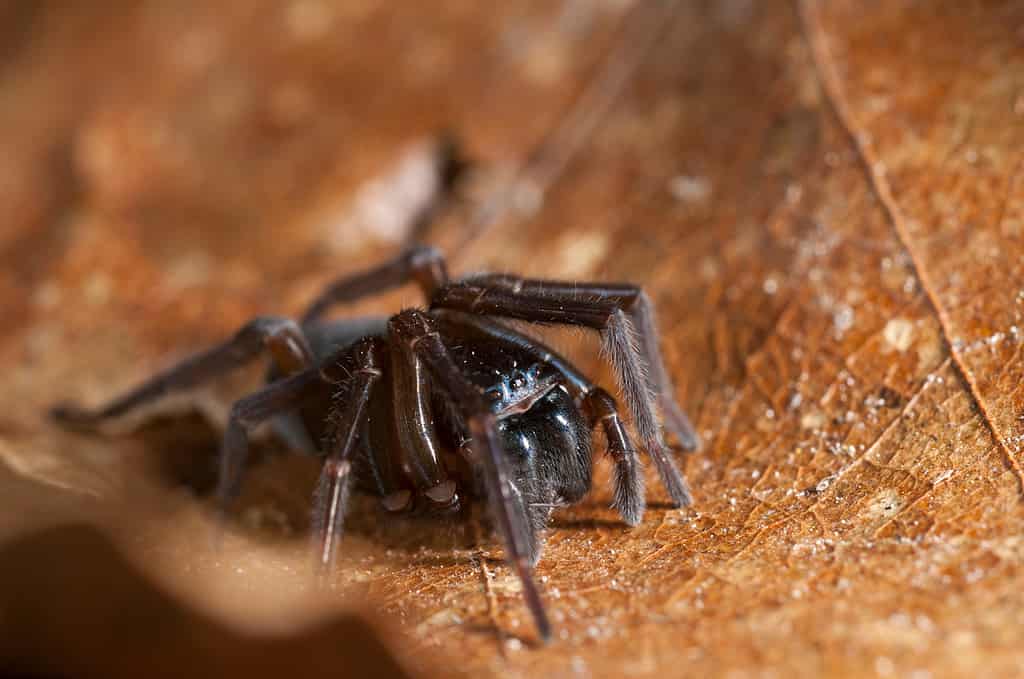
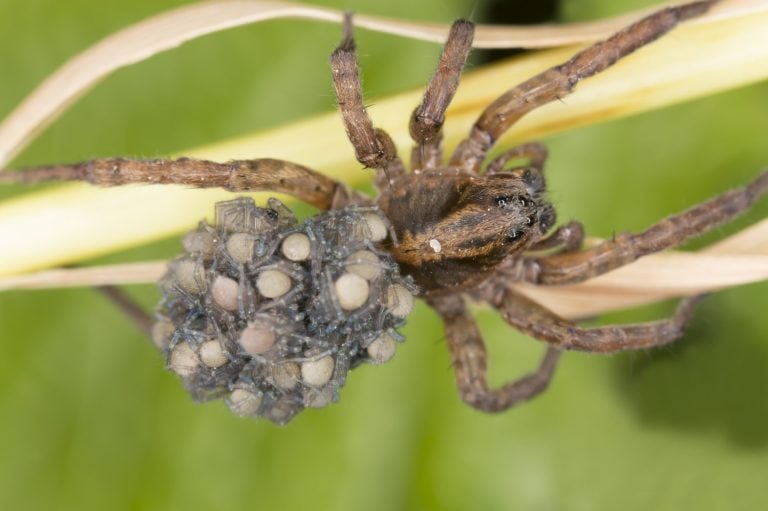
Black lace-weaver spider mothers are eaten by their offspring.
©Federico.Crovetto/Shutterstock.com
Spiders
Centipedes are not the only creatures where matriphagy has been observed. Several spider species, including Stegodyphus dumicola, which is an African native species, also show this behavior. The mothers initially feed the young on a nourishing fluid produced by her body but when this is all gone, they climb onto her and start to eat her. Similar behavior has been observed in Stegodyphus lineatus, a spider found in Israel, parts of the Mediterranean basin, throughout the Near East and in Asia Minor.
The Australian crab spider (Australomisidia ergandros) females lay just one clutch of babies. She stores a lot of nutrients inside her body in the form of trophic eggs. Her offspring feed on these through her leg joints. However, eventually she shrinks so much that she usually dies.
At least the black lace-weaver spider (Amaurobius ferox)has a mercifully quick death at the hands of her children. Initially, she produces trophic eggs that pass out of her body for them to feed on. Then, she drums on her web so that they know where to find her. She relinquishes her body to them, but they inject her with poison, so she dies before she is actually consumed.
Earwigs
Matriphagy has been observed in Anechura harmandi, a species of earwig. Studies have shown that it leads to a delay in the dispersal of the nymphs and an increase in their survival rate. These earwigs reproduce in colder weather, as this helps them avoid predators. However, there is also a shortage of food at this time, so matriphagy is a way of overcoming that problem.
Pseudoscorpions
Pseudoscorpions, also known as false scorpions, belong to the same class as spiders. They are distantly related to true scorpions but do not have a tail. The females feed their young a special milk and later provide them with insects. However, the first report of matriphagy in this species was published in 2005. It occurred during a period of food deprivation, during which the mother passively waited for her nymphs to attack her and did not react to them feeding on her body.
Matriphagy and Sociality
There are mothers all over the world who would love for their children to quit squabbling, but giving one’s own life to avoid sibling arguments may seem a little extreme. The mothers described here, however, are faced with children who compete so fiercely that they literally eat each other. Cannibalism among siblings has been recorded in both spiders and pseudoscorpions, often as a response to scarce resources. Matriphagy is one way to avoid this and it also encourages sociality in the offspring. It makes them more likely to work together for the benefit of the group. What more could a mother want?