
Quick Take
- Controlling zebra mussel populations requires an annual $500 million investment in the Great Lakes region.
- Utilizing byssal threads allows these mollusks to form dense colonies that destroy industrial machinery.
- Zebra mussels can lead to complete ecosystem and food chain collapses.
When people think about invasive species, they often conjure images of large feral pigs or Burmese pythons in the Florida Everglades wreaking havoc on the environment. They’re not necessarily wrong. After all, several organizations have been established to remove invasive snakes or swine from habitats to allow native species to thrive. But one of the most destructive invaders in the United States, the zebra mussel (Dreissena polymorpha), is much smaller than most people realize. Despite its small size, comparable to a fingernail, zebra mussels are both financially and ecologically devastating.
According to the University of California, Riverside’s Center of Invasive Species Research, managing zebra mussels in the Great Lakes alone costs an estimated $500 million annually, while national costs for controlling aquatic invasive species, including zebra mussels, are estimated to be in the billions. Surprisingly, controlling these mussels and preventing their spread is more cost-effective than repairing the damage they cause. But how did we get to this point? When were these mussels introduced, and why are they so difficult to manage? Let’s take a look at how zebra mussels came to the United States and completely changed our waterways.
What are Zebra Mussels?
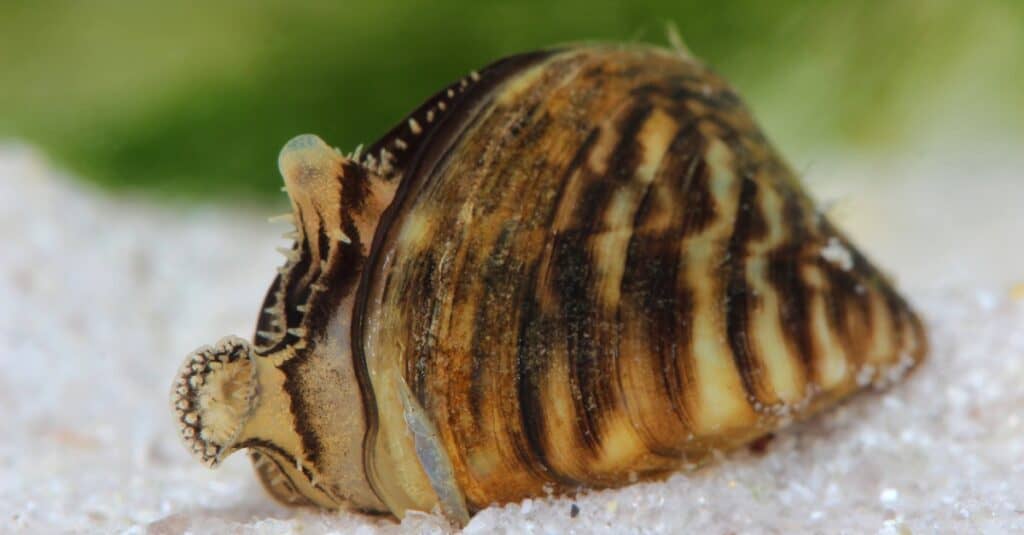
One female zebra mussel can release up to one million eggs annually, leading to the species’ rapid reproduction.
©iStock.com/VitalisG
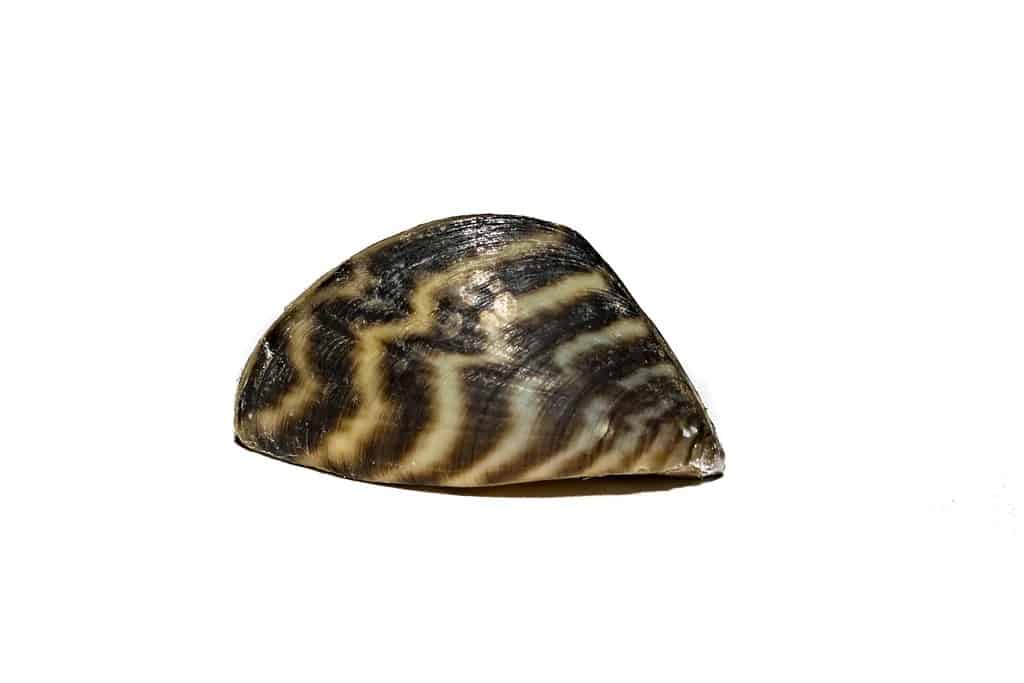
Zebra mussels, named for their characteristic “zebra-striped” shells, are small freshwater mollusks that can grow to around 1-1.5 inches in length (though they are often smaller). The mussels have an angular, D-shaped shell that helps them sit flush against whatever surface they attach to. Typically, zebra mussels prefer warmer water and are often found at shallower depths compared to quagga mussels, another invasive species. However, zebra mussels are resilient. They can tolerate both cooler and warmer water. Zebra mussels can also survive out of water for upwards of five days.
The Rapid Spread of Zebra Mussels
Zebra mussels are native to Russia and Eastern Europe and can be found in both the Black Sea and the Caspian Sea. Prior to arriving in the United States, zebra mussels effectively invaded Sweden, Italy, Great Britain, the Netherlands, and the Czech Republic.
In 1988, several graduate students studying aquatic life found zebra mussels in Michigan’s Lake St. Clair. Many people believe that ballast water discharge from transatlantic ships introduced the mussels to the area.
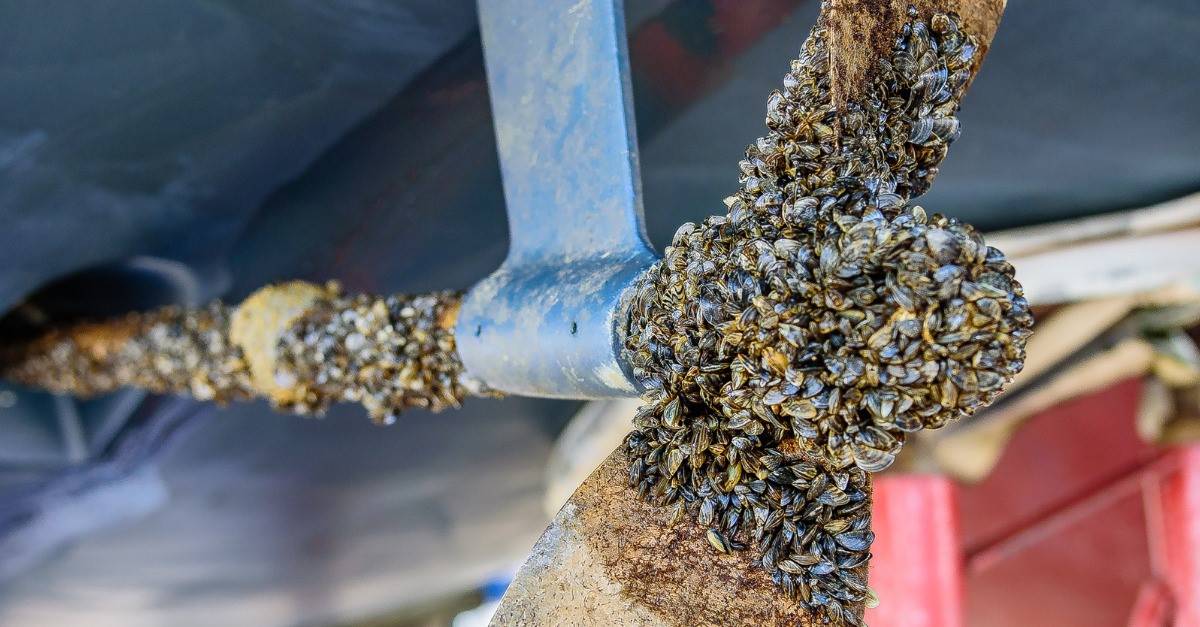
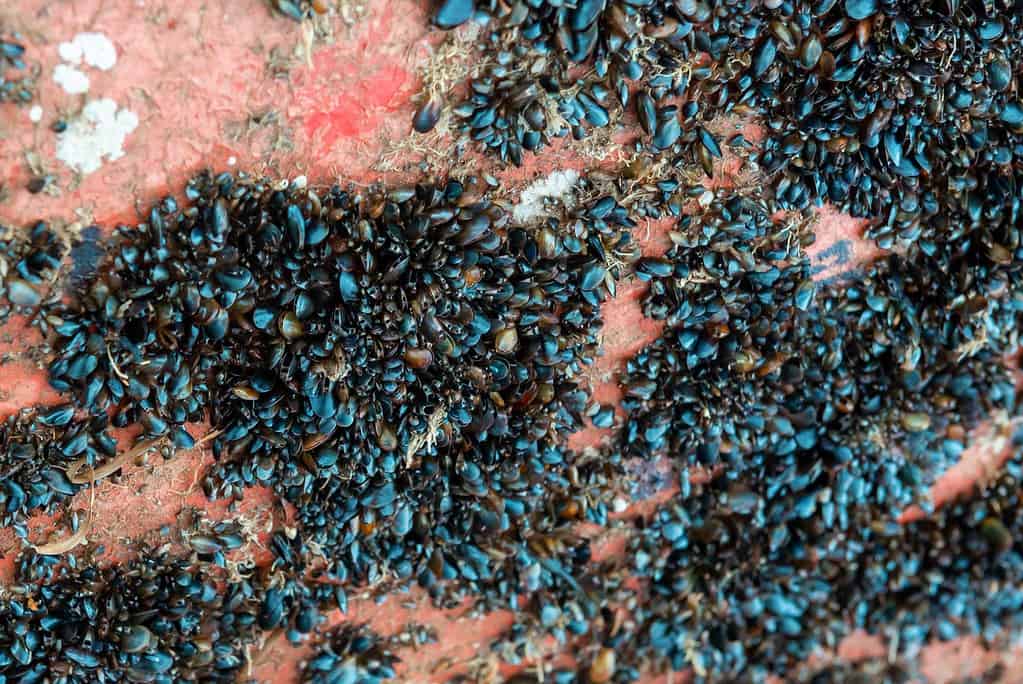
These mussels can form dense colonies with tens of thousands (or more!) of zebra mussels per square meter.
©Jay Ondreicka/Shutterstock.com
Zebra mussels reproduce prolifically. Although zebra mussels only live for two to five years, a female zebra mussel can produce up to one million eggs annually. Around 500,000 eggs per meter hatch, releasing veligers (the mussels’ larval stage).
The veligers don’t necessarily stay close to their parents. Instead, they drift in the water for a few days, or up to two weeks, before settling and attaching to hard surfaces using byssal threads. If you’ve ever heard the term “beard” in reference to mussels, it refers to their byssal threads. These sticky, protein-rich fibers are incredibly strong, allowing the zebra mussels to cement themselves into place. They can attach to docks, boats, machinery, or even other native mussels.
Because these mussels can reproduce so rapidly, it’s no surprise that they quickly invaded all the Great Lakes, especially given the interconnection of those waterways. Commercial shipping also spread juvenile and adult zebra mussels. Zebra mussels have since been found in watersheds across the United States, including Virginia, Texas, Louisiana, Michigan, Arkansas, and Missouri (among many others!).
Why Are Zebra Mussels So Damaging?
Before we talk about the modern impact of zebra mussels, let’s go back to the Monroe Power Plant in Lake Erie in 1989. According to a 1990 report published in Proceedings of the American Power Conference, “In fall 1988 densities [of zebra mussels] in the intake canal were less than 50 per sq. meter but increased to over 700,000 per sq meter by fall 1989. Intake structures and associated equipment are covered by a layer of mussels 5-8 cm thick. High densities have fouled trash bars, main steam condensors, heat exchangers, and low-pressure service water systems.”
Millions of zebra mussels had cemented themselves, using byssal threads, throughout the water intake pipes. The buildup of these mussels caused significant blockages, requiring Monroe Power Plant to hydroblast the mussels off sensitive system components. But that wasn’t all. The shells scraped and damaged pumps, pipes, and valves. Zebra mussels’ acidic waste can corrode pipes, and this corrosion worsens as the mussels die and decay. The Virginia Department of Wildlife Resources shares, “In the United States, Congressional researchers estimated that zebra mussels cost the power industry alone $3.1 billion in the 1993–1999 period, with their impact on industries, businesses, and communities over $5 billion.” Today, it’s estimated that the U.S. spends up to $1 billion each year to address zebra mussels.
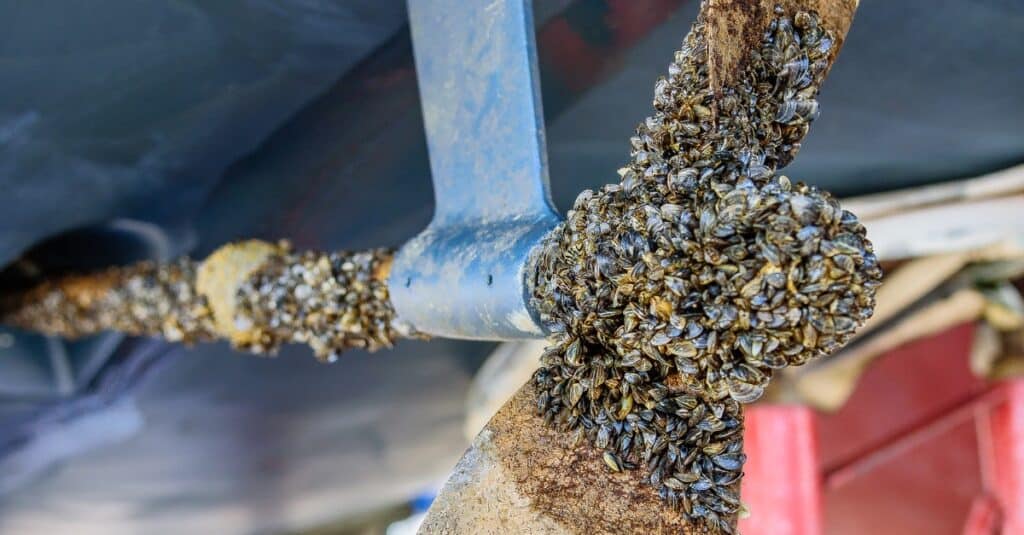
Since zebra mussels have spread, they have been found attached to boats or invading other industrial complexes. Zebra mussels can clog boat engines or damage hulls, making boat use and maintenance costly for owners. Many companies spend hundreds of thousands of dollars to several millions of dollars each year to remove zebra mussels, manage populations, or attempt to prevent further damage.
Because zebra mussels can excrete corrosive substances, they can reduce the efficiency and safety of boats and other machinery.
©Dolores M. Harvey/Shutterstock.com
Zebra Mussels’ Environmental Effects
Beyond the economic impact, zebra mussels enormously affect their ecosystems. These voracious mollusks threaten native species. North America is home to an estimated 300 native mussel species. In fact, mussels are known as a keystone species, which National Geographic defines as a species that is essential for the survival of the rest of that ecosystem. That’s because mussels have many roles: food, water purifiers, nutrient concentrators.
Hundreds of zebra mussels may attach to the shells of native mussels, weighing the native mussels down. To feed and breathe, mussels must open their shells. Zebra mussels filter out food before it can reach native mussels and also block their ability to breathe. Native mussels are left to starve and suffocate. With native mussel populations dying off massively, many scientists are worried about how their ecosystems will cope.
By encrusting the bottoms of rivers or lakes, zebra mussels cover the soft sediment that some arthropods, like crayfish, need for burrowing. As a result, those species decline, which can eventually lead to the collapse of the food chain.
Diet and Nutrition
Zebra mussels are filter feeders. They can filter up to one quart of water daily. On one hand, a single zebra mussel cannot do much for the health of a particular body of water. However, when thousands or millions of zebra mussels colonize a single area, they can sometimes improve water clarity. As a result, certain areas might see significant aquatic plant growth. However, this increased clarity isn’t always beneficial. Zebra mussels ingest beneficial algae and phytoplankton, but filter out toxic forms. Research shows this worsens toxic algae blooms.
Because zebra mussels filter so much food, beneficial algae and phytoplankton don’t have time to reproduce. As a result, the clearer water lacks the organisms necessary to support a healthy ecosystem. This, in turn, starves other creatures, such as zooplankton or Diporeia, which depend on algae and phytoplankton for food. In fact, zebra mussels have outcompeted Diporeia (small crustaceans), leading to the dramatic collapse of food chains in areas like the Great Lakes.
As you can see, the issue keeps compounding. The collapse of zooplankton causes small fish to lose their food source, which subsequently affects large fish and birds. Although some fish, such as blue catfish and redear sunfish, do eat zebra mussels, their predation is not enough to control zebra mussel populations or restore balance to the food web.
Spreading Toxicity
Zebra mussels, like other mussels, are bioaccumulators. That word essentially relates to the mussels’ filter-feeder status. When mussels filter the water, contaminants and pollutants in that water build up in their tissue. Zebra mussels may bioaccumulate pollutants up to 300,000x concentrations in the surrounding water. This makes mussels great for studying water quality or pollution levels. But bioaccumulation is bad for the animals that prey on zebra mussels.
When fish or crayfish eat the zebra mussels, the toxins enter their bodies. Later, these animals are preyed upon by birds. Birds can develop deadly avian botulism as toxins move up the food chain.
Can We Eradicate Zebra Mussels?
Despite being invasive, zebra mussels are now functionally endemic in certain parts of the United States.
©iStock.com/JeffCaughey
In all honesty, it’s unlikely that the U.S. will ever fully eradicate zebra mussels. After all, these mollusks have been present in the Great Lakes for decades at this point. Rather than attempting eradication, many states focus on mitigating damage and reducing the spread of zebra mussels. In addition to treating power plants or other areas, recommendations include:
- Cleaning, draining, and drying your boats and trailers
- Disposing of unused or unwanted bait
- Destroying, disposing of, and disinfecting moss balls for aquariums (many of which have been found to be contaminated with zebra mussels)
- Not moving water or creatures from one body of water to another