Quick Take
- Ring-necked snakes lack the anatomy scientists use to classify venomous snakes, but researchers made a surprising discovery hiding in their mouths. Discover what's in their mouths →
- Most people assume bright colors on a snake signal danger, yet ring-necked snakes break that rule in an unexpected way. See how venom fits in →
- A ring-necked snake bite won't hurt you the way you'd expect, but there is still one risk you shouldn't ignore. Find out the real risk →
- Dogs and ring-necked snakes cross paths more than you'd think, and the outcome isn't always as harmless as it sounds. Check the risk to dogs →
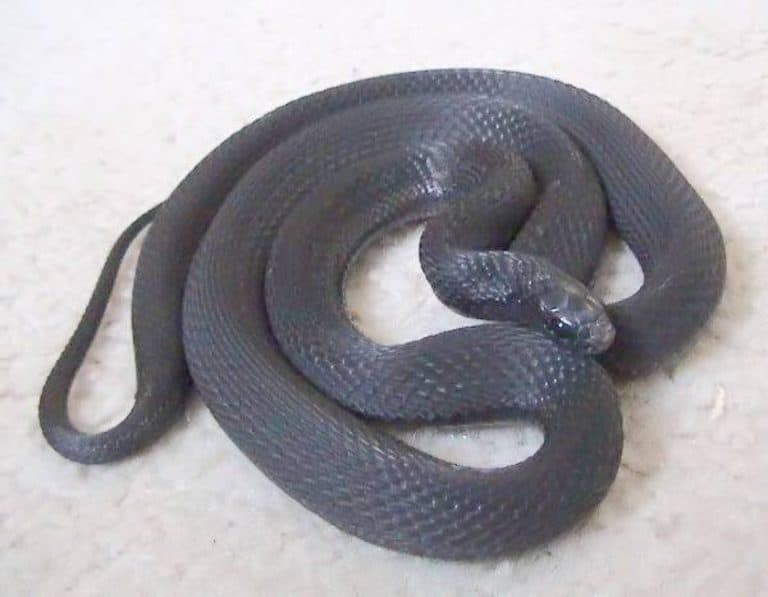
Ring-necked snakes are docile and are not harmful to humans. They are not aggressive, do not bite, and would rather coil up than strike if provoked. Most people think that ring-necked snakes are not venomous because they do not have actual venom glands. However, they possess a weak venom in their saliva that paralyzes their prey before consumption. This weak venom is not harmful to humans.
Do Ring-necked Snakes Bite?
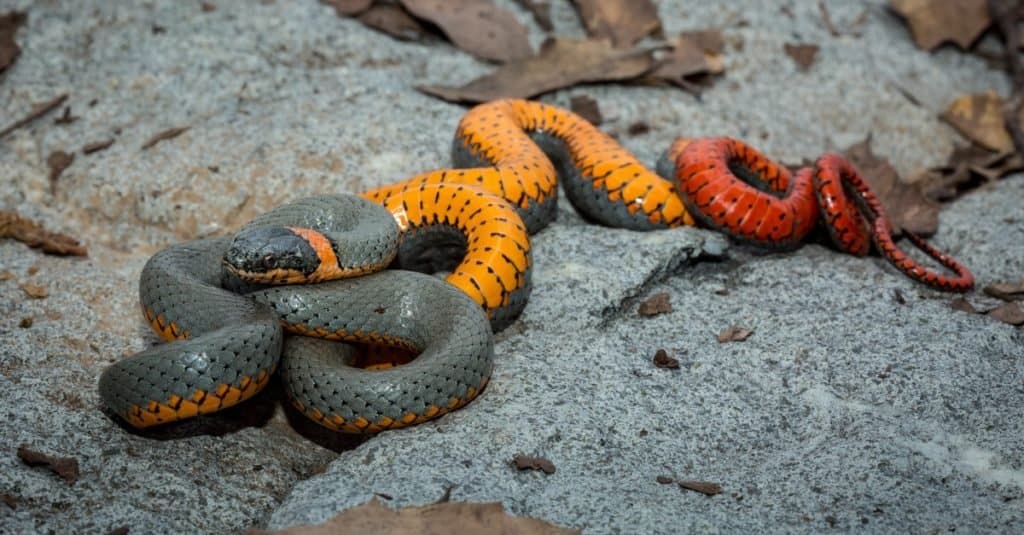
Ring-necked snakes rarely bite.
©Michael K. McDermott/Shutterstock.com
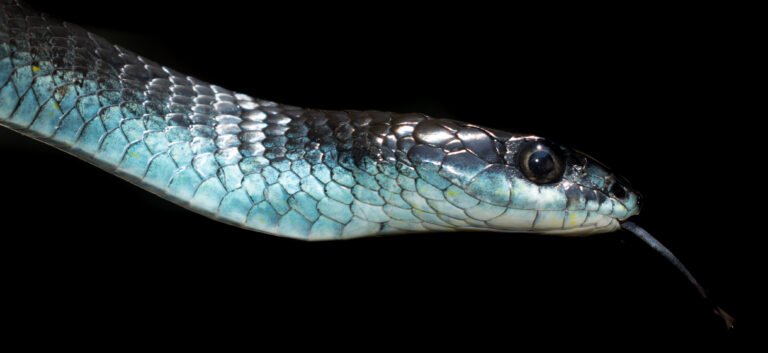
Like any other snake species, ring-necked snakes can bite, but only in extreme circumstances. Even if they do bite, they wouldn’t be able to use their rear fangs effectively, so it wouldn’t hurt and would only leave a few minor bite marks.
Ring-necked snakes are naturally shy and docile, and do not attack humans. They will slither away and hide rather than face confrontation. While most snakes bite when they feel threatened or provoked, ring-necked snakes are less likely to do so. Ring-necked snakes will coil up to hide from predators when threatened. In the wild, ring-necked snakes grow to a maximum of around 28 inches, making them less capable of defending themselves against predators and larger creatures.
Beyond their naturally docile temperament, ring-necked snakes are not equipped with large jaws to bite humans. Due to their small size, ring-necked snakes cannot open their jaws wide enough to inflict harmful wounds on humans, no matter how hard they try. Unlike most venomous snakes equipped with sharp fangs at the front of their mouth, ring-necked snakes don’t have fangs. Instead, they have enlarged teeth in the back of their mouths that puncture their prey so their venomous saliva can work its way in.
For years, biologists have considered ring-necked snakes non-venomous because they lack the typical anatomical structure of most venomous snakes. Venomous snakes usually have venom glands that supply venom to their fangs, and these fangs contain hollow channels that deliver venom to their prey or adversaries. But even though ring-necked snakes do not have venom glands, scientists have discovered that they possess a somewhat similar structure called Duvernoy’s glands. These glands produce very weak venom that helps them immobilize and kill smaller animals for food.
Are Ring-necked Snakes Dangerous to Humans?
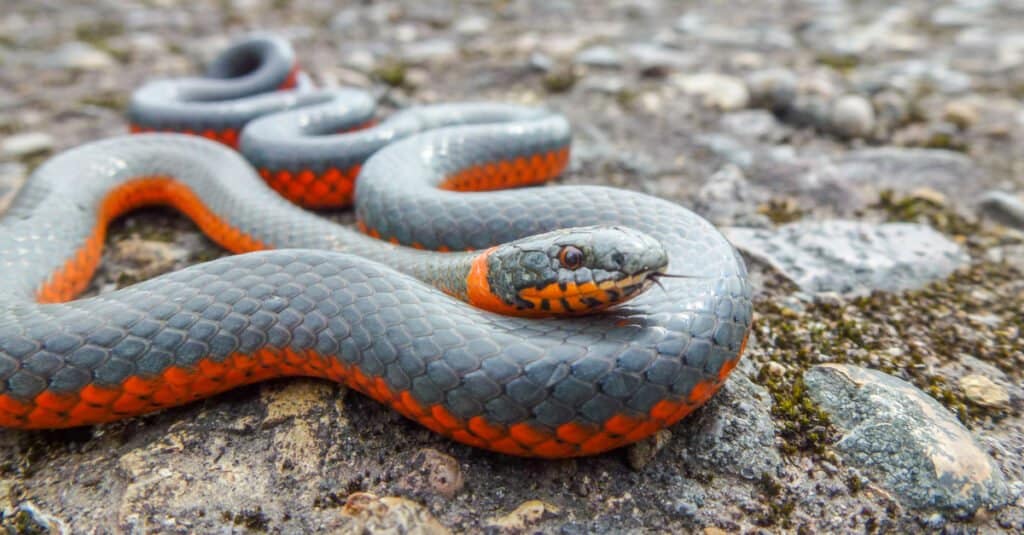
As they barely bite and have weak venom, ring-necked snakes aren’t dangerous to humans.
©Tom Fenske/Shutterstock.com
Ring-necked snakes are not dangerous to humans. While they have very weak venom in their saliva, ring-necked snakes barely bite humans. Beyond their passive and docile nature, ring-necked snakes bite only very rarely and only under extreme provocation. The worst outcomes from a ring-necked snake bite are mild bleeding, swelling, and bruising.
There are 14 subspecies of ring-necked snakes, of which the Northern and the Southern ring-necked snake are the most commonly cited. Neither is dangerous, and all subspecies have only mild venom in their saliva that is potent enough to subdue their prey but not to harm people and larger animals. In the wild, ring-necked snakes are predators of smaller animals, but they are also food for other larger animals and even larger snake species. Moreover, their venom is not only too weak to harm larger animals but is also not designed to repel predators. The ring-necked snake’s venom is used primarily for killing prey, not for defense. It is considered entirely ineffective against humans, making ring-necked snakes effectively harmless.
Are Ring-necked Snakes Venomous?
Poison involves ingestion, inhalation, or absorption through the skin — a passive delivery method in which a substance harms you only after you eat, breathe, or touch it, such as a death cap mushroom or poison ivy. Venomous refers to an active delivery method where an organism uses specialized tools like fangs, stingers, or spurs to inject toxins directly into your tissue or bloodstream, such as a rattlesnake or wasp. A classic mnemonic for this difference: if you bite it and get sick, it is poisonous; but if it bites you and you get sick, it is venomous.
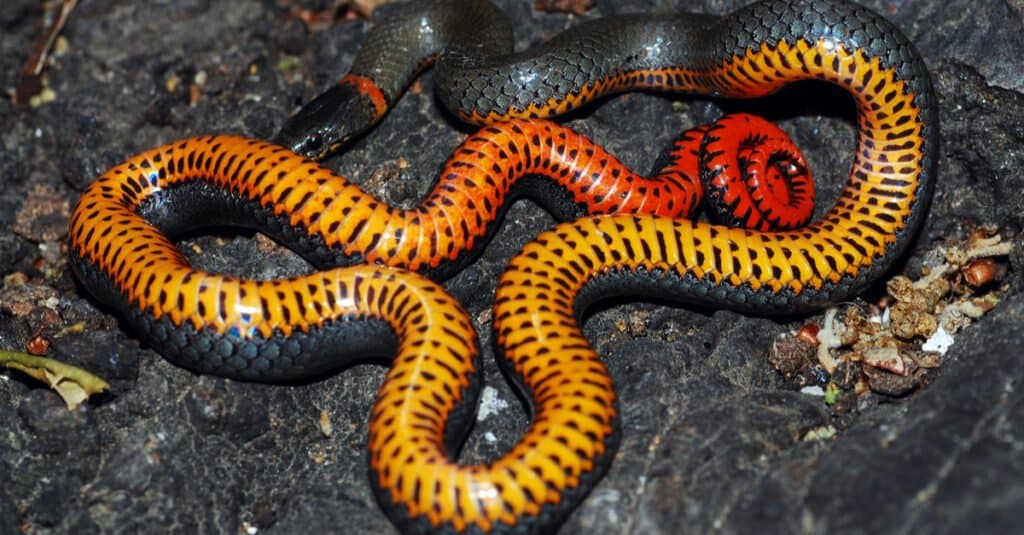
Ring-necked snakes are slightly venomous, but they are not poisonous.
©Jason Mintzer/Shutterstock.com
In the animal kingdom, having bright colors is a widespread warning signal seen across many animal groups, including insects, fish, amphibians, reptiles, and even some mammals. Ring-necked snakes may have colorful underbellies and rings around their necks, but these creatures are not poisonous and are only mildly venomous. Their venom is too mild to affect humans and other larger animals. Therefore, it is very safe to handle ring-necked snakes because they are accustomed to being handled and will not bite unless provoked. Even if they do, the bite won’t hurt and will only feel like a mild sting. Despite their weak venom, ring-necked snake bites may still introduce bacteria, so it is strongly recommended to wash the bite wound immediately to prevent infection.
Are Ring-necked Snakes Venomous to Dogs?
Ring-necked snake venom cannot harm dogs, and in most cases, ring-necked snakes are not venomous or dangerous to dogs. The bite of a ring-necked snake may not even penetrate a dog’s coat. However, ring-necked snake bites can sometimes trigger allergic reactions in dogs that may need medical attention.
Since the ring-necked snake’s venom is only effective on smaller prey, it does not harm larger animals such as dogs. Although ring-necked snakes may use mild constriction to subdue some prey, they are not large enough to pose a threat by constricting dogs. Dogs are naturally curious and may occasionally disturb ring-necked snakes. Ring-necked snakes are relatively timid and often coil up and hide rather than attack.