
The Cockatoo family (Cacatuidae) includes 21 species of crested parrots mainly native to Australasia. They are unique amongst the parrot order (Psittaciformes) for having a plumage palette limited almost entirely to white, black, gray, and pink, with highlights of red, orange, and yellow. As with parrots in general, it can sometimes be difficult to tell males and females apart, as they may have similar coloring. However, five key differences can be found in at least some cockatoo species that can help. Read on to find out what they are.
1. Size
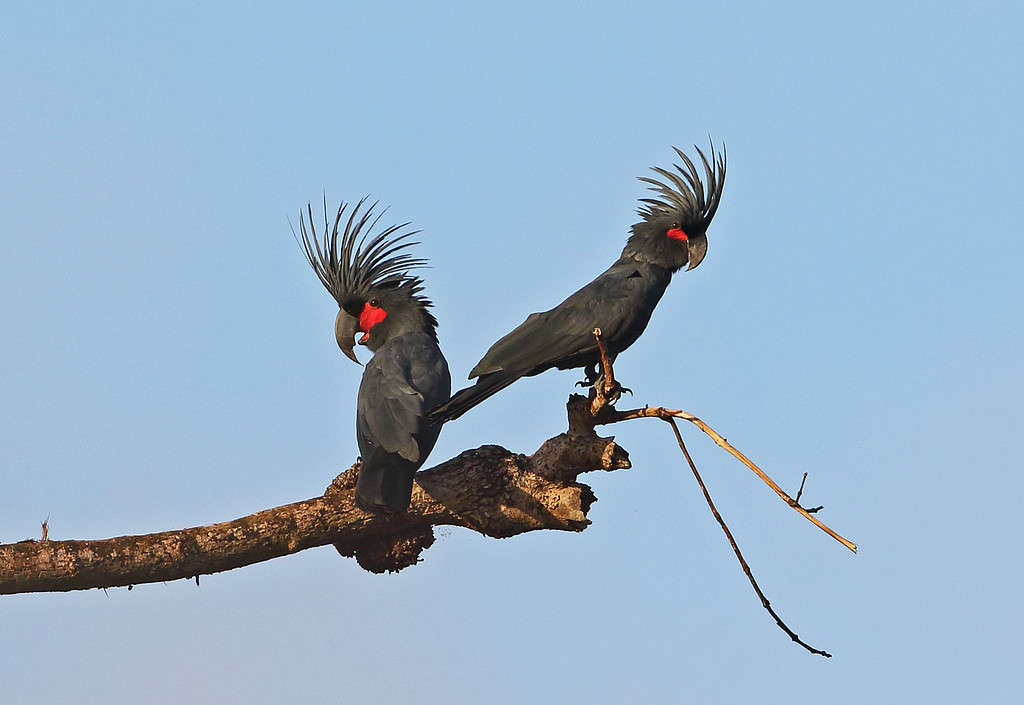
While palm cockatoo pairs may look the same at first, there are differences in both bill and cheek patch size.
©neil bowman/ via Getty Images
In four cockatoo species, the female is slightly smaller than the male. These species are the pink cockatoo (Cacatua leadbeateri), glossy black cockatoo (Calyptorhynchus lathami), red-tailed black cockatoo (Calyptorhynchus banksii), and galah (Eolophus roseicapilla). With salmon-crested cockatoos (Cacatua moluccensis), however, it is the male that is slightly larger. These size differences are usually only noticeable when pairs are side-by-side, and even then, they can be hard to spot. One species, however, has a unique size difference that is much easier to see. In palm cockatoos (Probosciger aterrimus), the male has a significantly larger beak!
2. Plumage Color

Unlike many other cockatoo species, it is easy to tell who’s who right away in gang-gang cockatoo pairs.
©Dirk Kotze/Shutterstock.com
In the majority of cockatoo species, males and females have identical plumage. However, there are some species with notable plumage differences. The most striking example is the gang-gang cockatoo (Callocephalon fimbriatum). In these cockatoos, only the males have the bright salmon-colored head, while females have more prominent barring. Cockatiels (Nymphicus hollandicus) also exhibit color differences, with males displaying a much brighter yellow head and orange cheek patch and females having more yellow on the tail. In addition, all six species of black cockatoos have subtle plumage differences between males and females, mostly on the faces and tails. These differences are summarized below.
Cockatoos with Different Plumage Colors in Adult Males and Females
| Species | Plumage Differences |
|---|---|
| Gang-Gang Cockatoo (Callocephalon fimbriatum) | male: salmon-colored head and crest female: gray head and crest; underparts more prominently barred and edged with orange and greenish-yellow; barring on tail |
| Cockatiel (Nymphicus hollandicus) | male: bright yellow head with bright orange ear-coverts; underwing and undertail black female: grayer head with yellowish wash on face and dull orange ear-coverts; faintly barred dark gray underparts; barred yellow and dark grey undertail; mostly yellow outer tail feathers |
| Palm Cockatoo (Probosciger aterrimus) | male has larger cheek patches |
| Glossy Black Cockatoo (Calyptorhynchus lathami) | female has yellow patches on head and neck, and red and yellow barred black tail panel with central two feathers all black |
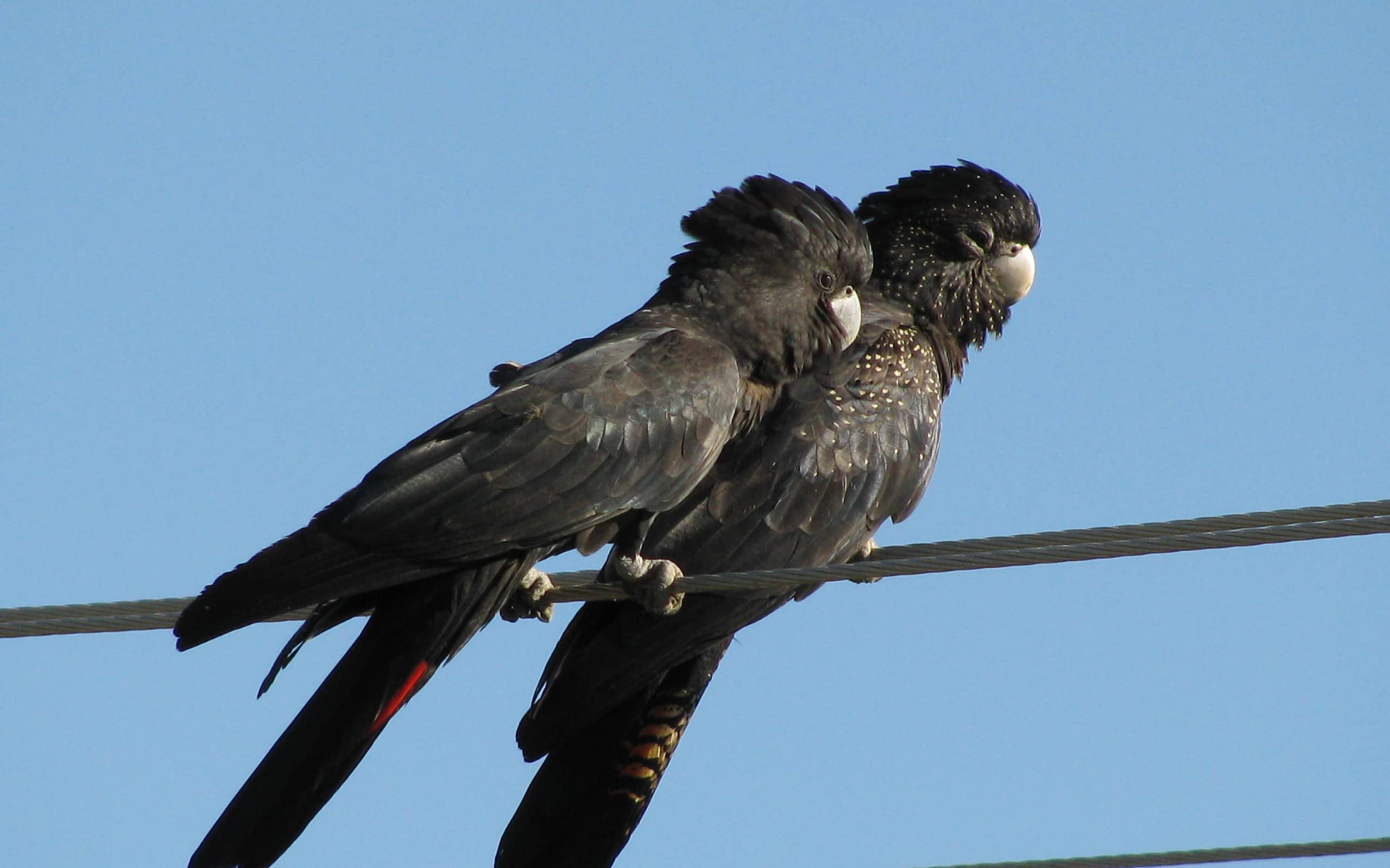
| Red-Tailed Black Cockatoo (Calyptorhynchus banksii) | male: black body with broad red subterminal tail-band female: brownish-black body with yellow spotting on head and shoulders; yellow-barred breast; orange-red barred undertail coverts; yellow-orange barred black subterminal tail-band |
| Baudin’s Black Cockatoo (Zanda baudinii) | female has larger ear patches |
| Carnaby’s Black Cockatoo (Zanda latirostris) | female has larger ear patches |
| Yellow-Tailed Black Cockatoo (Zanda funerea) | female has larger and brighter ear patches |
3. Eye Color
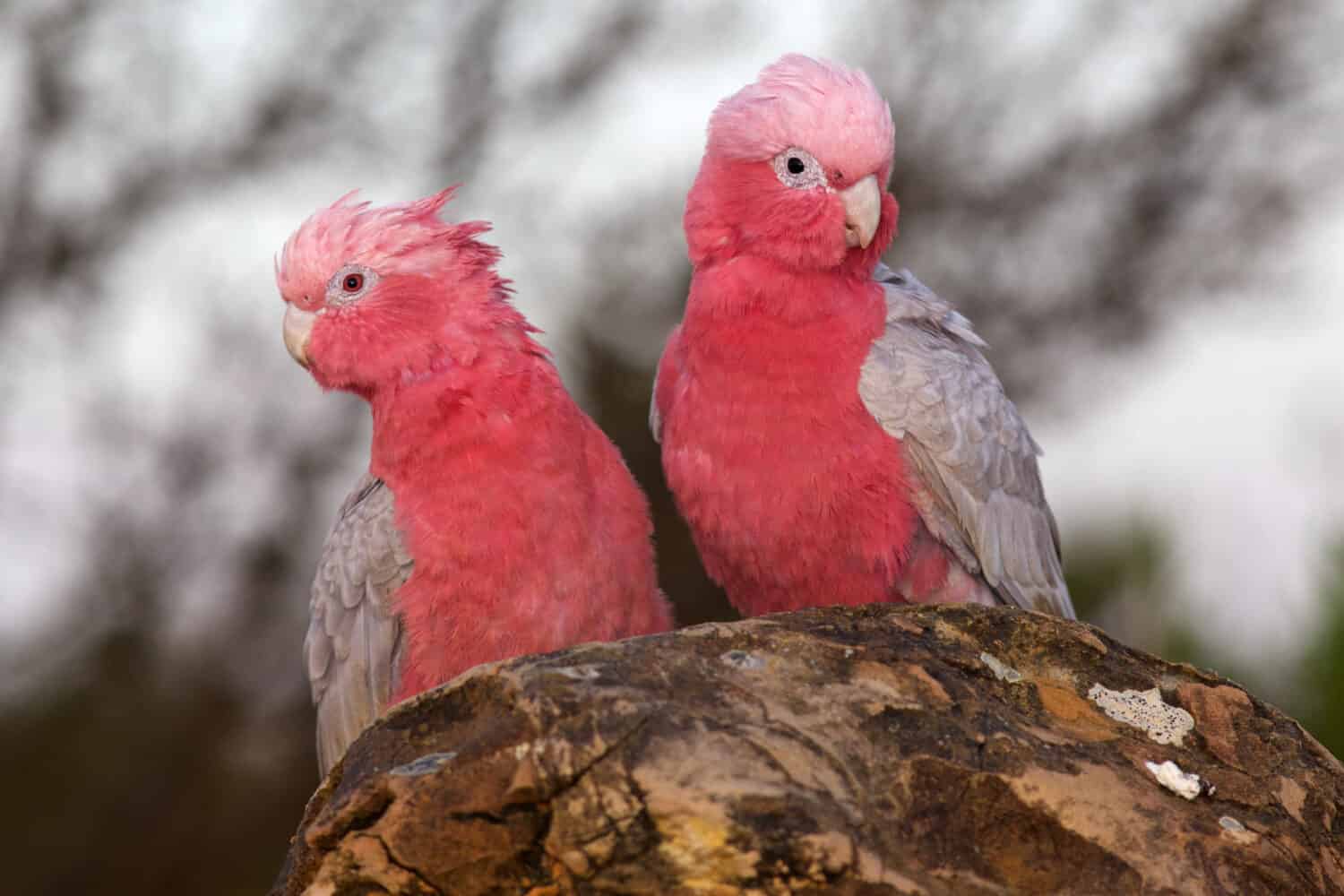
While galah pairs may look identical at first, their eye colors give away who’s who.
©David Steele/Shutterstock.com
There is another color difference that is more common amongst cockatoos: eye color. In ten cockatoo species, the iris color is different in adult males and females. These differences are summarized below.
Cockatoos with Different Eye Colors in Adult Males and Females
| Species | Male Eye Color | Female Eye Color |
|---|---|---|
| Galah (Eolophus roseicapilla) | dark brown | red |
| Pink Cockatoo (Cacatua leadbeater) | dark brown | red |
| Yellow-Crested Cockatoo (Cacatua sulphurea) | black | reddish-brown |
| Sulphur-Crested Cockatoo (Cacatua galerita) | dark brown | reddish-brown |
| Blue-Eyed Cockatoo (Cacatua ophthalmica) | black or dark brown | reddish |
| White Cockatoo (Cacatua alba) | black | reddish-brown |
| Salmon-Crested Cockatoo (Cacatua moluccensi) | black | dark brown |
| Tanimbar Corella (Cacatua goffiniana) | brown | reddish-brown |
| Ducorps’s cockatoo (Cacatua ducorpsii) | dark brown | reddish-brown |
| Philippine Cockatoo (Cacatua haematuropygia) | dark brown | reddish-brown |
4. Bill and Eye Ring Color
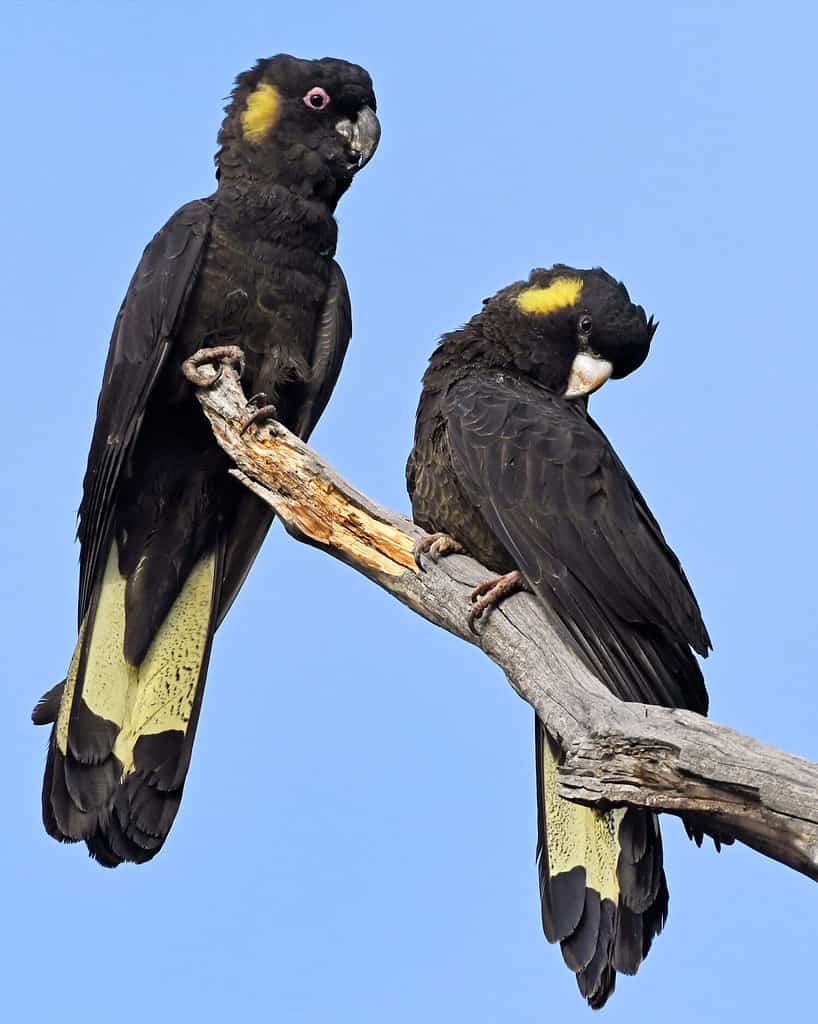
Yellow-tailed black cockatoo pairs have different colors of both beaks and eye rings.
©Greg Wyncoll/Shutterstock.com
The three black cockatoos of the Zanda genus have two interesting color differences between males and females. In Baudin’s black cockatoo (Zanda baudinii), Carnaby’s black cockatoo (Zanda latirostris), and the yellow-tailed black cockatoo (Zanda funerea), males have dark grey beaks, while females have bone-colored ones. In addition, males have pinkish eye rings, and females have dark gray.
5. Eggs and Incubation
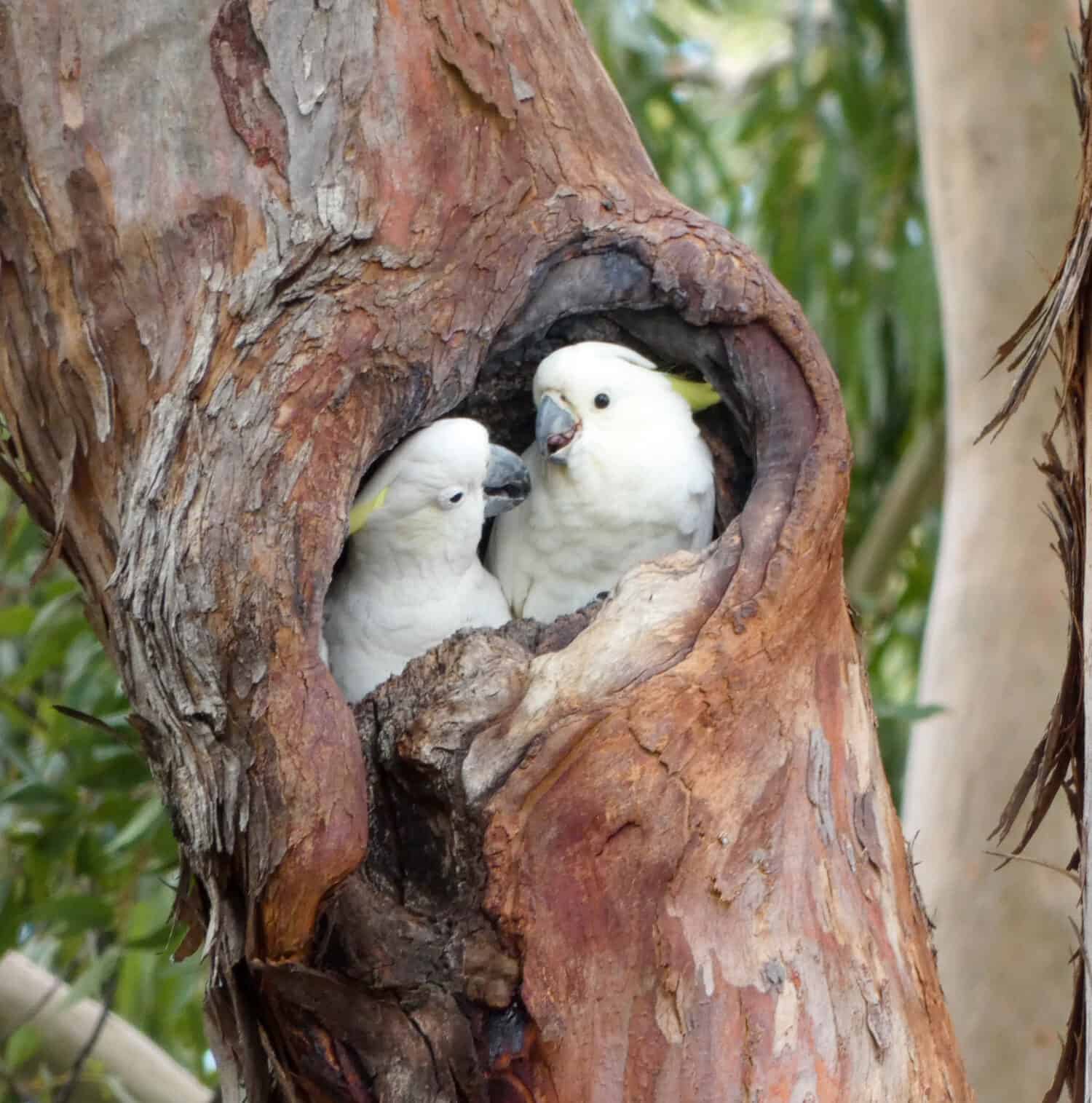
All cockatoos are cavity nesters.
©Melanie G Howell/Shutterstock.com
All cockatoos are monogamous with biparental care. Obviously, females are the ones who actually lay the eggs. However, in the two black cockatoos of the Calyptorhynchus genus, the glossy black cockatoo (Calyptorhynchus lathami) and red-tailed black cockatoo (Calyptorhynchus banksii), only the female incubates the eggs, with the male bringing her food provisions. In all other cockatoo species, however, both parents share incubation duties.
Summary of Male vs. Female Cockatoos: 5 Key Differences
| Trait | Differences |
|---|---|
| size | females slightly larger (four species: pink cockatoo, glossy black cockatoo, red-tailed black cockatoo, galah); males slightly larger (salmon-crested cockatoo only); male beak size larger (palm cockatoo only) |
| plumage color | differences in color patches on head, spotting or barring, and/or tail feathers (eight species: gang-gang cockatoo, cockatiel, all six black cockatoos) |
| eye color | male eye color dark brown or black, female eye color red, reddish-brown, or dark brown (ten species) |
| bill and eye ring color | male bills dark gray & eye rings pinkish, female bills bone-colored & eye rings dark gray (Zanda genus only, three species) |
| eggs and incubation | females lay eggs (all species); only females incubate (Calyptorhynchus genus only, two species) |