
Quick Take
- Bats can lock onto prey within 3 degrees of its exact position, yet one moth species somehow manages to make itself nearly impossible to catch. So how does it do it? See how bats hunt →
- Fleeing and diving work, but tiger moths have evolved a defense that doesn't require moving at all. Explore tiger moth clicks →
- Warning signals that scare bats off eventually stop working, but one variation stays effective far longer. How aposematism evolves →
- Even when bats figure out the moth's trick, they still can't catch it, and the reason why is stranger than you'd expect. Discover the jamming mechanism →
A large portion of an animal’s energy is spent searching for food, eating, and avoiding predation. Animals are constantly analyzing when they should venture out for a meal or flee to safety. Defense mechanisms can be lifesaving, but they also use up a lot of precious energy. Which ones should be deployed and when? One moth species has evolved a unique method: they block their predator’s ability to detect them. The tiger moth essentially jams the sonar detection of their bat predators.
How Do Bats Use Sonar to Hunt Prey?
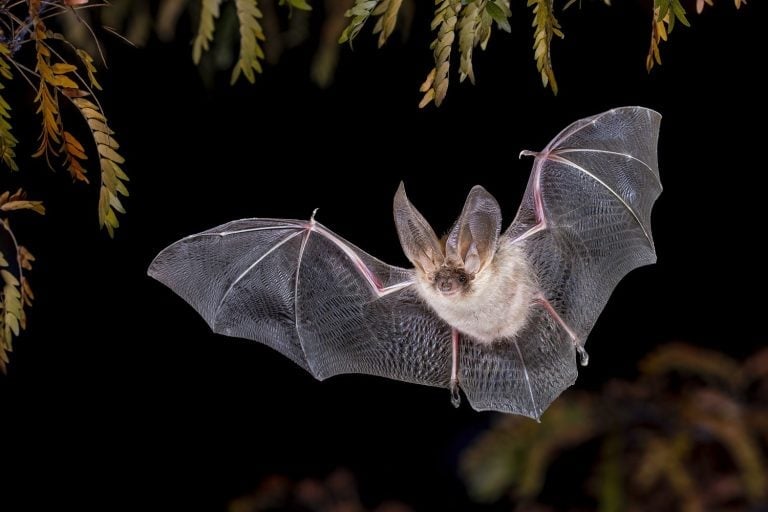
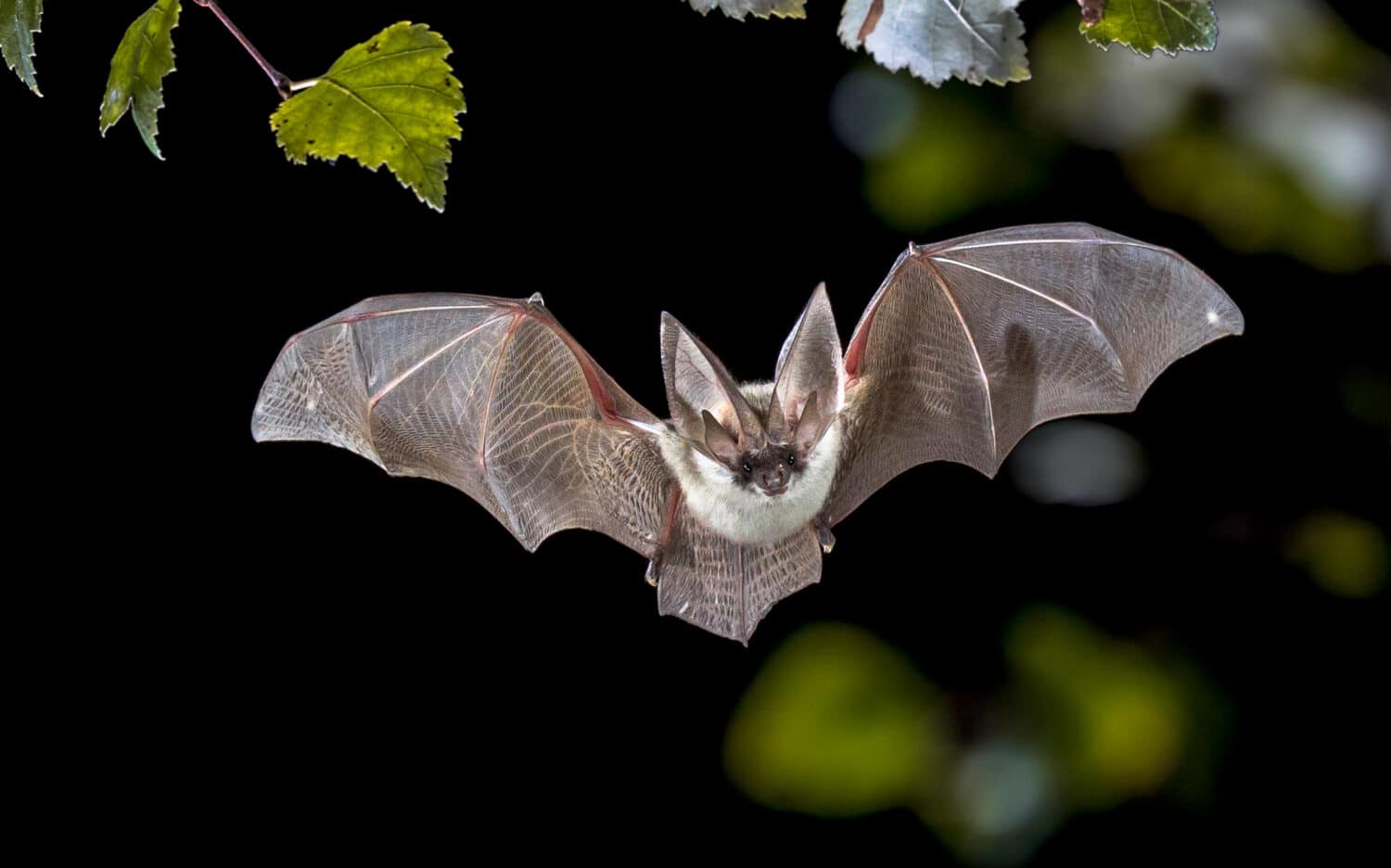
Bats use echolocation to locate fast-moving insects in the dark. They emit high-frequency sounds through their nose or mouth, using their larynx or tongue. The sound (sonic) waves bounce off objects and return to them. The bats detect the sound waves and build a mental picture of their surroundings. They can tell the distance, size, and speed of an object.

Bats use echolocation to hunt at night.
©BirdHunter591/iStock via Getty Images
At first, they search for prey in their surroundings using pulses at a relatively low rate of 7–12 calls per second. This is called search-phase echolocation. Once they have detected their prey, they gradually increase the rate of their emissions so that they can rapidly update the exact position and speed of the prey. This is the approach phase. Eventually, they can lock onto the target within 3 degrees of its exact position. The final phase is called the terminal buzz phase, during which the bat emits signals at a maximum rate, which can reach 160 calls/s in many species. It’s essential that the bat knows the exact location of the prey to complete the final capture maneuver.
How Can Moths Evade Bat Predators?
Moths can detect the echolocation calls that bats emit. They also act differently depending on the type of call. If they detect the quiet, drawn-out calls, they know that the bat is a long way off. The moth simply flies away from the source, taking up little energy.
When the moth detects a higher-intensity call, it means that a bat is close by and more drastic action is needed. The moth initiates a passive or active power dive or spirals to the ground to evade capture. Some moths, however, have an additional strategy.
Tiger Moth Ultrasonic Signals
Tiger moths and some other moth species respond to bat predators with their own ultrasonic bat calls. These clicks act as a warning signal, communicating that they are toxic and telling the bat to back off. This is called acoustic aposematism. While most bats are initially startled by this ultrasonic call, they typically get used to it after a few exposures, making the defense less effective.
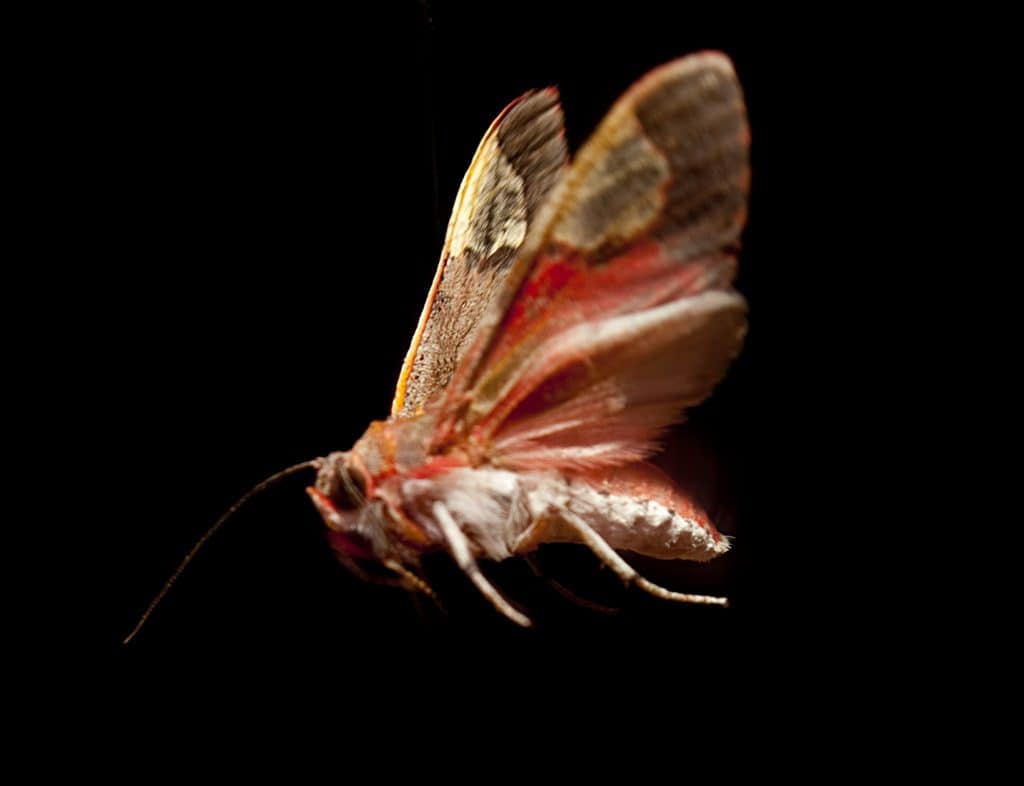
Bertholdia trigona can jam a bat’s sonic signals.
©Ajcoyote, CC BY-SA 3.0 , via Wikimedia Commons – Original / License
One particular species of tiger moth called Bertholdia trigona has an even better defense. This tiger moth can actually disrupt the bat’s processing of prey echoes. It’s a biological sonar jamming system. Bertholdia trigona is the only animal in nature known to defend itself by jamming a bat’s sonar. Experiments have shown that bats need a longer period of time to adapt to these jamming clicks than with regular acoustic aposematism.
Bertholdia trigona are found in the Southwestern United States from Arizona to Texas, and north to the mountains to Wyoming and South Dakota. The adults are seen flying from mid-July through August. Their wings are brown with a large pale yellow translucent patch along the costa near the tip and two or three yellowish spots along the inner margin near the base.
How Do Moths Use Sonic Jamming to Evade Bats?
There have been several theories put forward to explain how B. trigona jamming clicks work. Experiments have shown that it is likely due to a phenomenon called ranging interference. The moth’s clicks overlap or closely precede the bat’s sonic emissions, reducing the bat’s precision in determining how far away the tiger moth is. This makes it very hard for the bat to complete the final capture maneuvers.
The jamming clicks do not jam the bat’s initial positional sonic location. But once the bat gets closer, the moth’s position essentially becomes blurred. Even though the bat may attempt a strike, it is not likely to be on target. Scientists noticed that even after the bats had gotten used to the clicks, they were still not very good at catching the moths. The experiments seemed to suggest that the bats knew there was a moth nearby but could not pin down the location accurately enough to catch it! What’s more, the moths that produced more clicks were less likely to be attacked.