
Quick Take
- Five seabirds can fool a casual glance, and one of them is so convincing that many people think it's a penguin. Meet the top lookalike →
- Black-and-white coloring is the easy part. The giveaways are hiding in places most people never check. Spot the beak clues →
- Penguins and their impostors share a surprising set of habits, from nesting to colony life, yet a few differences settle the question fast. Compare shared colony habits →
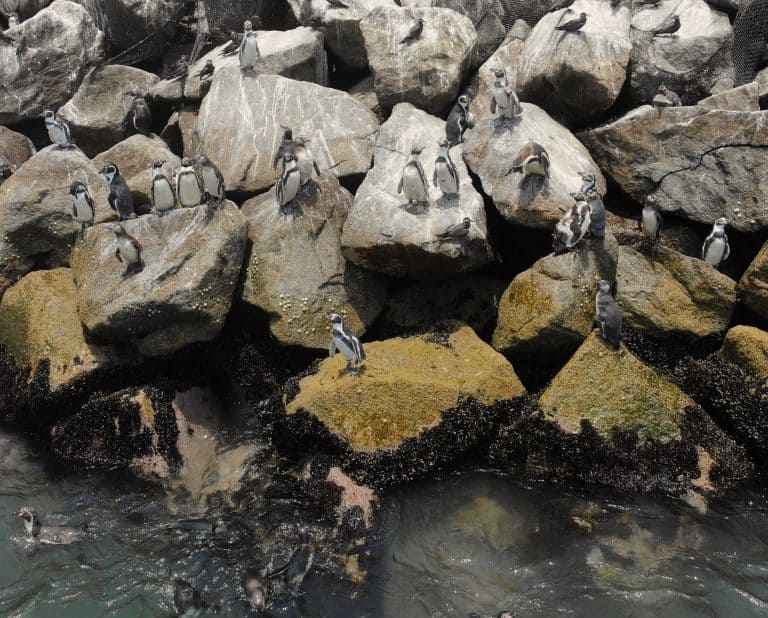
Few birds enjoy as much popularity and worldwide recognition as penguins. These flightless, carnivorous, black-and-white seabirds belong to the family Spheniscidae. They are semi-aquatic, spending up to 75% of their lives in the water. While relatively awkward on land, penguins move with amazing agility and speed through the water. Using their webbed feet and wings as flippers, they can swim up to 22mph.
Nearly all of these flightless birds live in the Southern Hemisphere, particularly in Antarctica and its surrounding islands. The Galápagos penguin is the only species that can be found in warmer weather at or north of the equator. In this article, you’ll discover 5 different birds that look like penguins. These penguin lookalikes may be able to fool a casual observer, but we’ll discuss exactly how they differ.
About Penguins
Scientists recognize 18 different penguin species, which come in a variety of shapes and sizes. The little penguin is the smallest penguin in the world. On average, these cute little birds measure 13 inches long and have unique blue-and-white feathers. The emperor penguin is the largest species of penguin. These majestic birds can reach up to 4.3 feet tall and have a yellow collar and breast.
Despite the differences in size, there are a few things all penguins have in common when it comes to appearance. First, all penguins have black or dark backs with white bellies. They have countershading camouflage, where their dark backs blends into the water when seen from above, while their pale undersides blend into the surface light when seen from below. Second, they have streamlined, football-shaped bodies to help them quickly move through the water. Keep reading to learn which birds are most like penguins.

Emperor penguins are the largest penguin species, standing over 4 feet tall.
©Altitude Visual/Shutterstock.com
5. Common Murre
Also known as the common guillemot, the common murre (Uria aalge) is a large auk in the family Alcidae. They range across low-Arctic and boreal waters, spending most of their time in the waters of the North Atlantic and North Pacific. Common murres live on a diet of fish, squid, mollusks, and crustaceans, and catch food by diving deep underwater. They are capable swimmers and can dive to depths of nearly 600 feet below the surface. In order to find food, they may travel up to 60 miles out to sea. During the breeding season, they gather into large colonies numbering in the thousands. Like some species of penguin, they do not create nests but lay their eggs directly on rocky ledges. Their plumage appears white on their bellies and charcoal or black on their backs. On average, they stand around 15 to 18 inches long and weigh from 1.7 to 2.7 pounds.
In appearance, common murres look like penguins, especially small ones such as a young Adélie penguin. That said, you can easily tell apart a common murre and penguin in several ways. For example, unlike penguins, common murres can fly. Although they aren’t particularly agile in the air, they still have strong wings rather than flippers. Common murres swim like ducks on top of the water. In addition, they live in completely different parts of the world. Nearly all penguins live in the Southern Hemisphere, while common murres only live in the Northern Hemisphere. Lastly, a common murre’s beak is longer and thinner than the beak of most penguin species. While king and emperor penguins sport longer, more tapered beakers, their beaks also feature yellow coloring. Meanwhile, the common murre’s beak is all black.

The common murre looks a lot like a small Adélie penguin.
©iStock.com/slowmotiongli
4. Razorbill
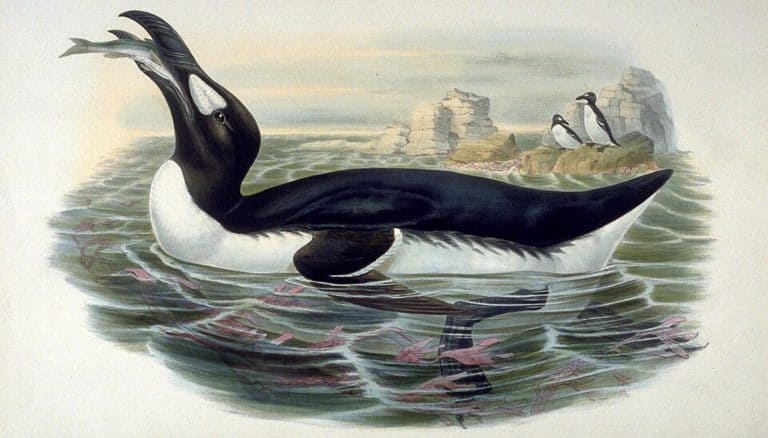
The razorbill (Alca torda), or lesser auk, is another member of the auk family Alcidae. Currently, it is the closest living relative of the recently extinct great auk. Razorbills live in the sub-Arctic waters of the North Atlantic around Greenland, Canada, and Western Europe. The razorbill gets its name from its beak, which contains extremely sharp edges. This adaptation helps the razorbill to grab fish and defend itself against potential predators. Like other seabirds and penguins, it lives off a diet of fish and crustaceans, as well as worms. To catch food, they will dive into the water and swim down nearly 400 feet below the surface. Razorbills mate for life and both males and females will help nest and care for their young. Their belly appears solid white, while their backs look all black. In general, adult razorbills measure 14.5 to 15 inches long and weigh from 1 to 2 pounds.
A razorbill could easily be mistaken for an African or Humboldt penguin. However, look again and you’ll quickly see that a razorbill is just another one of the birds that look like penguins. First of all, unlike penguins, razorbills are strong and agile flyers. Like other seabirds, they swim like ducks on top of the water. Additionally, their feathered wings look very different from the streamlined flippers of a penguin. Another difference has to do with the shape and color of their beak. Unlike most penguins, which feature yellow and orange in their beak, a razorbill’s beak looks only black and white. Even compared with penguins that lack yellow in their beaks, a razorbill’s beak features a distinctive pattern that sets it apart. Its beak contains a thin, white vertical line near the tip and another that runs along its length.
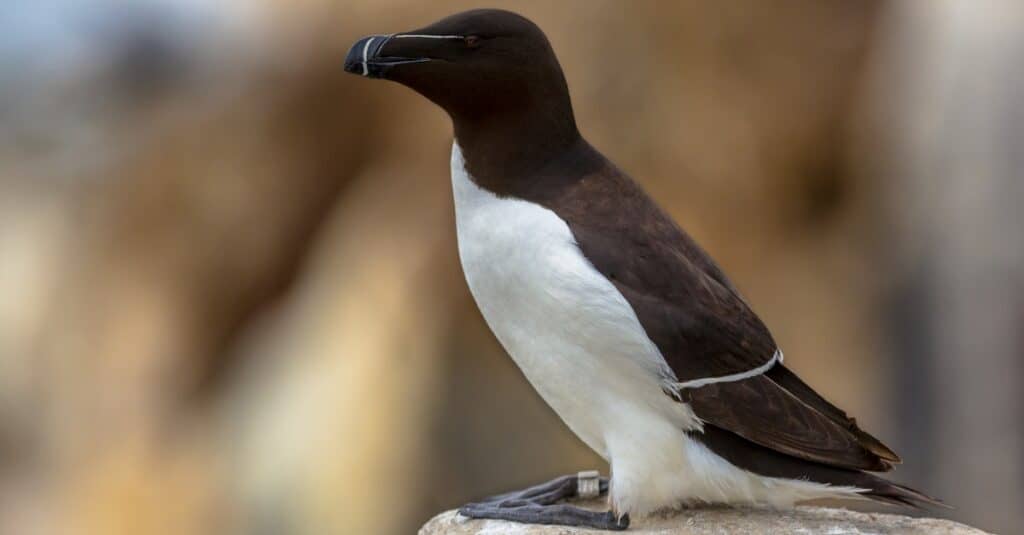
The razorbill could easily be mistaken for a Humboldt penguin.
©iStock.com/CreativeNature_nl
3. Little Auk
Also known as the dovekie, the little auk (Alle alle) is the sole member in the genus Alle of the Alcidae family. Little auks live in the waters of the North Atlantic from Alaska and Russia to Greenland and Norway. Like other auks, little auks hunt for food by diving underwater. Similar to penguins, they breed in large colonies and lay only a single egg. They lay their eggs on rocky cliffsides and tend to feed close to their nests during the breeding season. Their plumage looks white on their bellies and black on their head, back, and wings. True to their name, little auks measure quite small, ranging from 7.5 to 8 inches long.
While their color is similar to a penguin’s, a little auk is fairly different from a penguin. First of all, like most birds that look like penguins but aren’t, little auks can fly. These birds also swim like ducks, with their bodies on the surface of the water. In addition, while they do eat fish, their diet primarily consists of tiny crustaceans. Furthermore, little auks measure smaller than even the tiniest penguins. Standing side-by-side, most people could easily distinguish the larger penguin from the smaller little auk. Lastly, little auks feature a very short, curved beak. Compared to a penguin, their beak looks noticeably smaller in relation to the size of their face.

A little auk is substantially smaller than a penguin, although it looks similar.
©iStock.com/AGAMI stock
2. Booby
The booby is a seabird in the Sulidae family, which also contains its close relative, the gannet. The booby’s unusual name likely comes from the Spanish slang bobo, or “stupid.” This nickname comes from their habit of landing on ships, only for the crew to catch and eat them. Boobies live in the waters of the South Atlantic and Pacific. Like other seabirds, they hunt for food by diving into the water, but they are also specialized aerial hunters. They live on a diet of fish, as well as the occasional squid. There are 7 extant booby species in the genus Sula, but only two of them look similar to a penguin: the brown booby and blue-footed booby share the most similarities with a penguin. Both have a white belly with dark plumage on the backs and wings. On average, boobies measure around 30 inches long and weigh about 3 pounds.
On closer inspection, the birds look quite different from one another. First of all, a booby’s dark plumage is more brown than black. Second, most boobies have a solid yellow beak, compared to a penguin’s black or orange beak. The one exception is the blue-footed booby, whose beak is dark. In addition, the blue-footed booby’s webbed feet appear bright blue, which is where it gets its name. This stands in stark contrast to penguins, whose feet are orange, black, or pale pink. Boobies swim and float on the ocean surface just like ducks. Lastly, while most boobies nest on the ground much like penguins, a few booby species build their nests in trees.

One could be forgiven for mistaking a booby for a penguin, but they actually look quite different.
©BlueOrange Studio/Shutterstock.com
1. Puffin
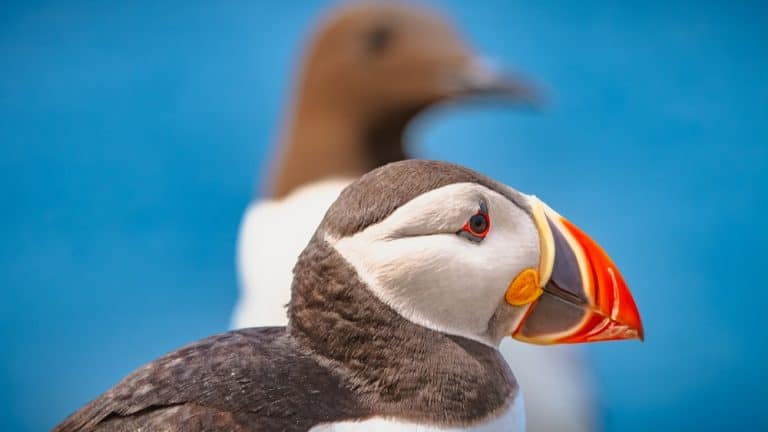
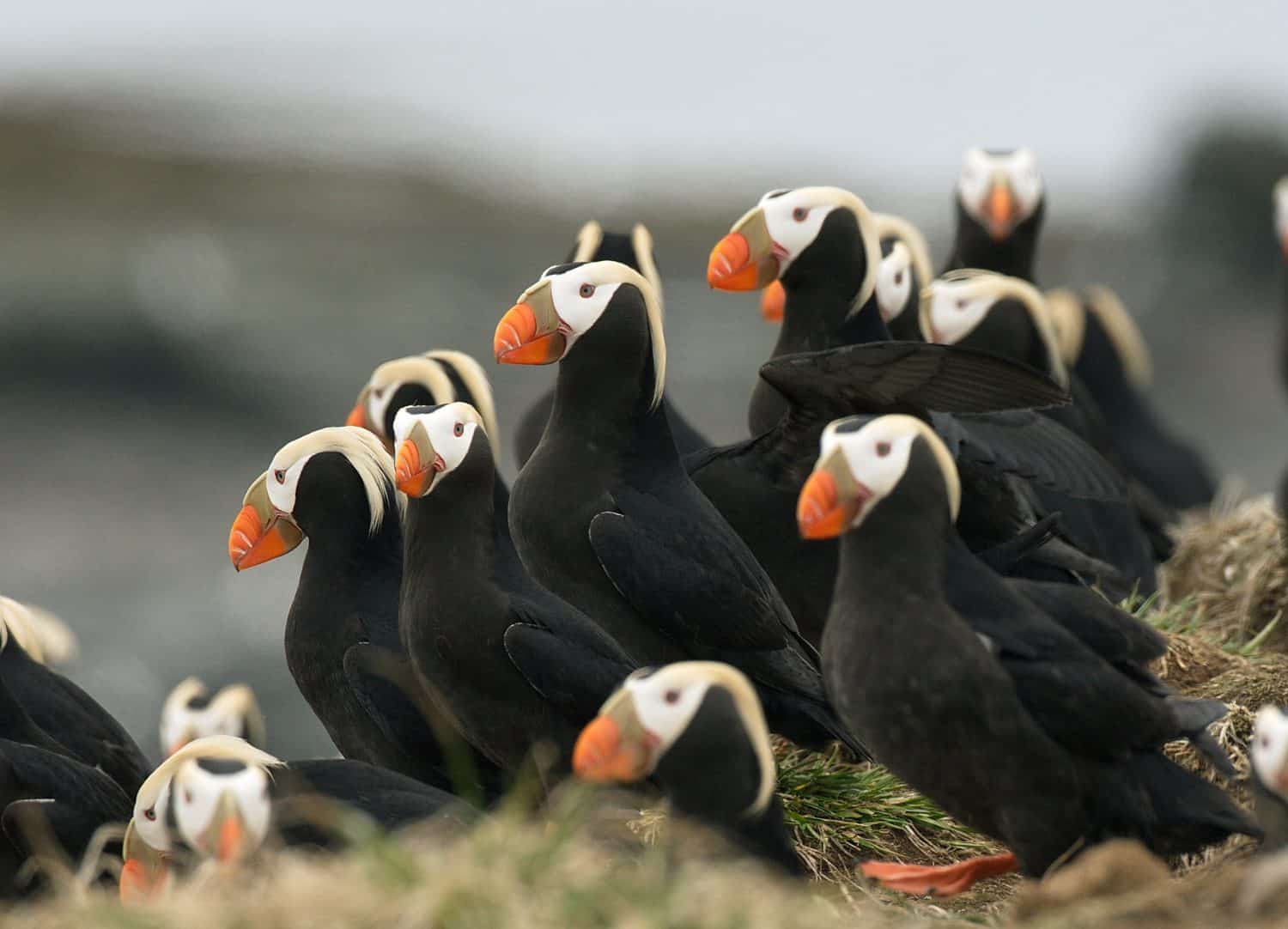
The puffin ranks first among the birds that look like penguins. In fact, many people mistakenly believe that puffins belong in the penguin family. In reality, puffins belong to the genus Fratercula in the auk family Alcidae. Puffins live in the North Atlantic and the Pacific Ocean. They breed and live in large colonies, and make their nests on rocky cliffs. Like other seabirds, they hunt for food by diving into the water in search of prey. Puffins live on a diet of mostly fish and zooplankton. Their plumage includes a white belly and black back, wings, and head. Tufted puffins also have head plumes similar to crested penguins. Puffins measure 10 to 15 inches long and weigh between 0.7 and 2 pounds.
Despite the fact that penguins and puffins often get mixed up they differ in many ways. Puffins are smaller than all but the tiniest penguins. In addition, puffins can fly with their short, powerful wings, whereas penguins cannot. Furthermore, while penguins build their nests on the ground, puffins frequently make their nests in burrows. That said, if the ground is too hard, they will make their nests above ground in crevices. Puffins can both float and swim on the surface, as well as swim underwater. One of the most noticeable physical differences between a puffin and a penguin concerns their beaks. While some penguins have color in their beaks, a puffin’s beak is much more colorful. Their beaks contain multiple colors ranging from yellow to red to black and white.
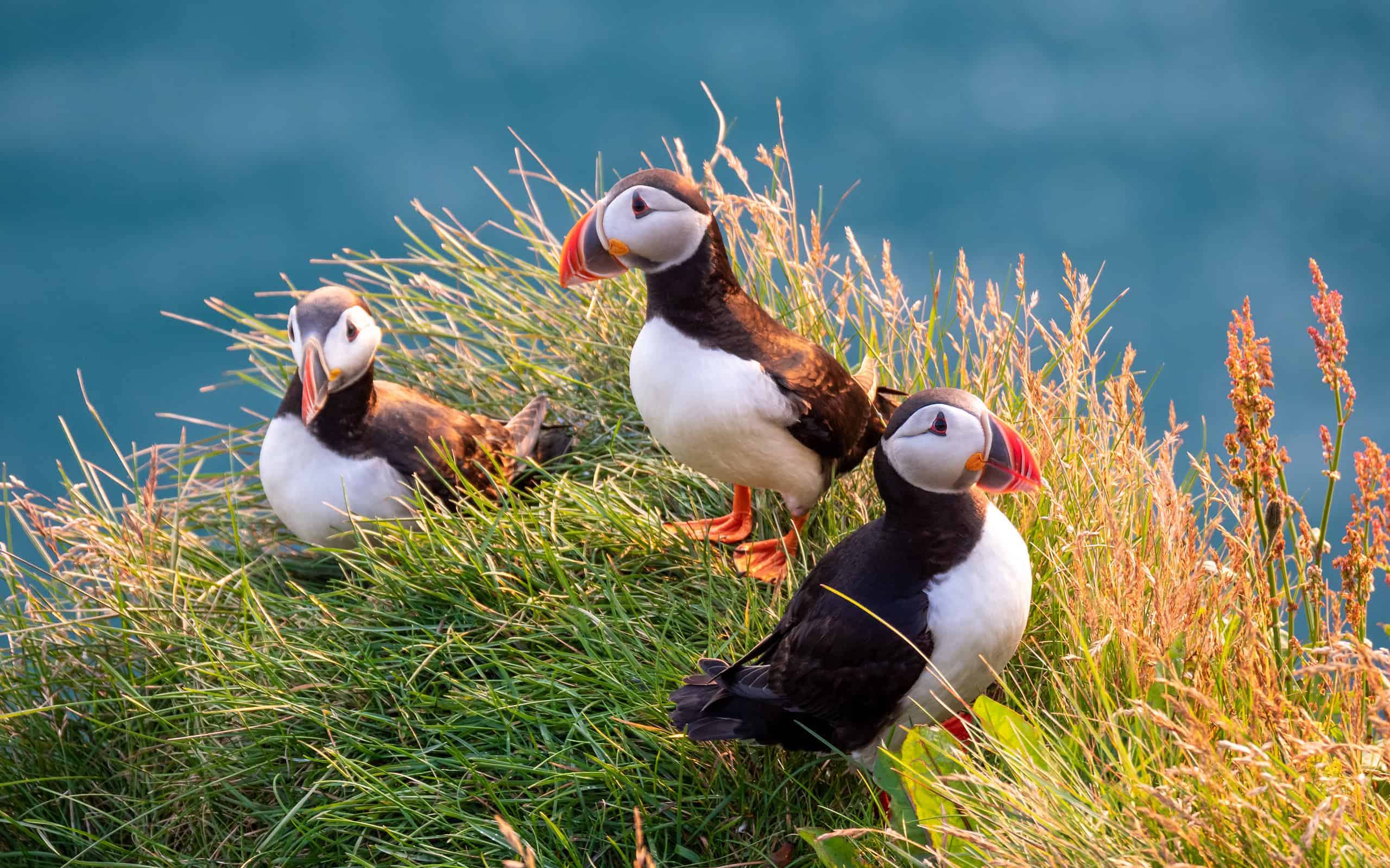
Although their coloring is the same as a penguin’s, puffins’ beaks are much more colorful.
©bzzup/iStock via Getty Images